Semax and Selank are two synthetic peptides developed in Russia during the 1980s and 1990s with documented effects on cognition and anxiety, respectively. They are often combined into a "nootropic stack" because their mechanisms are complementary: Semax upregulates brain-derived neurotrophic factor (BDNF), while Selank modulates the GABAergic system to reduce anxiety without sedation. For semax specifically, see our semax for focus ADHD deep dive. Selank shines for anxiety; see our 5 Best Peptides for Anxiety: Selank, Semax, DSIP & Oxytocin ranking. Both peptides rank in our 8 Best Peptides for Brain Function & Cognitive Enhancement guide.
Key Takeaway
Semax is a synthetic fragment of ACTH (adrenocorticotropic hormone) that boosts BDNF and has neuroprotective properties. Selank is a synthetic analog of tuftsin that acts on GABA receptors to reduce anxiety. Both are approved medications in Russia but have no FDA approval in the United States. Most published clinical data comes from Russian research groups, and independent Western replication is limited.
What Is Semax and How Does It Work?
Semax is a heptapeptide with the sequence Met-Glu-His-Phe-Pro-Gly-Pro. It is a synthetic analog of the ACTH(4-10) fragment, meaning it was derived from a portion of adrenocorticotropic hormone but engineered to retain neurotrophic effects while eliminating hormonal activity. It was developed at the Institute of Molecular Genetics of the Russian Academy of Sciences in the late 1980s.[1]
The primary mechanism involves BDNF upregulation. In rat studies, intranasal Semax increased BDNF mRNA expression in the hippocampus within 30 minutes of administration. BDNF is a protein that supports the survival, growth, and differentiation of neurons, and it plays a direct role in learning and memory formation.[1]
Semax also affects the expression of genes related to immune and vascular function in the brain. A genome-wide transcriptional analysis in a rat model of focal brain ischemia found that Semax altered the expression of 24 genes related to the immune response and 12 genes involved in vascular processes within 3 hours of administration.[2]
In Russia, Semax is approved as a prescription medication (0.1% nasal drops) for conditions including cognitive disorders, stroke recovery, and optic nerve atrophy. It has been on the Russian List of Vital and Essential Drugs since the early 2000s. It has no FDA approval in the United States and is classified as a research compound here.
What Is Selank and What Does It Do to GABA?
Selank is a synthetic analog of tuftsin, a naturally occurring tetrapeptide (Thr-Lys-Pro-Arg) that is a fragment of the immunoglobulin G heavy chain. Researchers at the Institute of Molecular Genetics extended tuftsin by adding three amino acids (Pro-Gly-Pro) to its C-terminus, which improved metabolic stability and gave the molecule anxiolytic properties in addition to its immunomodulatory effects.[3]
Selank's anxiolytic mechanism centers on the GABAergic system. It binds to GABA-A receptors and allosterically modulates their activity, similar to how benzodiazepines work, but without producing sedation or dependence. A transcriptomic study found that Selank administration altered the expression of 45 out of 84 genes involved in GABAergic neurotransmission in the rat frontal cortex within one hour.[4]
A clinical trial involving 62 patients with generalized anxiety disorder compared Selank to medazepam (a benzodiazepine). Both groups showed comparable reductions in anxiety scores, but the Selank group did not experience the sedation or cognitive impairment typical of benzodiazepine use.[3]
Like Semax, Selank is approved in Russia as a 0.15% nasal spray for anxiety and neurasthenia. It is not approved by the FDA.
Why Are Semax and Selank Stacked Together?
The rationale is straightforward. Semax targets cognition (BDNF, neuroplasticity, focus), while Selank targets emotional regulation (GABA modulation, anxiety reduction). For someone who wants better cognitive output without the interference of anxiety, combining them addresses both sides of the equation.
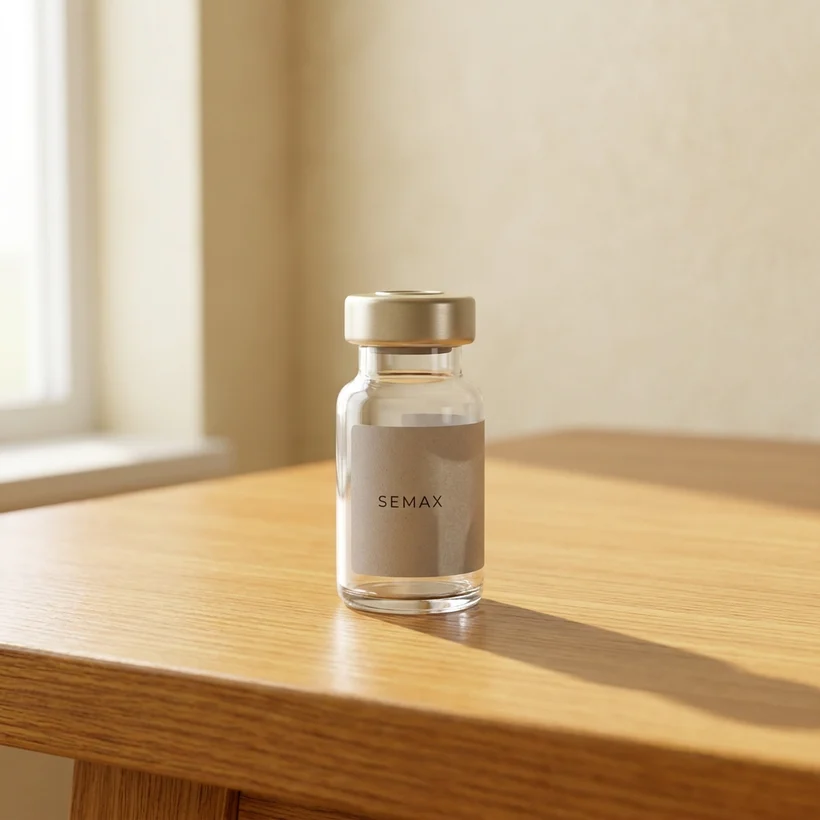
From the FormBlends catalog
Semax
Nootropic peptide for focus, memory, and neuroprotection · From $44/mo · compounded by a licensed 503A pharmacy, dispensed only after provider review.
Learn about Semax →A functional connectivity study examined both peptides' effects on resting-state brain activity. Semax showed measurable changes in dorsolateral prefrontal cortex (DLPFC) connectivity, the brain region responsible for executive function and working memory. Selank showed changes in amygdala connectivity, the region that governs fear and anxiety responses.[5]
In practice, users report that the combination produces a state of calm focus: cognitive sharpness from Semax without the jitteriness or stress reactivity that sometimes accompanies stimulant-type nootropics. Selank smooths out the experience.
What Are the Typical Dosing Protocols?
Both peptides are most commonly administered intranasally, though subcutaneous injection is also used. Protocols typically reported in clinical and community settings:
| Parameter | Semax | Selank |
|---|---|---|
| Common dose (nasal) | 200-600 mcg, 2-3x daily | 250-500 mcg, 2-3x daily |
| Common dose (subcutaneous) | 100-300 mcg daily | 250-500 mcg daily |
| Cycle length | 10-20 days on, 10 days off | 14-21 days on, 7-14 days off |
| Onset | Minutes to hours (nasal) | Minutes to hours (nasal) |
| Half-life | ~3-5 minutes (short, but effects persist) | Several minutes (gene expression changes last hours) |
The nasal route is preferred because both peptides have poor oral bioavailability (they get broken down in the gut). Nasal administration bypasses first-pass metabolism and allows relatively rapid absorption through the nasal mucosa into the cerebrospinal fluid. The Russian-approved pharmaceutical formulations are nasal drops.
When stacking, users typically administer Semax in the morning for cognitive effects and Selank in the afternoon or as needed for anxiety control. Some users take both simultaneously.
What About Dihexa and PE-22-28 as Newer Nootropic Peptides?
Dihexa and PE-22-28 represent a newer generation of nootropic peptides with different mechanisms than Semax and Selank. Both remain purely experimental.
Dihexa is a synthetic hexapeptide developed at Washington State University as a derivative of angiotensin IV. Its proposed mechanism is promoting synaptogenesis, the physical creation of new connections between neurons. In hippocampal neuron cultures, Dihexa increased dendritic spine density from about 15 spines per 50 micrometers to 41 spines, a nearly three-fold increase. It was originally developed for Alzheimer's disease research.[6]
There is a significant concern with Dihexa's evidence base. Some of the foundational research papers have come under scrutiny for data integrity issues, and the pro-drug version failed in clinical trials. No controlled human trials of Dihexa itself have been published. Despite this, it circulates widely in peptide communities.
PE-22-28 is a shorter, more stable analog of Spadin, a naturally occurring peptide with antidepressant properties. It works by blocking TREK-1 potassium channels in the brain. In animal studies, it showed antidepressant effects with faster onset than SSRIs and improvements in hippocampus-dependent memory tasks. PE-22-28 may also function as a BDNF mimetic, activating TrkB receptors, which gives it a dual mechanism.[7]
Neither Dihexa nor PE-22-28 has human clinical trial data. They are significantly more speculative than Semax and Selank, which at least have decades of clinical use in Russia and published human studies.
How Strong Is the Evidence for Nootropic Peptides?
The evidence varies widely by compound. A realistic assessment:
| Peptide | Human Clinical Data | Regulatory Status | Confidence Level |
|---|---|---|---|
| Semax | Multiple Russian clinical trials; approved drug | Approved in Russia; not FDA-approved | Moderate |
| Selank | GAD trial (62 patients); approved drug | Approved in Russia; not FDA-approved | Moderate |
| Dihexa | None published | Research compound only | Low (data integrity concerns) |
| PE-22-28 | None published | Research compound only | Low (animal data only) |
The biggest limitation of Semax and Selank data is geographic. Nearly all clinical studies were conducted in Russia and published in Russian-language journals, with English translations or summaries appearing on PubMed. Western academic institutions have not independently replicated most of these findings. That does not mean the data is wrong, but it does mean the standard of evidence is lower than what you would see for an FDA-approved drug with multi-center, multi-country clinical trials.
What Are the Side Effects and Safety Concerns?
Both Semax and Selank have favorable safety profiles based on their decades of clinical use in Russia. Reported side effects tend to be mild:
Semax side effects: Nasal irritation or dryness (most common), mild headache in some users, occasional changes in appetite. No serious adverse events have been reported in published clinical literature.
Selank side effects: Nasal irritation, mild fatigue in some users. No dependence, tolerance, or withdrawal symptoms have been documented, which is a significant advantage over benzodiazepines for anxiety management.
Dihexa concerns: Because Dihexa promotes synaptogenesis, some researchers have raised theoretical concerns about uncontrolled neural growth and potential cancer risk (HGF/c-Met pathway activation). No human safety data exists.
PE-22-28 concerns: Limited safety data. Animal studies have not raised major red flags, but the absence of human trials means the risk profile is unknown.
For anyone considering these peptides, working with a licensed provider who understands peptide pharmacology is recommended. These are not supplements. They are pharmacologically active compounds that affect brain chemistry. peptide therapy guide Start with our Peptide Therapy: Complete Guide to Benefits, Types, and Safety [2026] if you are new to peptides.
What Should You Realistically Expect from a Nootropic Peptide Stack?
If you are expecting a "Limitless pill" experience, you will be disappointed. The effects of Semax and Selank are real but modest by most user accounts. Semax users typically describe improved focus, better verbal fluency, and slightly faster recall. Selank users report reduced baseline anxiety and better stress tolerance. The combination tends to produce a state of engaged calm, alert without being wired.
These are not stimulants. They do not produce the pronounced subjective "high" of caffeine, amphetamines, or modafinil. Their effects are subtler and often become more noticeable after several days of consistent use. Some users report that they only recognize the effects when they stop taking them and notice a decline in their cognitive baseline.
The newer peptides (Dihexa, PE-22-28) are harder to assess because no human clinical data exists. Anecdotal reports are mixed and unreliable. Anyone using these is essentially self-experimenting with research chemicals.
Frequently Asked Questions
Are Semax and Selank legal in the United States?
Semax and Selank are not FDA-approved drugs in the United States, and they are not classified as controlled substances. They are available through research peptide suppliers and some compounding pharmacies. Their legal status exists in a gray area: not approved for medical use, but not prohibited for research or personal use in most jurisdictions.
Can I take Semax and Selank at the same time?
Yes, many users administer both intranasally at the same time or within the same session. There are no known interactions between the two compounds. Some prefer to use Semax in the morning for cognitive effects and Selank later in the day for anxiety, but simultaneous use is common.
How long does it take for Semax to work?
Intranasal Semax begins to affect BDNF expression within 30 minutes based on animal data. Subjectively, many users report feeling the effects within 15 to 30 minutes of nasal administration. The effects typically last 4 to 6 hours, though the underlying neuroplasticity changes from BDNF upregulation may persist longer.
Is Selank addictive like benzodiazepines?
No. Despite acting on GABA receptors, Selank does not produce the dependence, tolerance, or withdrawal symptoms associated with benzodiazepines. Published clinical data shows no evidence of addiction potential. This is one of its main advantages over conventional anxiolytic medications.
Should I use nasal or injectable Semax?
The nasal route is the standard clinical route used in Russia and provides good absorption directly into brain tissue. Subcutaneous injection is an alternative but may not provide the same direct CNS access. Most clinical data is based on nasal administration, making it the better-supported route.
Are nootropic peptides better than traditional nootropics like modafinil?
They work differently. Modafinil is a wakefulness-promoting agent with strong acute effects. Semax and Selank work through neuroplasticity and receptor modulation, producing subtler, cumulative effects. Neither category is objectively "better." The choice depends on individual goals, side effect tolerance, and whether you want acute stimulation or background neurotrophic support.
Is Dihexa safe to use?
There is no human safety data for Dihexa. Some foundational research papers have been questioned for data integrity. The compound activates the HGF/c-Met pathway, which has theoretical implications for uncontrolled cell growth. Using Dihexa is self-experimentation with an unproven research chemical. Most experts recommend caution.
Does FormBlends sell Semax or Selank?
FormBlends specializes in SEMAGLUTIDE and TIRZEPATIDE through licensed telehealth providers. This article is educational content about the broader peptide space. Consult with a qualified provider for access to any specific peptide therapy.
Medical References
- Dolotov OV, et al. Semax, an analog of ACTH(4-10) with cognitive effects, regulates BDNF and trkB expression in the rat hippocampus. Brain Res. 2006;1117(1):54-60. PMID: 16996037
- Medvedeva EV, et al. The peptide semax affects the expression of genes related to the immune and vascular systems in rat brain focal ischemia: genome-wide transcriptional analysis. BMC Genomics. 2014;15:228. PMC3987924
- Zozulia AA, et al. Efficacy and possible mechanisms of action of a new peptide anxiolytic selank in the therapy of generalized anxiety disorders and neurasthenia. Zh Nevrol Psikhiatr Im S S Korsakova. 2008;108(4):38-48. PMID: 18454096
- Kolyvanov GB, et al. Selank administration affects the expression of some genes involved in GABAergic neurotransmission. Front Pharmacol. 2016;6:300. PMC4757669
- Ershov PV, et al. Functional connectomic approach to studying Selank and Semax effects. Bull Exp Biol Med. 2020;168(5):630-636. PMID: 32342318
- McCoy AT, et al. A novel inhibitor of the hepatocyte growth factor/scatter factor (HGF/SF) pathway reveals distinct mechanisms for cognitive improvement. J Pharmacol Exp Ther. 2013;344(3):633-643. PMID: 23123199
- Djillani A, et al. Role of TREK-1 in health and disease, focus on the central nervous system. Front Pharmacol. 2019;10:379. PMID: 28336943
This article is for educational purposes only and does not constitute medical advice. Always consult with a licensed healthcare provider before starting any peptide protocol. FormBlends connects you with licensed providers who can evaluate your individual health needs.
Last updated: 2026-04-10
Related guides
- Best Cognitive Peptide Stack: Semax + Selank + Dihexa
- Semax Nootropic Brain Cognitive Guide
- Selank Anxiety Nootropic Peptide Guide
- Selank Peptide Anxiety Cognitive Function
- Selank for Anxiety Reduction Nootropic: Evidence and Guide
- Semax vs Selank Peptide: Honest Comparison | FormBlends
Ready when you are
Semax
Nootropic peptide for focus, memory, and neuroprotection · From $44/mo · compounded by a licensed 503A pharmacy, dispensed only after provider review.
Learn about Semax →