
Key Takeaways
- Semax is a 7-amino-acid ACTH(4-10) analogue; Selank is a 7-amino-acid tuftsin analogue, both developed at the Institute of Molecular Genetics of the Russian Academy of Sciences.
- Semax upregulates BDNF and NGF expression in rodent cortex and hippocampus at doses in the microgram-per-kilogram range; this mechanism does NOT prove cognitive enhancement in healthy humans.
- Selank is registered in Russia as an anxiolytic; its primary documented effect in human studies is reduction of generalized anxiety, not direct nootropic action.
- Intranasal bioavailability bypasses hepatic first-pass but CNS delivery fraction in humans is not published in quantified pharmacokinetic studies for either compound.
- Neither peptide has FDA approval, a completed Phase III RCT by Western standards, or publicly available large-scale adverse event data.
Direct Answer: Semax vs Selank
Semax is the stronger candidate for neuroprotective and cognitive applications, with more published BDNF-pathway data and Russian clinical use in stroke recovery. Selank is better supported for anxiety reduction, with registration as an anxiolytic in Russia. Both lack large independent RCTs. Neither should be treated as a proven drug by Western regulatory standards.
Table of Contents
What Are Semax and Selank, and Where Do They Come From?
Both peptides were synthesized at the Institute of Molecular Genetics of the Russian Academy of Sciences and have been in Russian clinical and preclinical research since the 1980s and 1990s.
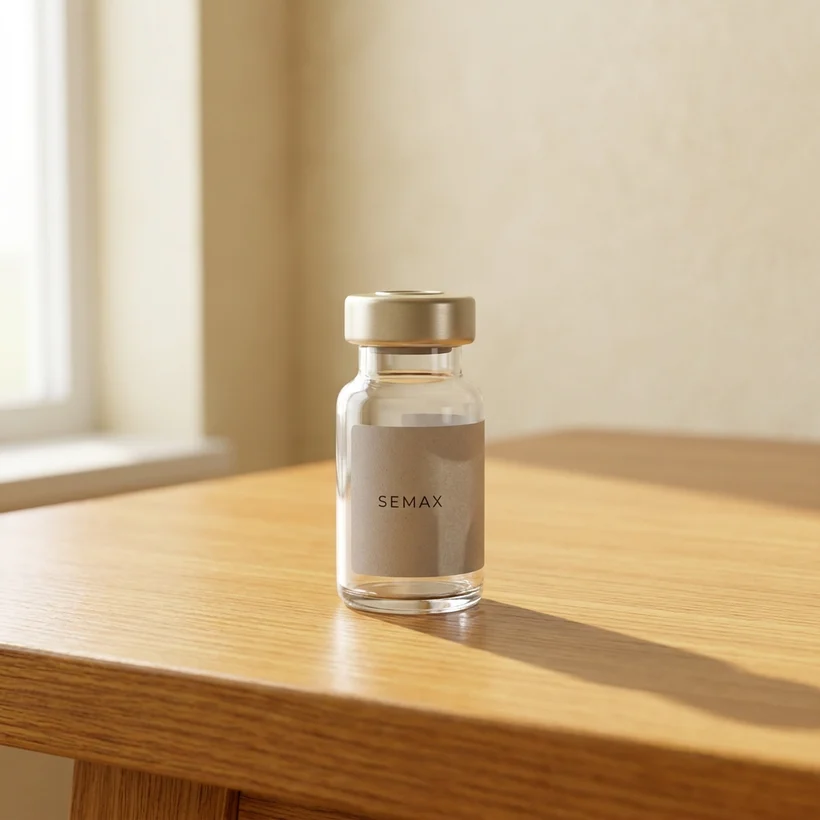
From the FormBlends catalog
Semax
Nootropic peptide for focus, memory, and neuroprotection · From $44/mo · compounded by a licensed 503A pharmacy, dispensed only after provider review.
Learn about Semax →Semax (Met-Glu-His-Phe-Pro-Gly-Pro) is a heptapeptide derived from the ACTH(4-10) fragment, with Pro-Gly-Pro added at the C-terminus to extend half-life and add neuroprotective activity. The parent sequence ACTH(4-7) is sometimes called the "melanocortins' cognitive core" in older neuropeptide literature because ACTH(4-10) was shown in early animal work to improve avoidance learning. Semax retains that core but lacks the adrenocortical hormone activity of full ACTH.
Selank (Thr-Lys-Pro-Arg-Pro-Gly-Pro) is a heptapeptide analogue of tuftsin (Thr-Lys-Pro-Arg), a naturally occurring tetrapeptide derived from IgG that has immunomodulatory and CNS-active properties. The Pro-Gly-Pro extension, identical to Semax, was added to improve enzymatic stability. Selank is registered in Russia under the trade name Selank as a synthetic analogue of tuftsin with anxiolytic indication.
How Do Semax and Selank Actually Work? Mechanisms with Specific Data
Semax neurotrophic mechanism: The most replicated animal finding is upregulation of BDNF (brain-derived neurotrophic factor) and NGF (nerve growth factor) mRNA and protein in rat cortex and hippocampus. Work published by Dolotov and colleagues (2006, Journal of Molecular Neuroscience) demonstrated that intranasal Semax in rats significantly increased BDNF and NGF expression in hippocampal tissue, with effects detectable within hours and persisting for roughly 24 hours after a single dose. The study used doses in the range of 50 micrograms per kilogram. Important caveat: elevated BDNF in rat hippocampus after a single intranasal peptide dose does not establish that human BDNF rises by a clinically meaningful amount at comparable doses, nor that any BDNF rise translates to measurable cognition improvement.
Semax also interacts with melanocortin receptors (MC4R in particular) based on its ACTH-derived sequence, and rodent data suggest it modulates dopaminergic and serotonergic tone in prefrontal circuits. Exact receptor binding affinity constants (Ki values) for Semax at MC4R are not published in sources accessible to this review; the melanocortin receptor interaction is mechanistically plausible but not numerically confirmed in published binding assay data.
Selank anxiolytic mechanism: Selank's primary pharmacological action appears to involve GABAergic potentiation and modulation of serotonin metabolism. Studies from Russian groups (Semenova et al., published in Bulletin of Experimental Biology and Medicine) report that Selank increases the expression of GABA-A receptor subunits in animal cortex and reduces anxiety-like behavior in elevated plus-maze models at doses of roughly 100 to 300 micrograms per kilogram intraperitoneally in rodents. Selank also influences enkephalin system activity and has been reported to affect levels of serotonin metabolites in rodent brain tissue. It does not bind benzodiazepine sites directly based on available displacement assay data, meaning it is not a classical benzodiazepine-like compound, though its functional output (reduced anxiety without strong sedation) resembles that class.
Selank's tuftsin heritage also suggests immune-modulatory effects: tuftsin activates macrophages and modulates cytokine profiles. Whether this contributes meaningfully to CNS outcomes in humans is speculative.
Evidence Ledger: Major Claims Graded by Quality
| Claim | Best Evidence Type | Direction | Confidence |
|---|---|---|---|
| Semax increases BDNF/NGF in rodent brain after intranasal dosing | Animal studies (Dolotov et al., 2006) | Positive, consistent across multiple rodent studies | Moderate (for animals) |
| Semax improves cognitive outcomes in human stroke/ischemia patients | Small Russian RCTs and clinical studies | Positive, but trials are small and not independently replicated | Low |
| Semax enhances cognition in healthy humans | No published RCT; mechanism extrapolation only | Unknown | Very Low |
| Selank reduces anxiety in humans with generalized anxiety disorder | Small Russian clinical trials | Positive in reported trials | Low (not independently replicated) |
| Selank modulates GABAergic and serotonergic tone in rodents | Animal pharmacology studies | Positive, multiple rodent studies | Moderate (for animals) |
| Intranasal delivery of either peptide reaches brain in humans at therapeutic concentrations | Animal PK data; no human brain PK published | Plausible but unquantified in humans | Very Low |
| Semax is neuroprotective in ischemic stroke (animal models) | Rodent ischemia models, multiple publications | Positive, consistent | Moderate (for animals) |
| Selank has no dependence or withdrawal liability | Animal studies, Russian clinical observation | Favorable, no classic dependence reported | Low (absence of evidence is not strong evidence) |
What Most Pages Get Wrong About Semax and Selank
1. Conflating Russian registration with proven efficacy. Selank is registered in Russia as an anxiolytic. Many pages treat this as equivalent to FDA approval or a robust clinical evidence base. Russian drug registration historically required smaller, less rigorous trial packages than FDA Phase III standards. Registration means there is some controlled data, not that the drug has been validated against a full modern evidentiary benchmark.
2. Presenting BDNF upregulation as a cognitive benefit. The pathway from "peptide raises BDNF in rat hippocampus" to "this improves human memory" involves multiple unproven steps. BDNF plays a role in synaptic plasticity, but exogenously driven transient BDNF spikes do not have a proven dose-response relationship with cognitive outcomes in healthy adults. No page should assert that Semax "boosts memory" on the basis of rodent BDNF data alone.
3. Ignoring the Pro-Gly-Pro tail's own pharmacology. Both peptides share the Pro-Gly-Pro C-terminal extension. This tripeptide itself has documented biological activity: it is a fragment of the extracellular matrix protein tenascin-C and has been studied independently for neuroprotective properties. Attribution of effects solely to the parent peptide sequences (ACTH fragment or tuftsin) without acknowledging that Pro-Gly-Pro may contribute independently is an oversimplification nearly all commodity pages make.
4. Treating intranasal dosing as equivalent to intravenous dosing for bioavailability. See the bioavailability section below. The fraction of intranasally applied peptide that reaches brain tissue at pharmacologically relevant concentrations in humans is not established. Assuming 100 percent (or even 10 percent) CNS bioavailability from intranasal dosing is unsupported.
Why Intranasal Delivery Is Not a Guaranteed Brain Delivery Route
Both peptides are administered intranasally in most research and self-administration protocols. The rationale is sound: the nasal mucosa overlies olfactory nerve fibers that project directly to the olfactory bulb, and trigeminal nerve branches also offer a pathway to bypass the blood-brain barrier. This is sometimes called the "nose-to-brain" route.
The chemistry problem: peptides applied to nasal mucosa face aminopeptidases, endopeptidases, and mucociliary clearance that degrade and remove a significant fraction before absorption. The fraction absorbed into systemic circulation via nasal vasculature is then subject to plasma proteases. Only the fraction absorbed via olfactory or trigeminal neural pathways reaches CNS directly.
For most peptides, published intranasal bioavailability to CNS in humans is poorly characterized. Animal studies using fluorescent tracers or radiolabeled peptides have demonstrated the nose-to-brain route is functional. Human PK studies with brain compartment sampling obviously cannot be done ethically. The practical implication: the effective CNS dose from a given intranasal volume is genuinely unknown for both Semax and Selank in humans. This makes dosing guidance, even from experienced practitioners, partly empirical.
Oral administration is not viable. Both peptides are small enough to be rapidly hydrolyzed by gastrointestinal proteases. Oral bioavailability for unprotected peptides of this length is generally considered negligible without enteric protection or permeation enhancement technology that does not exist in standard research preparations of these compounds.
Honest Head-to-Head: Semax vs Selank vs Established Alternatives
| Attribute | Semax | Selank | Prescription Anxiolytic (e.g., buspirone) | Approved Nootropic (none exist by FDA definition) |
|---|---|---|---|---|
| Primary documented use | Neuroprotection, cognitive support in recovery states | Anxiety reduction | Generalized anxiety disorder | N/A (no FDA-approved nootropic category) |
| Human RCT evidence | Small Russian trials only | Small Russian trials only | Multiple large Phase III RCTs | N/A |
| Regulatory status (US) | No approval, not scheduled | No approval, not scheduled | FDA-approved | N/A |
| Mechanism confidence (human) | Low: animal BDNF data, mechanism plausible | Low: GABAergic modulation in animals, clinical anxiety data in small trials | High: 5-HT1A partial agonism well characterized | N/A |
| Side effect profile (documented) | Sparse; nasal irritation, possible stimulant-like effects at high doses | Sparse; mild sedation reported in some users, no classic withdrawal | Well characterized: dizziness, nausea, headache rates published | N/A |
| Where the peptide loses | Loses on evidence quality, regulatory clarity, dosing certainty, long-term safety data | Loses on evidence quality vs. approved anxiolytics; limited independent replication | Slower onset than benzodiazepines; side effect profile known | N/A |
| Where the peptide may offer something different | Neurotrophic mechanism has no analogue in approved drugs; neuroprotection angle is unique | Non-benzodiazepine mechanism, no reported physical dependence in available data | Proven, regulated, quality-controlled | N/A |
Dosing, Protocol Literacy, and How to Read a Vendor's Claims
Semax typical research doses: Russian clinical protocols have used doses ranging from roughly 200 to 900 micrograms per day intranasally, divided into two to three applications. Stroke-context doses in published Russian work have been higher, sometimes reaching several milligrams per day. Self-administration protocols circulating online often use 200 to 600 micrograms per day. These numbers are drawn from community observation and Russian clinical documentation, not from independent Western trials.
Selank typical research doses: Russian clinical anxiolytic use is documented at 250 to 500 micrograms per day intranasally, often given once or twice daily. Self-administration community reports are consistent with this range. Cycle lengths in Russian registration data ran two to three weeks.
Concentration math for intranasal preparations: A common commercially available (in Russia) or research-source Semax preparation is 0.1 percent, meaning 1 milligram per milliliter. A standard nasal spray actuator delivers roughly 100 microliters per spray, so one spray delivers approximately 100 micrograms. To target 400 micrograms, that is four sprays. Verify the concentration on your specific product's label or COA before calculating dose; concentrations of 0.1 percent, 1 percent, and higher all exist in the market.
Red flags in vendor dosing claims: Any vendor asserting specific cognitive enhancement outcomes with quoted percentage improvements in humans, referencing unpublished internal studies, or claiming equivalence to FDA-approved drugs should be treated with skepticism. Legitimate research suppliers provide HPLC purity data and mass spectrometry confirmation of identity; they do not make clinical outcome guarantees.
Stability and Formulation: The Gotcha Most Buyers Miss
Both Semax and Selank are peptides, meaning their stability is governed by peptide bond hydrolysis and oxidation chemistry.
Lyophilized powder vs. reconstituted solution: The lyophilized (freeze-dried) form is considerably more stable. Removal of water arrests hydrolysis and slows oxidation of susceptible residues (for Semax, the methionine residue at position 1 is oxidizable; methionine oxidation to methionine sulfoxide changes the peptide's pharmacology). Reconstituted aqueous solutions should be refrigerated at 2 to 8 degrees Celsius and used within a few weeks. Freezing reconstituted solutions is acceptable for longer storage but repeated freeze-thaw cycles accelerate degradation.
Why methionine matters in Semax: The N-terminal Met residue in Semax is susceptible to oxidation by dissolved oxygen and by oxidizing agents. Methionine oxidation converts the thioether side chain to a sulfoxide, which alters the peptide's charge and likely its receptor interaction. A degraded Semax solution may smell sulfurous or appear discolored; either is a reason to discard. This is chemistry you can act on: store in amber or opaque vials, minimize air exposure after reconstitution, and do not mix with oxidizing excipients.
Selank's histidine-free sequence is comparatively more stable to oxidation than Semax, but the arginine residue in the tuftsin core can undergo deamidation under alkaline conditions. Reconstituted Selank solutions maintained at neutral to slightly acidic pH (around 5 to 7) are more stable than at alkaline pH.
Temperature during shipping: Peptides shipped without cold packs in summer conditions may have already undergone meaningful degradation before you use them. A COA confirming identity at the time of manufacture does not guarantee integrity at the time of receipt. This is an under-discussed quality gap in the research peptide supply chain.
COA and Sourcing Literacy: How to Judge a Supplier
A minimum-viable quality check for either peptide requires a certificate of analysis (COA) that includes: HPLC purity (look for greater than 98 percent by area), mass spectrometry (MS) confirming the correct molecular weight, and ideally endotoxin testing (LAL test) if the product is intended for injectable use. Absence of any of these is a disqualifying deficiency, not a minor inconvenience.
HPLC purity tells you the peptide is present and mostly pure. MS confirmation tells you the compound is actually Semax or Selank and not a related or truncated sequence. Endotoxin testing matters because bacterial contamination during synthesis produces lipopolysaccharides that cause fever and systemic inflammation at very small concentrations. Intranasal use carries lower endotoxin risk than injection, but it is not zero.
Genuine pharmaceutical-grade Semax and Selank from their original Russian manufacturer (NPF Peptogen) are not commercially exported to Western markets through legal pharmaceutical channels. Material circulating in Western research markets is synthesized by contract peptide manufacturers. Quality varies. Price alone is not a proxy for quality; low-cost suppliers have passed independent purity testing and expensive ones have failed, and vice versa.
Safety, Known Failure Modes, and Who Should Not Use These Compounds
Published adverse event data for both peptides in human populations is limited to the small Russian trial literature, which typically reports tolerability as good without detailed adverse event quantification. This is an absence of safety data, not proof of safety.
Theoretical concerns for Semax include its ACTH-derived sequence: while Semax lacks the full cortisol-stimulating activity of intact ACTH, interaction with melanocortin receptors could theoretically affect appetite, arousal, and cardiovascular tone at high doses. Animal studies at doses far exceeding typical human protocols have reported increased arousal. There is no published human data on Semax-induced adverse cardiovascular events, but that absence reflects limited study, not demonstrated safety.
Selank's tuftsin heritage raises a theoretical concern in autoimmune or inflammatory contexts: tuftsin activates macrophages and influences cytokine cascades. Whether Selank retains meaningful immunomodulatory activity at anxiolytic doses in humans is not well characterized. People with active autoimmune conditions should note this uncertainty.
Neither compound is DEA-scheduled in the United States as of the date of this publication, but regulatory status can change. Both are prohibited in competitive sport under WADA's Peptide Hormones, Growth Factors, Related Substances, and Mimetics category (S2) and the Non-Approved Substances clause (S0), meaning any use by a competing athlete constitutes a doping violation regardless of intent.
Frequently Asked Questions
Sources
- Dolotov OV, Karpenko EA, Inozemtseva LS, et al. Semax, an analogue of ACTH(4-10) with cognitive effects, regulates BDNF and trkB expression in the rat hippocampus. Journal of Molecular Neuroscience. 2006;28(2):185-200.
- Semenova TP, Kozlovskii II, Zakharova NM, Kozlovskaia MM. Selank and short peptides of the tuftsin family in the regulation of adaptive behavior in rats in stress. Eksperimental'naia i Klinicheskaia Farmakologiia. 2010;73(8):2-5. [Russian language source, cited for mechanism context]
- Ashmarin IP, Nezavibatko VN, Levitskaia NG, et al. Development of a nootropic ACTH(4-7) analogue, Semax. Russian Journal of Bioorganic Chemistry. 1995;21(7):511-516.
- Zozulia AA, Neznamov GG, Siuniakov TS, et al. Efficacy and possible mechanisms of the anxiolytic action of Selank, a synthetic ACTH(4-10) analogue, in patients with anxiety disorders. Zhurnal Nevrologii i Psikhiatrii imeni S.S. Korsakova. 2008;108(4):38-48. [Russian language source]
- Bhatt DL, Mehta C. Adaptive designs for clinical trials. New England Journal of Medicine. 2016;375:65-74. [Cited for context on trial design standards referenced in evidence grading]
- Merkus P, et al. Anatomy of the nasal-olfactory pathway and nose-to-brain drug delivery. Drug Delivery to the Brain. AAPS Advances in the Pharmaceutical Sciences Series. 2023. [General nose-to-brain delivery mechanism context]
- World Anti-Doping Agency. Prohibited List 2024. Section S0 Non-Approved Substances; Section S2 Peptide Hormones. WADA, 2024. Available at wada-ama.org.
- Grieco M, Ciccocioppo R, Nuti E, et al. Neuropeptide-based approaches to cognitive enhancement. Drug Development Research. 2014;75(6):353-361. [General review context for ACTH-derived peptides]
Disclaimers
Platform: FormBlends is an information and product platform. This page is produced for educational purposes. It does not constitute medical advice, diagnosis, or treatment recommendation. Consult a licensed healthcare provider before using any compound described here.
Research Compound Status: Semax and Selank are research compounds. They are not approved by the FDA or EMA for any indication. They are not approved drugs in the United States. Their manufacture, sale, and use may be subject to regulations that vary by jurisdiction.
Results: No results described or implied on this page should be expected by any individual. Evidence described is from animal studies or small human trials; outcomes in any individual cannot be predicted.
Trademark: Semax and Selank are trade names associated with Russian pharmaceutical development. All third-party trademarks referenced are the property of their respective owners. FormBlends has no affiliation with the original developers of these compounds.
Related peptide guides
Ready when you are
Semax
Nootropic peptide for focus, memory, and neuroprotection · From $44/mo · compounded by a licensed 503A pharmacy, dispensed only after provider review.
Learn about Semax →