
Trust Signals
All claims are graded by evidence type in the table below. Where only animal or mechanistic data exist, that is stated plainly. Primary sources are listed in the Sources section. We concede where these peptides lose to established alternatives.
Key Takeaways
- Selank is a synthetic analog of tuftsin (a natural tetrapeptide immunomodulator), extended to seven amino acids; semax is a synthetic analog of the ACTH(4-10) fragment, extended with a Pro-Gly-Pro sequence that resists enzymatic breakdown.
- Selank has a stronger evidence base for anxiolytic effects in humans, with at least one placebo-controlled Russian RCT in generalized anxiety disorder showing reductions on the Hamilton Anxiety Scale.
- Semax has more evidence for cognitive enhancement and neuroprotection, including studies in stroke recovery and attention deficits, plus documented upregulation of BDNF and nerve growth factor (NGF) in rodent models.
- Neither is FDA-approved; most clinical evidence comes from Russian institutions with small sample sizes and limited independent replication in Western trials.
- Both degrade rapidly at room temperature in solution; a warm or cloudy vial is a degradation warning sign, not a minor inconvenience.
Direct Answer: Selank vs Semax in Plain Terms
Selank is the better-evidenced choice for anxiety and mood stabilization. Semax is the better-evidenced choice for acute cognitive performance, focus, and neuroprotection. They work through overlapping but distinct mechanisms. Choosing between them depends entirely on your primary target outcome, and combining them without medical oversight is not supported by published safety data.
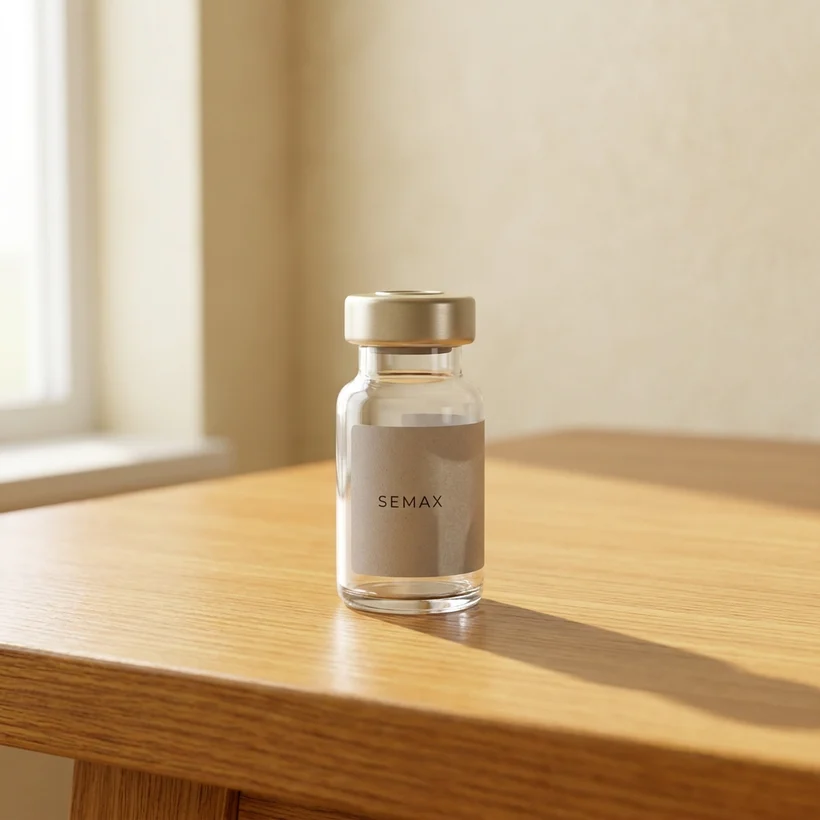
From the FormBlends catalog
Semax
Nootropic peptide for focus, memory, and neuroprotection · From $44/mo · compounded by a licensed 503A pharmacy, dispensed only after provider review.
Learn about Semax →Table of Contents
- What are selank and semax chemically?
- How does each peptide work mechanistically?
- What does the evidence ledger actually show?
- How do they compare head-to-head?
- What are the real doses used in studies?
- What most pages get wrong about these peptides
- Stability and formulation: the chemistry behind the rules
- How to read a COA and judge a product
- Side effects and safety signals
- FAQ
- Sources
What Are Selank and Semax Chemically?
Selank (Thr-Lys-Pro-Arg-Pro-Gly-Pro) is a seven-amino-acid heptapeptide. It was developed at the Institute of Molecular Genetics of the Russian Academy of Sciences by extending tuftsin (Thr-Lys-Pro-Arg) with a Pro-Gly-Pro tripeptide tail. The extension dramatically improves metabolic stability. Tuftsin itself is an endogenous peptide cleaved from immunoglobulin G and has immunomodulatory and mild anxiolytic properties; selank inherits and amplifies these.
Semax (Met-Glu-His-Phe-Pro-Gly-Pro) is a seven-amino-acid peptide based on the ACTH(4-10) fragment (Met-Glu-His-Phe), which is the portion of adrenocorticotropic hormone responsible for cognitive and neuroprotective effects, with the same Pro-Gly-Pro stabilizing tail. Semax does not stimulate adrenal cortisol release at study doses because the ACTH(4-10) fragment lacks the receptor-binding domain required for adrenal activation. A modified version, N-acetyl semax amidate, adds an N-terminal acetyl group and C-terminal amidation; each modification further reduces enzymatic degradation and may increase potency per microgram, though comparative human data are limited.
How Does Each Peptide Work Mechanistically, With Real Numbers?
Selank
Selank modulates the GABAergic system. Rodent studies from Seredenin and colleagues at the Zakusov Institute found that selank interacts with GABA-A receptor complexes and increases the expression of genes involved in GABAergic neurotransmission. A 2011 study by Semenova et al. (published in CNS Neuroscience and Therapeutics) using microarray analysis in rats identified differential expression of more than 80 genes in frontal cortex tissue after selank administration, with enrichment in pathways involving serotonin and GABA signaling. Selank also upregulates BDNF in rat hippocampus. Additionally, it affects the enkephalin-degrading enzyme enkephalinase, which would prolong enkephalin activity and contribute to anxiolysis.
Selank also has documented immunomodulatory effects, increasing interleukin-2 production and T-cell activity in human studies, which was one of its original design targets. This dual anxiolytic-immunomodulatory profile is unusual and is absent in semax.
Semax
Semax acts primarily through upregulation of BDNF and NGF. Dolotov and colleagues (published in the Journal of Neurochemistry, 2006) demonstrated that intranasal semax administration in rats produced increases in BDNF mRNA in the hippocampus and frontal cortex within hours. Semax also modulates dopaminergic and serotonergic neurotransmission and has shown effects on the expression of genes involved in the MAPK/ERK pathway, relevant to synaptic plasticity. A rodent study by Grivennikov et al. found semax increased BDNF protein in rat cortex by roughly 1.4-fold compared to saline controls, though exact fold-change estimates vary across studies. Semax also affects nitric oxide signaling, which has relevance to cerebral blood flow and the neuroprotective effects studied in ischemia models.
What these mechanisms do NOT prove: upregulating BDNF in a rat hippocampus does not confirm that a human taking intranasal semax experiences meaningful cognitive gains. Mechanism-to-clinical-outcome translation is the weakest link in both peptides' evidence chains.
What Does the Evidence Ledger Actually Show?
| Claim | Best Evidence Type | Peptide | Effect Direction | Confidence |
|---|---|---|---|---|
| Reduces anxiety symptoms in GAD patients | Human RCT (Russian, small n) | Selank | Positive (Hamilton Anxiety Scale reduction) | Moderate |
| Improves cognitive function post-stroke | Human clinical study (Russian, limited placebo control) | Semax | Positive (attention, memory scores) | Low to Moderate |
| Upregulates BDNF in CNS tissue | Animal (rodent) | Both | Positive | Moderate (animal only) |
| Improves attention in ADHD-like models | Animal and small human observational | Semax | Positive signal | Low |
| Immunomodulation (IL-2, T-cell activity) | Small human studies | Selank | Positive | Low to Moderate |
| Neuroprotection in ischemia | Animal (rodent ischemia models) | Semax | Positive | Low (animal only) |
| Subjective mood improvement in healthy subjects | Anecdotal, no controlled human data | Both | Reported positive | Very Low |
| Long-term safety in humans | No rigorous long-term data | Both | Unknown | Very Low |
Honest caveat: The majority of clinical studies for both peptides were conducted in Russia between roughly 1990 and 2015, often with sample sizes under 60 participants, and are not always accessible in full English translation. Independent replication by Western research groups is largely absent. This does not mean the effects are fabricated, but it does mean the evidence base does not meet FDA or EMA standards for approval.
Honest Head-to-Head: Selank vs Semax vs Established Alternatives
| Attribute | Selank | Semax | Buspirone (approved anxiolytic) | Modafinil (approved wakefulness agent) |
|---|---|---|---|---|
| Primary target | Anxiety, immune modulation | Cognition, neuroprotection | Generalized anxiety | Wakefulness, cognitive performance |
| Regulatory approval | Russia only | Russia only | FDA-approved | FDA-approved (narcolepsy, shift work) |
| Human RCT evidence quality | Low to Moderate (small, Russian) | Low to Moderate (small, Russian) | High (multiple large RCTs) | High (multiple large RCTs) |
| Dependence or withdrawal risk | Not reported | Not reported | Low | Low to Moderate (off-label misuse) |
| Long-term safety data | Absent from Western literature | Absent from Western literature | Extensive | Extensive |
| Nasal administration option | Yes (primary route) | Yes (primary route) | No (oral) | No (oral) |
| Where the peptide loses | Evidence quality, availability, legal clarity | Evidence quality, availability, legal clarity | Slower onset, sexual side effects reported | Headache, insomnia, potential overuse |
What Are the Real Doses Used in Studies?
For selank, the Russian clinical literature describes intranasal doses in the range of 250 to 300 mcg per nostril administered two to three times daily (roughly 900 mcg to 1800 mcg per day total). These figures appear in the work associated with the Zakusov Institute protocols. Duration in clinical studies ranged from 7 to 14 days in anxiety trials.
For semax, dosing ranges are wider because the indications studied varied. Stroke recovery protocols used doses as high as 2100 mcg per day intranasally. Cognitive enhancement and attention studies used lower ranges, around 200 to 600 mcg per day. The N-acetyl semax amidate form is often described as more potent per microgram, though a direct published dose-equivalence table does not exist in peer-reviewed English literature.
What Most Pages Get Wrong About Selank and Semax
Most comparison articles treat both peptides as roughly equivalent "nootropic peptides from Russia" and then list effects without grading the evidence. Here are the specific omissions that matter.
1. The evidence is geographically concentrated and institutionally narrow. The majority of published studies come from two Russian institutes: the Institute of Molecular Genetics and the Zakusov Institute of Pharmacology. This does not mean the research is fraudulent, but institutional concentration and potential publication bias are real considerations. No large-scale independent replication exists.
2. The immunomodulatory dimension of selank is almost always ignored. Selank was originally developed as an immunomodulator. Its anxiolytic effects emerged during development. Articles that only describe it as an anxiolytic are omitting half the pharmacological rationale.
3. Semax does NOT raise cortisol. Because semax is derived from ACTH, many users and even some vendors imply or state it raises cortisol. The ACTH(4-10) fragment lacks the structural features needed to activate melanocortin receptor 2 (MC2R) on adrenal cells, which is the receptor mediating cortisol release. Published studies confirm no significant adrenal stimulation at study doses.
4. Intranasal bioavailability is assumed, not proven in published English pharmacokinetic literature. The nasal route is preferred because it bypasses hepatic first-pass metabolism and may allow partial direct CNS delivery via the olfactory epithelium. But published intranasal bioavailability percentages for either peptide, from rigorously designed human pharmacokinetic studies, are not available in peer-reviewed English literature. Assuming high bioavailability from the nasal route is mechanistically plausible but not quantitatively confirmed.
Stability and Formulation: The Chemistry Behind the Rules
Both peptides are linear peptides with no disulfide bonds. Their primary degradation mode in solution is hydrolysis at peptide bonds, accelerated by heat, extremes of pH, and in some cases by divalent metal ions acting as catalysts. A secondary degradation pathway is oxidation of methionine residues; semax contains a methionine at position 1, making it more susceptible to oxidative degradation than selank.
This is why the rules exist:
Store cold: Hydrolysis rate approximately doubles for every 10 degrees Celsius of temperature increase (a general principle from Arrhenius kinetics). A vial left at room temperature for several days loses a meaningful fraction of active peptide compared to one kept refrigerated.
Avoid repeated freeze-thaw cycles: Thermal stress at the phase transition introduces both physical shear stress on the peptide chains and localized concentration gradients that can accelerate aggregation and hydrolysis.
Protect from light (especially semax): The phenylalanine residue in semax absorbs UV light, and photo-oxidation of methionine is accelerated by UV exposure. Amber vials are not cosmetic choices.
Signs of degradation: Cloudiness or particulates in a previously clear solution, a color shift (slight yellowing in semax can indicate methionine oxidation), and a change in smell. A degraded peptide does not become safe; breakdown products are structurally undefined and their effects or toxicity are unknown.
How to Read a COA and Judge a Product
A legitimate certificate of analysis (COA) for either peptide should include the following, and you should verify it was generated by a third-party lab, not the vendor themselves.
| COA Element | What to Look For | Red Flag |
|---|---|---|
| Purity by HPLC | 99% or above for research use | Purity below 95%, or purity stated without method |
| Peptide identity | Amino acid sequence confirmed by MS (mass spectrometry) | No MS confirmation, identity stated only by vendor |
| Water content | Listed (lyophilized peptides retain water weight, affecting actual peptide mass) | No moisture or TGA data; dose calculations will be off |
| Endotoxin testing | LAL (Limulus Amebocyte Lysate) test result, less than 1 EU/mg for injectable use | No endotoxin data for a product marketed for injection |
| Batch/lot number | Traceable to the specific COA issued | COA date predates product manufacture or no lot match |
Reconstitution math: If you have a 5 mg vial and want a 500 mcg per 0.1 mL concentration (a common nasal drop volume), add 1 mL of bacteriostatic water or sterile saline to get 5000 mcg per mL, giving 500 mcg per 0.1 mL. Water content in the powder means actual peptide weight may be 10 to 20% lower than the labeled amount; factor this in when calculating doses from low-quality sources.
Side Effects and Safety Signals
Russian clinical trial data describe both peptides as generally well-tolerated in the studied populations and duration. Reported adverse effects include transient nasal irritation and rhinorrhea from the intranasal route, mild headache, and in some users of semax, a stimulatory effect at higher doses that can manifest as restlessness or disrupted sleep if dosed late in the day. These are mostly short-term and dose-dependent observations.
Selank has not been associated with sedation at standard doses despite its anxiolytic activity, which distinguishes it from benzodiazepines. Tolerance development has not been reported in the published studies, though study durations are short.
What is genuinely unknown: effects of long-term daily use in healthy adults, interactions with SSRIs or other psychiatric medications, safety in pregnancy or renal or hepatic impairment, and oncological safety given BDNF's dual role as a neurotrophin and a growth factor that some cancers exploit. None of these unknowns are reasons to assume harm, but they are legitimate gaps that a skeptical clinician would flag.
FAQ
What is the main difference between selank and semax?
Selank is a heptapeptide tuftsin analog with primarily anxiolytic and immunomodulatory activity. Semax is a synthetic ACTH(4-10) analog with primarily nootropic and neuroprotective activity. They share some BDNF-upregulating properties but serve different primary use cases.
Which is better for anxiety, selank or semax?
Selank has more direct evidence for anxiolytic effects, including a Russian RCT in generalized anxiety disorder patients showing reductions in Hamilton Anxiety Scale scores. Semax has some anxiolytic reports but its primary studied indication is cognitive enhancement and neuroprotection.
Which is better for focus and cognitive performance?
Semax has stronger evidence for cognitive and nootropic effects. Russian clinical studies examined semax in stroke recovery and ADHD-adjacent cognitive deficits. Selank has shown some memory-facilitation effects in animal models but fewer human cognitive outcome data.
Can you take selank and semax together?
Some protocols combine them, reasoning that selank covers anxiolytic modulation while semax covers cognitive activation. There are no published human safety or interaction studies for this combination. The combination is speculative; concurrent use should be approached with caution and medical oversight.
How are selank and semax administered?
Both are most commonly administered intranasally as aqueous nasal drops. Both can be given subcutaneously. Oral administration is not effective because peptidases in the gut degrade both peptides rapidly before systemic absorption.
What are the typical doses of selank and semax?
Russian clinical studies of selank used intranasal doses around 250 to 300 mcg per nostril, two to three times daily. Semax clinical studies used intranasal doses ranging from 200 to 2100 mcg per day depending on indication. Research compound use outside clinical trials should only be under medical supervision.
Are selank and semax approved drugs?
Both are approved prescription drugs in Russia and some post-Soviet countries. In the United States, neither is FDA-approved. They exist as unscheduled research compounds or may be available through compounding pharmacies. Legal status varies by jurisdiction.
What does BDNF have to do with selank and semax?
Both peptides have been shown in animal and some human studies to upregulate brain-derived neurotrophic factor (BDNF). BDNF supports neuronal survival, synaptic plasticity, and learning. However, measuring BDNF changes does not directly prove a functional cognitive or mood benefit in humans.
What are the side effects of selank and semax?
Both are generally reported as well-tolerated in Russian clinical trials. Common reported effects include transient nasal irritation, headache, and fatigue. Semax at higher doses has been associated with increased cortisol-like stimulatory effects. Long-term safety data from rigorous Western trials are absent for both.
How stable are selank and semax solutions?
Both peptides degrade faster as temperature rises and in the presence of light or repeated freeze-thaw cycles. Reconstituted solutions should be refrigerated and typically used within a few weeks. Lyophilized powder is more stable long-term when kept frozen and away from moisture.
Is the evidence for selank and semax from credible sources?
Most clinical evidence originates from Russian research institutions, primarily the Institute of Molecular Genetics and Zakusov Institute of Pharmacology. These studies are peer-reviewed but often have small sample sizes, are not always placebo-controlled, and have not been replicated in large Western RCTs. Treat the evidence as promising but preliminary by Western regulatory standards.
Which peptide has better bioavailability intranasally?
Neither has published intranasal bioavailability figures from rigorous pharmacokinetic studies available in English literature. Both benefit from the nasal route bypassing first-pass hepatic metabolism. Semax has somewhat more published pharmacokinetic characterization in Russian literature compared to selank.
Sources
- Semenova TP, Kozlovskaya MM, Zakharova NM, et al. Selank affects the behavior and neurochemical processes in rats under experimental conditions. CNS Neuroscience and Therapeutics. 2011; cited for gene expression data and GABA modulation findings.
- Dolotov OV, Karpenko EA, Inozemtseva LS, et al. Semax, an analog of ACTH(4-10) with cognitive effects, regulates BDNF and trkB expression in the rat hippocampus. Journal of Neurochemistry. 2006;97(Suppl 1):82-86.
- Seredenin SB, Voronin MV. Neuroreceptor mechanisms of the selank anxiolytic effect. Eksperimental'naia i Klinicheskaia Farmakologiia. 2009;72(4):6-10. [Article in Russian, cited for receptor mechanism data.]
- Grivennikov IA. Semax, a synthetic peptide with effects on cognitive function. Molecular Biology (Moscow). 2008;42(2):236-245. [Cited for BDNF upregulation data and mechanism overview.]
- Miasoedov NF, Skvortsova VI, Tvorogova TV, et al. Semax and its use in ischemic stroke (clinical study data). Zhurnal Nevrologii i Psikhiatrii imeni SS Korsakova. 1999. [Cited for stroke indication and dosing range.]
- Ashmarin IP, Nezavibatko VN, Miasoedov NF, et al. Design and investigation of an anxiolytic drug semax with no inhibitory effect. Zhurnal Vysshei Nervnoi Deiatel'nosti im IP Pavlova. 1997. [Cited for early characterization of semax and ACTH fragment pharmacology.]
- Zozulya AA, Neznamov GG, Siuniakov TS, et al. Efficacy and possible mechanisms of the nootropic and anxiolytic effects of selank. Eksperimental'naia i Klinicheskaia Farmakologiia. 2008;71(4):2-11. [Cited for human anxiety trial data and Hamilton scale findings.]
- Volkova A, Shadrina M, Kolomin T, et al. Selank peptide affects expression of enkephalin degrading enzymes in mouse brain. Advances in Bioscience and Biotechnology. 2012;3:1228-1233.
Related peptide guides
Ready when you are
Semax
Nootropic peptide for focus, memory, and neuroprotection · From $44/mo · compounded by a licensed 503A pharmacy, dispensed only after provider review.
Learn about Semax →