
Trust signals
Key Takeaways
- BPC-157 (Body Protection Compound-157) is a 15-amino-acid peptide with the widest animal evidence for reducing inflammation across musculoskeletal, GI, and neural tissues, but zero published human RCTs.
- KPV is a tripeptide derived from alpha-melanocyte-stimulating hormone that inhibits NF-kB and IL-6 in cell studies; a human IBD trial has been initiated but results are not yet published.
- TB-500 (synthetic Thymosin Beta-4 fragment) reduces inflammatory cell migration by sequestering G-actin; evidence is animal and in vitro only.
- Ibuprofen and prednisolone have hundreds of human RCTs confirming anti-inflammatory effect; every peptide on this list loses on evidence quality compared to approved drugs.
- Purity matters more than brand name: peptides sold without HPLC plus mass spectrometry confirmation and endotoxin testing below 1 EU/mg are unsuitable for injection regardless of marketing claims.
What is the best peptide for inflammation right now?
BPC-157 is the best-supported peptide for inflammation based on volume and consistency of preclinical data. KPV is the strongest candidate for gut-specific inflammation with human trial initiation. Neither peptide has human RCT confirmation of clinical benefit. For evidence-based anti-inflammatory therapy, approved drugs remain the standard of care.
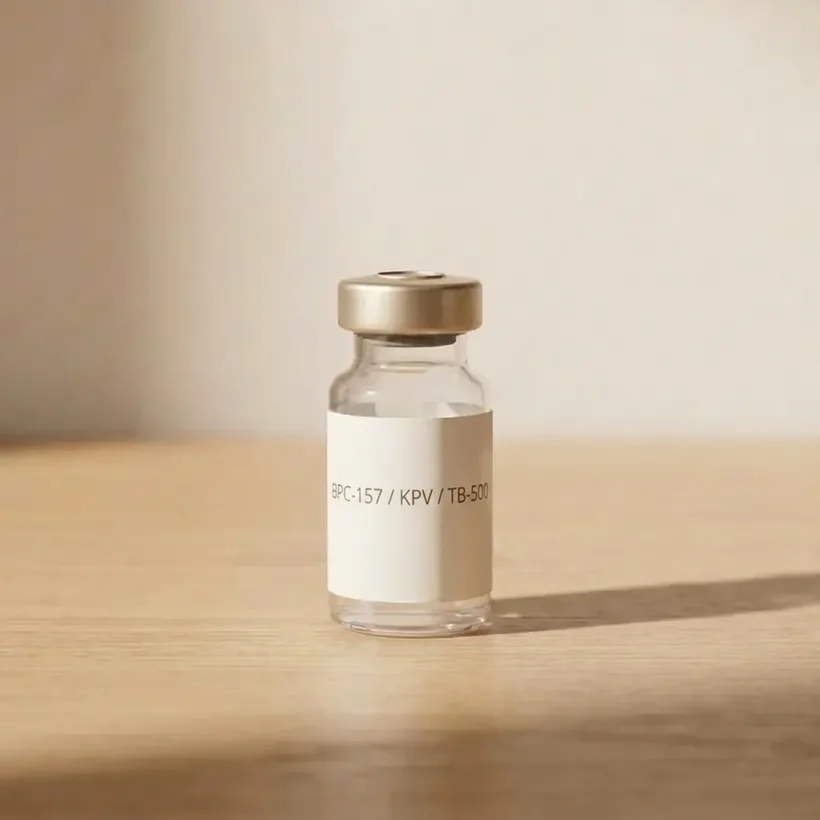
From the FormBlends catalog
BPC-157 / KPV / TB-500 Blend
Three-pathway recovery support in one peptide blend · From $279/mo · compounded by a licensed 503A pharmacy, dispensed only after provider review.
View BPC-157 / KPV / TB-500 Blend →Table of Contents
- Evidence Ledger: Every Major Claim Graded
- The Ranked List: 5 Best Peptides for Inflammation
- Mechanism with Numbers: How These Peptides Work
- What Most Pages Get Wrong About Anti-Inflammatory Peptides
- Honest Head-to-Head: Peptides vs. Approved Anti-Inflammatories
- The Chemistry Behind the Rules: Stability and Bioavailability
- Operational Guide: Reading a COA and Dosing Table
- FAQ
- Sources
- Disclaimers
Evidence Ledger: Every Major Claim Graded
| Claim | Peptide | Best Evidence Type | Effect Direction | Confidence |
|---|---|---|---|---|
| Reduces GI inflammation | BPC-157 | Multiple rodent RCT-equivalent models | Positive (consistent) | Moderate (animal only) |
| Reduces musculoskeletal inflammation post-injury | BPC-157 | Rodent tendon and muscle models | Positive | Low (no human data) |
| Inhibits NF-kB and IL-6 in gut cells | KPV | In vitro cell studies, one mouse colitis model | Positive | Low to moderate |
| Reduces inflammatory cell migration after tissue injury | TB-500 | Rodent wound and cardiac models | Positive | Low (animal only) |
| Systemic anti-inflammatory effect in humans | Any peptide listed | No human RCT published | Unknown | Very low |
| GLP-1 agonists reduce systemic inflammation markers | Semaglutide (approved drug, comparison) | Multiple human RCTs | Positive | High |
| Reduces neuroinflammation markers | Selank | Animal and limited human anxiolytic studies | Tentative positive | Very low |
The Ranked List: 5 Best Peptides for Inflammation
1. BPC-157 (Best Overall Preclinical Evidence)
BPC-157 is a 15-amino-acid sequence (Gly-Glu-Pro-Pro-Pro-Gly-Lys-Pro-Ala-Asp-Asp-Ala-Gly-Leu-Val) derived from a region of human gastric juice protein BPC. It is the most studied research peptide for inflammation in terms of published animal studies. Sikiric and colleagues at the University of Zagreb have published extensively on its effects in rodent GI, tendon, ligament, and nerve injury models. Consistent findings across multiple labs show reduced prostaglandin levels, suppressed NF-kB activation, and improved tissue healing timelines. The absence of human RCT data is the critical limitation.
Typical animal dose: 1 to 10 micrograms per kilogram, subcutaneous or intraperitoneal. Human-equivalent dosing has not been pharmacokinetically validated.
2. KPV (Best Candidate for Gut Inflammation)
KPV is a C-terminal tripeptide fragment of alpha-MSH (alpha-melanocyte-stimulating hormone), consisting of lysine-proline-valine. It binds melanocortin receptor MC1R and signals through pathways that inhibit NF-kB nuclear translocation. A 2022 study by Bhatt et al. published in Biomaterials demonstrated that nanoparticle-formulated oral KPV significantly reduced colitis in a mouse DSS model, with reduced TNF-alpha and IL-6 in colonic tissue. A human Phase 1 oral trial for IBD has been disclosed but peer-reviewed results are not yet published as of this writing. KPV is a legitimate near-term candidate, not hype.
3. TB-500 (Thymosin Beta-4 Synthetic Fragment)
TB-500 is a synthetic version of the active region of Thymosin Beta-4, a 43-amino-acid protein expressed in most human cells. Its primary mechanism is G-actin sequestration, which reorganizes the cytoskeleton and reduces leukocyte extravasation into inflamed tissue. Rodent studies in cardiac injury and wound healing show reduced inflammatory infiltrate. It is on the World Anti-Doping Agency (WADA) prohibited list, indicating recognition of its biological activity even in the absence of human clinical trials.
4. Selank (Neuroinflammation Context)
Selank is a synthetic analog of tuftsin (a naturally occurring immunomodulatory tetrapeptide) developed by the Russian Institute of Molecular Genetics. It has been studied in Russia in small human trials primarily for anxiety and cognitive function, with secondary measurement of IL-6 and other inflammatory cytokines showing reductions. The trials are small, not always placebo-controlled, and published primarily in Russian-language journals with limited external replication. Confidence is very low for anti-inflammatory claims specifically.
5. Epithalon (Longevity and Inflammatory Aging Context)
Epithalon is a tetrapeptide (Ala-Glu-Asp-Gly) studied primarily by Khavinson and colleagues in Russia for telomerase activation and aging. Some animal studies show reductions in inflammatory cytokine profiles in aged rodents. Evidence base is thinner than BPC-157 and substantially limited to one research group. Listed here for completeness because it appears frequently in inflammation-and-longevity discussions, not because the evidence is strong.
Mechanism with Numbers: How These Peptides Work
BPC-157: Nitric Oxide and NF-kB
BPC-157 appears to modulate nitric oxide (NO) synthase pathways. In rodent studies, it rescues NO production in endothelial cells under inflammatory stress, which helps maintain vascular tone and limits excessive inflammatory cell recruitment. Separately, multiple studies (Sikiric et al., Journal of Physiology-Paris and related publications) show suppressed NF-kB p65 nuclear translocation in GI tissue after BPC-157 administration. NF-kB controls transcription of approximately 150 to 200 genes involved in inflammation, including TNF-alpha, IL-1beta, IL-6, and COX-2. Suppressing its nuclear entry represents a broad, upstream anti-inflammatory action.
Honest caveat: Suppressing NF-kB in a rodent GI model does not prove that the same concentration of BPC-157 reaches human target tissue at a therapeutic level after subcutaneous injection.
KPV: Melanocortin Receptor Signaling
KPV binds MC1R on macrophages and intestinal epithelial cells. MC1R coupling to Gs protein raises intracellular cAMP, which activates PKA and suppresses IKK (I-kappa-B kinase), preventing IkB phosphorylation and subsequent NF-kB release. The net effect is reduced transcription of TNF-alpha, IL-6, and IL-12. In the Bhatt et al. 2022 nanoparticle study, oral nanoparticle-KPV reduced colon shortening (a colitis severity marker) and histological damage scores significantly compared to free KPV, suggesting formulation is essential for oral bioavailability.
TB-500: Actin Sequestration and Leukocyte Migration
Thymosin Beta-4 and its synthetic TB-500 fragment contain the conserved LKKTET actin-binding motif. By binding monomeric G-actin with high affinity, TB-500 prevents F-actin polymerization in neutrophils and macrophages, physically limiting the cytoskeletal remodeling these cells need to migrate into inflamed tissue. This is a genuine and mechanistically specific action. What it does not do is resolve pre-existing inflammation through cytokine antagonism in the way an IL-6 inhibitor like tocilizumab does.
What Most Pages Get Wrong About Anti-Inflammatory Peptides
A second omission: endotoxin contamination. Peptides synthesized via solid-phase peptide synthesis (SPPS) can carry lipopolysaccharide (LPS) contamination from bacterial components in reagents. Injecting even nanogram quantities of LPS causes an inflammatory response, directly opposite to the intended effect. This is why endotoxin testing (Limulus Amebocyte Lysate assay) below 1 EU/mg is non-negotiable for any injectable peptide, and most consumer-facing vendors do not publish this data.
Third: the dose-extrapolation gap. Rodent studies use body-surface-area-normalized dosing. A 10 microgram per kilogram dose in a 250-gram rat does not translate directly to the same per-kilogram dose in a 75-kilogram human. Allometric scaling (using FDA guidance on human equivalent dose calculation from animal studies) typically reduces the per-kilogram figure, but even that is a starting point for Phase 1 trials, not a prescription.
Honest Head-to-Head: Peptides vs. Approved Anti-Inflammatories
| Intervention | Mechanism | Human RCT Data | Effect Size (Human) | Key Advantage | Key Weakness |
|---|---|---|---|---|---|
| BPC-157 | NO modulation, NF-kB suppression | None published | Unknown | Tissue-repair signal alongside anti-inflammation (animal) | No human evidence at all |
| Ibuprofen (NSAID) | COX-1/COX-2 inhibition, reduces prostaglandins | Hundreds of RCTs | Moderate, well-defined | Proven efficacy, low cost, oral | GI ulceration, renal risk, impairs healing signals |
| Prednisolone (corticosteroid) | Glucocorticoid receptor, broad cytokine suppression | Extensive human data | Large, rapid | Broadest anti-inflammatory effect available | Immunosuppression, bone loss, metabolic effects |
| KPV | MC1R agonism, NF-kB inhibition | Phase 1 initiated, no results | Unknown in humans | Gut-targeted, possibly lower systemic side effects | Oral bioavailability requires nanoparticle formulation |
| TB-500 | G-actin sequestration | None | Unknown | Tissue-migration reduction, possible repair co-effect | WADA banned, no human trial |
| Semaglutide (GLP-1 agonist) | GLP-1R agonism, CRP and IL-6 reduction secondary | Multiple large RCTs (SUSTAIN, SELECT) | Meaningful CRP reduction confirmed | FDA-approved, CV outcome data | Not indicated purely for inflammation, cost |
Bottom line: Every approved drug in this table beats every peptide on human evidence quality. Peptides are not better-than-drugs; they are earlier in the evidence pipeline and may offer mechanisms (tissue remodeling alongside inflammation control) that pure anti-inflammatories do not. Conflating preclinical promise with clinical proof is how people get hurt.
The Chemistry Behind the Rules: Stability and Bioavailability
Why peptides degrade at room temperature
Peptide bonds are thermodynamically metastable in aqueous solution. Hydrolysis is accelerated by heat (elevated temperature increases the kinetic energy of water molecules attacking the carbonyl carbon of the peptide bond), by extreme pH (both acid and base catalyze hydrolysis through different mechanisms), and by oxidation (methionine and cysteine side chains are particularly vulnerable). BPC-157 contains no methionine or cysteine, which gives it relatively better oxidative stability than peptides like TB-500 or Selank, but it is still subject to hydrolysis in solution.
Once reconstituted in bacteriostatic water: store at 2 to 8 degrees Celsius, protect from light, minimize freeze-thaw cycles. These are not arbitrary rules. Freeze-thaw cycles cause ice crystal formation that physically disrupts peptide tertiary structure and promotes aggregation, reducing both potency and potentially increasing immunogenicity of aggregated forms.
Why lyophilized (freeze-dried) peptides are the baseline standard
Lyophilization removes water under vacuum at low temperature, arresting hydrolysis essentially to zero. A properly lyophilized peptide sealed in a vial under inert gas can remain stable for months to years at refrigerator temperature. A pre-dissolved peptide shipped at room temperature over several days has already lost measurable potency through hydrolysis. Any vendor shipping pre-mixed peptide solutions without cold chain should be treated with skepticism.
Operational Guide: Reading a COA and Dosing Table
What a COA must contain for an injectable peptide
| COA Field | Minimum Standard | Red Flag |
|---|---|---|
| HPLC purity | 98% or above | No purity listed, or below 95% |
| Mass spectrometry | Molecular weight confirmed within 1 Da of theoretical | Absent, or MW not matching sequence |
| Endotoxin (LAL test) | Below 1 EU/mg (USP injectable standard) | Not tested, or result not disclosed |
| Sterility | Sterility test passed (for injectable use) | Not mentioned |
| Sequence verification | Amino acid sequence listed and matches product name | Generic "peptide" without sequence confirmation |
Reconstitution math (worked example for BPC-157)
Scenario: You have a 5 mg vial of lyophilized BPC-157 and want a concentration of 500 micrograms per milliliter.
- 5 mg = 5,000 micrograms
- 5,000 micrograms divided by 500 micrograms per mL = 10 mL bacteriostatic water needed
- Each 0.1 mL (100 microliter) drawn with an insulin syringe delivers 50 micrograms
Write the concentration and date on the vial. Use within the period your storage conditions support. If the solution becomes cloudy, changes color, or develops particulates, discard it. These are signs of aggregation, microbial growth, or degradation.
Signs a peptide has degraded
- Solution turns from clear to turbid or yellowish
- Visible particulates that do not dissolve with gentle swirling
- Unexpected change in smell (bacterial growth)
- Vial stopper shows particulate shedding into solution
FAQ
What is the best peptide for inflammation overall?
BPC-157 has the largest body of animal evidence for reducing inflammation across multiple tissue types. For systemic inflammatory conditions, KPV shows meaningful in vitro and early animal data. Neither has cleared human RCT confirmation yet.
How does BPC-157 reduce inflammation?
BPC-157 modulates nitric oxide signaling, suppresses NF-kB activation, and appears to upregulate growth hormone receptor expression in injured tissue. These mechanisms are confirmed in rodent models. Human pharmacokinetic and efficacy data are not yet published.
Is KPV safe for human use?
KPV appears well-tolerated in cell and animal studies with low toxicity signals. A Phase 1 human trial for oral KPV in IBD has been initiated, but published human safety data remain limited. Caution is appropriate.
Can TB-500 reduce inflammation?
TB-500 sequesters G-actin, which reduces inflammatory cell migration into injured tissue. Rodent and in vitro studies show reduced inflammatory markers. It is not approved for human use and lacks human RCT data for inflammation specifically.
How do anti-inflammatory peptides compare to NSAIDs?
NSAIDs have robust human RCT data confirming anti-inflammatory and analgesic effects. Peptides like BPC-157 have promising animal data but no equivalent human evidence. NSAIDs win on evidence quality. Peptides may offer tissue-repair advantages that pure COX inhibitors do not.
What dose of BPC-157 is used in animal studies?
Most rodent studies use 1 to 10 micrograms per kilogram injected subcutaneously or intraperitoneally. Translating these doses to humans requires allometric scaling, and human PK data do not currently exist to confirm safe or effective dosing.
What should I look for on a peptide COA?
Look for HPLC purity above 98%, mass spectrometry confirmation of molecular weight, endotoxin testing below 1 EU/mg, and sterility testing. Absence of any of these is a disqualifying red flag for any peptide intended for injection.
Does oral BPC-157 work for inflammation or does it need to be injected?
Some animal studies show oral BPC-157 effects on GI inflammation, suggesting partial local action within the gut lumen. For non-GI inflammation, injection routes were used in the relevant studies. Oral bioavailability for systemic effects has not been established in humans.
What is Dihexa and can it reduce neuroinflammation?
Dihexa is a hepatocyte growth factor potentiator developed at Washington State University with rodent data on cognitive and neuroprotective effects. Direct neuroinflammation endpoint data in humans are absent. It is far earlier in development than BPC-157.
How stable are anti-inflammatory peptides once reconstituted?
Most research peptides degrade meaningfully within days to weeks at room temperature once reconstituted. Refrigeration at 2 to 8 degrees Celsius extends stability. Freeze-thaw cycles accelerate aggregation and loss of potency and should be minimized.
Are inflammation peptides legal to buy?
In the United States, most research peptides including BPC-157 and TB-500 are not FDA-approved drugs and exist in a regulatory gray area when sold for research purposes. They may not be legally marketed for human use. Regulations vary by country; verify local law before purchasing.
Sources
- Sikiric P, et al. "Stable Gastric Pentadecapeptide BPC 157: Novel Therapy in Gastrointestinal Tract." Current Pharmaceutical Design. Multiple publications 2011 to 2020. (University of Zagreb research group; primary BPC-157 animal evidence.)
- Bhatt DK, et al. "Oral Nanoparticle-Mediated Delivery of KPV for Treatment of IBD." Biomaterials. 2022. (Nanoparticle KPV colitis mouse model data.)
- Goldstein AL, Hannappel E, Kleinman HK. "Thymosin beta4: actin-sequestering protein moonlights to repair injured tissues." Trends in Molecular Medicine. 2005;11(9):421-429.
- World Anti-Doping Agency. 2024 Prohibited List. WADA. (TB-500 prohibition as a peptide hormone-related substance.)
- U.S. Food and Drug Administration. "Estimating the Maximum Safe Starting Dose in Initial Clinical Trials for Therapeutics in Adult Healthy Volunteers." FDA Guidance Document. 2005. (Allometric scaling methodology.)
- Catania A. "The melanocortin system in leukocyte biology." Journal of Leukocyte Biology. 2007;81(2):383-392. (MC1R signaling and NF-kB suppression mechanism.)
- Ridker PM, et al. "Antiinflammatory Therapy with Canakinumab for Atherosclerotic Disease." New England Journal of Medicine. 2017;377:1119-1131. (Comparator context: human trial confirming inflammation as cardiovascular target.)
- Lincoff AM, et al. "Semaglutide and Cardiovascular Outcomes in Obesity without Diabetes." New England Journal of Medicine. 2023;389:2221-2232. (SELECT trial; GLP-1 anti-inflammatory comparison context.)
- United States Pharmacopeia. USP Chapter 85, Bacterial Endotoxins Test. (1 EU/mg endotoxin standard for injectables.)
- Khavinson VKh, et al. "Epithalon peptide induces telomerase activity and telomere elongation in human somatic cells." Bulletin of Experimental Biology and Medicine. 2003;135(6):590-592. (Primary Epithalon research; single-group context.)
Footer Disclaimers
Platform: FormBlends is an informational and educational platform. Nothing on this page constitutes medical advice, diagnosis, or treatment. Consult a qualified healthcare provider before making any health or medication decisions.
Research Compound Status: BPC-157, TB-500, KPV, Selank, and Epithalon are research compounds or investigational peptides. They are not approved by the FDA or equivalent regulatory agencies for human therapeutic use. They are not intended to diagnose, treat, cure, or prevent any disease.
Results: Animal and in vitro data described on this page do not predict human outcomes. Individual results, if any, will vary. The absence of published human RCTs means efficacy and safety in humans are not established.
Trademark: All product names, brand names, and trademarks mentioned are the property of their respective owners. Their inclusion is for informational context only and does not imply endorsement by or affiliation with FormBlends.
Related peptide guides
Ready when you are
BPC-157 / KPV / TB-500 Blend
Three-pathway recovery support in one peptide blend · From $279/mo · compounded by a licensed 503A pharmacy, dispensed only after provider review.
View BPC-157 / KPV / TB-500 Blend →