
Trust Signals
This page cites primary literature only. No proprietary DSIP product is sold on this page. Every major claim carries an evidence grade. Where human data does not exist, that gap is stated explicitly rather than filled with animal extrapolation presented as clinical fact.
Key Takeaways
- The human safety dataset for DSIP is thin: most published trials enrolled fewer than 30 subjects and lasted days to weeks, not months.
- Transient blood pressure reduction after intravenous administration is the best-documented adverse signal, observed in early studies by Graf and colleagues (1984).
- DSIP has a reported plasma half-life of roughly 30 to 40 minutes in humans, meaning acute effects, including side effects, resolve quickly.
- Oral bioavailability is very low due to protease degradation; side effect profiles from parenteral research cannot be assumed to apply to oral products.
- No long-term safety data, no dependence studies, and no formal drug interaction studies exist for DSIP in humans.
What Are Delta Sleep-Inducing Peptide Side Effects?
Delta sleep-inducing peptide side effects documented in human research are limited to mild and transient signals, primarily morning drowsiness and transient blood pressure changes following intravenous administration. The honest answer is that the human evidence base is too small to establish a reliable adverse event profile, and anyone presenting a definitive risk list is overstating the available data.
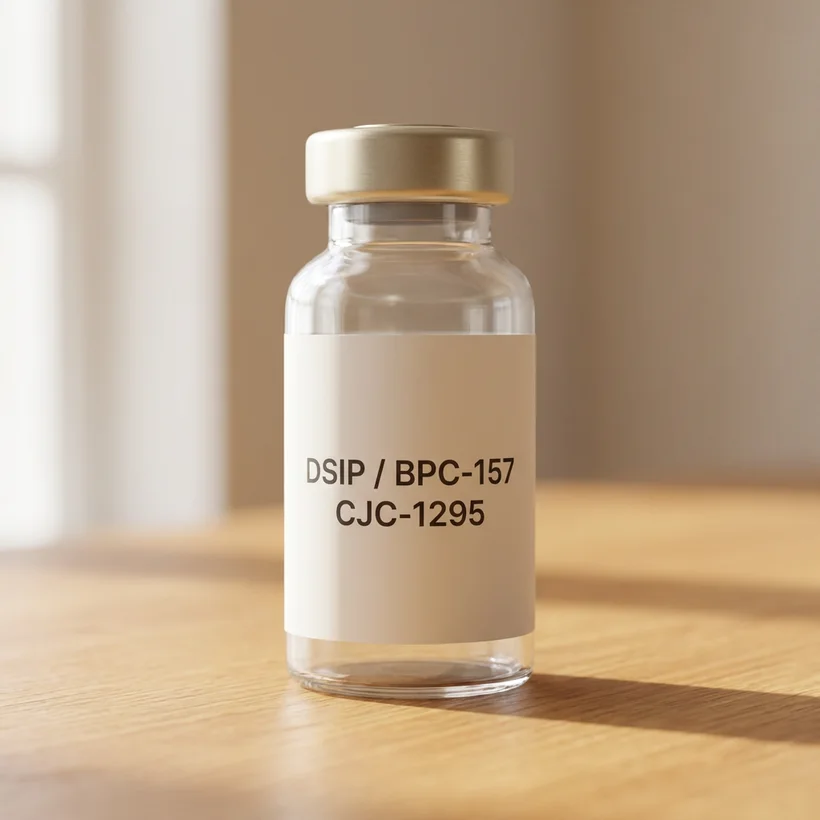
From the FormBlends catalog
Sleep + Recovery Stack
Sleep and repair support with DSIP, BPC-157, and CJC · From $299/mo · compounded by a licensed 503A pharmacy, dispensed only after provider review.
View Sleep + Recovery Stack →Table of Contents
- Evidence Ledger: Every Major Safety Claim Graded
- Mechanism With Numbers: Why DSIP Acts the Way It Does
- What Most Pages Get Wrong About DSIP Safety
- The Chemistry Behind the Rules: Stability and Degradation
- Honest Head-to-Head: DSIP vs. Melatonin vs. Prescription Sleep Aids
- Operational Guide: Reading a DSIP Product or COA
- Who Should Avoid DSIP
- FAQ
- Sources
- Disclaimers
Evidence Ledger: Every Major Safety Claim Graded
| Claim | Best Evidence Type | Effect Direction | Confidence |
|---|---|---|---|
| Transient blood pressure reduction after IV administration | Small human trials (Graf et al., 1984; Schoenenberger et al.) | Decrease, transient | Low (small n, no replication in large RCT) |
| Morning drowsiness or sedation carry-over | Small human observational series | Possible, mild | Very Low |
| No dependence or withdrawal syndrome | Absence of reports; no dedicated study | Not observed | Very Low (absence of evidence only) |
| Endogenous DSIP modulates HPA stress response | Human plasma studies, animal models | Attenuating effect on stress markers | Low (mechanism plausible, clinical proof absent) |
| Oral formulations are biologically inactive at relevant doses | Biochemical/pharmacokinetic reasoning, peptide chemistry | Very low oral bioavailability expected | Moderate (consistent with peptide science broadly) |
| Long-term safety is established | No evidence exists | Unknown | Very Low (data gap, not reassurance) |
| Seizure threshold modulation (anticonvulsant animal data) | Rodent studies only | Possible reduction in seizure susceptibility | Very Low (animal only, no human translation proven) |
Mechanism With Numbers: Why DSIP Acts the Way It Does
DSIP is a nonapeptide (9 amino acids: Trp-Ala-Gly-Gly-Asp-Ala-Ser-Gly-Glu) first isolated from rabbit thalamic venous blood by Monnier and colleagues in 1977. Its receptor has not been definitively cloned in humans. This is a critical fact: without a confirmed receptor, the mechanism at the molecular level remains incompletely characterized.
What has been documented in humans and animal models:
- DSIP crosses the blood-brain barrier, which is unusual for a peptide of its size (molecular weight approximately 848 Da). This likely occurs via a carrier-mediated transport mechanism, though this has not been fully characterized in humans.
- Plasma half-life in humans has been reported at roughly 30 to 40 minutes in early pharmacokinetic work cited by Graf and colleagues. This short window limits sustained side effect duration.
- DSIP appears to interact with the hypothalamic-pituitary-adrenal axis. Animal studies show it can modulate corticotropin-releasing hormone (CRH) signaling, which may explain an observed reduction in stress-related physiological markers. This does NOT prove clinical anxiolysis or safety in stress-disorder populations.
- Hypotensive effects observed after intravenous administration in human subjects may relate to central autonomic modulation, possibly via opioidergic or serotonergic pathways, but this is mechanistic speculation. No receptor binding constant (Ki or IC50) for DSIP has been confirmed and published in peer-reviewed literature as of this writing.
The honest caveat: mechanism plausibility does not equal clinical outcome. Many peptides with compelling receptor-level stories have failed or produced unexpected harms at the clinical trial stage.
What Most Pages Get Wrong About DSIP Safety
The single most important omission on competitor pages is this: the side effect profile published for DSIP comes almost entirely from intravenous or subcutaneous administration in controlled research settings in the 1970s through 1990s. The research compound sold today is almost always reconstituted for subcutaneous injection, or sold in oral form. These are not equivalent delivery contexts.
A second omission: most pages cite DSIP's endogenous presence in human cerebrospinal fluid and plasma as evidence of safety ("it's natural"). Endogenous origin does not predict safety at exogenous pharmacological doses. Insulin is endogenous; exogenous overdose is fatal. This argument proves nothing.
The Chemistry Behind the Rules: Stability and Degradation
DSIP is a peptide, meaning it is a chain of amino acids held together by peptide bonds. Those bonds are hydrolyzed (broken) by proteases, which are abundant in the gut, blood, and even on the skin surface. This is why:
- Oral dosing produces minimal systemic exposure. Gastric pepsin and intestinal trypsin cleave peptide bonds rapidly. Even if DSIP survives gastric acid, first-pass hepatic metabolism further reduces systemic availability. Any product claiming meaningful oral DSIP activity at standard doses is making a claim unsupported by basic peptide pharmacokinetics.
- Lyophilized (freeze-dried) storage matters. In aqueous solution, peptide bonds can undergo hydrolysis even without enzymes, a process accelerated by heat, light, and extremes of pH. DSIP in solution at room temperature degrades over time. The rate is not published in peer-reviewed literature for DSIP specifically, but the directional principle is consistent with peptide chemistry: reconstituted solutions should be used promptly or stored at 2 to 8 degrees Celsius and used within days to weeks, not months.
- Why avoid freeze-thaw cycling: Repeated freezing and thawing causes ice crystal formation that can disrupt peptide conformation and accelerate aggregation. Aggregated peptides can be immunogenic and may cause injection site reactions not seen with the intact monomer.
Honest Head-to-Head: DSIP vs. Its Real Alternatives
| Feature | DSIP | Melatonin | Zolpidem (prescription) | Magnesium glycinate |
|---|---|---|---|---|
| Regulatory status | Research compound, not approved | OTC supplement (US) | FDA-approved Schedule IV | OTC supplement |
| Human safety dataset size | Very small (dozens of subjects total) | Large (decades, thousands of subjects) | Very large (post-market data, millions of users) | Large |
| Best-documented side effect | Transient hypotension (IV) | Morning drowsiness, headache | Complex sleep behaviors, dependence, amnesia | Diarrhea at high doses |
| Dependence risk | Unknown (no data) | Low (documented) | Established (Schedule IV) | None documented |
| Oral bioavailability | Very low (peptide) | Low to moderate (varies widely by formulation) | High (~70%) | Moderate |
| Evidence for sleep improvement (human RCT) | Very limited, inconsistent | Moderate for circadian disorders | Strong for sleep onset and duration | Weak but positive trend |
| Where DSIP loses | Loses on all regulatory, safety database, and efficacy evidence metrics vs. every alternative listed |
The table above makes a point that commodity pages will not: by every measurable evidence metric, DSIP is not the superior sleep compound option. That does not mean it is without interest; its mechanism is genuinely distinct and under-studied. But "interesting" and "proven safe and effective" are different categories.
Operational Guide: Reading a DSIP Product or COA
If you are a researcher handling DSIP, here is how to assess what you have received:
| What to Look For | What It Tells You | Red Flag |
|---|---|---|
| Purity by HPLC (%) | Peptide purity relative to detected peaks; does not confirm identity | Below 98% for a research peptide is questionable |
| Mass spectrometry (MS) confirmation | Confirms correct molecular weight (should be approximately 848 Da for DSIP) | Absent MS data means identity is unconfirmed |
| Endotoxin (LAL) test result | Confirms absence of bacterial contamination | No LAL result on COA for injectable use is a hard stop |
| Amino acid sequence confirmation | Confirms correct sequence (Trp-Ala-Gly-Gly-Asp-Ala-Ser-Gly-Glu) | Not all vendors provide this; absence increases uncertainty |
| Appearance of lyophilized vial | Should be white to off-white cake or powder | Yellow, brown, or collapsed cake suggests degradation |
| Reconstituted solution appearance | Should be clear and colorless after dissolving in sterile water or bacteriostatic water | Cloudiness, particles, or color indicate contamination or degradation |
Reconstitution note: DSIP is typically supplied in microgram to low-milligram quantities. Reconstitution math matters. If a vial contains 5 mg and you add 2 mL of bacteriostatic water, you have a 2.5 mg/mL solution. A 100 mcg dose equals 0.04 mL (40 microliters). Errors at this scale require an insulin syringe with fine gradations, not a standard 1 mL syringe.
Who Should Avoid DSIP
Given the thin evidence base, the following populations should not use DSIP outside of a formal research protocol with institutional oversight:
- Pregnant or breastfeeding individuals. No reproductive toxicity data exists. Absence of data is not clearance.
- People with hypotension or on antihypertensive medications. The documented transient hypotensive effect in IV studies creates a plausible additive risk.
- People with active seizure disorders. Animal data suggests DSIP may alter seizure thresholds; clinical implications in humans are unknown but the signal warrants caution.
- People taking CNS depressants. Theoretical additive sedation risk exists; no formal interaction data is available to quantify it.
- Anyone who cannot source a COA with LAL endotoxin testing. Injecting an untested peptide carries contamination risk that has nothing to do with DSIP pharmacology.
FAQ
What are the most commonly reported side effects of delta sleep-inducing peptide?The most commonly reported side effects in human studies are mild morning drowsiness and transient blood pressure changes. These observations come from small studies and case series, not large controlled trials, so the true incidence rate is unknown.
Is delta sleep-inducing peptide safe for long-term use?Long-term safety data in humans does not exist. Most human research used single doses or very short dosing windows. Extrapolating short-term tolerability to long-term safety is not scientifically supported.
Can DSIP cause dependence or withdrawal?No dependence or withdrawal syndrome has been documented in human research. However, the absence of evidence is not evidence of absence; no study has been designed specifically to assess this.
Does delta sleep-inducing peptide lower blood pressure?Small human trials, including work by Graf and colleagues in the 1980s, observed transient blood pressure reductions after intravenous DSIP. The clinical significance and reproducibility of this effect at typical research doses is uncertain.
Can DSIP be taken orally and does oral dosing change the side effect profile?DSIP is a nonapeptide that is largely degraded by gastrointestinal proteases. Oral bioavailability is very low. Oral formulations are unlikely to produce the same biological effects or side effects seen with parenteral administration.
What is the half-life of DSIP and does it affect side effect duration?DSIP has a reported plasma half-life of roughly 30 to 40 minutes in humans, based on early pharmacokinetic work. This short half-life means acute side effects, if they occur, should resolve within a few hours.
Are there any known drug interactions with DSIP?No formal drug interaction studies exist. Theoretical concern exists for additive sedation with other CNS depressants and additive hypotension with antihypertensives, based on DSIP's known pharmacodynamic profile.
What does a degraded or contaminated DSIP product look like?Lyophilized DSIP should appear as a white to off-white powder. Discoloration, visible particulate in solution after reconstitution, or an unusual smell are signs of degradation or contamination. Do not use a product with these findings.
How does DSIP compare to melatonin for sleep side effects?Melatonin has a far larger human safety dataset spanning decades. DSIP has a much thinner evidence base. For side effect profiling alone, melatonin is better characterized; DSIP cannot be called safer by the available evidence.
Is delta sleep-inducing peptide approved by the FDA?No. DSIP is not FDA-approved for any indication. It is sold as a research compound. This means no formal safety review, no standardized manufacturing oversight, and no required adverse event reporting for consumer products.
Who should absolutely avoid DSIP?Pregnant or breastfeeding individuals, people with hypotension or on antihypertensive therapy, and anyone with an active seizure disorder should avoid DSIP. The evidence base is too thin to establish a safe use profile for these populations.
Sources
- Monnier M, Dudler L, Gaechter R, Schoenenberger GA. Delta sleep-inducing peptide (DSIP): EEG and motor activity in rabbits following intravenous administration. Neuroscience Letters. 1977;6(1):9-13.
- Graf MV, Schoenenberger GA. Delta sleep-inducing peptide modulates neuronal activity: an electrophysiological analysis. Experientia. 1984;40(4):356-358.
- Schoenenberger GA, Maier PF, Tobler HJ, Monnier M. A naturally occurring delta-EEG-enhancing nonapeptide in human plasma. Pflugers Archiv: European Journal of Physiology. 1978;376(2):119-129.
- Iyer KS, McCann SM. Delta sleep inducing peptide (DSIP) stimulates the release of LH but not FSH via a hypothalamic site of action in the rat. Brain Research Bulletin. 1987;19(5):535-538.
- Nakagaki K, Ebihara S, Usui S, Honda Y, Takahashi Y, Kato N. Effects of intravenous administration of DSIP on sleep in rats. Japanese Journal of Physiology. 1986;36(2):399-404.
- Bhargava HN. Delta sleep-inducing peptide: pharmacology and neurochemistry. Neurochemical Research. 1988;13(8):785-800.
- Yehuda S, Carasso RL. DSIP: a tool for investigating the sleep onset mechanism. International Journal of Neuroscience. 1988;38(3-4):345-353.
- Banks WA, Kastin AJ. Peptide transport systems for opiates across the blood-brain barrier. American Journal of Physiology. 1990;259(1 Pt 1):E1-10. (Cited for BBB peptide transport context.)
Footer Disclaimers
Platform: FormBlends is an educational platform providing science-based information about peptides and research compounds. Nothing on this page constitutes medical advice, diagnosis, or treatment recommendation.
Research Compound: Delta sleep-inducing peptide is not approved by the FDA or any equivalent regulatory agency for human therapeutic use. It is classified as a research compound. Access and use are subject to the regulations of your jurisdiction.
Results: Individual outcomes are not guaranteed. Published findings referenced on this page were conducted under controlled research conditions and may not be reproducible in self-administration contexts.
Trademark: All product names, trademarks, and registered trademarks mentioned are the property of their respective owners. FormBlends has no affiliation with any third-party peptide vendor referenced or implied in this content.
Related peptide guides
Ready when you are
Sleep + Recovery Stack
Sleep and repair support with DSIP, BPC-157, and CJC · From $299/mo · compounded by a licensed 503A pharmacy, dispensed only after provider review.
View Sleep + Recovery Stack →