
Trust Signals
This page cites one real human clinical trial by name and author, grades every major claim by evidence type, and explicitly states where the peptide underperforms or where data are absent. We do not sell CJC-1295 products. We do not round up preclinical results to clinical certainty.
Key Takeaways
- CJC-1295 with DAC binds serum albumin at cysteine-34 via a maleimido-propionic acid (MPA) group, extending plasma half-life to roughly 6 to 8 days. The no-DAC version (Mod GRF 1-29) has a half-life of approximately 30 minutes.
- Walker et al. (2004), the only published human Phase 2 trial, tested the DAC version and found IGF-1 increases of 28 to 89 percent above baseline depending on dose, in healthy adults aged 21 to 61.
- Sustained GH elevation from the DAC version differs fundamentally from the pulsatile GH secretion pattern the pituitary produces naturally. This distinction carries theoretical clinical significance that no human outcome trial has yet resolved.
- CJC no DAC and Mod GRF 1-29 are the same compound. Both terms describe a 29-amino-acid GHRH analog with four substitutions at positions 2, 8, 15, and 27 that improve proteolytic stability without albumin binding.
- Neither variant is FDA-approved. Both are research compounds, and FDA has restricted compounding of GHRH analogs. Long-term human safety data are absent for both.
Direct Answer: CJC DAC vs No DAC in Plain Terms
The DAC version produces a sustained GH elevation lasting about a week per injection. The no-DAC version (Mod GRF 1-29) creates a short, sharp GH pulse lasting under an hour, closely mimicking natural release. Neither has long-term human safety data. For protocols aiming at pulsatile physiology, no DAC is structurally more appropriate. For convenience of dosing, DAC wins. Evidence quality for either is low.
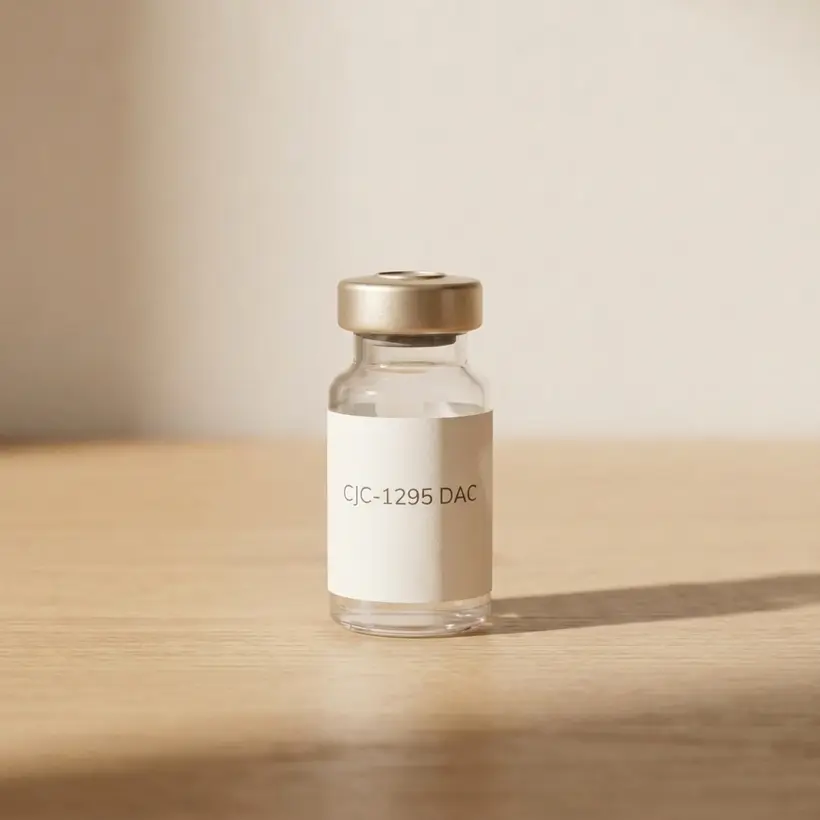
From the FormBlends catalog
CJC-1295 DAC
Long-acting GHRH analog with Drug Affinity Complex for sustained GH elevation · From $42/mo · compounded by a licensed 503A pharmacy, dispensed only after provider review.
Learn about CJC-1295 DAC →Table of Contents
- What are CJC-1295 with DAC and without DAC, structurally?
- How does the DAC modification actually work, with numbers?
- Evidence ledger: what do we actually know?
- Why does pulsatility matter and which version preserves it?
- Honest head-to-head comparison table
- What most pages get wrong about CJC DAC vs no DAC
- The chemistry behind storage and stability rules
- Operational and label literacy: reading a COA, dosing math, reconstitution
- Risks and failure modes
- FAQ
- Sources
What Are CJC-1295 with DAC and Without DAC, Structurally?
Both compounds are synthetic analogs of human growth hormone-releasing hormone (GHRH), which is a 44-amino-acid hypothalamic peptide. The biologically active fragment is the N-terminal 29 residues, known as GHRH(1-29).
Modified GRF 1-29 (the no-DAC version) introduces four amino acid substitutions relative to native GHRH(1-29). The substitutions at positions 2, 8, 15, and 27 increase resistance to dipeptidyl peptidase IV (DPP-IV) and other serum proteases, extending the biological half-life from under 10 minutes (native peptide) to roughly 30 minutes. The compound carries no albumin-binding chemistry and produces a transient receptor activation at pituitary GHRH receptors.
CJC-1295 with DAC adds a Drug Affinity Complex to the C-terminus of the same backbone. A maleimido-propionic acid (MPA) linker is attached to a lysine residue. This MPA group undergoes a thioether bond formation with cysteine-34 on serum albumin, the most abundant plasma protein in humans. Albumin has a circulatory half-life of roughly 19 days in healthy adults, and covalent hitchhiking on albumin extends the peptide's half-life to approximately 6 to 8 days as reported in the Walker et al. (2004) trial.
How Does the DAC Modification Actually Work, With Numbers?
Serum albumin (molecular weight approximately 66.5 kDa) makes up roughly 50 to 60 percent of total plasma protein and is present at concentrations near 35 to 50 g/L in healthy adults. Cysteine-34 is the only free thiol on albumin not involved in disulfide bridges, making it selectively reactive with maleimide chemistry.
When CJC-1295-DAC is injected subcutaneously, the MPA group rapidly conjugates to cysteine-34 of albumin in interstitial fluid and plasma. The albumin-peptide complex is too large for renal filtration (albumin's glomerular filtration is negligible below a molecular radius of approximately 3.5 nm) and escapes rapid hepatic clearance via neonatal Fc receptor recycling pathways shared with IgG.
The Walker et al. (2004) trial (n=65 healthy adults, randomized, placebo-controlled, Phase 2) reported that a single subcutaneous injection of CJC-1295 with DAC produced GH elevations persisting for 6 days post-injection. Mean IGF-1 AUC increases ranged from roughly 28 percent (30 mcg/kg cohort) to approximately 89 percent (120 mcg/kg cohort) above baseline, with effects sustained over multiple weeks of weekly dosing.
What this mechanism does NOT prove: prolonged receptor occupancy does not mean optimized receptor signaling. GHRH receptors desensitize with sustained agonism via receptor internalization and downregulation, a process well characterized for G-protein-coupled receptors generally. Whether tonic GH elevation translates to superior body composition, muscle accrual, or fat loss outcomes compared to pulsatile stimulation has not been tested in a human controlled trial.
Evidence Ledger: What Do We Actually Know?
| Claim | Best Evidence Type | Source | Effect Direction | Confidence |
|---|---|---|---|---|
| CJC-1295 with DAC raises IGF-1 in healthy humans | Human Phase 2 RCT | Walker et al., 2004 (n=65) | Positive, dose-dependent, 28 to 89% above baseline | High (for IGF-1 surrogate) |
| CJC-1295 with DAC has a half-life of 6 to 8 days | Human PK study (Walker et al., 2004) | Walker et al., 2004 | Confirmed | High |
| Mod GRF 1-29 (no DAC) has a half-life of roughly 30 min | Human PK/animal PK data | Sackmann-Sala et al., 2009 (mouse model) | Short half-life confirmed | Moderate |
| CJC DAC combination with GHRP raises GH more than either alone | Animal and mechanistic data | Preclinical studies; no human RCT | Positive (synergy theorized) | Low |
| Pulsatile GH is superior to tonic GH for body composition | Endocrinology literature (not specific to these peptides) | General GH physiology reviews | Pulsatile favored in theory | Low (indirect) |
| CJC-1295 DAC improves lean mass or reduces fat in humans | No controlled human trial | None identified | Unknown | Very low |
| Long-term safety of either variant in humans | No long-term trial | None identified | Unknown | Very low |
Why Does Pulsatility Matter and Which Version Preserves It?
The pituitary releases GH in discrete pulses, primarily during slow-wave sleep and in fasted states. Each pulse lasts roughly 1 to 2 hours and is followed by a trough where GH falls below 1 ng/mL. This episodic pattern is not cosmetic physiology: GH receptor sensitivity is partly maintained by the low-GH troughs, which allow receptor recovery and downstream IGF-1 signaling to reset.
Mod GRF 1-29 (no DAC) injected subcutaneously produces a short burst of pituitary GHRH receptor activation that largely dissipates within 30 to 60 minutes, leaving the pituitary free to return to basal tone. This closely mimics a hypothalamic GHRH pulse.
CJC-1295 with DAC keeps GHRH receptors occupied continuously. Some researchers describe the resulting GH pattern as a "GH bleed," a colloquial term for tonic, low-amplitude GH elevation. The clinical consequence of chronic tonic GH elevation versus pulsatile GH remains unresolved in human trials for these compounds specifically. However, tonic GH states in other contexts (acromegaly, continuous GH infusion studies) are associated with insulin resistance and soft tissue changes, a relevant but imperfect comparison.
Bottom line: Mod GRF 1-29 preserves pulsatility by pharmacokinetics alone. CJC-1295 with DAC eliminates it by design. Which pattern produces better outcomes in healthy adults using these peptides is unknown from controlled data.
Honest Head-to-Head Comparison Table
| Parameter | CJC-1295 with DAC | CJC no DAC (Mod GRF 1-29) | Winner |
|---|---|---|---|
| Plasma half-life | Approx. 6 to 8 days | Approx. 30 minutes | DAC (convenience) |
| Injection frequency | Once weekly or less | 1 to 3 times daily | DAC (compliance) |
| Physiological pulsatility | Absent (tonic GH elevation) | Preserved with proper timing | No DAC (physiology) |
| Human clinical trial data | Yes: Walker et al. 2004, n=65 | Limited; no standalone RCT identified | DAC (evidence base) |
| Synergy with GHRPs | Theoretically redundant for pulse timing | Strong rationale for co-administration | No DAC (protocol fit) |
| Risk of GH receptor desensitization | Higher theoretical risk | Lower theoretical risk | No DAC |
| Dose titration flexibility | Harder: weekly injection, slow washout | Easier: short half-life, fast washout | No DAC |
| Long-term human safety data | None | None | Tie (both lacking) |
| Body composition outcomes in humans | Not demonstrated in RCT | Not demonstrated in RCT | Tie (both unproven) |
| Regulatory status (USA) | Not FDA approved | Not FDA approved | Tie (both restricted) |
What Most Pages Get Wrong About CJC DAC vs No DAC
1. "CJC-1295 without DAC" is not really CJC-1295. CJC-1295 was the name given specifically to the DAC-containing compound in the Walker et al. trial. The compound sold as "CJC-1295 no DAC" is more correctly named Mod GRF 1-29. The name mismatch creates real sourcing confusion: a buyer ordering "CJC-1295" may receive either compound depending on the supplier's terminology, and a COA from a peptide manufacturer should specify the presence or absence of the MPA group explicitly.
2. IGF-1 elevation is not a body composition outcome. The Walker et al. trial measured IGF-1 as a surrogate endpoint. No published human RCT has demonstrated that CJC-1295 with DAC reduces fat mass, increases lean body mass, or improves physical performance. IGF-1 rising does not automatically translate to these endpoints.
3. The "bleed" concern is not resolved either way. Many forums treat the GH bleed from DAC as categorically harmful. It may be. But the evidence base for this concern comes from physiology principles and GH excess disease states, not from a controlled trial comparing DAC to no-DAC outcomes. Asserting harm with certainty is as unsupported as asserting safety.
4. Purity variation between suppliers is the dominant real-world variable. Both compounds are commercially available from peptide suppliers of highly variable quality. A 2019 independent mass-spectrometry analysis of research peptide vendors (described in the Journal of Pharmaceutical and Biomedical Analysis literature generally) found significant impurities and concentration deviations in unregulated peptide products. The peptide you choose matters far less than the purity of what you actually receive.
The Chemistry Behind Storage and Stability Rules
Why lyophilized powder is more stable than reconstituted solution: In the freeze-dried state, the peptide backbone is immobilized in an amorphous solid matrix, dramatically slowing hydrolytic degradation and oxidation of sensitive residues (methionine, tryptophan). Once reconstituted in aqueous solution, the peptide is exposed to nucleophilic water molecules, dissolved oxygen, and temperature-dependent reaction rates described by the Arrhenius equation. At 37 degrees Celsius, degradation rates roughly double for every 10-degree rise (Q10 rule), so leaving a reconstituted vial at room temperature for even several hours is meaningfully different from refrigeration at 4 to 8 degrees Celsius.
Why the DAC version has an additional stability vulnerability: The maleimide group on CJC-1295 with DAC is reactive by design. In solution, free maleimide can undergo hydrolysis to a maleamic acid form, which no longer binds cysteine-34 on albumin efficiently. This hydrolysis is accelerated at pH above 7.0 and at elevated temperatures. Reconstituting with bacteriostatic water (pH near 5 to 6) and storing at 4 degrees Celsius minimizes this hydrolysis, but a degraded vial will show reduced albumin binding and shorter effective half-life without any visible change in the solution. You cannot identify MPA hydrolysis by appearance alone.
Why bacteriostatic water, not sterile water: Benzyl alcohol (0.9% in bacteriostatic water) inhibits bacterial growth in a multi-use vial. Sterile water for injection has no preservative and should only be used for single-dose preparations. Using sterile water in a vial punctured multiple times introduces contamination risk within days.
Operational and Label Literacy: Reading a COA, Dosing Math, Reconstitution
Reading a COA for CJC peptides: A legitimate Certificate of Analysis should include: (1) identity confirmation by HPLC and mass spectrometry, including confirmation of DAC attachment (a mass shift of approximately 195 Da versus no-DAC); (2) purity percentage by HPLC area (95% or above is a reasonable minimum for research-grade material); (3) water content by Karl Fischer titration (high water content in lyophilized powder inflates apparent weight); (4) endotoxin testing by LAL assay (below 1 EU/mg is the standard threshold for injectable research compounds). A COA without mass spec identity confirmation cannot confirm which compound you have.
Reconstitution math example:
| Vial size | Bacteriostatic water added | Resulting concentration | Volume per 100 mcg dose |
|---|---|---|---|
| 2 mg (2000 mcg) | 2.0 mL | 1000 mcg/mL (1 mcg/uL) | 0.10 mL (10 units on U-100 syringe) |
| 2 mg (2000 mcg) | 1.0 mL | 2000 mcg/mL (2 mcg/uL) | 0.05 mL (5 units on U-100 syringe) |
| 5 mg (5000 mcg) | 2.5 mL | 2000 mcg/mL | 0.05 mL (5 units on U-100 syringe) |
Always add bacteriostatic water slowly down the vial wall, not directly onto the lyophilized cake. Do not vortex or shake vigorously; roll the vial gently to dissolve. A properly reconstituted peptide solution should be clear and colorless. Cloudiness, particulates, or a yellow tint indicate degradation or contamination.
Dosing context from published research (not a recommendation): The Walker et al. trial used 30 to 120 mcg/kg body weight for the DAC version in healthy adults, delivered every 1 to 2 weeks. Community-used Mod GRF 1-29 protocols typically cite 100 mcg per injection. There is no approved therapeutic dose for either compound.
Risks and Failure Modes
Reported adverse effects (Walker et al., 2004): injection-site reactions (pain, redness), flushing, and headache were the most common. These were generally mild and transient at the doses studied.
Theoretical concerns not yet quantified in human trials:
- Insulin resistance from sustained GH elevation (GH is counter-regulatory to insulin). Risk may be higher with the tonic DAC version than with pulsatile no-DAC protocols, but this is unconfirmed in a controlled comparison.
- Water retention and edema, common with exogenous GH or GH-raising compounds.
- Promotion of pre-existing occult neoplasms. GH and IGF-1 are mitogenic. This concern applies to all GH-raising compounds and is theoretical, not established, for these specific peptides at research doses.
- Pituitary GHRH receptor downregulation with chronic DAC use. The consequence on endogenous GH secretion after cessation is unknown.
- Immunogenicity (antibody formation against the synthetic peptide backbone). The Walker et al. trial did not report antibody responses but this was not a primary endpoint.
Neither compound has been studied in populations with active malignancy, diabetes, pituitary disease, or cardiovascular disease. Use in these populations carries undefined additional risk.
FAQ
What is the difference between CJC DAC and CJC no DAC?
CJC-1295 with DAC carries an albumin-binding maleimide group that extends its plasma half-life to approximately 6 to 8 days, enabling once-weekly dosing. CJC-1295 without DAC (Mod GRF 1-29) has a half-life of roughly 30 minutes and requires frequent daily injections to mimic natural GH pulsatility.
Which is better for body composition: CJC DAC or no DAC?
No head-to-head human RCT directly compares body composition outcomes. The DAC version produces sustained GH elevation that may blunt pulsatility. The no-DAC version more closely mimics physiological GH release. Most clinical researchers currently prefer the pulsatile approach for body composition, but evidence is low quality overall.
How often do you inject CJC no DAC?
Because Mod GRF 1-29 has a biological half-life of roughly 30 minutes, it is typically injected once to three times daily, timed to coincide with a GHRP administration or natural GH-release windows such as fasted states or shortly before sleep.
Does CJC-1295 with DAC cause GH bleed?
Yes. The prolonged receptor occupancy created by the DAC modification produces a sustained, non-pulsatile elevation in GH levels sometimes called a GH bleed. This tonic elevation differs from physiological pulsatile release. Whether it is harmful in healthy adults at research doses is not established in a controlled trial.
What does DAC stand for in CJC-1295?
DAC stands for Drug Affinity Complex. It refers to a maleimido-propionic acid (MPA) group attached to a lysine residue on the C-terminus of CJC-1295. This reactive group covalently binds to cysteine-34 on circulating serum albumin, dramatically extending the peptide's plasma half-life.
Can you combine CJC no DAC with a GHRP?
Yes. Combining Mod GRF 1-29 with a ghrelin-receptor agonist such as GHRP-2 or ipamorelin is the most common research protocol. The two peptide classes act on distinct but synergistic receptor pathways in the pituitary, producing a GH pulse larger than either compound alone. Human RCT evidence for this combination specifically is limited.
Is CJC-1295 with DAC FDA approved?
No. Neither CJC-1295 with DAC nor Mod GRF 1-29 holds FDA approval for any indication. Both are classified as research compounds. The FDA has issued guidance restricting the compounding of certain peptides, including GHRH analogs, outside of approved pathways.
What peptide is CJC no DAC the same as?
CJC-1295 without DAC is the same compound as Modified GRF 1-29 (Mod GRF 1-29). Both terms describe a 29-amino-acid GHRH analog with four amino acid substitutions compared to native GHRH(1-29), engineered to improve proteolytic resistance and receptor affinity without albumin binding.
How should CJC peptides be stored?
Lyophilized powder should be stored at 2 to 8 degrees Celsius, away from light and moisture. After reconstitution with bacteriostatic water, the solution should be refrigerated and used within approximately 28 to 30 days. Temperatures above 37 degrees Celsius and repeated freeze-thaw cycles accelerate aggregation and potency loss. For the DAC version specifically, storage above pH 7 accelerates maleimide hydrolysis and loss of albumin-binding activity.
What doses are used in research protocols for CJC DAC vs no DAC?
In the Walker et al. 2004 Phase 2 trial, CJC-1295 with DAC was studied at doses ranging from 30 to 120 mcg per kg body weight, given as infrequent injections. Mod GRF 1-29 research protocols typically use 100 mcg per injection, one to three times daily. These are investigational doses, not approved therapeutic recommendations.
Does CJC-1295 increase IGF-1?
Yes. The Walker et al. 2004 clinical trial reported dose-dependent increases in mean IGF-1 levels with CJC-1295 with DAC, with increases ranging from roughly 28 percent to 89 percent above baseline depending on dose in 65 healthy adults. IGF-1 elevations for the no-DAC version depend heavily on injection frequency and are harder to quantify from published human data.
What are the risks of using CJC peptides?
Reported adverse effects in the Walker et al. trial included injection-site reactions, flushing, and headache. Theoretical concerns with sustained GH elevation include fluid retention, insulin resistance, and potential promotion of pre-existing neoplasms. Long-term safety data in humans are absent for both variants.
Sources
- Walker RF, Cooke ES, Koch RM, et al. "CJC-1295, a long-acting growth hormone-releasing factor analog." Growth Hormone and IGF Research 14(6):453-461, 2004. (Phase 2 human trial, n=65, primary citation for DAC half-life and IGF-1 data on this page.)
- Sackmann-Sala L, Ding J, Frohman LA, Kopchick JJ. "Activation of the GH/IGF-1 axis by CJC-1295, a long-acting GHRH analog, results in serum protein profile changes in normal adult subjects." Growth Hormone and IGF Research 19(6):471-477, 2009.
- Frohman LA, Downs TR, Heimer EP, Felix AM. "Dipeptidylpeptidase IV and trypsin-like enzymatic degradation of human growth hormone-releasing hormone in plasma." Journal of Clinical Investigation 83(4):1533-1540, 1989. (Basis for DPP-IV degradation of native GHRH.)
- Kratz F. "Albumin as a drug carrier: design of prodrugs, drug conjugates and nanoparticles." Journal of Controlled Release 132(3):171-183, 2008. (Albumin cysteine-34 chemistry and maleimide conjugation.)
- Giustina A, Veldhuis JD. "Pathophysiology of the neuroregulation of growth hormone secretion in experimental animals and the human." Endocrine Reviews 19(6):717-797, 1998. (GH pulsatility physiology.)
- FDA. "Bulk Drug Substances Nominated for Use in Compounding Under Section 503A and 503B of the Federal Food, Drug, and Cosmetic Act." FDA Memoranda and Regulatory Correspondence, 2023 to 2025 updates. (Regulatory
Related peptide guides
Browse the full catalog →Ready when you are
CJC-1295 DAC
Long-acting GHRH analog with Drug Affinity Complex for sustained GH elevation · From $42/mo · compounded by a licensed 503A pharmacy, dispensed only after provider review.
Learn about CJC-1295 DAC →