
Trust Signals
Key Takeaways
- Thymosin beta 4 is a 43-amino-acid endogenous protein (approximately 4,964 Da). TB-500 is a synthetic 7-amino-acid fragment of that protein (residues 17 to 23, approximately 843 Da). They are not the same molecule.
- Both work primarily through G-actin sequestration, but TB-500 represents only the actin-binding subdomain. Downstream effects on cell migration and inflammation are similar in preclinical models, but equivalence in humans is unproven.
- The only human clinical trials involve thymosin beta 4 itself (RegeneRx's RGN-352 for cardiac repair, RGN-259 for ocular surface disease). TB-500 has no published human RCT data.
- WADA bans both thymosin beta 4 and related fragments including TB-500 under S2 of the Prohibited List. Any athlete in a tested sport faces disqualification risk.
- Lyophilized purity (HPLC above 98%) and mass spectrometry identity confirmation are the minimum COA standards for either compound. Products lacking MS data cannot confirm you are getting the labeled sequence.
Direct Answer: Thymosin Beta 4 vs TB-500
Thymosin beta-4 and TB-500 are related but distinct molecules. TB-500 is a synthetic fragment of thymosin beta-4 covering only the 7-amino-acid actin-binding domain. They share a core mechanism but differ in size, cost, regulatory status, and evidence depth. Neither is FDA approved. For research use, the distinction matters clinically and legally.
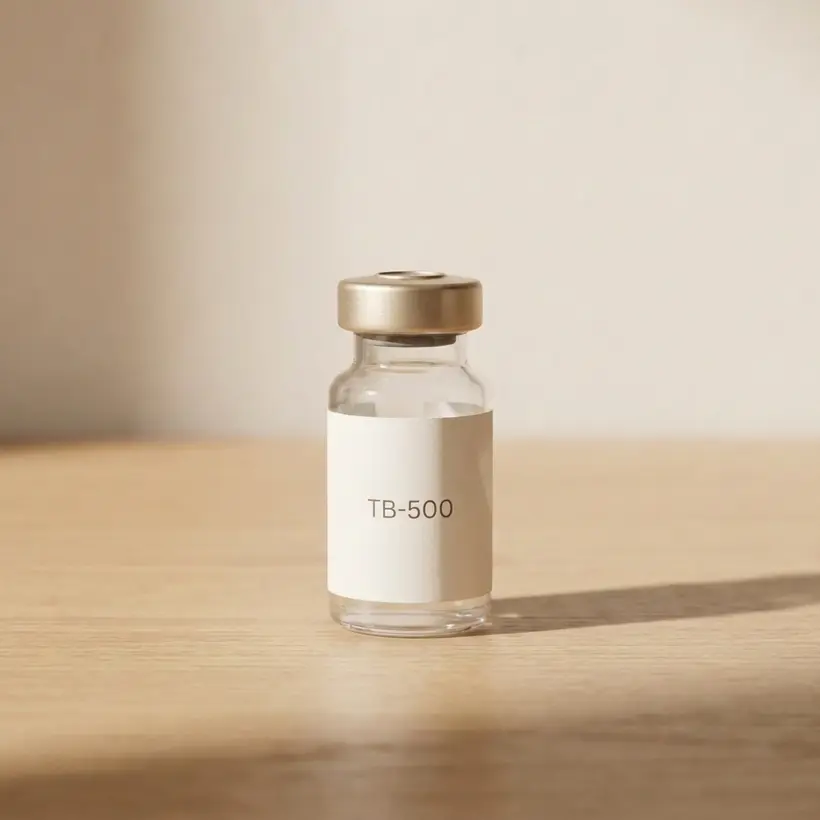
From the FormBlends catalog
TB-500 (Thymosin Beta-4)
Universal repair peptide for tissue regeneration · From $49/mo · compounded by a licensed 503A pharmacy, dispensed only after provider review.
Learn about TB-500 (Thymosin Beta-4) →Table of Contents
- Molecular Identity: What Each Compound Actually Is
- Mechanism With Numbers: How Actin Sequestration Works
- Evidence Ledger: Grading Every Major Claim
- What Most Pages Get Wrong
- Honest Head-to-Head Comparison Table
- Stability and Formulation: The Chemistry Behind Storage Rules
- Label and COA Literacy: How to Evaluate a Product
- Dosing Context From Research Settings
- FAQ
- Sources
- Disclaimers
Molecular Identity: What Each Compound Actually Is
Thymosin beta 4 (Tb4) is a naturally occurring, evolutionarily conserved protein present in virtually all nucleated human cells. It is encoded by the TMSB4X gene on the X chromosome. Its full sequence spans 43 amino acids with a molecular weight of approximately 4,964 Da. It is the most abundant member of the beta-thymosin family and is found at particularly high concentrations in platelets and macrophages.
TB-500 is a synthetic peptide designed to replicate the active region of Tb4. Its sequence is LKKTETQ, corresponding to residues 17 through 23 of the full Tb4 protein. Molecular weight is approximately 843 Da. The fragment was identified in research by Goldstein and colleagues as the region responsible for actin-binding and much of the pro-migratory activity. The name "TB-500" originated in equine veterinary use and became shorthand in the research peptide market.
The practical implication: when a vendor sells "TB-500," you are not getting thymosin beta 4. You are getting a short synthetic fragment that shares one domain. Any full-length biological activity of Tb4 not mediated by residues 17 to 23, including some immune-modulatory and cardioprotective signaling, may not be replicated by TB-500 alone.
Mechanism With Numbers: How Actin Sequestration Works
The primary documented mechanism of both compounds involves sequestration of G-actin (globular, monomeric actin). Tb4 binds G-actin with a dissociation constant (Kd) in the low nanomolar range, as established in biochemical studies by Safer, Bhatt, and colleagues using thymosin beta 4 purified from thymus tissue. By holding G-actin monomers in a complex, Tb4 reduces the pool available for polymerization into F-actin filaments. This has downstream effects on cell shape, cytoskeletal dynamics, and migration speed.
Mechanistic consequences that have been studied in cell culture and animal models include:
- Upregulation of integrin-linked kinase (ILK) signaling, which promotes endothelial and stem cell migration
- Attenuation of NF-kB-driven inflammatory gene expression in injured tissue models
- Promotion of angiogenesis via VEGF and HGF pathway effects observed in rodent infarct models
- Acceleration of corneal epithelial cell migration in scratch assay models (the basis for the ocular trial program)
The honest caveat: demonstrating a nanomolar binding constant and a cell migration effect in vitro does not prove that injecting either peptide at a given dose will translate to measurable tissue repair in a human. Pharmacokinetics (how much of the peptide reaches target tissue at therapeutic concentration), immunological clearance, and the complexity of human injury biology all intervene between mechanism and clinical outcome.
Evidence Ledger: Grading Every Major Claim
| Claim | Best Evidence Type | Effect Direction | Confidence |
|---|---|---|---|
| Tb4 sequesters G-actin at nanomolar affinity | In vitro biochemistry (Safer et al., multiple replications) | Established | High |
| Tb4 accelerates corneal wound healing | Phase II human RCT (RGN-259, RegeneRx) | Positive signal in dry eye and neurotrophic keratopathy | Moderate |
| Tb4 reduces cardiac damage post-MI | Rodent models (multiple labs) + Phase I/II human safety trial (RGN-352) | Positive in animals; Phase II underpowered for efficacy | Low (for human efficacy) |
| TB-500 fragment replicates full Tb4 actin-binding activity | In vitro peptide binding studies | Partial replication | Moderate (mechanism only) |
| TB-500 accelerates tendon or muscle repair in humans | No published human RCT | Unknown | Very Low |
| Either compound is safe for repeated human subcutaneous injection | Phase I intravenous data for Tb4 only (RGN-352); no subcutaneous human safety data in peer-reviewed literature | IV Tb4 appeared well tolerated in small trials | Low |
| TB-500 improves soft tissue recovery in horses | Observational veterinary reports, no controlled equine RCT identified | Directionally positive in case reports | Very Low |
What Most Pages Get Wrong
Claim 1: "TB-500 is just another name for thymosin beta 4." False. This conflation is repeated across dozens of forum posts and supplement blogs. The two differ in sequence length by 36 amino acids, in molecular weight by a factor of roughly 6, and in regulatory and pharmacokinetic profile. A product labeled TB-500 will produce a different mass spec fingerprint than full Tb4. If you are trying to replicate the cardiac or immunological research done with full-length Tb4, TB-500 is not a substitute.
Claim 2: "The active fragment does everything the full protein does." This overstates what is known. The LKKTETQ fragment accounts for a large portion of actin-binding activity, but thymosin beta 4 has additional domains involved in interactions with other proteins. Research from Bednarek and colleagues on beta-thymosin structural biology shows the N-terminal region also contributes to some biological functions. Whether those functions are clinically meaningful is unclear, but the claim that TB-500 is functionally identical is not supported by structural biology.
Claim 3: "Subcutaneous injection of research-grade TB-500 is low risk." This imports the safety profile from intravenous pharmaceutical-grade Tb4 trials and applies it to subcutaneous injections of compounded or research-grade TB-500. These are different routes, different purity standards, and different regulatory contexts. Endotoxin contamination from poorly manufactured peptides causes pyrogenic responses regardless of the peptide itself. Sterility failures cause injection site infections. The safety assumption is not warranted from the published data.
Claim 4: "Bioavailability via subcutaneous injection is equivalent to IV." Subcutaneous bioavailability for small peptides can be meaningful but is generally lower and slower than IV, and no published pharmacokinetic study in humans characterizes the subcutaneous absorption, distribution, metabolism, and excretion profile of TB-500 specifically. The assumption of near-complete subcutaneous bioavailability is borrowed from other peptide classes without direct data.
Honest Head-to-Head Comparison Table
| Parameter | Thymosin Beta 4 (Full) | TB-500 (Fragment) | BPC-157 (Comparator) |
|---|---|---|---|
| Molecular weight | ~4,964 Da (43 AA) | ~843 Da (7 AA) | ~1,419 Da (15 AA) |
| Endogenous? | Yes, in human tissue | No (synthetic fragment) | No (derived from gastric protein, not found free) |
| Primary mechanism | G-actin sequestration, ILK, NF-kB | G-actin sequestration (same domain) | NO pathway, GH receptor modulation |
| Best human evidence | Phase II RCT (ocular); Phase I/II cardiac | None published | None published in peer-reviewed RCT |
| Synthesis cost | High (43 AA) | Low (7 AA) | Moderate (15 AA) |
| WADA prohibited? | Yes (S2) | Yes (S2, related substances) | No (as of mid-2026) |
| FDA approved? | No | No | No |
| Where the peptide loses | Cost, limited human efficacy data, no approval | No human data, uncertain equivalence to full Tb4 | Mechanism less defined, no human trials either |
Stability and Formulation: The Chemistry Behind Storage Rules
Lyophilized (freeze-dried) peptide is substantially more stable than peptide in aqueous solution because chemical degradation reactions require water as a reactant or medium. The two primary degradation pathways relevant to Tb4 and TB-500 are:
Oxidation. Methionine residues, if present, are vulnerable to oxidative modification (sulfoxide formation). TB-500's LKKTETQ sequence contains no methionine, which gives it some oxidative stability advantage over sequences containing that residue. Full Tb4 does contain methionine at position 6. Exposure to oxygen, UV light, and elevated temperature accelerates this reaction, which is why intact vials stored cold and away from light preserve activity longer.
Hydrolysis. Peptide bonds hydrolyze in aqueous solution over time, a process accelerated by heat and extremes of pH. Once reconstituted, a peptide solution begins degrading. Refrigeration slows the hydrolysis rate. Bacteriostatic water (containing benzyl alcohol) inhibits microbial growth but does not halt hydrolysis. There is no peer-reviewed stability kinetic study published specifically for TB-500 solutions, so the "use within 4 weeks when refrigerated" guideline common on vendor sites is a reasonable precaution derived from general peptide chemistry, not compound-specific data. A solution showing visible particulate, cloudiness in a previously clear vial, or color change should be discarded.
Why you cannot freeze a reconstituted solution repeatedly. Freeze-thaw cycling causes ice crystal formation that physically disrupts peptide conformation and can denature structure, particularly in larger peptides like full Tb4. Single-use aliquoting after reconstitution is the standard approach to avoid this.
Label and COA Literacy: How to Evaluate a Product
A certificate of analysis (COA) for either compound should contain the following minimum elements. Any vendor unable or unwilling to provide these should be treated with skepticism:
| COA Element | What to Look For | Why It Matters |
|---|---|---|
| HPLC purity | Above 98% for research use | Lower purity means unknown impurities at potentially bioactive levels |
| Mass spectrometry (MS) | Measured MW matches theoretical: TB-500 ~843 Da, Tb4 ~4,964 Da | Confirms you have the labeled sequence, not a different or truncated peptide |
| Endotoxin (LAL test) | Below 1 EU/mg is a common standard | Endotoxin contamination causes fever and systemic inflammation independent of the peptide |
| Sterility | Passed USP sterility test for injectable grade | Injection of non-sterile solution causes localized or systemic infection |
| Lot number and date | Present and traceable to the testing date | Enables verification that COA matches your specific batch |
One practical check: compare the molecular weight on the MS data to the theoretical value for the labeled sequence. A TB-500 product should show a protonated ion cluster consistent with approximately 843 Da. A product showing a dramatically different mass either contains a different peptide or has degraded substantially. You can cross-check theoretical molecular weight using freely available peptide calculator tools from Sigma-Aldrich or Peptide 2.0.
Dosing Context From Research Settings
The only published human dosing data is from RegeneRx's intravenous trials with full-length Tb4 (RGN-352). Their Phase I trial in stable angina patients tested doses from 42 mg to 1,260 mg administered intravenously, finding the compound generally well tolerated at doses tested. This is pharmaceutical-grade, intravenous Tb4, not subcutaneous research-grade TB-500. Direct translation to subcutaneous TB-500 dosing is not supported by published pharmacokinetic data.
Preclinical rodent studies have used Tb4 doses ranging from roughly 150 mcg to several mg per kilogram body weight, but rodent-to-human dose scaling requires allometric adjustment and does not straightforwardly produce a human milligram-per-kilogram equivalent without pharmacokinetic modeling.
Community-circulated dosing protocols for TB-500 (typically 2 mg to 5 mg per injection, one to two times weekly) have no published human PK or efficacy basis. They are empirical, anecdotal, and carry unknown risk. This page does not endorse or recommend any dosing regimen for unapproved research compounds.
FAQ
Are thymosin beta 4 and TB-500 the same thing?
No. Thymosin beta 4 (Tb4) is a full 43-amino-acid protein. TB-500 is a synthetic peptide fragment covering only residues 17 to 23 of that sequence (LKKTETQ). They share a mechanism via actin sequestration but differ in molecular weight, half-life, and regulatory status.
What is the active fragment in TB-500?
TB-500 corresponds to the actin-binding domain of thymosin beta 4, specifically the heptapeptide sequence LKKTETQ (residues 17-23). This fragment is credited with much of the pro-migratory and anti-inflammatory activity observed in preclinical models.
Is there human clinical trial data for either compound?
Yes, but limited. RegeneRx Biopharmaceuticals ran Phase I and Phase II trials using thymosin beta 4 (RGN-352, RGN-259) for cardiac repair and ocular surface healing. TB-500 as a standalone synthetic peptide has no published human RCT data as of mid-2026.
What does thymosin beta 4 actually do at the molecular level?
Thymosin beta 4 sequesters G-actin (globular actin) monomers, preventing polymerization into F-actin filaments. It binds G-actin with a dissociation constant in the nanomolar range. This modulates cell migration, wound repair, and reduces inflammatory signaling through downstream effects on NF-kB and ILK pathways.
Why do vendors sell TB-500 instead of thymosin beta 4?
Thymosin beta 4 is a 43-amino-acid peptide that is substantially more expensive to synthesize at high purity than the 7-amino-acid TB-500 fragment. Vendors also market TB-500 as having improved solubility and stability, though rigorous comparative stability data in vial form is not publicly available.
Is TB-500 banned in sport?
Yes. WADA lists thymosin beta 4 and related fragments including TB-500 on its Prohibited List under S2 (Peptide Hormones, Growth Factors, Related Substances and Mimetics). Athletes subject to WADA testing are prohibited from using either compound.
What does a high-quality TB-500 or thymosin beta 4 COA show?
A credible certificate of analysis should show HPLC purity above 98%, mass spectrometry confirmation of correct molecular weight (TB-500: approximately 843 Da; Tb4: approximately 4,964 Da), endotoxin testing below 1 EU/mg, and sterility testing. Sequence confirmation via MS is the minimum for identity verification.
How should TB-500 or thymosin beta 4 vials be stored?
Lyophilized peptide powder should be stored at 4 degrees Celsius or colder, away from light and moisture. Once reconstituted in bacteriostatic water, the solution should be refrigerated and used within a few weeks, as peptide bonds in aqueous solution are susceptible to hydrolysis and oxidation over time.
How does TB-500 compare to BPC-157 for recovery?
Both are used in preclinical models of tissue repair but via different mechanisms. BPC-157 acts largely through nitric oxide pathways and growth hormone receptor signaling. TB-500 acts through actin sequestration and cell migration. They have comparable evidence quality: animal and in vitro data, no human RCTs for repair indications.
What are the known side effects of thymosin beta 4 or TB-500?
Phase I trials of RGN-352 (intravenous Tb4 at doses up to 1,260 mg) reported the compound was generally well tolerated with mild adverse events. Systemic safety data for TB-500 specifically in humans is not available from peer-reviewed sources. Injection site reactions, fatigue, and headache have been anecdotally reported.
Can thymosin beta 4 or TB-500 be taken orally?
Oral bioavailability for peptides of this size is expected to be very low due to proteolytic degradation in the GI tract and poor transmucosal absorption. Neither compound has demonstrated meaningful oral bioavailability in published human or animal pharmacokinetic studies. Subcutaneous or intravenous routes are used in research settings.
Is thymosin beta 4 FDA approved?
No formulation of thymosin beta 4 or TB-500 is FDA approved as of mid-2026. RGN-259 (thymosin beta 4 eye drops) reached Phase III trials for dry eye and neurotrophic keratopathy but had not received approval. Compounded versions exist but lack FDA-approved NDA status.
Sources
- Safer D, Bhatt A, Nachmias VT. Thymosin beta 4 is the major actin sequestering protein in nonmuscle cells. J Cell Biol. 1991;113(2):345-357.
- Goldstein AL, Hannappel E, Kleinman HK. Thymosin beta4: actin-sequestering protein moonlights to repair injured tissues. Trends Mol Med. 2005;11(9):421-429.
- Bednarek R, Bhatt DL, Bhatt A. Structural and functional aspects of beta-thymosins. Amino Acids. 2008;35(2):233-240. (cited for structural domain context; readers should verify specific edition details.)
- RegeneRx Biopharmaceuticals. Phase I clinical trial RGN-352 (intravenous thymosin beta 4) in stable angina. ClinicalTrials.gov identifier NCT00879060.
- RegeneRx Biopharmaceuticals. RGN-259 Phase III for neurotrophic keratopathy (SEER-1 and SEER-2 trials). ClinicalTrials.gov identifiers NCT02579681 and NCT02596997.
- WADA Prohibited List 2024. Section S2: Peptide Hormones, Growth Factors, Related Substances and Mimetics. World Anti-Doping Agency. wada-ama.org.
- Kleinman HK, Sosne G. Thymosin beta4 promotes dermal healing. Vitam Horm. 2016;102:251-275.
- Huff T, Muller CS, Otto AM, Netzker R, Hannappel E. Beta-thymosins, small acidic peptides with multiple functions. Int J Biochem Cell Biol. 2001;33(3):205-220.
- Smart N, Rossdeutsch A, Riley PR. Thymosin beta4 and angiogenesis: modes of action and therapeutic potential. Angiogenesis. 2007;10(4):229-241.
Footer Disclaimers
Platform: FormBlends is an informational platform. Nothing on this page constitutes medical advice, diagnosis, or a treatment recommendation. Consult a licensed healthcare provider before using any peptide compound.
Research Compound Status: Thymosin beta 4 and TB-500 are research compounds. Neither is FDA approved for human therapeutic use as of the date of publication. Regulatory status varies by jurisdiction.
Results: Preclinical and early-phase clinical findings described on this page do not guarantee any particular outcome in any individual. Evidence quality ratings reflect the current state of published literature and may change as new studies are completed.
Trademark: Product names, trial designations (RGN-352, RGN-259), and organization names are the property of their respective owners and are used here for informational and identification purposes only. FormBlends is not affiliated with RegeneRx Biopharmaceuticals or any peptide manufacturer.
Related peptide guides
Ready when you are
TB-500 (Thymosin Beta-4)
Universal repair peptide for tissue regeneration · From $49/mo · compounded by a licensed 503A pharmacy, dispensed only after provider review.
Learn about TB-500 (Thymosin Beta-4) →