Last February, a 43-year-old consultant named Derek in Austin told his prescribing physician he'd been averaging four and a half hours of "real" sleep per night for six months. He'd tried melatonin (made him fall asleep fine, wake at 2 AM), trazodone (mornings felt like wading through concrete), and a brief stint on zolpidem that scared him enough to flush the remainder. His physician started him on 50 mcg subcutaneous DSIP, thirty minutes before bed. "I didn't feel drugged," Derek said at his four-week follow-up. "I just woke up and realized I'd actually been asleep the whole time. That hadn't happened in months."
Derek's experience is fairly representative of what DSIP does and, just as importantly, what it doesn't do.
Delta Sleep Inducing Peptide got its dramatic name from Marcel Monnier's 1977 isolation of the compound from the cerebral venous blood of rabbits in induced delta-wave sleep states. The name stuck. But calling DSIP a "sleep inducer" is a bit like calling fish oil a "heart drug." It gestures at the right organ system while overstating the mechanism. DSIP is better understood as a sleep architecture modulator: it doesn't knock you out, it reorganizes what happens after you're out.
What Monnier Found (and What Came After)
Monnier's original electrophysiological data showed increased delta-wave power during sleep in DSIP-treated animals. That part was fairly clean. The jump to humans has been messier.
Some human sleep studies have reported reduced sleep latency, increased total sleep time, and improved subjective sleep quality. A frequently cited 1986 European study by Graf and Kastin examined intravenous DSIP administration in chronic insomniacs and reported statistically significant improvements in sleep efficiency and a reduction in nighttime awakenings over a two-week period. A separate 1989 study by Schneider-Helmert and Schoenenberger used polysomnography to track sleep stage transitions in insomniacs given DSIP and found that the most consistent changes appeared not in total sleep time but in the proportion of Stage 3 and Stage 4 sleep, the deep, slow-wave phases. Other groups, however, found minimal effects on standard polysomnographic parameters when testing healthy volunteers without baseline sleep complaints, suggesting DSIP may preferentially benefit people whose sleep architecture is already disrupted rather than optimizing already-normal sleep.
The inconsistency across trials is probably the main reason DSIP never became a mainstream pharmaceutical product. Drugmakers want dose-response curves they can hang a label on, and DSIP doesn't cooperate neatly. Regulatory agencies want large, double-blinded, placebo-controlled trials with replicable results, and the peptide research community has historically been underfunded relative to what that kind of evidence generation requires.
Here's the thing, though. The most consistent finding across the research isn't about falling asleep faster. It's about what kind of sleep you get once you're there. Specifically, changes in slow-wave sleep, the deepest phase of non-REM sleep. That's the stage tied to physical recovery, growth hormone secretion, and memory consolidation. A 1991 review by Iyer and colleagues noted that DSIP's effects on delta EEG power were more pronounced in subjects with documented slow-wave sleep deficits than in those with normal baseline architecture. If your sleep quantity is fine but you wake up feeling like you slept in a clothes dryer, slow-wave sleep deficiency is a reasonable suspect.
There's also preliminary data suggesting DSIP interacts with endogenous opioid pathways and stress-response systems, specifically reducing ACTH and cortisol in some animal models. If that translates to humans, it could partially explain why some people report that DSIP helps most during periods of high psychological stress, when cortisol disruption of sleep architecture is most pronounced. The data here is suggestive, not conclusive.
What DSIP Won't Do (Worth Saying Clearly)
DSIP does not produce acute sedation. If you've taken Ambien or Ativan and you're expecting that soft, warm gravitational pull toward unconsciousness, DSIP will disappoint you.
It also doesn't produce next-morning grogginess in the available reports, which is actually the point. And it carries no documented dependence or withdrawal profile, which makes it an entirely different animal from the benzodiazepine and Z-drug categories.
People who are most dissatisfied with DSIP are generally those who expected it to feel like something. It often doesn't feel like much of anything acutely. The signal shows up the next morning, or after a week of use, when you notice you're not dragging through 2 PM like you're moving underwater.
It is also worth stating clearly: DSIP does not treat the underlying causes of sleep apnea, periodic limb movement disorder, circadian rhythm disorders, or psychiatric conditions that fragment sleep. It is not a substitute for a sleep study if one is clinically indicated.
Dosing and Timing
Reference dosing for sleep applications sits at 50 to 100 mcg subcutaneous, administered 30 to 60 minutes before intended sleep. Some research protocols have pushed up to 250 mcg, but the data doesn't convincingly show that higher doses produce proportionally better sleep outcomes. More is not reliably more here. In fact, one small study reported that 250 mcg produced more reports of vivid dreaming without corresponding improvements in objective sleep measures compared to the 100 mcg arm.
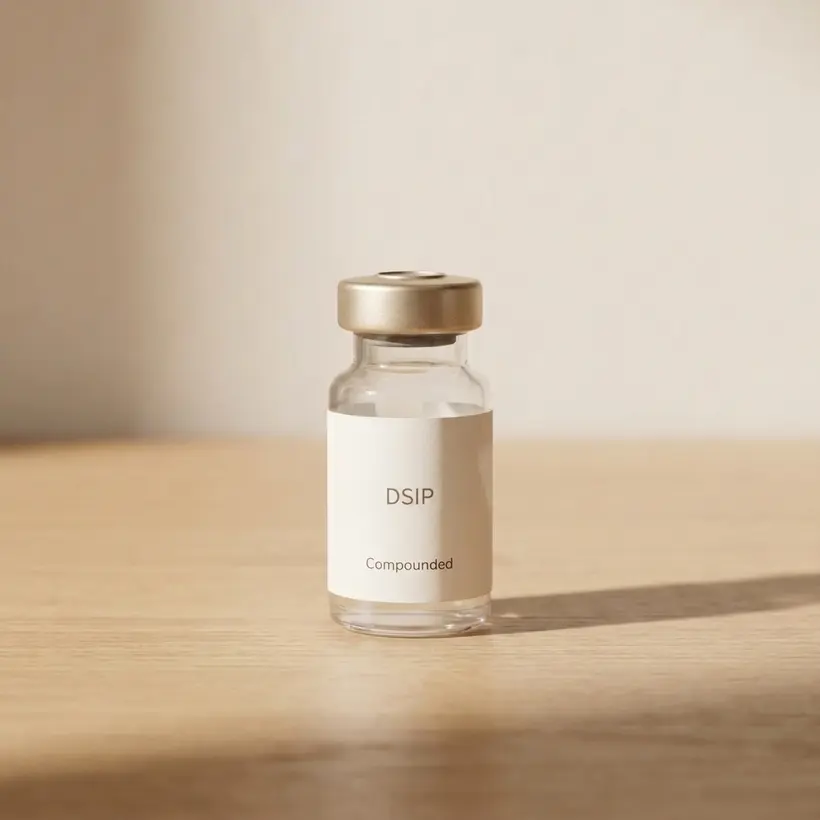
From the FormBlends catalog
DSIP (Delta Sleep-Inducing Peptide)
Restore deep, restorative delta wave sleep · From $179/mo · compounded by a licensed 503A pharmacy, dispensed only after provider review.
View DSIP (Delta Sleep-Inducing Peptide) →A reasonable starting approach: 50 mcg for the first week, assess subjectively, then decide whether titration makes sense with your prescriber. Some clinicians suggest keeping a brief sleep diary during the initial period, noting time to sleep, number of awakenings, perceived sleep depth, and how you feel in the first hour after waking. This kind of crude self-tracking is more useful than relying on a single overall impression, because the improvements from DSIP can be gradual enough that you miss them without a written record.
Cycle patterns vary because there's no Western consensus. Three common approaches:
- Short-term blocks of one to three weeks during periods of disrupted sleep (travel, high-stress work stretches, post-surgical recovery), then stop. This is probably the best-supported use pattern based on the existing clinical literature, where study durations have generally been two to four weeks.
- Intermittent, as-needed dosing only on nights where sleep disruption is anticipated. Some people use this approach around business travel across time zones, combining DSIP with melatonin for circadian resetting.
- Continuous nightly use over longer periods (described anecdotally but not formally validated). Some practitioners report patients using DSIP nightly for several months without apparent tolerance, but this has not been studied in a controlled setting.
And this should be obvious but rarely is: DSIP works best layered on top of actual sleep hygiene. Consistent schedule, dark room, cool temperature, no screens in the last hour, caffeine cutoff by early afternoon. A peptide can't compensate for scrolling Twitter at midnight under fluorescent lighting. One of the more interesting anecdotal patterns reported by prescribers is that patients who adopt strong sleep hygiene practices alongside DSIP sometimes find they no longer need the peptide after four to six weeks, as though the combination helps reset their baseline sleep patterns. Whether that's the DSIP, the hygiene changes, or both working together isn't clear from anecdote alone, but it's a pattern worth noting.
How It Stacks Against the Usual Sleep Toolkit
Melatonin primarily addresses circadian timing and sleep onset. DSIP addresses sleep depth and architecture. They're solving different problems, which is why some people combine them (melatonin for the front door, DSIP for the interior). No formal protocol validates the combination, but the mechanistic logic is reasonable. Typical melatonin doses in this context are 0.5 to 1 mg, well below the 5 to 10 mg doses commonly sold over the counter, which often overshoot what's needed for circadian signaling and can cause next-day grogginess of their own.
Benzodiazepines produce sedation but actually suppress slow-wave sleep, which is somewhat perverse if you think about it. A person taking lorazepam or temazepam nightly may be unconscious for eight hours but spending less time in the restorative deep sleep stages than they would without the medication. They also carry dependence and withdrawal concerns that make long-term use genuinely risky. DSIP does none of this.
Z-drugs (zolpidem, zaleplon) are chemically distinct from benzos but functionally similar in their sleep architecture effects and dependence profiles. Same basic critique applies. Zolpidem in particular has a well-documented association with complex sleep behaviors (sleep-eating, sleep-driving) that were the reason Derek flushed his prescription.
Trazodone is a sedating antidepressant used off-label for sleep. It works, but the sedation is blunt-instrument stuff, and plenty of patients (like Derek) find the morning residue intolerable. It can also cause orthostatic hypotension, particularly in older adults, and has interactions with other serotonergic medications that limit its flexibility.
GH-releasing peptides (CJC-1295, Ipamorelin) dosed in the evening for growth hormone release can secondarily improve slow-wave sleep through the GH axis. The mechanism is indirect, working through hormonal signaling rather than direct sleep architecture modulation. Growth hormone release is naturally concentrated during slow-wave sleep, so there's a bidirectional relationship: better deep sleep promotes more GH release, and higher GH activity may support deeper sleep. Some protocols stack DSIP with evening GH peptides on the theory that complementary pathways might compound the benefit. The theory is plausible; the evidence is thin. People interested in this combination should discuss it explicitly with their prescriber rather than layering peptides without clinical oversight.
Glycine, the amino acid, deserves mention as a lower-intervention comparison point. A 2012 study by Bannai and colleagues found that 3 grams of glycine before bed improved subjective sleep quality and reduced daytime sleepiness in participants with mildly impaired sleep. Glycine acts partly through thermoregulation, lowering core body temperature, and partly through NMDA receptor modulation. It's available over the counter, well-tolerated, and cheap. For mild sleep quality issues, it may be worth trying before stepping up to a prescription peptide.
What to Actually Expect
I think the honest summary is this: DSIP is a subtle intervention that works gradually, works for some people and not others, and offers its best value to those whose primary complaint is sleep quality rather than sleep onset.
The effects tend to become apparent across multiple nights of use rather than announcing themselves dramatically on night one. People who track their sleep with wearables sometimes notice increased deep sleep percentages before they notice any subjective difference. One clinician described the typical trajectory as: "Night one, nothing. Night four, maybe something. Week two, the patient says they feel different in the mornings but can't articulate how. Week three, they start using the word 'rested' for the first time in our conversation."
Individual variability is substantial, and we don't have good predictors for who will respond well. That's a real limitation. Anecdotally, patients whose sleep disruption is primarily stress-driven (high cortisol, racing thoughts, light and fragmented sleep with frequent awakenings) seem to respond more favorably than those whose issues are purely circadian or mechanical. But this is pattern recognition from clinical reports, not controlled data.
The flip side of the variability is that the downside risk is small: occasional transient headache, mild dizziness in some reports, rare vivid dreams. No dependence signature. No withdrawal. No morning fog. Injection site irritation is possible, as with any subcutaneous peptide, but uncommon at these small volumes.
If you have undiagnosed sleep apnea, restless legs syndrome, or another structural sleep disorder, DSIP is not the answer. Those conditions need specific clinical evaluation and targeted treatment, not a peptide layered on top. DSIP is for the person whose sleep mechanics are intact but whose sleep quality has degraded. If you snore heavily, if your partner reports that you stop breathing during sleep, or if you experience involuntary leg movements at night, those findings warrant a sleep study before any peptide is considered.
Frequently Asked Questions
Does DSIP make you fall asleep faster?
Results on sleep onset are mixed. Some patients report reduced sleep latency; others notice no acute onset effect. DSIP does not produce sedation comparable to benzodiazepines or Z-drugs. Its primary action is on sleep depth and architecture, not speed of falling asleep. If your main problem is lying awake for an hour before sleep begins, DSIP alone may not address that. Circadian interventions (melatonin, light exposure timing, consistent wake times) are better first-line tools for sleep onset.
Can I take DSIP every night?
Short-term nightly use has been described in research settings, typically over two to four weeks. Continuous long-term nightly use has not been formally studied. Many protocols favor intermittent or time-limited use, but there's no evidence of dependence or tolerance buildup in the available literature. Some prescribers recommend using DSIP nightly for a defined block (two to three weeks), then pausing to assess whether the benefits persist without ongoing dosing.
Will DSIP make me groggy in the morning?
Most available reports describe minimal next-morning grogginess. This is one of the key practical advantages over sedative sleep medications. People who are sensitive to next-day cognitive effects from trazodone, diphenhydramine, or benzodiazepines often find DSIP noticeably cleaner in this regard.
Can I take DSIP with melatonin?
Some protocols combine the two based on different mechanisms of action (melatonin for circadian timing, DSIP for sleep depth). There is no formal clinical validation of the combination, but the rationale is mechanistically sound. If combining, most practitioners suggest keeping melatonin at physiological doses (0.5 to 1 mg) rather than the supraphysiological doses commonly found in supplement stores.
What dose should I start with?
50 mcg subcutaneous, 30 to 60 minutes before bedtime, is the most common starting dose. This is informational, not a prescription. Dosing decisions should be made with your prescriber based on your clinical history and sleep complaints.
How long before I notice a difference?
Most people who respond to DSIP notice improvements across the first one to two weeks rather than on the first night. Tracking sleep quality subjectively or with a wearable device can help identify patterns. A simple sleep diary noting bedtime, estimated time to fall asleep, number of awakenings, wake time, and a 1-to-10 quality rating is often more useful than relying on memory alone.
Is DSIP safe long-term?
Short- and medium-term safety data is reassuring, with no dependence or withdrawal patterns documented. However, multi-year continuous use data does not exist. Periodic reassessment with your prescriber is reasonable. The absence of long-term data is not the same as evidence of harm, but it does mean that the conservative approach is to use DSIP in defined blocks rather than indefinitely.
Related Reading
- DSIP Hub
- DSIP Dosage Protocols
- Best Peptides for Sleep
- Selank Hub
- Epithalon Hub
Compliance Footer
DSIP is not approved by the FDA for the prevention, mitigation, treatment, or cure of any disease, including sleep disorders. Compounded DSIP is prepared by licensed compounding pharmacies for individual patients under a valid prescription from a licensed prescriber. Information on this page is educational and is not medical advice. Individual results vary.
Ready when you are
DSIP (Delta Sleep-Inducing Peptide)
Restore deep, restorative delta wave sleep · From $179/mo · compounded by a licensed 503A pharmacy, dispensed only after provider review.
View DSIP (Delta Sleep-Inducing Peptide) →