Marcus, a 41-year-old CrossFit coach in Austin, had been dealing with bilateral Achilles tendinopathy for the better part of two years. Physical therapy helped. Shockwave therapy helped a little more. But he was still modifying workouts three days a week. When his prescriber started him on a TB-500 cycle at 2.5 mg twice weekly, he felt almost nothing for the first 10 days. "I kept checking the vials like maybe they were bunk," he told me. By week three, he noticed he could do box jumps without the familiar morning-after tightness. By week eight, deep into maintenance dosing, he described his tendons as "boring," which, for a guy who'd been managing around pain for two years, was the highest compliment he could give.
His experience tracks with the general pattern: a loading phase of four to six weeks at 2 to 2.5 mg subcutaneously twice weekly, a maintenance phase of six to twelve weeks at 2 mg weekly, and a planned break of four to eight weeks before reassessment. Specific timing varies with indication, response, and prescriber judgment.
Here's what each of those phases actually looks like, why cycling matters, and how to think about doing it again.
Why Bother Cycling?
There's no established maximum duration for compounded TB-500. There are also no long-term human safety trials to tell us where the ceiling should be. So cycling is essentially a hedge, a structured way to avoid open-ended dosing of a compound we don't have decades of data on. It gives you:
- A defined window to evaluate whether the stuff is actually working
- Lower cumulative exposure than running it continuously
- A built-in reassessment point (rather than just... never stopping)
- Time for any subtle effects, good or bad, to declare themselves
Running TB-500 indefinitely without breaks isn't supported by anything in the literature. The boring truth is that structured caution is the only reasonable approach with research-stage compounds.
Loading, Maintenance, Break: The Three Acts
Think of a TB-500 cycle like seasoning a cast-iron pan. The loading phase lays down the initial layers. Maintenance keeps the coating intact. The break lets you check whether the seasoning held.
Loading (Weeks 1 through 4-6)
- 2 to 2.5 mg, twice weekly (Monday/Thursday spacing is typical)
- Goal: saturate tissue concentrations before stepping down
- A gentler on-ramp (1 mg twice weekly for two weeks, then stepping up) works for patients who tend to be sensitive to new compounds
Maintenance (Weeks 5-7 through 12-18)
- 2 mg, once weekly
- Goal: sustain whatever benefit loading established, at roughly half the weekly exposure
- Some patients never need this phase. If the issue resolved during loading, there's no reason to keep going. Others stay here for three months under prescriber supervision.
Break (4 to 8+ weeks)
- No dosing
- Goal: planned washout and honest reassessment
- Here's the thing: TB-500 has a long biological tail. Effects experienced during the active cycle often persist for weeks after the last injection. Don't evaluate whether the cycle "worked" the day after your last dose. Wait until the break is actually over.
How Cycles Differ by What You're Treating
Not every TB-500 cycle looks the same. The underlying problem shapes the structure.
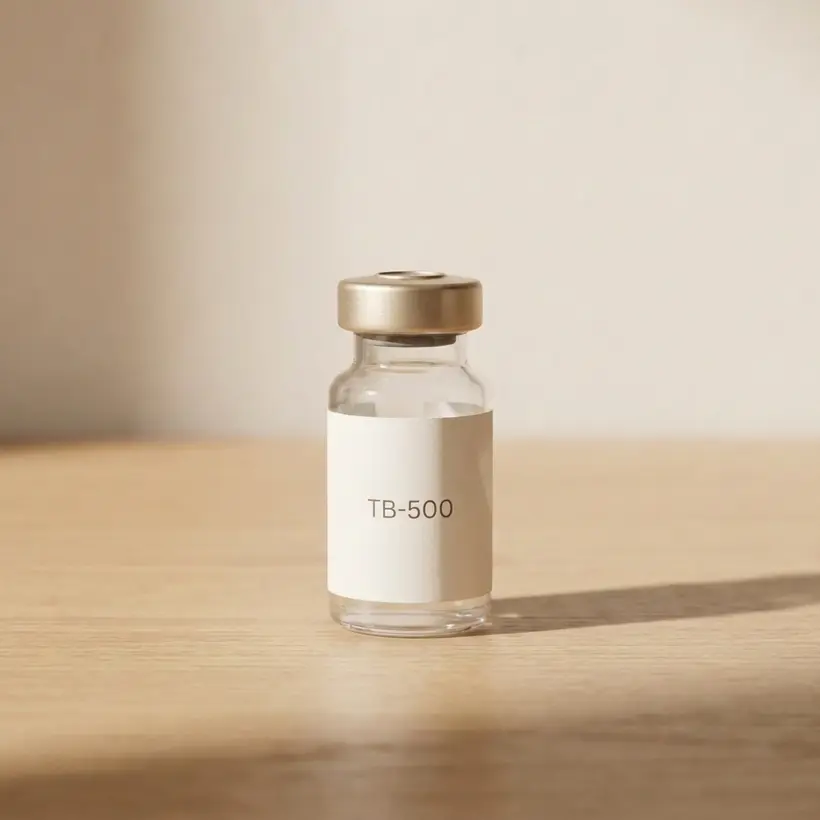
From the FormBlends catalog
TB-500 (Thymosin Beta-4)
Universal repair peptide for tissue regeneration · From $49/mo · compounded by a licensed 503A pharmacy, dispensed only after provider review.
Learn about TB-500 (Thymosin Beta-4) →Acute soft-tissue injury (a partial hamstring tear, a Grade 2 ankle sprain that won't finish healing): Loading at 2.5 mg twice weekly for four weeks, maintenance at 2 mg weekly for four to eight weeks, four-week break, reassess. Shorter and more aggressive on the front end.
Chronic tendinopathy (the Achilles that's been grumbling for 18 months, the lateral epicondyle that flares every time you grip a barbell): Loading at 2 mg twice weekly for six weeks, maintenance at 2 mg weekly for eight to twelve weeks, eight-week break. If there's a partial response, one additional cycle is reasonable.
Post-surgical recovery (under direct prescriber supervision): Loading doesn't start until the acute post-op phase clears. Then 2 mg twice weekly for four to six weeks. Maintenance and break timing depend entirely on individual recovery trajectory.
Multiple soft-tissue sites (the patient who has a bad shoulder, a cranky knee, and a stiff low back all at once): Standard six-week loading, extended maintenance to twelve weeks, eight-week break before considering a repeat.
What the Timeline Actually Feels Like
Weeks 1 to 2: Some patients report mild fatigue, a vague head-pressure feeling, or something resembling a low-grade flu. These tend to resolve on their own. Feeling zero change in the target complaint at this point is completely normal, not a sign of failure.
Weeks 2 to 4: This is when initial perceived improvements, if they're coming, usually start to show up. For soft-tissue issues, that often means less discomfort during or after activity. It's subtle. You might not notice it until you realize you forgot to ice afterward.
Weeks 4 to 6: End of the loading window. Whatever subjective benefit exists is typically most apparent now. This is the decision point: continue into maintenance, or pause if the issue has resolved.
During maintenance: The goal is stability or continued gradual improvement. A plateau here isn't failure. It's actually a reasonable signal that you've gotten what loading could give you and it might be time to enter the break.
During the break: Resist the urge to restart early. Reassess honestly at the end of the planned break, not during it.
When a Second (or Third) Cycle Makes Sense
Some patients run two to three cycles per year, separated by breaks. There's no established annual maximum because there's no long-term controlled human data to base one on. Conservative practice caps yearly exposure rather than allowing continuous protocols.
Where this falls apart is when a full first cycle produces no perceptible benefit. Repeating the same protocol and hoping for a different outcome doesn't make pharmacological sense. If cycle one didn't move the needle, the prescriber should consider re-evaluating the diagnosis, adjusting dose or duration, layering in other modalities like physical therapy, or simply discontinuing TB-500 altogether.
A Note on Stacking
TB-500 is sometimes paired with BPC-157, growth hormone secretagogues, or other research-stage peptides. The typical approach aligns BPC-157's daily dosing with TB-500 loading and maintenance, then pauses both during the break.
I should be direct: there is no controlled-trial evidence showing stacked cycles outperform single-peptide cycles for any specific indication. The rationale is mechanistic (different pathways, potentially complementary effects) rather than proven. Stacking adds complexity, cost, and exposure. It's not automatically better.
Reasons to Pull the Plug Early
Sometimes you don't finish a cycle. Valid reasons:
- Persistent significant side effects: large injection-site reactions, fatigue lasting beyond two weeks, any sign of allergic response
- No perceived benefit after a full loading phase, in discussion with your prescriber
- A new diagnosis that contraindicates use (active malignancy, pregnancy)
- You simply want to stop. That's always sufficient.
Citations
Goldstein AL et al. Thymosin beta4: actin-sequestering protein moonlights to repair injured tissues. Trends in Molecular Medicine. 2005.
Crockford D et al. Thymosin beta4: structure, function, and biological properties supporting current and future clinical applications. Annals of the New York Academy of Sciences. 2010.
FAQ
How long should my first cycle be?
A typical first cycle runs four to six weeks of loading followed by maintenance. Total duration is usually 12 to 18 weeks plus the planned break, so budget roughly five months start to finish.
How long between cycles?
Four to eight weeks is the most common break window. For chronic conditions being managed over longer timelines, some prescribers extend breaks to 12 weeks.
Can I run TB-500 year-round?
Not advisable given the limited human safety data. Planned breaks and capped annual exposure are the standard conservative approach.
What if I see no effect by week four?
Talk to your prescriber. The options include continuing into maintenance to give the cycle its full window, adjusting the dose, revisiting the diagnosis, or stopping. Continuing blindly isn't a plan.
Can I extend the loading phase?
Some chronic presentations use eight-week loading windows under prescriber supervision. Extending loading without a clinical rationale just adds exposure without clear upside.
Is a lower loading dose effective?
Some patients start at 1 mg twice weekly for two weeks before stepping up. There's no comparative data showing this is less effective; it simply reaches target tissue levels more gradually.
Do I need bloodwork during a cycle?
TB-500 doesn't have established monitoring labs the way testosterone or thyroid medication does. Your prescriber may order general health panels at baseline and post-cycle, but there's no TB-500-specific marker to track.
Internal Links
- Hub: TB-500 overview
- Pillar: Peptide therapy overview
- Product: TB-500 product page
- Sibling: TB-500 dosage protocols
- Sibling: TB-500 benefits research
- Sibling: TB-500 side effects
---
Disclaimer: TB-500 is not approved by the FDA for any indication. Compounded TB-500 is prepared for individual patients through licensed compounding pharmacies based on prescriber clinical judgment. This article is educational and is not medical advice. Research-stage peptides should only be used under qualified prescriber supervision. Individual results vary.
Ready when you are
TB-500 (Thymosin Beta-4)
Universal repair peptide for tissue regeneration · From $49/mo · compounded by a licensed 503A pharmacy, dispensed only after provider review.
Learn about TB-500 (Thymosin Beta-4) →