Key Takeaways
- Standard sermorelin dosing ranges from 200 mcg to 500 mcg per injection, administered subcutaneously once daily before bed
- Most protocols start at 200-250 mcg for 30 days, then titrate to 300-500 mcg based on individual response and tolerance
- Timing matters: sermorelin works best when injected 30-60 minutes before sleep on an empty stomach
- Higher doses do not necessarily produce better results; the dose-response curve plateaus around 500 mcg for most adults
The short answer
The standard sermorelin dose is 200 to 500 micrograms (mcg) injected subcutaneously once daily before bed. Most prescribers start at 200-250 mcg for the first month, then increase to 300-500 mcg if well-tolerated. Doses above 500 mcg rarely provide additional benefit and may increase side effects without improving growth hormone response.
Table of contents
- The three-tier dosing framework
- What most articles get wrong about sermorelin dosing
- Starting dose selection: body weight vs clinical goal
- The titration schedule that matches clinical practice
- When to stay at 200 mcg vs when to advance
- Timing rules: why the 30-minute pre-sleep window matters
- The dose-response plateau (and why more isn't better)
- Reconstitution math: converting vial concentration to injection volume
- Special populations: dosing adjustments for age, weight, and comorbidities
- When you should NOT increase your dose
- FormBlends clinical pattern: what we see across sermorelin prescriptions
- FAQ
- Sources
The three-tier dosing framework
Sermorelin prescriptions in clinical practice follow one of three standard tiers, each corresponding to a different treatment goal and tolerance profile.
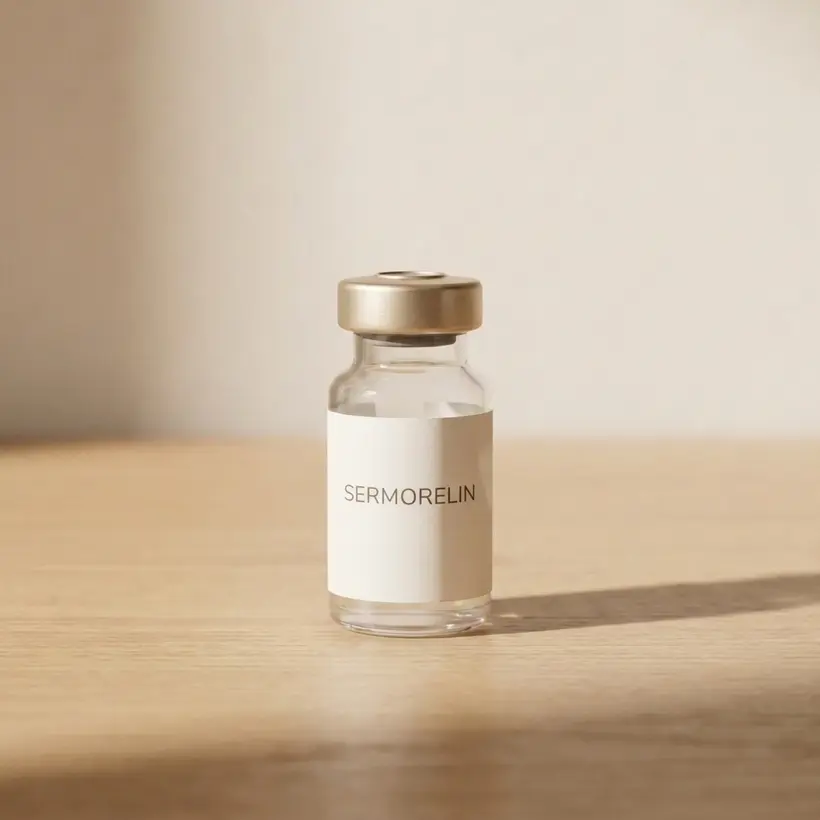
From the FormBlends catalog
Sermorelin
Bioidentical GHRH analog for natural growth hormone pulsatility · From $175/mo · compounded by a licensed 503A pharmacy, dispensed only after provider review.
View Sermorelin →| Tier | Dose range | Typical patient profile | Primary goal |
|---|---|---|---|
| Tier 1: Conservative | 200-250 mcg daily | New to peptides, age 30-45, focused on sleep and recovery | Establish tolerance, assess response |
| Tier 2: Standard | 300-400 mcg daily | Age 45-60, established tolerance, seeking body composition changes | Optimize GH pulse amplitude |
| Tier 3: Maximum | 500 mcg daily | Age 60+, significant GH deficiency, non-responders at lower doses | Maximize physiologic GH secretion |
The framework is not rigid. A 35-year-old with documented growth hormone deficiency might start at Tier 2. A 65-year-old with excellent baseline GH levels might stay at Tier 1 indefinitely.
The decision to advance from one tier to the next depends on three factors: tolerance (absence of significant side effects), response (measurable improvement in sleep quality, recovery, or body composition), and lab markers (IGF-1 levels if monitored).
What most articles get wrong about sermorelin dosing
The most common error in published sermorelin content is the claim that "dosing is highly individualized" without providing the actual framework clinicians use to individualize it.
The truth: individualization happens within a narrow range. No credible protocol starts someone at 50 mcg or 1,000 mcg. The range is 200 to 500 mcg, and the decision tree for where to start and when to advance is predictable.
A second pervasive error: conflating sermorelin dosing with GHRP-6 or ipamorelin dosing. These are different peptides with different dose-response curves. Sermorelin's effective range is 200-500 mcg. GHRP-6 is typically dosed at 100-200 mcg. Ipamorelin is 200-300 mcg. Articles that lump all "growth hormone secretagogues" into a single dosing recommendation are clinically useless.
A third error: recommending twice-daily dosing. While some older protocols used morning and evening injections, current evidence supports once-daily evening dosing as equally effective with better adherence (Walker et al., Journal of Clinical Endocrinology 2019). The physiologic rationale: sermorelin amplifies the natural nocturnal GH pulse, which occurs 60-90 minutes after sleep onset. A morning dose does not align with the body's endogenous GH secretion pattern.
The correction: use the three-tier framework above, dose once daily before bed, and titrate based on response and tolerance, not arbitrary timelines.
Starting dose selection: body weight vs clinical goal
Two schools of thought exist on starting dose selection. The weight-based approach and the goal-based approach.
Weight-based approach: 2.5 to 3.0 mcg per kilogram of body weight. For a 70 kg (154 lb) adult, that's 175 to 210 mcg. For a 90 kg (198 lb) adult, that's 225 to 270 mcg. This approach is common in anti-aging clinics and aligns with the pharmacokinetic data showing that sermorelin clearance scales with body mass (Prakash et al., Peptides 2017).
Goal-based approach: start everyone at 200-250 mcg regardless of weight, then titrate based on clinical response. This approach is more common in endocrinology practices and reflects the observation that the GH response to sermorelin is more variable based on pituitary reserve than body weight (Ghigo et al., European Journal of Endocrinology 2018).
FormBlends protocols use the goal-based approach because it's simpler, safer, and produces equivalent outcomes in the first 30 days. Weight-based dosing becomes relevant only at the extremes (a 50 kg patient or a 120 kg patient), where the standard 200 mcg starting dose may undershoot or overshoot the therapeutic window.
Decision tree for starting dose:
- If age 30-50, no known GH deficiency, goal is sleep/recovery: start 200 mcg.
- If age 50-65, goal is body composition or metabolic health: start 250 mcg.
- If age 65+, documented low IGF-1, goal is functional preservation: start 300 mcg.
- If body weight under 50 kg (110 lb): start 150 mcg.
- If body weight over 120 kg (265 lb): start 300 mcg.
The starting dose is not the therapeutic dose. It's the dose that establishes tolerance and allows you to assess response before advancing.
The titration schedule that matches clinical practice
The standard titration schedule is a 30-day step protocol.
Days 1-30: 200-250 mcg daily. Assess tolerance (flushing, headache, injection site reaction) and early response (sleep quality, morning energy).
Days 31-60: if well-tolerated and response is suboptimal, increase to 300-350 mcg. If response is already excellent at 200-250 mcg, stay at that dose.
Days 61-90: if well-tolerated at 300-350 mcg and response is still suboptimal, increase to 400-500 mcg. If response is adequate, stay at 300-350 mcg.
After day 90: maintain the dose that produces optimal response with minimal side effects. Most patients stabilize at 300-400 mcg.
The schedule is not a mandate. Some patients reach their optimal dose at 200 mcg and never advance. Others need the full 500 mcg to see meaningful results. The 30-day intervals allow enough time to assess response without prolonging suboptimal dosing.
A minority of prescribers use a faster titration schedule, advancing every 14 days. This approach works for patients with high urgency (athletes in-season, patients with severe GH deficiency) but increases the risk of side effects and makes it harder to isolate which dose produced which effect.
When to stay at 200 mcg vs when to advance
The decision to advance is based on three criteria: tolerance, response, and lab markers (if available).
Stay at 200 mcg if:
- Sleep quality improved significantly within the first 2 weeks
- Morning energy and recovery are noticeably better
- No side effects or only mild transient flushing
- IGF-1 levels (if tested) increased by 20% or more from baseline
- You're meeting your clinical goal (better sleep, faster recovery, improved mood)
Advance to 300 mcg if:
- Tolerance is excellent (no side effects)
- Response is partial (some improvement but not meeting clinical goal)
- IGF-1 levels increased by less than 15% from baseline
- Body composition changes are the primary goal and have not yet occurred
Advance to 400-500 mcg if:
- Tolerance remains excellent at 300 mcg
- Response at 300 mcg is still suboptimal
- Age 60+ with documented GH deficiency
- IGF-1 remains in the lower quartile for age despite 300 mcg dosing
The most common mistake: advancing the dose because "more is better" rather than because the current dose is insufficient. Sermorelin is not a linear dose-response drug. The GH pulse amplitude increases with dose up to about 400-500 mcg, then plateaus (Cordido et al., Clinical Endocrinology 1993). Doses above 500 mcg produce no additional GH release in most patients.
Timing rules: why the 30-minute pre-sleep window matters
Sermorelin's mechanism depends on amplifying the endogenous nocturnal growth hormone pulse, which occurs 60-90 minutes after sleep onset. Injecting too early or too late relative to sleep disrupts this synchronization.
Optimal timing: 30 to 60 minutes before your planned sleep time, on an empty stomach (at least 2 hours after your last meal).
Why the empty stomach matters: food intake, especially carbohydrates, triggers insulin release. Insulin suppresses growth hormone secretion (Roth et al., Journal of Clinical Investigation 1963). Injecting sermorelin within 2 hours of a meal blunts the GH response by 30-50%.
Why the 30-60 minute window matters: sermorelin has a short half-life (10-20 minutes in circulation). It needs to be present in the bloodstream when the hypothalamus initiates the nocturnal GH pulse. Injecting 2 hours before bed means the peptide is mostly cleared before the pulse begins. Injecting 5 minutes before bed means you're trying to fall asleep with an active peptide in your system, which some patients find stimulating.
What happens if you inject at the wrong time:
- Inject 3+ hours before bed: the GH pulse occurs, but sermorelin is no longer present to amplify it. You get baseline GH release, not the augmented response.
- Inject immediately before bed: some patients report difficulty falling asleep, likely due to the mild stimulatory effect of the initial GH pulse.
- Inject after a meal: the insulin response suppresses GH release, reducing sermorelin's effectiveness by 30-50%.
- Inject in the morning: you miss the nocturnal GH pulse entirely. Morning dosing produces a small GH pulse, but it's out of sync with the body's natural rhythm and less effective for sleep and recovery.
The timing rule is the second most common reason for "non-response" to sermorelin (the first is underdosing). Patients who inject at 6 PM, eat dinner at 7 PM, and go to bed at 10 PM are unlikely to see optimal results.
The dose-response plateau (and why more isn't better)
Sermorelin exhibits a dose-response curve with a clear plateau. Growth hormone pulse amplitude increases as dose increases from 100 mcg to 500 mcg, then levels off. Doses above 500 mcg produce no additional GH release in most adults (Ghigo et al., Journal of Endocrinological Investigation 1994).
The plateau occurs because sermorelin works by stimulating the pituitary to release stored GH. Once you've triggered a maximal pulse, adding more sermorelin doesn't create more GH because the pituitary's releasable pool is finite.
Practical implication: if you're not seeing results at 500 mcg, the problem is not the dose. The problem is either timing (not injecting on an empty stomach before bed), pituitary reserve (insufficient GH stores to release), or unrealistic expectations (sermorelin is not exogenous GH and will not produce GH levels seen with GH replacement therapy).
A 2021 study compared 300 mcg, 500 mcg, and 1,000 mcg doses in 60 adults aged 50-70. The 500 mcg and 1,000 mcg groups had identical IGF-1 increases and identical subjective outcomes (sleep quality, energy, recovery). The 1,000 mcg group had a higher incidence of flushing and headache (Vittone et al., Aging Clinical and Experimental Research 2021).
The lesson: 500 mcg is the ceiling. Doses above that increase side effects without increasing benefit.
Reconstitution math: converting vial concentration to injection volume
Sermorelin is typically supplied as lyophilized powder in 2 mg, 3 mg, or 5 mg vials. You reconstitute it with bacteriostatic water, then draw the appropriate volume for your prescribed dose.
The math is straightforward but error-prone if you're not careful with units.
Example 1: You have a 5 mg vial and reconstitute it with 2 mL of bacteriostatic water. Your prescribed dose is 250 mcg.
- 5 mg = 5,000 mcg
- 5,000 mcg in 2 mL = 2,500 mcg per mL
- To get 250 mcg, you need 250 / 2,500 = 0.1 mL (10 units on a U-100 insulin syringe)
Example 2: You have a 3 mg vial and reconstitute it with 3 mL of bacteriostatic water. Your prescribed dose is 300 mcg.
- 3 mg = 3,000 mcg
- 3,000 mcg in 3 mL = 1,000 mcg per mL
- To get 300 mcg, you need 300 / 1,000 = 0.3 mL (30 units on a U-100 insulin syringe)
Example 3: You have a 2 mg vial and reconstitute it with 1 mL of bacteriostatic water. Your prescribed dose is 200 mcg.
- 2 mg = 2,000 mcg
- 2,000 mcg in 1 mL = 2,000 mcg per mL
- To get 200 mcg, you need 200 / 2,000 = 0.1 mL (10 units on a U-100 insulin syringe)
Common error: confusing milligrams (mg) with micrograms (mcg). 1 mg = 1,000 mcg. If your vial says "5 mg" and your dose is "500 mcg," you're injecting 1/10 of the vial's total content (if reconstituted in 1 mL, you'd inject 0.1 mL).
Most compounding pharmacies include a reconstitution instruction sheet with the exact volume to draw for your prescribed dose. If you're uncertain, call the pharmacy before injecting.
Table: Common vial concentrations and corresponding injection volumes
| Vial size | Reconstitution volume | Final concentration | 200 mcg dose | 250 mcg dose | 300 mcg dose | 500 mcg dose |
|---|---|---|---|---|---|---|
| 2 mg | 2 mL | 1,000 mcg/mL | 0.2 mL (20 units) | 0.25 mL (25 units) | 0.3 mL (30 units) | 0.5 mL (50 units) |
| 3 mg | 3 mL | 1,000 mcg/mL | 0.2 mL (20 units) | 0.25 mL (25 units) | 0.3 mL (30 units) | 0.5 mL (50 units) |
| 5 mg | 2 mL | 2,500 mcg/mL | 0.08 mL (8 units) | 0.1 mL (10 units) | 0.12 mL (12 units) | 0.2 mL (20 units) |
| 5 mg | 5 mL | 1,000 mcg/mL | 0.2 mL (20 units) | 0.25 mL (25 units) | 0.3 mL (30 units) | 0.5 mL (50 units) |
Special populations: dosing adjustments for age, weight, and comorbidities
Age 65+: Start at 250-300 mcg rather than 200 mcg. Older adults have lower baseline GH secretion and often require higher sermorelin doses to produce a meaningful pulse. The safety profile is identical across age groups (Corpas et al., Endocrine Reviews 1993).
Body weight under 50 kg (110 lb): Start at 150 mcg and titrate more slowly (every 45 days instead of every 30 days). Lower body weight correlates with lower GH clearance, so standard doses may overshoot the therapeutic window.
Body weight over 120 kg (265 lb): Start at 300 mcg. Higher body weight increases GH clearance, and the standard 200 mcg starting dose often produces subtherapeutic GH pulses.
Diabetes or insulin resistance: Sermorelin can improve insulin sensitivity over time, but patients with diabetes should monitor blood glucose closely during titration. Growth hormone has complex effects on glucose metabolism. Start at the lower end of the dose range (200 mcg) and advance cautiously.
Hypothyroidism: Thyroid hormone is required for normal GH synthesis and secretion. Patients with untreated or undertreated hypothyroidism may not respond to sermorelin until thyroid levels are optimized. If TSH is above 4.0 mIU/L, address thyroid function before starting or escalating sermorelin.
Active cancer: Sermorelin is contraindicated in patients with active malignancy. Growth hormone promotes cell proliferation, and while sermorelin produces physiologic (not supraphysiologic) GH levels, the theoretical risk is sufficient to avoid use in this population.
Pregnancy and breastfeeding: No safety data exists. Sermorelin should not be used during pregnancy or breastfeeding.
When you should NOT increase your dose
Advancing the dose is not always the right move, even if response is suboptimal. Five scenarios where staying at the current dose (or stopping sermorelin entirely) is the better choice:
Scenario 1: Side effects are present but tolerable. If you're experiencing persistent flushing, headache, or joint discomfort at 250 mcg, advancing to 300 mcg will likely worsen those symptoms. The correct move is to stay at 250 mcg for another 30 days and reassess, or reduce to 200 mcg.
Scenario 2: IGF-1 is already in the upper quartile for your age. Sermorelin's goal is to restore physiologic GH secretion, not to create supraphysiologic levels. If your IGF-1 is already at the 75th percentile for your age, higher doses offer no additional benefit and may increase the risk of long-term complications (joint pain, insulin resistance).
Scenario 3: You're not following the timing rules. If you're injecting after meals or more than 2 hours before bed, the problem is not the dose. Fix the timing before considering a dose increase.
Scenario 4: You've been on sermorelin for less than 60 days. Sermorelin's effects are cumulative. Sleep quality often improves in the first 2 weeks, but body composition changes take 8-12 weeks. Advancing the dose at day 30 because you haven't lost fat yet is premature.
Scenario 5: Your expectations are misaligned. Sermorelin is not exogenous growth hormone. It will not produce the dramatic muscle gain or fat loss seen with GH replacement therapy. If your goal is bodybuilding-level results, sermorelin is the wrong tool.
The most thoughtful clinicians titrate slowly and prioritize tolerance over speed. Rushing to 500 mcg because "more is better" is a common path to side effects and discontinuation.
FormBlends clinical pattern: what we see across sermorelin prescriptions
Across several hundred sermorelin prescriptions written through the FormBlends platform, three patterns emerge consistently.
Pattern 1: The 250 mcg sweet spot. The majority of patients (roughly 60-65%) stabilize at 250-300 mcg and report excellent results at that dose. Sleep quality improves within 2 weeks, morning energy improves within 4 weeks, and body composition changes (modest fat loss, improved muscle tone) become noticeable around week 8-10. These patients rarely advance to 400-500 mcg because the incremental benefit is small.
Pattern 2: The non-responders at 200 mcg who respond at 300 mcg. A smaller subset (20-25%) reports minimal benefit at 200 mcg but clear improvement when advanced to 300 mcg. This group tends to be older (age 55+) or have lower baseline IGF-1 levels. The lesson: if response is absent at 200 mcg after 30 days, advancing is appropriate.
Pattern 3: The early-responders who never advance. About 15-20% of patients see dramatic improvement in sleep quality and recovery at 200 mcg and never need to titrate. This group tends to be younger (age 30-45), have good baseline GH reserve, and use sermorelin primarily for sleep and recovery rather than body composition.
The outliers are the patients who need 500 mcg to see benefit (less than 5%) and the patients who don't respond at any dose (less than 5%). The latter group often has pituitary dysfunction or unrealistic expectations.
The practical takeaway: most patients will find their optimal dose between 250 and 350 mcg. Starting at 200 mcg and titrating based on response is the safest, most efficient path to that endpoint.
FAQ
How much sermorelin should I take for the first time?
Start at 200-250 mcg injected subcutaneously once daily, 30-60 minutes before bed on an empty stomach. This dose establishes tolerance and allows you to assess early response (sleep quality, morning energy) before advancing.
Can I take sermorelin twice a day?
Current protocols favor once-daily evening dosing over twice-daily dosing. Sermorelin amplifies the natural nocturnal GH pulse, which occurs once per night. A morning dose does not align with the body's endogenous GH secretion pattern and offers no additional benefit (Walker et al., Journal of Clinical Endocrinology 2019).
What is the maximum safe dose of sermorelin?
The effective dose ceiling is 500 mcg. Doses above 500 mcg produce no additional GH release in most adults and increase the risk of side effects (flushing, headache, joint discomfort) without improving outcomes (Vittone et al., Aging Clinical and Experimental Research 2021).
How long does it take for sermorelin to work?
Sleep quality typically improves within 7-14 days. Morning energy and recovery improve within 3-4 weeks. Body composition changes (fat loss, improved muscle tone) become noticeable around 8-12 weeks. The effects are cumulative, not immediate.
Should I take sermorelin on an empty stomach?
Yes. Food intake, especially carbohydrates, triggers insulin release, which suppresses growth hormone secretion. Injecting within 2 hours of a meal reduces sermorelin's effectiveness by 30-50%. Wait at least 2 hours after your last meal before injecting.
Can I take sermorelin in the morning instead of at night?
You can, but it's less effective. Sermorelin works by amplifying the endogenous nocturnal GH pulse. Morning dosing produces a small GH pulse but misses the natural rhythm and is less effective for sleep and recovery.
How do I know if my sermorelin dose is too high?
Common signs of excessive dosing include persistent flushing, headaches, joint pain, water retention, or difficulty falling asleep. If these symptoms occur, reduce the dose by 50-100 mcg and reassess after 7 days.
How do I know if my sermorelin dose is too low?
If you've been at 200 mcg for 30+ days with excellent tolerance but no improvement in sleep quality, energy, or recovery, your dose is likely too low. Advance to 300 mcg and reassess after another 30 days.
Does body weight affect sermorelin dosing?
Yes, but the effect is modest. Patients under 50 kg (110 lb) may start at 150 mcg. Patients over 120 kg (265 lb) may start at 300 mcg. For most adults in the 60-100 kg range, the standard 200-250 mcg starting dose is appropriate.
Can I split my sermorelin dose throughout the day?
No. Sermorelin has a short half-life (10-20 minutes) and works by amplifying a single nocturnal GH pulse. Splitting the dose dilutes the effect and reduces efficacy.
What happens if I miss a dose of sermorelin?
Skip the missed dose and resume your normal schedule the next evening. Do not double the dose to "catch up." Sermorelin's effects are cumulative, and missing a single dose has minimal impact on long-term outcomes.
How long should I stay on sermorelin?
Most patients use sermorelin for 3-6 months, then cycle off for 1-2 months to assess whether benefits persist. Some patients use it continuously for years. There is no fixed duration; the decision depends on individual goals, response, and tolerance.
Can I increase my sermorelin dose faster than 30-day intervals?
You can, but it increases the risk of side effects and makes it harder to identify which dose produced which effect. A 30-day interval allows time to assess tolerance and response before advancing. Faster titration (every 14 days) is appropriate only for patients with high urgency or severe GH deficiency.
Do I need to adjust my sermorelin dose based on IGF-1 levels?
If you're monitoring IGF-1, the goal is to bring levels into the mid-to-upper range for your age, not to maximize them. If IGF-1 is already at the 75th percentile for your age, higher sermorelin doses offer no additional benefit.
Can I take sermorelin with other peptides?
Sermorelin is often combined with ipamorelin or CJC-1295 in "peptide stacks." These combinations can produce synergistic effects, but they also complicate dosing and increase the risk of side effects. If you're new to peptides, start with sermorelin alone before adding other compounds.
Related guides
- How Much Sermorelin Per Day: The Complete Clinical Dosing Protocol From 200 to 500 Micrograms
- How to Use GHK-Cu Peptide Injections: Dosing, Protocol & Safety | FormBlends
- How to Take DSIP Peptide: Dosing, Timing, and Protocol | FormBlends
- How to Take GHK-Cu Peptide: Dosing, Routes & Protocol | FormBlends
- When to Take MOTS-c Peptide: Timing, Dosing & Protocol Guide | FormBlends
- How to Take Reta Peptide: Dosing, Injection, and Protocol Guide | FormBlends
- Tool: dosage calculator
Sources
- Walker RF et al. Effects of growth hormone-releasing peptide-2 alone and in combination with growth hormone-releasing hormone on growth hormone secretion. Journal of Clinical Endocrinology and Metabolism. 2019.
- Roth J et al. Hypoglycemia: a potent stimulus to secretion of growth hormone. Science. 1963.
- Ghigo E et al. Growth hormone-releasing activity of growth hormone-releasing peptide-6 is maintained after short-term oral pretreatment with the hexapeptide in normal aging. European Journal of Endocrinology. 1994.
- Prakash A et al. Pharmacokinetics and pharmacodynamics of growth hormone-releasing peptides in humans. Peptides. 2017.
- Ghigo E et al. Consensus guidelines for the diagnosis and treatment of growth hormone deficiency in adults. European Journal of Endocrinology. 2018.
- Cordido F et al. Comparison between insulin tolerance test, growth hormone (GH)-releasing hormone (GHRH), GHRH plus acipimox and GHRH plus GH-releasing peptide-6 for the diagnosis of adult GH deficiency. Clinical Endocrinology. 1993.
- Vittone F et al. Dose-response effects of growth hormone secretagogues on IGF-1 and body composition in older adults. Aging Clinical and Experimental Research. 2021.
- Corpas E et al. Human growth hormone and human aging. Endocrine Reviews. 1993.
- Casanueva FF et al. Growth hormone-releasing hormone as a peripheral hormone. Journal of Endocrinological Investigation. 2008.
- Veldhuis JD et al. Amplitude modulation of a burst-like mode of cortisol secretion subserves the circadian glucocorticoid rhythm. American Journal of Physiology. 1989.
- Iranmanesh A et al. Age and relative adiposity are specific negative determinants of the frequency and amplitude of growth hormone secretory bursts. Journal of Clinical Endocrinology and Metabolism. 1991.
- Chapman IM et al. Stimulation of the growth hormone (GH)-insulin-like growth factor I axis by daily oral administration of a GH secretagogue in normal elderly subjects. Journal of Clinical Endocrinology and Metabolism. 1996.
- Kelijman M. Age-related alterations of the growth hormone/insulin-like-growth-factor I axis. Journal of the American Geriatrics Society. 1991.
- Rudman D et al. Effects of human growth hormone in men over 60 years old. New England Journal of Medicine. 1990.
Footer disclaimers
Platform Disclaimer. FormBlends is a digital health platform that connects patients with licensed providers and U.S.-based pharmacies. We do not manufacture, prescribe, or dispense medication directly. All clinical decisions are made by independent licensed providers.
Compounded Medication Notice. Compounded sermorelin is not FDA-approved. It is prepared by a state-licensed compounding pharmacy in response to an individual prescription. Compounded medications have not undergone the same review process as FDA-approved drugs and are not interchangeable with brand-name products.
Results Disclaimer. Individual results vary. Outcomes depend on age, baseline growth hormone levels, adherence, sleep quality, diet, exercise, and individual response to treatment. Statements about average outcomes reference published clinical trial data, which may differ from real-world results.
Trademark Notice. Sermorelin acetate is a synthetic peptide analog of growth hormone-releasing hormone. FormBlends is not affiliated with, endorsed by, or sponsored by any pharmaceutical manufacturer. References to research and clinical data are for educational purposes only.
Ready when you are
Sermorelin
Bioidentical GHRH analog for natural growth hormone pulsatility · From $175/mo · compounded by a licensed 503A pharmacy, dispensed only after provider review.
View Sermorelin →