
Trust Signals
Conflicts of interest: FormBlends sells peptide products. All claims are graded by evidence tier. Speculation is labeled as such.
Scope: This page covers timing, mechanism, dosing conventions, and bioavailability. It is not a substitute for medical advice.
Key Takeaways
- The reviewed human exercise studies measured endogenous MOTS-c, rather than comparing injection times. They do not establish a 30-60 minute pre-exercise schedule.
- MOTS-c is a 16-amino-acid mitochondria-derived peptide that activates AMPK and suppresses the folate cycle under metabolic stress, the mechanism that makes exercise-adjacent timing biologically plausible.
- The 2021 Reynolds mouse experiment used daily 5 mg/kg intraperitoneal treatment for two weeks. That is not a human timing schedule.
- The selected sources do not supply a human oral-versus-subcutaneous bioavailability comparison. Mouse intraperitoneal treatment and a registered human subcutaneous study are different evidence types.
- Human safety data are extremely limited. A recruiting human study has no posted results; its planned regimen does not establish an optimal timing window.
Direct Answer: When to Take MOTS-c Peptide
The reviewed studies do not establish a best time to inject MOTS-c, either by clock time or relative to exercise. A sample collected before or after exercise is not a dose administered before or after exercise. The evidence ledger below identifies the intervention, sampling schedule and result status separately.
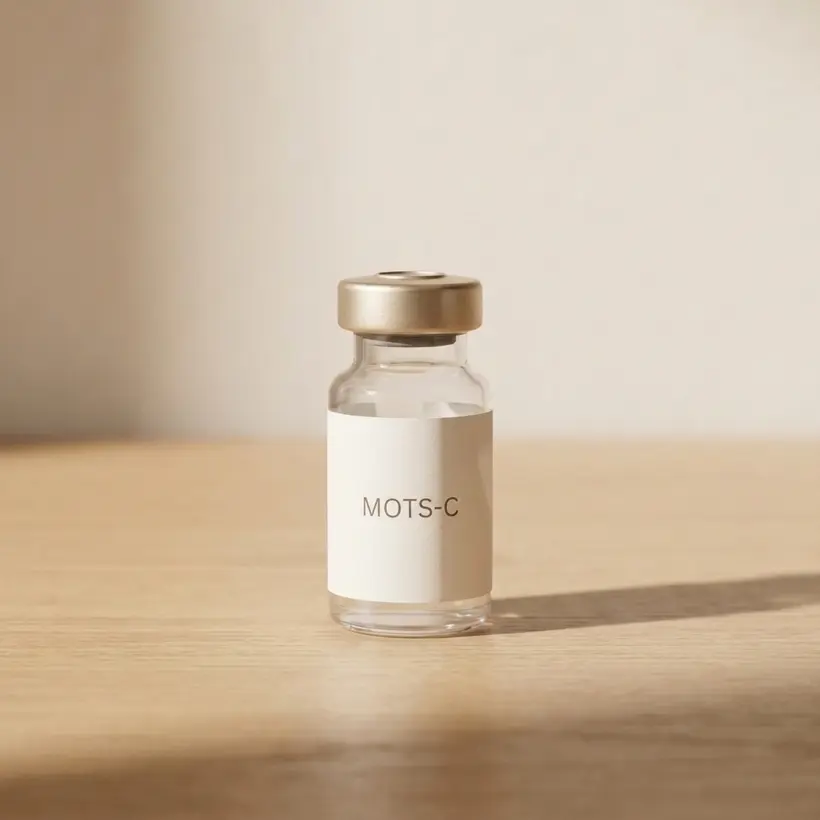
From the FormBlends catalog
MOTS-c
Mitochondrial-derived exercise mimetic that regulates metabolic homeostasis · From $249/mo · compounded by a licensed 503A pharmacy, dispensed only after provider review.
View MOTS-c →Table of Contents
- What does MOTS-c do and why does timing matter mechanistically?
- Evidence ledger: how strong is each timing claim?
- Should MOTS-c be taken before or after exercise?
- Morning vs. evening: does time of day matter?
- What dose and frequency are used in research?
- What most pages get wrong: oral vs. injection bioavailability
- Stability, reconstitution, and formulation gotchas
- Honest head-to-head: MOTS-c vs. real alternatives
- Operational guide: reading a MOTS-c COA and vial label
- FAQ
- Sources
What Does MOTS-c Do and Why Does Timing Matter Mechanistically?
MOTS-c (Mitochondrial Open Reading Frame of the 12S rRNA type-c) is a 16-amino-acid peptide encoded within the 12S rRNA gene of mitochondrial DNA. Its sequence in humans is MRWQEMGYIFYPRKLR. It was first characterized by Lee et al. in a 2015 Cell Metabolism paper (PMID: 25738459) which showed it regulates glucose metabolism and opposes diet-induced obesity in mice.
The mechanistic chain relevant to timing:
- Metabolic stress trigger: Under glucose restriction or exercise, mitochondria release MOTS-c into the cytoplasm and then into systemic circulation.
- AMPK activation: MOTS-c activates AMP-activated protein kinase (AMPK), the master energy-sensing enzyme, which increases GLUT4 translocation and skeletal muscle glucose uptake.
- Folate cycle suppression: The Lee 2015 paper showed MOTS-c inhibits the folate cycle and de novo purine synthesis pathway, with AICAR (an AMPK activator) accumulating as a result. This is one of the more specific mechanistic data points in the literature.
- Nuclear translocation: A 2018 paper (Kim et al., PMID 29983246) showed that under stress, MOTS-c translocates to the nucleus and modulates stress-response gene expression, suggesting downstream effects that outlast the peptide's circulating half-life.
Mechanism versus schedule: A metabolic-stress pathway can motivate an experiment, but it cannot select a human injection time without a timing comparison.
Evidence Ledger: How Strong Is Each Timing Claim?
| Source | Intervention or measurement | Timing information | What it answers |
|---|---|---|---|
| Reynolds et al., 2021 | Endogenous MOTS-c in ten young men | Before, during and after cycling, plus four-hour recovery | Exercise-associated measurements, not injection timing |
| von Walden et al., 2021 | Endurance, resistance or control; ten participants allocated per group | Before, 30 minutes and three hours after exercise | MOTS-c trend after endurance exercise; not a dosing trial |
| NCT07505745 | Registered MOTS-c versus placebo | Fixed daily regimen for 12 weeks | Recruiting, estimated 120 participants; no posted results |
| NCT03998514 | CB4211 investigational analog | Phase 1a/1b study, completed | 88 actual participants; no posted results; not interchangeable with native MOTS-c |
A registry describes a planned or conducted study. It is not a published efficacy result, and a daily regimen is not a morning-versus-evening comparison.
Should MOTS-c Be Taken Before or After Exercise?
A mouse treatment schedule cannot establish whether before or after exercise is better in humans. The comparison needs the same preparation, route, amount and population, with timing as the variable.
The human exercise observations cited here were reported in 2021. The separate 2018 nuclear-translocation paper concerns metabolic-stress signaling, not a human exercise-injection schedule.
Post-exercise comparison: The selected sources do not compare injected MOTS-c before versus after exercise. They cannot rank either window or justify a second-choice schedule.
What the 2021 human exercise clock actually measured
In Reynolds et al., ten sedentary young men completed ten 60-second cycling intervals, with 75-second rest or low-intensity periods. Blood samples were collected before exercise, after the fifth interval, immediately after finishing, and after four hours of recovery. Muscle biopsies were collected before exercise, within about five minutes after finishing, and after recovery. Participants did not receive MOTS-c.
| Measurement | Reported change | Timing interpretation |
|---|---|---|
| Muscle protein signal after exercise | 11.9-fold relative to baseline | A tissue measurement, not an administered amount |
| Circulating level during exercise | 1.6-fold | Sample after the fifth interval, not a pre-exercise dose |
| Circulating level after exercise | 1.5-fold | Blood sample immediately after finishing; not a tested injection window |
The tissue and circulating measurements use different assays. Their fold changes cannot be converted into a vial amount or used to rank morning and evening injections. Original paper, Figure 1 and human exercise methods.
Morning vs. Evening: Does Time of Day Matter?
The reviewed studies do not establish morning dosing as superior. Exercise timing, clock time and injection timing are separate variables. A fasting instruction in a study method is also not proof that a peptide should be taken fasted.
To answer the title question directly, a study would need to assign comparable participants to different MOTS-c timing windows and measure the same relevant outcome. The sources in the ledger do not make that comparison.
What Dose and Frequency Are Used in Research?
The 2021 paper includes daily 5 mg/kg intraperitoneal treatment for two weeks in young mice. That is not a human subcutaneous amount. The current MOTS-c registry specifies a fixed daily 12-week regimen but does not post a mg amount or results in the selected fields.
The former table describing a published 10-25 mg human pilot did not identify an original study supporting that range. CB4211 is a separate investigational analog and does not supply a validated native-MOTS-c dose by substitution.
What Most Pages Get Wrong: Oral vs. Injection Bioavailability
A route comparison needs absorption measurements for the actual formulation. The structural properties below do not establish a human oral bioavailability percentage.
PubChem CID 146675088 records the human sequence MRWQEMGYIFYPRKLR and molecular weight 2174.6 g/mol. Enzymatic degradation and transport are separate from a measured formulation-specific absorption result:
- Gastric pepsin cleaves peptide bonds at aromatic and hydrophobic residues (phenylalanine, tyrosine, tryptophan), all of which appear in MOTS-c's sequence.
- Pancreatic proteases (trypsin, chymotrypsin, elastase) continue degradation in the small intestine.
- Even fragments that survive enzymatic attack face poor transcellular transport across enterocytes at this molecular weight without active transport mechanisms.
The selected sources do not provide a measured human oral bioavailability percentage. Protease susceptibility alone cannot establish that percentage as exactly zero for every formulation.
The current registered study lists a subcutaneous route, whereas the cited mouse experiment used an intraperitoneal route. A route listed in a registry does not provide measured human bioavailability or establish it as the only scientifically examined route.
Stability, Reconstitution, and Formulation Gotchas
This section covers what commodity pages almost universally skip.
Lyophilized (freeze-dried) storage: MOTS-c powder is stable at minus 20 degrees Celsius when kept dry and away from light. The peptide bond and secondary structure remain intact under these conditions for months to years. The practical risk is repeated freeze-thaw cycles, which can cause aggregation and loss of biological activity. Use single-use aliquots when possible.
Reconstitution: Bacteriostatic water (0.9% benzyl alcohol) is the standard reconstitution vehicle. Sterile water can be used but allows no preservative protection. Reconstitution protocol matters:
- Add water slowly to the side of the vial, not directly onto the lyophilate powder.
- Swirl gently. Do not vortex. Vigorous agitation can cause peptide aggregation and structural disruption.
- Reconstituted solution should be clear and colorless. Cloudiness, particulate matter, or yellowing suggests degradation or contamination.
Post-reconstitution stability: The sources in the timing ledger do not test this specific bacteriostatic-water formulation or establish a four-week period at 2-8°C. Do not use beyond the labeled period.
Why temperature matters (the chemistry): Peptides degrade by hydrolysis of the amide bond, a reaction accelerated by heat, pH extremes, and oxidative conditions. At physiologic-ish temperatures above 25 degrees Celsius, hydrolysis rates increase meaningfully over days. Methionine (M, the first residue in MOTS-c) is particularly susceptible to oxidation in solution, which can alter receptor-binding properties. This is why cold-chain shipping and refrigerated storage are not optional recommendations.
Honest Head-to-Head: MOTS-c vs. Real Alternatives for Metabolic and Performance Goals
| Intervention | Human RCT Evidence | Effect on Insulin Sensitivity | Effect on Exercise Capacity | Route | Regulatory Status (US) | Where MOTS-c Loses |
|---|---|---|---|---|---|---|
| MOTS-c | Registered native-peptide study without posted results | Mouse findings; no posted human trial outcomes | Mouse treatment findings | Mouse intraperitoneal; registered human subcutaneous | Not FDA approved; research compound | Nearly everywhere vs. approved agents |
| Metformin | Extensive, including UKPDS and DPP trials | Well-established improvement | Mixed; may blunt some adaptations | Oral | FDA approved (type 2 diabetes) | MOTS-c has no head-to-head; metformin wins on evidence |
| Exercise (structured aerobic) | Hundreds of RCTs | Robustly improves | Definitionally improves | N/A | N/A | MOTS-c loses; exercise is the proven intervention MOTS-c tries to mimic |
| GLP-1 agonists (semaglutide) | Large RCTs (SUSTAIN, STEP programs) | Significant improvement | Weight loss improves capacity indirectly | Injection | FDA approved | MOTS-c has no comparative data; GLP-1 agonists dominate on evidence |
| Humanin (related mitokine) | Very limited, similar to MOTS-c | Positive animal signal | Limited data | Injection | Research compound | Both are in similar evidence tiers; no clear winner |
Operational Guide: Reading a MOTS-c COA and Vial Label
If you are evaluating a MOTS-c product, here is what to look for:
- Certificate of Analysis (COA): Should confirm identity by HPLC (high-performance liquid chromatography) with purity stated as a percentage. Research-grade MOTS-c should be 98% or higher purity. Below 95% is a red flag for a metabolic or injection-use product.
- Mass spectrometry confirmation: The COA should include MS data confirming a molecular weight consistent with MOTS-c (approximately 2,174 Daltons for the human sequence). A product without MS confirmation cannot reliably claim it contains authentic MOTS-c and not a cheaper, structurally similar peptide.
- Endotoxin testing: Any injectable product should have a limulus amebocyte lysate (LAL) endotoxin test result. Bacterial endotoxin contamination in injectables causes fever and serious inflammatory reactions. This is not optional for anything going subcutaneously.
- Vial labeling: Should clearly state peptide mass in milligrams (not micrograms converted ambiguously), batch number traceable to the COA, and reconstitution instructions.
- Reconstitution math example: If a vial contains 10 mg and you add 2 mL of bacteriostatic water, your concentration is 5 mg/mL. A 10 mg calculation input corresponds to 2 mL. A 5 mg input corresponds to 1 mL. Write the concentration on the vial at reconstitution time to avoid dosing math errors.
What a degraded product looks like: Cloudy or particulate solution after reconstitution, yellow or brown discoloration, or a solution that does not fully dissolve after gentle swirling. Any of these is a reason to discard the vial. Degraded peptide is not merely inactive; fragmented peptides can have unpredictable biological or immunogenic effects.
FAQ
When should you take MOTS-c peptide: morning or evening?
The selected studies do not compare these injection windows. A sample time should not be presented as a dose time.
Should MOTS-c be taken before or after exercise?
The human exercise measurements did not administer MOTS-c before or after exercise; they therefore do not establish a preferred injection window.
How often should you take MOTS-c?
The current native-MOTS-c registry describes a daily 12-week study regimen. Without posted results, that schedule does not establish an optimal frequency.
What dose of MOTS-c is used in research?
The cited mouse experiment used 5 mg/kg/day intraperitoneally for two weeks. That amount and route do not validate the former 10-25 mg human pilot claim.
Does MOTS-c need to be injected or can it be taken orally?
The selected sources do not measure human oral-versus-subcutaneous bioavailability. Route, formulation and absorption need their own direct evidence.
Should MOTS-c be taken with food or on an empty stomach?
A research fasting condition is not a fed-versus-fasted injection trial. The reviewed sources do not quantify a food-timing advantage.
How long does MOTS-c stay active after injection?
The plasma half-life of MOTS-c in published research is not precisely established for humans. Peptide half-lives of this size class are typically measured in minutes to a few hours in circulation. Downstream signaling effects (AMPK activation, gene expression changes) can persist longer than the peptide itself.
Can MOTS-c be stacked with other peptides and when should each be dosed?
The selected studies do not compare stack schedules. Endogenous exercise measurements cannot determine when another peptide should be administered.
What does MOTS-c do in the body that makes timing matter?
MOTS-c is encoded in the 12S rRNA region of mitochondrial DNA. It activates AMPK, suppresses the folate cycle and de novo purine synthesis under metabolic stress, and regulates GLUT4-dependent glucose uptake in skeletal muscle. These pathways are most active during and after metabolic demand, which is why pre-exercise timing has a mechanistic basis.
Is MOTS-c safe for daily use?
Safety data in humans are extremely limited. Mouse studies at relatively high doses showed metabolic benefits without overt toxicity signals, but rodent tolerability does not predict human safety. No long-term human safety study has been published. Daily use carries unknown risks and should only occur under medical supervision.
Does the time of year or season affect MOTS-c levels or timing?
The selected studies do not establish a seasonal injection schedule. The original exercise observations should not be attributed to a different 2020 paper.
How do you reconstitute MOTS-c and does reconstitution affect timing?
Preparation instructions and chemical stability are different questions from exercise timing. The selected timing studies do not validate a universal four-week reconstitution period.
Sources
- Reynolds et al., 2021, exercise and MOTS-c, PMID 33473109.
- von Walden et al., 2021, acute exercise measurements, PMID 34351816.
- Kim et al., 2018, nuclear translocation, PMID 29983246.
- Lee et al., 2015, metabolic homeostasis, PMID 25738459.
- Native MOTS-c registered study, NCT07505745.
- CB4211 registered study, NCT03998514.
Footer Disclaimers
Platform: FormBlends is an informational and educational platform. Nothing on this page constitutes medical advice, diagnosis, or treatment. Consult a qualified healthcare provider before using any peptide compound.
Research Compound: MOTS-c is not approved by the U.S. Food and Drug Administration (FDA) for any therapeutic indication. It is sold for research purposes only. It is not intended for human use outside of a supervised clinical or research setting.
Results: Individual results, if any, will vary. The evidence for human benefit from MOTS-c is preliminary. Do not interpret preclinical (animal) findings as guarantees of human outcomes.
Trademark: All third-party product names, trademarks, and registered trademarks mentioned are the property of their respective owners. FormBlends is not affiliated with the original discoverers or patent holders of MOTS-c.
Related peptide guides
Ready when you are
MOTS-c
Mitochondrial-derived exercise mimetic that regulates metabolic homeostasis · From $249/mo · compounded by a licensed 503A pharmacy, dispensed only after provider review.
View MOTS-c →