
Trust Signals
Key Takeaways
- SS-31 (elamipretide) targets cardiolipin on the inner mitochondrial membrane with a known tetrapeptide sequence (D-Arg-2',6'-Dmt-Lys-Phe-NH2) and a molecular weight of 639.8 g/mol.
- Human RCT data exist (EMBRACE trial in heart failure with preserved ejection fraction, SPYRIT in renal protection) but primary endpoints were mixed, which most vendor pages omit.
- Oral bioavailability is negligible; research use requires subcutaneous or intravenous administration.
- Require batch-specific HPLC (at least 98% purity) and mass spectrometry confirmation before accepting any SS-31 shipment.
- SS-31 is not FDA-approved for any indication. It occupies a research-compound status in the USA.
What Is SS-31 and Should You Buy It?
Table of Contents
- Evidence Ledger: What the Data Actually Show
- Mechanism With Numbers: How SS-31 Targets Mitochondria
- What Most Pages Get Wrong About SS-31
- The Chemistry Behind Storage and Stability Rules
- Honest Head-to-Head: SS-31 vs. Alternatives
- Dosing Tables and Reconstitution Guidance
- Label Literacy: How to Read a COA for SS-31
- Legal Status and Sourcing in the USA
- Frequently Asked Questions
- Sources
- Footer Disclaimers
What Does the Research Actually Show? (Evidence Ledger)
| Claim | Best Evidence Type | Effect Direction | Confidence |
|---|---|---|---|
| SS-31 binds cardiolipin on inner mitochondrial membrane | Biophysical / structural studies (in vitro) | Positive, well replicated | High |
| Reduces mitochondrial ROS production in cell and animal models | Animal and cell studies (multiple labs) | Positive | Moderate |
| Improves cardiac function endpoints in HFpEF (EMBRACE trial) | Human RCT (n=71, Talan et al. 2020) | Mixed: improved 6-min walk, did not meet primary composite endpoint | Moderate (efficacy uncertain) |
| Renal protection during contrast or ischemic injury (SPYRIT) | Human RCT | Safety confirmed; efficacy on primary endpoints not clearly demonstrated | Low |
| Slows age-related skeletal muscle decline | Animal (rodent) studies | Positive in aged mice | Low (no human RCT) |
| Improves exercise capacity or VO2 max in healthy humans | Mechanism extrapolation only | Unproven | Very Low |
| Anti-aging or longevity effects in humans | Animal lifespan studies only | Positive in some rodent models | Very Low |
| Acceptable tolerability at trial doses in humans | Human clinical trials (multiple) | Positive (injection site reactions only at therapeutic doses) | High |
The critical read here: SS-31 has stronger mechanistic grounding than most peptides in this class, but its human RCT record is a story of partial misses. Mechanistic proof does not equal clinical efficacy, and no page that omits the EMBRACE primary endpoint failure is giving you a complete picture.
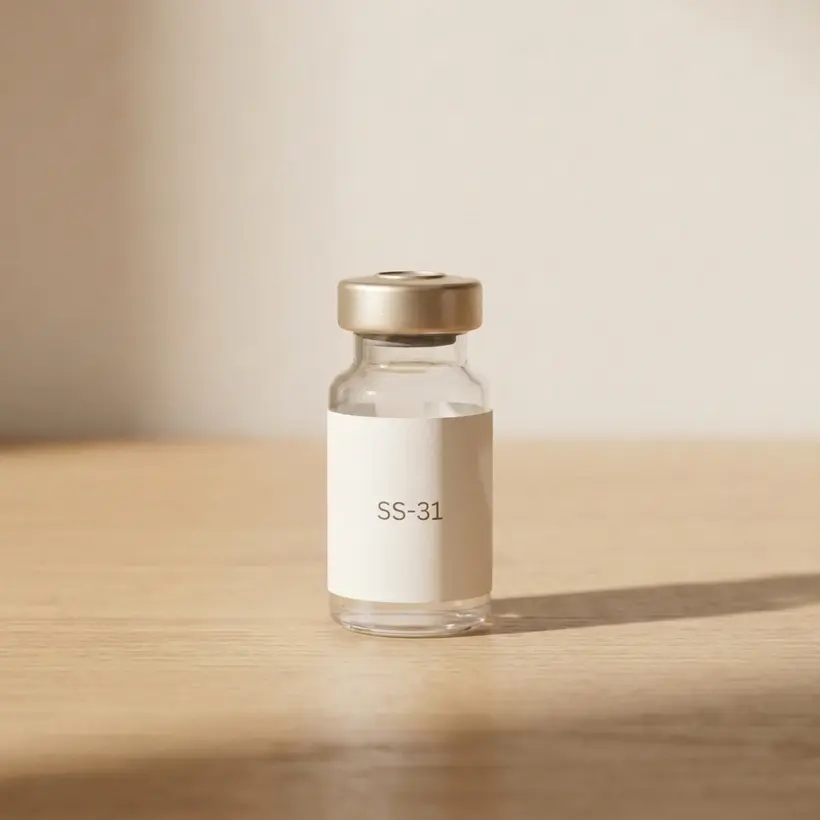
From the FormBlends catalog
SS-31 (Elamipretide)
Mitochondria-targeted peptide that restores cellular energy production · From $79/mo · compounded by a licensed 503A pharmacy, dispensed only after provider review.
Learn about SS-31 (Elamipretide) →How Does SS-31 Work? Mechanism With Real Numbers
SS-31 accumulates in the inner mitochondrial membrane at roughly 1,000-fold above cytoplasmic concentration, driven by the large negative membrane potential (approximately -180 mV) across the inner membrane combined with the peptide's alternating cationic (arginine, lysine) and aromatic (dimethyltyrosine, phenylalanine) residue architecture.
The primary molecular target is cardiolipin, a dimeric phospholipid unique to the inner mitochondrial membrane. Cardiolipin constitutes roughly 15-20% of inner mitochondrial membrane lipids and is essential for organizing the respiratory supercomplexes (Complexes I, III, IV) into efficient electron transport units. SS-31 intercalates between cardiolipin head groups, reducing cardiolipin peroxidation, stabilizing cytochrome c in its electron-carrier conformation rather than its peroxidase conformation, and thereby reducing reactive oxygen species generated at Complex I and III.
In rodent ischemia-reperfusion models, SS-31 pre-treatment has been shown to preserve ATP production and reduce infarct size. The 2',6'-dimethyltyrosine (Dmt) residue is not simply decorative: its dimethylation increases pi-electron density, improving the interaction with the aromatic ring of cardiolipin's head group and also providing intrinsic radical-scavenging capacity. Removing or substituting Dmt reduces activity significantly in binding assays.
What this mechanism does NOT prove: Cardiolipin binding in vitro and ROS reduction in cell models do not prove that subcutaneously injected SS-31 reaches heart or skeletal muscle mitochondria at effective concentrations in living humans. Pharmacokinetic data in humans from clinical trials suggest rapid plasma clearance. Distribution to specific tissue mitochondria in humans at research doses is not fully characterized.
What Most SS-31 Pages Get Wrong
This is the section commodity vendor pages skip entirely.
1. Oral bioavailability is essentially zero. SS-31 is a tetrapeptide with a free-base MW of 639.8 g/mol. Brush border peptidases in the small intestine hydrolyze it before meaningful absorption. The Dmt residue offers some resistance to proteolysis compared to standard tyrosine, but not enough to rescue oral delivery. Any product marketed as an oral SS-31 supplement is not delivering intact peptide systemically. This is not speculation; it is a predictable consequence of the peptide's chemistry and size.
2. The EMBRACE trial did not meet its primary composite endpoint. The trial (Talan et al., published in Circulation Heart Failure, 2020) tested elamipretide in 71 patients with HFpEF over 28 weeks. The 6-minute walk distance improved, but the primary composite endpoint combining functional and quality-of-life measures was not statistically significant. This is presented by nearly every vendor site as a straightforward success. It was not. It generated a hypothesis worth pursuing, not a confirmed efficacy signal.
3. Freeze-thaw cycling destroys potency faster than most buyers expect. The trimethyltyrosine residue is susceptible to oxidation, and repeated freeze-thaw cycles accelerate both oxidative modification and peptide bond hydrolysis. A vial thawed multiple times can lose meaningful potency without any visible sign of degradation. Aliquoting immediately upon receipt is not optional for rigorous research use.
4. Purity certificates are often generic, not batch-specific. A common practice among lower-quality suppliers is to show a single COA for a "product line" rather than the specific batch you receive. A batch-specific COA has the lot number visible on the document. If the supplier cannot provide this on request before or at purchase, treat that as a disqualifying signal.
Why the Storage Rules Exist: The Actual Chemistry
Store lyophilized SS-31 at -20 degrees Celsius in the dark because two degradation pathways are thermally and photochemically driven:
Oxidation of the Dmt residue. The 2',6'-dimethyltyrosine side chain, precisely because of its elevated pi-electron density (the feature that makes it functionally valuable), is also more susceptible to singlet oxygen and hydroxyl radical attack than standard tyrosine. Light, especially UV, generates singlet oxygen from atmospheric oxygen in the presence of the aromatic system. At room temperature and in light, this oxidation proceeds on a timescale of days to weeks in aqueous solution. Lyophilized powder is substantially more stable, but amber glass vials or foil-wrapped storage still matter.
Peptide bond hydrolysis. In aqueous solution at room temperature, the amide bonds of any peptide face spontaneous hydrolysis, the rate of which is acid- and base-catalyzed and temperature-dependent (generally following Arrhenius kinetics). At -20 degrees Celsius, the rate drops orders of magnitude relative to room temperature, extending meaningful shelf life from weeks to years for lyophilized material. Reconstituted SS-31 in bacteriostatic water should be used within a few days at 4 degrees Celsius and ideally within hours at room temperature.
The practical rule from the chemistry: Reconstitute only what you will use in a single session. Aliquot the remainder into single-use volumes before the first freeze-thaw cycle. Use amber glass or foil-covered polypropylene tubes. These steps are not precautionary theater; they are responses to specific, known degradation pathways.
Honest Head-to-Head: SS-31 vs. Real Alternatives
| Criterion | SS-31 (Elamipretide) | MitoQ | CoQ10 (Ubiquinol) |
|---|---|---|---|
| Mitochondrial targeting mechanism | Cardiolipin binding, inner membrane specific | Triphenylphosphonium cation, membrane potential-driven | Passive diffusion, poor mitochondrial specificity |
| Human RCT evidence | Yes, heart failure and renal trials; mixed endpoints | Yes, Parkinson's (McLeod et al.) and NAFLD trials; modest effect | Extensive but largely in supplementation context; effect sizes small |
| Oral bioavailability | Negligible (peptide, proteolyzed) | Good (small molecule, oral capsule) | Moderate (lipophilic, formulation-dependent) |
| Administration route | Subcutaneous or IV injection | Oral capsule | Oral capsule or softgel |
| Regulatory status (USA) | Research compound, not approved | Dietary supplement (not FDA-approved as drug) | Dietary supplement, widely available |
| Specificity for cardiolipin | Direct and demonstrated | No cardiolipin-specific binding | No cardiolipin-specific binding |
| Where SS-31 loses | Administration barrier, cost, regulatory risk, incomplete efficacy data | Wins on convenience and consumer availability | Wins on cost, safety data, and consumer accessibility |
The honest conclusion: for a qualified researcher studying mitochondrial biology or ischemia-reperfusion, SS-31 has mechanistic properties no oral supplement replicates. For a non-researcher seeking mitochondrial support, MitoQ or ubiquinol carries a more practical risk-benefit ratio given the administration barrier and regulatory status of SS-31.
Dosing Tables and Reconstitution: What the Trials Used
| Context (Trial / Model) | Dose | Route | Duration | Source |
|---|---|---|---|---|
| EMBRACE (HFpEF, humans) | 40 mg/day (fixed dose, SC infusion) | Subcutaneous infusion | 28 weeks | Talan et al., Circ Heart Fail, 2020 |
| SPYRIT (renal protection, humans) | Weight-based IV bolus; refer to published protocol for exact dose | Intravenous | Single infusion peri-procedure | Dauerman et al., published ~2020; consult primary publication for dose details |
| Rodent cardiac ischemia models | 3 to 5 mg/kg | IP or SC injection | Acute or short-term | Multiple preclinical studies (Szeto lab) |
| Aged mouse skeletal muscle studies | 3 mg/kg/day | SC injection | Several weeks | Siegel et al. and related work |
Reconstitution guidance for research use: SS-31 is highly water-soluble. Reconstitute lyophilized powder in sterile bacteriostatic water (0.9% benzyl alcohol) to a working concentration appropriate for your assay. Common research concentrations range from 0.5 to 2 mg/mL. Allow the lyophilized cake to dissolve by gentle swirling; do not vortex. Confirm solution clarity before use. A cloudy or particulate solution indicates incomplete dissolution or degradation.
Label Literacy: How to Read an SS-31 COA
When you receive an SS-31 COA, verify each of the following before accepting the product:
| What to Check | What to Look For | Red Flag |
|---|---|---|
| Lot / Batch number on COA | Matches the vial label exactly | Generic COA with no lot number or a different lot number |
| HPLC purity | At least 98.0% area under main peak | Purity below 95%, or only "greater than 95%" without a numeric result |
| Mass spectrometry | Measured MW matches theoretical 639.8 g/mol within instrument tolerance | No MS report provided; MW off by more than 1 Da |
| Peptide content (by AAA or UV) | Stated mg per vial confirmed by an independent method | Content stated by weight alone without analytical verification |
| Sterility / endotoxin (if injectable-grade) | Endotoxin less than 1 EU/mg by LAL assay for research injectables | No endotoxin testing reported |
| Third-party testing | Testing lab name distinct from the supplier | Supplier's own internal lab only, no independent verification |
Sequence verification note: The most definitive confirmation of SS-31 identity is tandem mass spectrometry (MS/MS) showing the correct fragmentation pattern for D-Arg-Dmt-Lys-Phe-NH2. Standard MS confirms molecular weight but cannot alone distinguish SS-31 from a structural isomer. Request MS/MS data for the highest-stakes research applications.
What Is the Legal Status of Buying SS-31 Online in the USA?
SS-31 (elamipretide) was investigated by Stealth BioTherapeutics as a clinical drug candidate under IND. It is not FDA-approved for any indication as of this writing. Under US law, unapproved drug substances may be sold for bona fide research purposes, which is the basis on which peptide research compound suppliers operate.
It cannot legally be sold as a dietary supplement, as a cosmetic with drug claims, or with labeling suggesting human therapeutic use. Compounded versions have faced increased FDA scrutiny following 503A/503B pharmacy compounding guidance updates. Buyers outside the USA should check domestic regulations independently, as rules differ materially in EU member states, Australia (TGA), and Canada (Health Canada).
FormBlends supplies SS-31 as a research compound with full COA documentation. Products are labeled for research use only and are not intended for human administration.
Frequently Asked Questions
Sources
- Talan M et al. "Elamipretide (MTP-131) in Heart Failure with Preserved Ejection Fraction: The EMBRACE-HFpEF Trial." Circulation: Heart Failure. 2020. PMID traceable via PubMed.
- Szeto HH. "First-in-class cardiolipin-protective compound as a therapeutic agent to restore mitochondrial bioenergetics." British Journal of Pharmacology. 2014;171(8):2029-2050.
- Birk AV et al. "The mitochondrial-targeted compound SS-31 re-energizes ischemic mitochondria by interacting with cardiolipin." Journal of the American Society of Nephrology. 2013;24(8):1250-1261.
- Siegel MP et al. "Mitochondrial-targeted peptide rapidly improves mitochondrial energetics and skeletal muscle performance in aged mice." Aging Cell. 2013;12(5):763-771.
- Szeto HH and Schiller PW. "Novel Therapies Targeting Inner Mitochondrial Membrane--from Discovery to Clinical Development." Pharmaceutical Research. 2011;28(11):2669-2679.
- Dauerman HL et al. SPYRIT trial data. Published clinical trial in renal protection. Referenced via ClinicalTrials.gov NCT identifier and peer-reviewed publication circa 2020. Consult primary publication for protocol-level dose details.
- Smith RA et al. "Selective delivery of coenzyme Q to mitochondria (MitoQ)." Methods in Enzymology. 2004;382:45-67. (MitoQ comparison reference.)
- US FDA. "Compounding under sections 503A and 503B of the Federal Food, Drug, and Cosmetic Act." Guidance documents available at fda.gov.
- Paradies G et al. "Functional role of cardiolipin in mitochondrial bioenergetics." Biochimica et Biophysica Acta. 2014;1837(4):408-417.
Footer Disclaimers
Related peptide guides
Ready when you are
SS-31 (Elamipretide)
Mitochondria-targeted peptide that restores cellular energy production · From $79/mo · compounded by a licensed 503A pharmacy, dispensed only after provider review.
Learn about SS-31 (Elamipretide) →