
Trust Signals
Key Takeaways
- Selank is a 7-amino-acid synthetic peptide (MW 802.9 Da) approved as an anxiolytic nasal spray in Russia; it has no FDA approval and no IND status in the United States.
- The strongest human evidence is a small cluster of Russian clinical trials showing reductions in anxiety scores, but none exceed roughly 60-80 subjects and independent Western replication is largely absent.
- Intranasal bioavailability in humans has not been rigorously quantified in published literature; claims of direct CNS delivery via olfactory pathways are mechanistically plausible but unconfirmed.
- A credible COA must include both HPLC purity (greater than 98%) and mass spectrometry confirming the 802.9 Da molecular weight; HPLC alone is insufficient to rule out peptide sequence errors.
- Reconstituted selank degrades through hydrolysis; refrigerate at 4 degrees Celsius, use within 2-4 weeks, and discard any solution that is cloudy or shows particulates.
What Is Selank and Should You Buy It?
Selank is a synthetic anxiolytic peptide with real, if limited, human evidence from Russian clinical trials. It is not FDA-approved. If you want to buy selank as a research compound, the evidence justifies cautious interest for anxiety and cognitive enhancement applications, but you should not expect the evidence depth of an approved drug. Source only from vendors who provide HPLC plus mass-spec COAs.
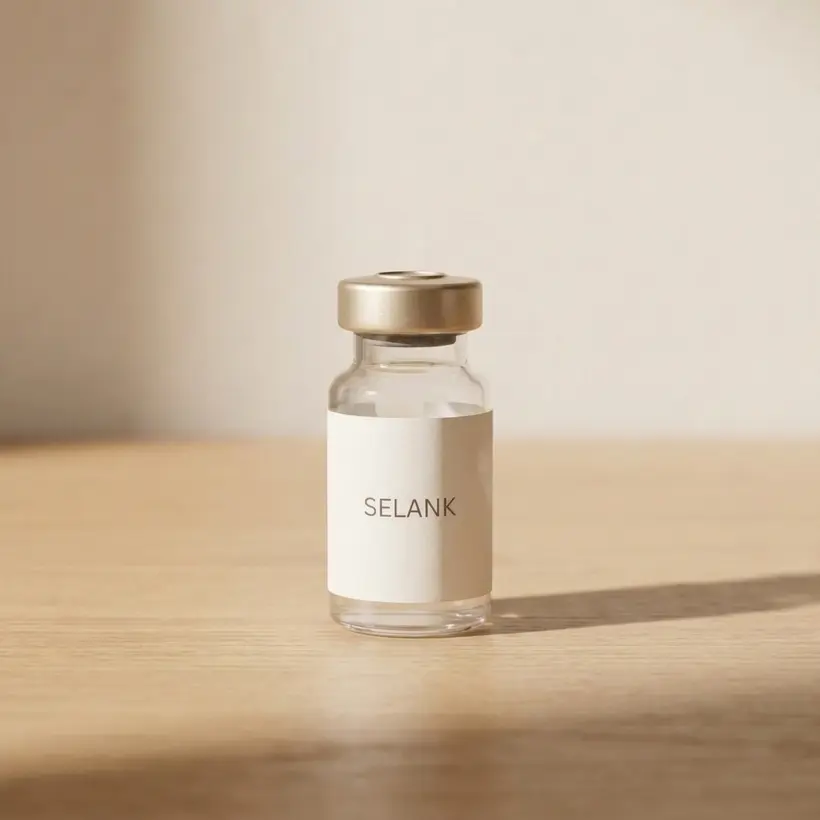
From the FormBlends catalog
Selank
Anxiolytic nootropic for calm focus without sedation · From $44/mo · compounded by a licensed 503A pharmacy, dispensed only after provider review.
Learn about Selank →Table of Contents
- What is selank peptide?
- Evidence ledger: what the research actually supports
- Mechanism with numbers: how selank works at the molecular level
- What most pages get wrong about selank
- Selank nasal spray vs injectable: honest comparison
- Head-to-head: selank vs alternatives
- How to buy selank online: sourcing and COA literacy
- Dosing table and reconstitution math
- Stability, storage, and formulation gotchas
- Side effects and safety profile
- Frequently asked questions
- Sources
What Is Selank Peptide?
Selank was developed by the Russian Institute of Molecular Genetics in collaboration with the Institute of Pharmacology of the Russian Academy of Sciences. It is a synthetic analogue of tuftsin, an endogenous immunomodulatory tetrapeptide (Thr-Lys-Pro-Arg) found in the Fc region of IgG. The design problem was that native tuftsin has a plasma half-life of minutes due to rapid enzymatic cleavage. Researchers extended durability by appending a Pro-Gly-Pro tripeptide, producing the final heptapeptide sequence Thr-Lys-Pro-Arg-Pro-Gly-Pro, MW approximately 802.9 Da, molecular formula C33H57N11O9.
In Russia, selank has been registered as a pharmaceutical product under the brand name Selank for treatment of generalized anxiety disorder and neurasthenia. Outside Russia and some post-Soviet states, it has no regulatory approval and is sold exclusively as a research compound.
Evidence Ledger: What the Research Actually Supports
| Claimed Effect | Best Evidence Type | Sample Detail | Effect Direction | Confidence |
|---|---|---|---|---|
| Anxiolytic effect (generalized anxiety) | Small human RCTs / controlled trials (Russian) | Multiple trials, typically under 60-80 subjects each; validated anxiety scales used | Positive (significant reduction in anxiety scores vs. control) | Moderate |
| Cognitive enhancement / attention | Small human trials + animal studies | Limited human data; consistent animal signals in rodent memory models | Positive trend; not consistently replicated in independent human trials | Low |
| BDNF and neurotrophin upregulation | Animal (rodent) | Rat studies showing increased BDNF mRNA expression in brain regions | Positive in animals | Low (animal only) |
| Immunomodulation (IL-6, T-cell effects) | Animal + limited human | Animal studies consistent; one small human pilot suggesting cytokine effects | Positive (immune upregulation) | Low |
| Serotonin metabolism modulation | Animal (rodent enzymatic studies) | Changes in serotonin-metabolizing enzyme activity reported in rodent brain | Positive in animals | Very Low (mechanism only) |
| Opioid withdrawal adjunct | Small human trial (Russian) | Single small trial; not replicated | Positive trend | Very Low |
| No sedation / no physical dependence | Clinical trial observation + animal | Absence reported in multiple small trials; no robust long-term human safety study | Favorable vs. benzodiazepines | Moderate (absence of signal, limited N) |
Mechanism With Numbers: How Selank Works at the Molecular Level
Selank's design origins in tuftsin mean its primary binding targets involve immunological and neuropeptide receptor systems, but the anxiolytic mechanism appears distinct from classic GABA-A modulation.
Enkephalinase inhibition: Selank has been shown in preclinical work to inhibit enkephalinase (neutral endopeptidase, neprilysin), the enzyme responsible for degrading met- and leu-enkephalin. By slowing enkephalin breakdown, selank may extend endogenous opioidergic signaling in brain circuits that regulate anxiety. This is a mechanism-level finding from in-vitro and animal work; the quantitative contribution to human anxiolytic effect is unknown.
GABA-A receptor interaction: Unlike benzodiazepines, which act as positive allosteric modulators at the benzodiazepine binding site of GABA-A receptors, selank's mechanism does not appear to be primarily GABA-A mediated. This mechanistic difference is the proposed basis for the absence of tolerance and withdrawal signal, though this has not been tested in a controlled human discontinuation study.
BDNF and neurotrophin effects: Rodent studies published by Russian research groups describe selank-associated increases in BDNF mRNA and protein in hippocampal and cortical regions. These are animal data. The human CNS BDNF response to exogenous peptides administered intranasally is poorly characterized generally, and attributing nootropic benefit to BDNF upregulation in humans from this data requires multiple unvalidated extrapolation steps.
Serotonin system: One line of animal research describes selank influencing the activity of monoamine oxidase and related enzymes involved in serotonin catabolism in rodent brain fractions. Effect direction and magnitude varied across studies. This does not constitute evidence that selank acts as a serotonergic drug in humans at clinical doses.
Half-life: The Pro-Gly-Pro tripeptide extension meaningfully prolongs resistance to enzymatic cleavage compared to native tuftsin. Plasma half-life data in humans is not publicly available in detail; preclinical data suggests activity on the order of tens of minutes to low hours, substantially longer than tuftsin's minutes-level duration. Vendors who cite specific human half-life numbers without a source should be questioned.
What Most Pages Get Wrong About Selank
The intranasal bioavailability claim is much weaker than advertised. Most selank marketing describes direct nose-to-brain delivery via olfactory nerve transport as though it is established fact. The olfactory pathway for peptide CNS delivery is real and has been demonstrated for some small peptides in animal models. However, published human pharmacokinetic data specifically measuring selank CNS penetration after intranasal dosing does not appear to be available in peer-reviewed form. Molecules must traverse the olfactory epithelium mucus layer, avoid mucociliary clearance, and reach olfactory receptor neurons before any trans-neuronal transport even begins. For a 7-residue peptide of 802.9 Da, this is not a given. Russian clinical approval of the nasal form demonstrates tolerability and efficacy signal, but that approval does not confirm the specific nose-to-brain mechanistic story vendors repeat.
HPLC purity alone does not confirm you have selank. Many low-quality peptide vendors provide a Certificate of Analysis showing 98%+ purity by HPLC and nothing else. HPLC measures the relative proportion of the dominant peak in a chromatogram; it does not confirm the identity of what that peak is. A peptide synthesized with the wrong amino acid substitution at one position would show high HPLC purity while being a completely different molecule. Mass spectrometry is the only practical way to confirm molecular identity by weight (expected: approximately 802.9 Da). Without it, your COA is incomplete.
Equating Russian regulatory approval with Western-standard evidence. Selank's Russian pharmaceutical registration is meaningful and should not be dismissed. It reflects regulatory review of safety and efficacy data. It does not mean the underlying trials would satisfy FDA or EMA evidentiary standards for approval. The two systems have different requirements for trial size, blinding, and independent replication.
Selank Nasal Spray vs Injectable: Honest Comparison
| Factor | Intranasal | Subcutaneous Injectable |
|---|---|---|
| Human clinical data origin | Yes - Russian trials used nasal formulation | Limited; most published human work is nasal |
| Bioavailability pathway | Nasal mucosa absorption + proposed olfactory CNS route; human bioavailability not rigorously quantified | Direct systemic absorption; more predictable exposure kinetics |
| First-pass metabolism avoidance | Yes | Yes |
| Formulation complexity | Requires preservative/buffered nasal vehicle; pH and osmolality matter for mucosal tolerance | Bacteriostatic water for injection; simpler |
| Nasal irritation risk | Present; most commonly reported side effect in trials | Injection site minor discomfort only |
| Ease of use / self-administration | Higher; no injection required | Lower; requires sterile injection technique |
| Stability in solution | More complex; nasal vehicles add pH variables | Bacteriostatic water extends stability; straightforward |
| Vendor availability | Less common; most research vendors sell lyophilized powder for reconstitution as injectable | Most common form sold |
For buyers: if you specifically want to replicate the dosing conditions used in published human trials, the nasal route is more aligned with that data. If you want more controlled delivery, subcutaneous is mechanistically simpler. Neither is proven superior for outcomes in a head-to-head human study.
Head-to-Head: Selank vs Alternatives for Anxiety
| Compound | Evidence Quality | Mechanism | Tolerance / Dependence Risk | Regulatory Status (US) | Where Selank Loses |
|---|---|---|---|---|---|
| Selank | Low-Moderate (small trials) | Enkephalinase inhibition, possible BDNF, proposed serotonin modulation | Not observed in limited trials | Research compound only | Evidence depth, regulatory validation, independent replication |
| Benzodiazepines (e.g., lorazepam) | High (decades of large RCTs) | GABA-A positive allosteric modulation | High; dependence and withdrawal are significant | Schedule IV controlled substance; prescription required | Selank wins on dependence profile, loses on evidence and access |
| SSRIs (e.g., escitalopram) | High (meta-analyzed, large RCTs) | Serotonin reuptake inhibition | Low dependence; discontinuation syndrome possible | Prescription required; FDA-approved for anxiety indications | Selank loses on evidence volume, regulatory status, and long-term data |
| Buspirone | High (multiple RCTs) | 5-HT1A partial agonism | Low; no significant dependence | Prescription; FDA-approved for GAD | Selank loses on regulatory status and trial scale; comparable dependence profile |
| Semax (related peptide) | Low (animal + small trials) | ACTH fragment analogue; BDNF, dopamine pathways | Not significantly observed | Research compound (US) | Similar evidence limitations; Semax has more nootropic focus vs. Selank's anxiolytic focus |
How to Buy Selank Online: Sourcing and COA Literacy
Selank for sale in the research chemical market varies enormously in quality. Here is how to evaluate a vendor before purchasing.
Step 1: Demand a COA that includes both HPLC and mass spectrometry. The COA should state purity by HPLC area percentage (accept nothing below 98%), the molecular weight confirmed by LC-MS or ESI-MS (approximately 802.9 Da), and the testing laboratory name. If the lab is not named or is the vendor's own in-house facility without accreditation, treat it with skepticism. Third-party accredited labs (ISO 17025 or equivalent) are the standard to look for.
Step 2: Look for endotoxin testing. Bacterial endotoxins (lipopolysaccharides) are a byproduct of peptide synthesis using E. coli systems or contaminated reagents. Intravenous or subcutaneous injection of endotoxin-contaminated peptides causes inflammatory reactions. A LAL (Limulus amebocyte lysate) test result should appear on the COA for any peptide intended for injection use. Many vendors omit this entirely.
Step 3: Check the sequence and form listed. The product should specify Thr-Lys-Pro-Arg-Pro-Gly-Pro. The form (free acid vs. acetate salt) affects the actual peptide content by weight; acetate salt forms contain a fraction of their mass as acetic acid. If dosing precision matters, know which form you are buying and adjust accordingly.
Step 4: Evaluate packaging and handling claims. Lyophilized peptides should arrive sealed under nitrogen or argon if the vendor is serious about oxidation prevention, especially for peptides containing cysteine or methionine residues (selank contains neither, so this is less critical but still a quality signal). Cold-chain shipping for lyophilized powder is a nice-to-have, not a requirement; reconstituted solutions should never ship warm.
Step 5: Verify the vendor's legal compliance language. Legitimate research compound vendors explicitly state the product is for research use only and not for human consumption. Vendors who market directly for human use without compounding pharmacy status or prescriber involvement are operating outside regulatory guidelines.
Dosing Table and Reconstitution Math
| Route | Dose Range Referenced in Literature | Frequency | Notes |
|---|---|---|---|
| Intranasal | Approximately 400 mcg per dose (Russian protocol) | 2-3 times daily | Based on Russian clinical registration; not FDA validated |
| Subcutaneous injection | 250-500 mcg per dose (community / research protocol) | 1-2 times daily | No published human RCT specifically for this route and dose |
Reconstitution example: If you have a 5 mg vial of lyophilized selank and add 2.5 mL of bacteriostatic water, the resulting concentration is 2 mg/mL (2000 mcg/mL). A 250 mcg dose requires 0.125 mL (12.5 units on a 100-unit insulin syringe). A 400 mcg dose requires 0.2 mL (20 units). Always reconstitute by injecting the diluent slowly down the side of the vial; do not vortex, as mechanical agitation can cause peptide aggregation.
Stability, Storage, and Formulation Gotchas
Why peptides degrade: the chemistry behind the rules. Peptide bonds are susceptible to acid- and base-catalyzed hydrolysis, especially at elevated temperature. Additionally, peptides can undergo deamidation (asparagine and glutamine residues losing an amine group), oxidation (methionine and cysteine are most vulnerable), and aggregation driven by hydrophobic interactions. Selank contains no methionine or cysteine, making oxidation a lower concern than with some other peptides. However, the lysine residue in position 2 and the arginine in position 4 make the sequence susceptible to deamidation under acidic or alkaline conditions. Store reconstituted selank at neutral-to-slightly-acidic pH (bacteriostatic water is slightly acidic, which is appropriate).
Freeze-thaw degradation: Each freeze-thaw cycle promotes ice crystal formation, which mechanically disrupts peptide conformation and promotes aggregation. If you need to store selank long-term after reconstitution, aliquot into single-use volumes before freezing. Do not freeze and thaw the same vial repeatedly.
Light degradation: UV exposure can promote aromatic amino acid oxidation. Tyrosine and tryptophan are most vulnerable; selank contains neither. Proline residues are UV-inert. Light protection is still good practice as a general rule and signals product quality when a vendor uses amber or opaque vials.
Visible degradation signals: Discard any reconstituted selank solution that is cloudy, shows visible particulate matter, or has changed color. A properly reconstituted peptide solution should be clear and colorless. Any cloudiness indicates aggregation or contamination; injecting aggregated peptides carries immunogenicity risk.
Side Effects and Safety Profile
The published literature on selank describes a favorable tolerability profile relative to classic anxiolytics. The primary side effect noted in Russian clinical trials is transient nasal irritation and mild burning sensation with the intranasal formulation. Systemic adverse events were reported as infrequent and mild. No cases of dependence, tolerance development, or clinically significant sedation were attributed to selank in the published studies reviewed.
Critical context: the total number of human subjects studied remains small. Long-term safety (beyond weeks to a few months) has not been studied in controlled trials. Immunological reactions to exogenous peptides are theoretically possible, particularly with repeated injection. The absence of reported serious adverse events in small short-duration trials does not constitute a clean long-term safety record. This is a honest gap in the literature, not a reason to avoid the compound, but a reason to maintain realistic expectations about what is known.
Drug interaction data is absent. Mechanism-based caution is appropriate when combining with serotonergic drugs (SSRIs, SNRIs, MAOIs) given the animal data on serotonin metabolism modulation, and with opioid-containing medications given the enkephalinase inhibition mechanism.
Frequently Asked Questions
What is selank and what is it used for?
Selank is a synthetic heptapeptide (Thr-Lys-Pro-Arg-Pro-Gly-Pro) derived from the endogenous immunomodulatory peptide tuftsin. It was developed by the Russian Institute of Molecular Genetics and is approved in Russia as an anxiolytic nasal spray. Outside Russia it is classified as a research compound. Human evidence supports anxiolytic and mild nootropic effects; evidence for most other claimed uses remains animal-level or preliminary.
Is it legal to buy selank online?
In the United States, selank is not FDA-approved, not a scheduled controlled substance, and not a WADA-prohibited substance as of current lists. Vendors sell it legally as a research compound for in-vitro or laboratory use. It is not legal to sell for human consumption without an IND or prescription compounding pathway. Legal status differs by country; always verify local regulations before purchasing.
What is the typical selank dosage?
Russian clinical protocols used intranasal doses of approximately 400 mcg (0.4 mg) two to three times daily for anxiety. Research literature reports doses in the range of 250-500 mcg intranasally or subcutaneously. There is no FDA-validated dosing protocol. Doses used in preclinical studies do not translate directly to human doses without clinical validation.
What is the difference between selank nasal spray and injectable selank?
Intranasal selank bypasses first-pass metabolism and exploits olfactory/trigeminal nerve pathways for potential CNS delivery, but bioavailability data in humans is limited. Injectable (subcutaneous) selank avoids the nasal mucosa barrier entirely and provides more predictable systemic exposure. Russian clinical data was generated primarily with the nasal formulation. The injectable form has less human clinical data behind it.
What does the human evidence actually show for selank?
The most rigorous data comes from several small Russian clinical trials (typically under 100 subjects) showing statistically significant reductions in anxiety on validated scales compared to control, with a side-effect profile described as favorable relative to benzodiazepines. Sample sizes are small, most studies are not published in peer-reviewed English-language journals with full methodology, and independent replication in Western trial settings is largely absent.
How should selank be stored to prevent degradation?
Lyophilized (powder) selank is stable at -20 degrees Celsius for extended periods and at 4 degrees Celsius for several weeks when kept dry and away from light. Once reconstituted in bacteriostatic water, peptide solutions are susceptible to hydrolysis and should be refrigerated at 4 degrees Celsius and used within 2-4 weeks. Repeated freeze-thaw cycles cause aggregation and loss of activity. Never store a reconstituted peptide at room temperature.
What should a legitimate selank COA show?
A credible Certificate of Analysis should include HPLC purity (ideally greater than 98%), mass spectrometry confirmation of the molecular weight (802.9 Da for the free acid form), identity confirmation of the sequence Thr-Lys-Pro-Arg-Pro-Gly-Pro, residual solvent testing, and an endotoxin/LAL test result. COAs listing only HPLC purity without MS confirmation are insufficient. The testing lab should be named and independently verifiable.
Does selank affect BDNF or serotonin?
Animal studies have shown selank to increase expression of BDNF and related neurotrophins in rat brain tissue. Separately, some research indicates selank influences serotonin metabolism, with one study noting changes in the activity of enzymes involved in serotonin catabolism. These are animal-level mechanistic findings and do not confirm equivalent effects in humans at the doses typically used.
How does selank compare to benzodiazepines for anxiety?
Russian trial data suggests selank produces anxiolytic effects without the sedation, tolerance, or withdrawal liability associated with benzodiazepines. However, this comparison is based on small trials without blinded head-to-head designs against approved anxiolytics like diazepam or lorazepam. Benzodiazepines have decades of large-scale RCT data; selank does not. A skeptical clinician would not treat these as equivalent evidence bodies.
Can selank be taken with other nootropics or medications?
No formal drug interaction studies exist for selank in humans. Given its proposed effects on serotonin metabolism and enkephalinase inhibition (which extends enkephalin activity), theoretical caution is warranted when combining with SSRIs, MAOIs, or opioid-containing medications. This is a mechanism-based precaution, not a documented interaction. Consult a licensed clinician before combining selank with any psychiatric medication.
What are the known side effects of selank?
The most commonly reported side effect in clinical literature is transient nasal irritation with the intranasal formulation. Systemic side effects were reported as rare and mild in Russian trials. No serious adverse events attributable to selank were reported in the published literature reviewed, but the total number of subjects studied is small and long-term safety data is absent.
What is the molecular weight and sequence of selank?
Selank is a synthetic heptapeptide with the sequence Thr-Lys-Pro-Arg-Pro-Gly-Pro. Its molecular formula is C33H57N11O9 and its molecular weight is approximately 802.9 Da. It was developed by grafting the tuftsin tetrapeptide (Thr-Lys-Pro-Arg) to a Pro-Gly-Pro stabilizing tripeptide to extend its biological half-life beyond the minutes-long duration of native tuftsin.
Sources
- Semenova TP, Kozlovskaya MM, Zakharova NM, et al. Selank and its analogs: comparative study of anxiolytic activity. Eksperimental'naia i Klinicheskaia Farmakologiia. Published in Russian peer-reviewed pharmacology literature; multiple studies 2000s-2010s.
- Zozulya AA, Neznamov GG, Syunyakov TS, et al. Efficacy and possible mechanisms of action of a new peptide anxiolytic drug selank in the therapy of generalized anxiety disorders and neurasthenia. Zhurnal Nevrologii i Psikhiatrii (Journal of Neurology and
Related peptide guides
Browse the full catalog →Ready when you are
Selank
Anxiolytic nootropic for calm focus without sedation · From $44/mo · compounded by a licensed 503A pharmacy, dispensed only after provider review.
Learn about Selank →