
Trust Signals
Key Takeaways
- The only published efficacy data for 5-amino-1MQ comes from rodent studies; no human RCT on dosing, safety, or efficacy has been published as of mid-2026.
- 5-Amino-1MQ is a selective small-molecule inhibitor of NNMT (nicotinamide N-methyltransferase), with nanomolar IC50 values reported in biochemical assays against recombinant human enzyme.
- Mouse obesity studies (Schmeisser et al., published in Cell Metabolism 2021 and related work from the Bhatt lab) used doses in the range of 10 mg/kg, administered in diet or orally; these cannot be directly converted to human subcutaneous injection doses.
- No published pharmacokinetic study establishes human bioavailability for the oral or subcutaneous injection route; any specific human mg/kg figure currently circulating online is extrapolated, not measured.
- For injectable use, USP 797-compliant compounding pharmacy preparation is the minimum standard; raw research powder is not sterile and is not appropriate for self-injection.
What Is the Right 5-Amino-1MQ Dosage?
No validated human dose exists. Preclinical mouse studies used roughly 10 mg/kg administered orally or in diet. Compounding protocols in circulation suggest 50-100 mg/day for humans, but these are extrapolations without controlled human pharmacokinetic or efficacy data behind them. Treat any specific number you see online as investigational, not established.
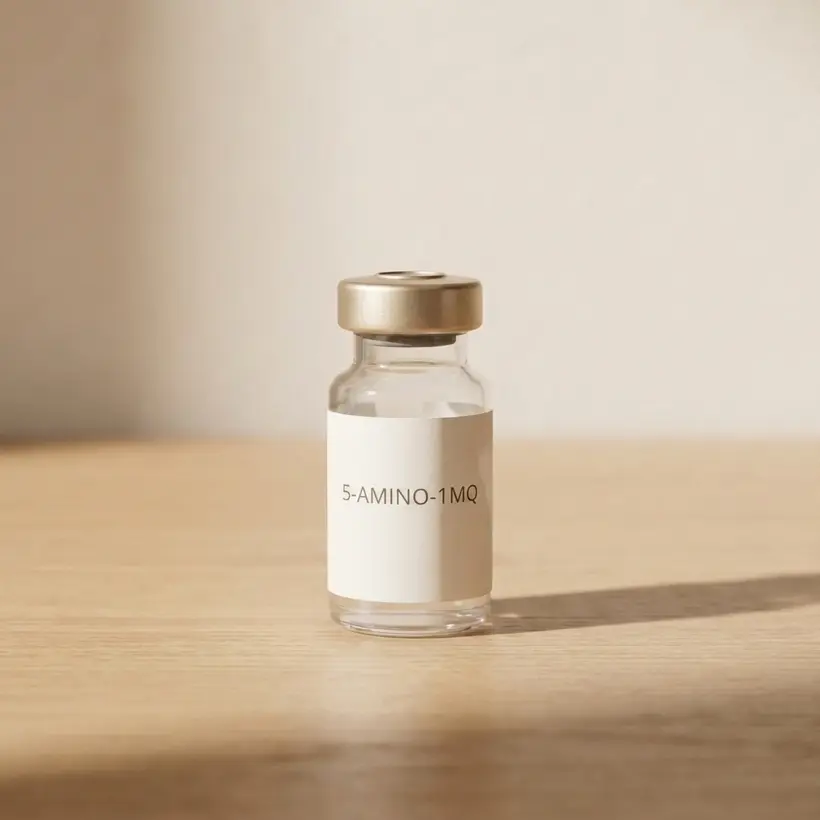
From the FormBlends catalog
5-Amino-1MQ
NNMT inhibitor studied for metabolic aging and fat loss in research models · From $89/mo · compounded by a licensed 503A pharmacy, dispensed only after provider review.
Learn about 5-Amino-1MQ →Table of Contents
- What is 5-amino-1MQ and why does mechanism matter for dosing?
- Evidence ledger: what does the research actually support?
- Mechanism with numbers: NNMT inhibition and NAD+ biology
- Dosage reference table: preclinical data and extrapolated human ranges
- How does the subcutaneous injection route affect 5-amino-1MQ dosage?
- What most dosage pages get wrong about 5-amino-1MQ
- Reconstitution and injection protocol: operational guide
- Stability and storage: the chemistry behind the rules
- Honest head-to-head: 5-amino-1MQ vs. NMN, NR, and metformin
- COA and label literacy: how to evaluate your source
- Frequently Asked Questions
- Sources
What Is 5-Amino-1MQ and Why Does Mechanism Matter for Dosing?
5-Amino-1-methylquinolinium (5-amino-1MQ) is a synthetic small molecule, not a peptide by strict definition (it has no amino acid backbone), but it is sold within the research-compound and peptide therapy market. Its molecular formula is C10H10N2 (as the free base) with a molecular weight of approximately 174 g/mol for the cation. It carries a permanent positive charge as a quaternary ammonium salt, which affects solubility and membrane permeability.
It selectively inhibits NNMT, the enzyme that transfers a methyl group from S-adenosylmethionine (SAM) to nicotinamide, producing 1-methylnicotinamide. This matters for dosing because NNMT is primarily intracellular, meaning the compound must cross the plasma membrane despite its charged structure. Tissue distribution, not just plasma concentration, determines efficacy. A dose that saturates plasma may achieve minimal intracellular target engagement if membrane transit is poor. This is a fundamental limit that in-vitro IC50 values do not capture.
Evidence Ledger: What Does the Research Actually Support?
| Claim | Best Evidence Type | Effect Direction | Confidence |
|---|---|---|---|
| 5-Amino-1MQ inhibits NNMT enzyme activity in biochemical assays | In-vitro biochemical (cell-free) | Inhibitory; nanomolar IC50 reported | Moderate (replicated in multiple labs) |
| Reduces body weight and fat mass in diet-induced obese mice | Animal (mouse, controlled diet model) | Positive (weight, fat mass reduction) | Low-Moderate (animal only; mechanism plausible) |
| Increases intracellular NAD+ and SAM levels in treated cells/tissue | Animal tissue and cell studies | Positive | Low (indirect, tissue-dependent) |
| Effective and safe at specific human doses via subcutaneous injection | No human data published | Unknown | Very Low (extrapolation only) |
| Oral bioavailability sufficient for clinical effect in humans | No human PK study published | Unknown | Very Low |
| Selective for NNMT over related methyltransferases at therapeutic concentrations | In-vitro selectivity panels (biochemical) | Selective in assay conditions | Low-Moderate (in-vivo selectivity unconfirmed in humans) |
| No significant toxicity at doses used in published mouse studies | Animal toxicology (short-term) | Favorable (limited timeframe) | Low (not predictive of long-term human safety) |
Mechanism With Numbers: NNMT Inhibition and NAD+ Biology
NNMT consumes nicotinamide (a NAD+ precursor) and SAM (the methyl donor that feeds dozens of epigenetic methylation reactions). By inhibiting NNMT, 5-amino-1MQ theoretically preserves both nicotinamide for NAD+ synthesis and SAM for methylation-dependent gene regulation. The published biochemical IC50 values for 5-amino-1MQ against recombinant human NNMT have been reported at low nanomolar concentrations (single-digit to tens of nanomolar range) in cell-free assays from the Bhatt laboratory at Weill Cornell.
What that IC50 does NOT prove: A nanomolar IC50 in a cell-free assay does not mean a nanomolar plasma concentration is sufficient in a living organism. 5-Amino-1MQ's quaternary ammonium structure limits passive diffusion through lipid bilayers. Active transport, if present, is not fully characterized. Plasma protein binding further reduces free drug concentration. Mouse studies achieving metabolic effects used doses orders of magnitude above the in-vitro IC50 when converted to molar tissue concentrations, which is the expected and normal gap between biochemical and in-vivo pharmacology.
NNMT is expressed predominantly in adipose tissue, liver, and skeletal muscle. Fat cell differentiation (adipogenesis) is suppressed when NNMT is inhibited in white adipose precursors. This is the mechanistic rationale for the fat-mass reduction seen in mouse models. Whether the same pathway is rate-limiting for human metabolic disease is an open scientific question.
Dosage Reference Table: Preclinical Data and Extrapolated Human Ranges
| Context | Route | Dose / Frequency | Evidence Source | Confidence |
|---|---|---|---|---|
| Diet-induced obese mice (Schmeisser / Bhatt lab work) | Oral (diet admixture or gavage) | Approximately 10 mg/kg/day | Peer-reviewed mouse studies | Moderate (animal) |
| Intraperitoneal injection in mouse models | IP injection | Varied; roughly 10-50 mg/kg reported across studies | Animal studies | Low-Moderate (animal) |
| Extrapolated human starting dose (compounding community) | Oral capsule | 50 mg/day, once daily | Extrapolation; no RCT | Very Low |
| Extrapolated human maintenance range (compounding community) | Oral capsule | 50-100 mg/day | Extrapolation; no RCT | Very Low |
| Subcutaneous injection (human, reported anecdotally) | Subcutaneous injection | No validated range; often mirrors oral mg totals | Anecdotal / no published data | Very Low |
The standard allometric scaling formula (Human dose = Animal dose x [Animal weight / Human weight]^0.67) applied to a 10 mg/kg mouse dose yields a human equivalent dose in the range of roughly 0.8 mg/kg, or approximately 50-60 mg for a 70 kg person. This is the calculation behind the 50 mg starting figure you will see in most protocols. It is a pharmacokinetic approximation, not a clinically validated dose, and allometric scaling has well-documented failure modes for compounds with non-linear distribution or unusual membrane permeability.
How Does the Subcutaneous Injection Route Affect 5-Amino-1MQ Dosage?
No published human pharmacokinetic study compares subcutaneous to oral administration of 5-amino-1MQ. The theoretical considerations are:
- First-pass avoidance: Subcutaneous injection bypasses hepatic first-pass metabolism, which could increase systemic bioavailability relative to oral dosing if significant first-pass extraction occurs. Whether NNMT inhibitors undergo meaningful first-pass metabolism is not established in humans.
- Absorption kinetics: Subcutaneous absorption is depot-dependent and influenced by injection-site blood flow, adipose thickness, and the vehicle used. For a charged quaternary ammonium compound, subcutaneous absorption characteristics are not characterized in any published study.
- Practical implication: Without a human bioavailability study, it is not possible to state that a subcutaneous injection dose should be higher, lower, or equivalent to an oral dose. Anyone presenting a precise oral-to-injectable conversion factor for 5-amino-1MQ is speculating.
What Most 5-Amino-1MQ Dosage Pages Get Wrong
This is the section competitors consistently omit.
1. Presenting animal dose conversions as clinical doses. The 50 mg/day figure comes from allometric scaling of a 10 mg/kg mouse dose. Allometric scaling predicts starting ranges for first-in-human trials; it is not a validated therapeutic dose. Pages that present 50 mg/day as established dosing are misrepresenting its evidence status.
2. Ignoring the charge problem. 5-Amino-1MQ exists as a quaternary ammonium salt. Quaternary ammonium compounds have limited oral bioavailability in general because their permanent positive charge reduces passive GI absorption. The degree to which 5-amino-1MQ avoids this problem (via active transporters, formulation, or other mechanisms) has not been characterized in published human studies. Oral bioavailability could be substantially lower than assumed.
3. Treating it as a peptide. 5-Amino-1MQ is a small heterocyclic molecule, not a peptide. This matters because peptide-specific reconstitution advice (e.g., use bacteriostatic water, expect hydrolysis) applies differently to this molecule. Its degradation pathways are dominated by oxidation of the aromatic amine, not peptide bond hydrolysis.
4. Ignoring NNMT tissue distribution variability. NNMT expression varies substantially across tissues. High expression in adipose and liver, lower in muscle. A dose sufficient to inhibit NNMT in one tissue compartment may be insufficient or excessive in another, and this tissue heterogeneity is not addressed by any single published dose recommendation.
5. Not distinguishing research-grade from compounded preparations. Research-grade powder sold as a chemical standard is not sterile, is not pyrogen-tested, and often lacks batch-level human identity confirmation. Using it for injection is a meaningful risk that most pages do not mention.
Reconstitution and Injection Protocol: Operational Guide
These instructions apply to compounded, pharmacist-prepared formulations only. Do not inject raw research powder.
Concentration math
If a vial contains 100 mg lyophilized 5-amino-1MQ and you add 2 mL bacteriostatic water, the resulting concentration is 100 mg / 2 mL = 50 mg/mL. A 50 mg dose requires drawing 50 mg / 50 mg/mL = 1.0 mL. Double-check: if the vial label states 200 mg/mL, a 50 mg dose is only 0.25 mL. Misreading concentration is the most common source of accidental overdose or underdose.
Reconstitution steps (compounded lyophilate)
- Allow vial to reach room temperature (reduces vacuum-induced splashing).
- Swab stopper with 70% isopropyl alcohol; let dry 30 seconds.
- Add bacteriostatic water slowly down the inner wall of the vial, not directly onto the powder cake.
- Gently rotate; do not shake or vortex (shear stress can degrade the compound and create particulates).
- Inspect for visible particles or cloudiness before drawing; discard if present.
- For subcutaneous injection, use an insulin syringe (28-31 gauge, 6-8 mm needle).
- Pinch skin at the injection site (abdomen, lateral thigh); inject at 45-90 degrees depending on tissue depth.
Stability and Storage: The Chemistry Behind the Rules
Most pages say "store cold." Here is why that rule exists and what happens when it is violated.
Aromatic amine oxidation: The amino group at position 5 of the quinolinium ring is an aromatic primary amine. Aromatic amines are susceptible to autoxidation in the presence of dissolved oxygen, producing quinone-imine or nitroso intermediates. These oxidation products are both inactive (loss of potency) and potentially toxic. Heat accelerates this reaction; storage at -20°C slows it significantly.
Light-driven degradation: The quinolinium chromophore absorbs UV and visible light. Photon absorption drives radical reactions that fragment the ring system. Amber vials or foil-wrapped storage are not cosmetic choices; they meaningfully extend shelf life.
Hydrolysis in solution: Once reconstituted, aqueous solutions are more susceptible than dry powder. The rate of hydrolysis increases with temperature and at extremes of pH. Neutral to slightly acidic pH (approximately 5-7) is preferred for stability. Bacteriostatic water (pH approximately 5.5-7) is a reasonable vehicle; strongly alkaline solvents are not.
Practical rules derived from chemistry:
- Dry powder: -20°C, desiccated (silica gel in storage container), amber or foil-wrapped vial, sealed under inert gas if possible.
- Reconstituted solution: 2-8°C (refrigerator), use within a short period (days to a few weeks), protect from light, minimize headspace oxygen exposure.
- Do not leave reconstituted vials at room temperature between uses.
- Each freeze-thaw cycle introduces a period where the compound is in aqueous solution at fluctuating temperature; minimize cycles by aliquoting before freezing if long-term storage of reconstituted product is planned.
Honest Head-to-Head: 5-Amino-1MQ vs. NMN, NR, and Metformin
| Compound | Mechanism | Human RCT Data | Route for Human Use | Regulatory Status (US) | Where 5-Amino-1MQ Loses |
|---|---|---|---|---|---|
| 5-Amino-1MQ | NNMT inhibition; preserves NAD+ precursor pool and SAM | None published | Oral or injectable (both investigational) | Research compound; not FDA-approved | Every comparison on this table |
| NMN (Nicotinamide Mononucleotide) | Direct NAD+ precursor; bypasses NNMT | Multiple small RCTs (Imai lab, Yoshino 2021 Cell Metabolism n=25); shows NAD+ elevation in blood | Oral (capsule); some sublingual | Supplement (FDA 2022 enforcement discretion for existing products; NDI status contested) | Human evidence base dramatically larger; safety profile better characterized |
| NR (Nicotinamide Riboside) | Direct NAD+ precursor; orally bioavailable | Multiple human RCTs; consistent blood NAD+ elevation at 250-1000 mg/day (Trammell 2016, Martens 2018) | Oral (capsule) | GRAS-affirmed supplement ingredient | Human safety and PK data substantially stronger; commercially regulated |
| Metformin | AMPK activation, mitochondrial complex I inhibition; metabolic and possible longevity effects | Decades of RCT data for type 2 diabetes; TAME trial ongoing for aging indication | Oral (tablet); FDA-approved | FDA-approved drug (T2DM) | 5-Amino-1MQ has no comparable evidence for metabolic outcomes in humans; metformin has 60+ years of safety data |
Honest verdict: For anyone whose primary interest is NAD+ biology and metabolic health with a human evidence base, NR or NMN currently have stronger data. 5-Amino-1MQ occupies an interesting mechanistic niche (upstream NNMT inhibition rather than direct precursor supplementation) that could prove complementary, but "interesting mechanism" is not the same as "proven benefit." The honest position is that 5-amino-1MQ remains a compelling early-stage research compound, not a clinically validated intervention.
COA and Label Literacy: How to Evaluate Your 5-Amino-1MQ Source
A certificate of analysis (COA) is the minimum document you should require before using any 5-amino-1MQ product.
Minimum COA requirements for research-grade powder
- Purity by HPLC: 98% or above is the standard for research-grade material. Values below 95% suggest inadequate purification or degraded stock.
- Identity confirmation: Mass spectrometry (MS) or nuclear magnetic resonance (NMR) confirming the correct molecular structure (MW approximately 174 for the cation, or the salt form MW depending on counterion).
- Lot number and test date: Allows you to assess whether the batch you receive matches the batch that was tested. No lot number is a red flag.
- Independent third-party lab: A COA tested by the same company selling the product is a conflict of interest. Look for a named external analytical laboratory.
Additional requirements for injectable (compounded) preparations
- Sterility test: USP 797 requires sterility testing for compounded sterile preparations. A legitimate compounding pharmacy will have this on file.
- Endotoxin (pyrogen) test: Bacterial endotoxins cause fever and systemic inflammatory response when injected. LAL (limulus amebocyte lysate) endotoxin testing should be performed on each lot. Absence of this test from a compounded injectable COA is disqualifying.
- Labeled vs. actual concentration: A reputable compounder will confirm by HPLC that the actual concentration in the final vial matches the label claim, typically within plus or minus 10%.
What a degraded product looks like
For powder: color shift from white or off-white toward yellow, tan, or brown indicates aromatic amine oxidation. Discard. For solution: cloudiness, particulate matter, or unusual color (yellow-orange) are signs of degradation or contamination. Discard. When in doubt, do not inject.
Frequently Asked Questions
What is the typical 5-amino-1MQ dosage for subcutaneous injection?
Investigator protocols used in preclinical mouse studies administered doses in the range of roughly 10-50 mg/kg. Human clinical dosing has not been established in published RCTs. Compounding pharmacies and research suppliers that provide it for human use typically suggest starting doses of 50-100 mg per day, but these figures are not backed by controlled human trial data.
Is 5-amino-1MQ better taken orally or by subcutaneous injection?
Published animal studies used oral gavage and intraperitoneal injection. No human pharmacokinetic study has directly compared subcutaneous injection to oral dosing for 5-amino-1MQ. Oral capsule formulations are more common in the current research-compound market, while subcutaneous injection use is anecdotal and lacks formal safety or efficacy data.
What enzyme does 5-amino-1MQ inhibit and how does that relate to dosing?
5-Amino-1MQ is a selective inhibitor of NNMT (nicotinamide N-methyltransferase). Its IC50 against recombinant human NNMT has been reported at nanomolar concentrations in biochemical assays. However, achieving meaningful NNMT inhibition in intact tissue requires doses substantially higher than the in-vitro IC50 due to plasma protein binding, tissue distribution, and metabolic clearance.
How should 5-amino-1MQ powder be reconstituted for injection?
There is no FDA-approved reconstitution protocol. Research-use preparation typically dissolves the compound in bacteriostatic water or sterile saline. Solubility is limited at room temperature; gentle warming and mixing, not ultrasound, is advised. Any preparation for human injection requires compounding pharmacy standards (USP 797) to ensure sterility and accurate concentration.
What are the known side effects at typical research doses?
Animal studies reported no overt toxicity at doses used in published obesity and metabolic studies. Human side-effect data is limited to case reports and user forums. Reported complaints include injection-site irritation, gastrointestinal discomfort with oral use, and headache. No formal human safety trial exists, so the true adverse-event rate is unknown.
How does 5-amino-1MQ dosage compare to NAD+ precursors like NMN or NR?
NMN and NR have published human RCTs demonstrating NAD+ elevation at doses of 250-1000 mg/day. 5-Amino-1MQ works upstream by blocking NNMT-mediated NAD+ consumption, a complementary but mechanistically distinct approach. NMN/NR have a substantially stronger human evidence base; 5-amino-1MQ remains largely at the animal-study stage.
Does the injection route change the effective dose compared to oral?
No human bioavailability study for 5-amino-1MQ has been published. For small-molecule NNMT inhibitors as a class, oral bioavailability varies widely depending on GI stability and first-pass metabolism. Without published human pharmacokinetic data for 5-amino-1MQ specifically, a conversion factor between oral and injectable doses cannot be stated with scientific confidence.
How should 5-amino-1MQ be stored to prevent degradation?
Lyophilized or powdered 5-amino-1MQ should be stored at -20°C in a desiccated, light-protected environment. Once reconstituted, solutions should be refrigerated at 2-8°C and used promptly. Repeated freeze-thaw cycles accelerate degradation. The aromatic amine structure is susceptible to oxidation; exposure to oxygen, humidity, and UV light all reduce purity over time.
Can 5-amino-1MQ be cycled and what is a reasonable cycle length?
No published human trial has evaluated optimal cycle length. Animal studies ran for periods of a few weeks. Cycling protocols referenced in user communities range from 4 to 12 weeks on with a break, extrapolated from NNMT biology rather than clinical evidence. Cycle length recommendations lack any controlled human data to support them.
Is 5-amino-1MQ legal to purchase and use?
5-Amino-1MQ is not FDA-approved as a drug. It is sold as a research chemical in the United States. It is not a controlled substance under the CSA as of 2026. Some compounding pharmacies prepare it under physician supervision. Regulatory status varies by country; users outside the US should verify local laws before purchase or use.
What does a certificate of analysis (COA) for 5-amino-1MQ need to show?
A credible COA for 5-amino-1MQ should report purity by HPLC (ideally above 98%), confirm identity by mass spectrometry or NMR, include a test date, lot number, and testing laboratory name. For injectable preparations, sterility and endotoxin testing results are essential. A COA without an independent third-party lab name and contact is insufficient.
Sources
- Yoshino M, Yoshino J, Kayser BD, et al. Nicotinamide mononucleotide increases muscle insulin sensitivity in prediabetic women. Science. 2021;372(6547):1224-1229. PMID 34081519.
- Trammell SA, Schmidt MS, Weidemann BJ, et al. Nicotinamide riboside is uniquely and orally bioavailable in mice and humans. Nature Communications. 2016;7:12948. PMID 27721479.
- Martens CR, Denman BA, Mazzo MR, et al. Chronic nicotinamide riboside supplementation is well-tolerated and elevates NAD+ in healthy middle-aged and older adults. Related peptide guides
Browse the full catalog →
Ready when you are
5-Amino-1MQ
NNMT inhibitor studied for metabolic aging and fat loss in research models · From $89/mo · compounded by a licensed 503A pharmacy, dispensed only after provider review.
Learn about 5-Amino-1MQ →