
Trust Signals
All claims are graded by evidence type. No manufacturer sponsorship influenced this content. Updated 2026-05-29. This page is for research and educational purposes only and does not constitute medical advice.Key Takeaways
- SNAP-8 (acetyl octapeptide-3) has a molecular weight of approximately 828.9 g/mol and acts as a competitive partial antagonist at the SNARE complex, specifically mimicking the N-terminal fragment of SNAP-25.
- No human RCT has validated an injectable dosage; published cosmetic efficacy data is limited to manufacturer-sponsored topical studies reporting roughly 16 to 30 percent reductions in wrinkle depth metrics.
- SNAP-8 10 mg lyophilized vials reconstituted with 10 mL bacteriostatic water yield a 1 mg/mL working solution that can be diluted further; the appropriate injectable concentration has not been established by any controlled trial.
- Unlike botulinum toxin, which irreversibly cleaves SNAP-25 and lasts 3 to 6 months, SNAP-8 competes reversibly and is expected to degrade within hours to days in tissue, meaning any effect is transient and frequency of retreatment would need to be higher.
- Endotoxin testing on the COA is mandatory for injectable-grade sourcing; its absence is a disqualifying red flag regardless of HPLC purity percentage.
What Is the SNAP-8 Peptide Injection Dosage?
The honest answer: there is no clinically validated injectable dosage for SNAP-8. No published human RCT has established a safe or effective injectable concentration, volume per site, number of sites, or treatment interval. Any protocol in current compounding practice derives from convention and extrapolation from topical data, not controlled human trials. Topical formulations at 4 to 8 percent concentration represent the only setting where published efficacy data exists.
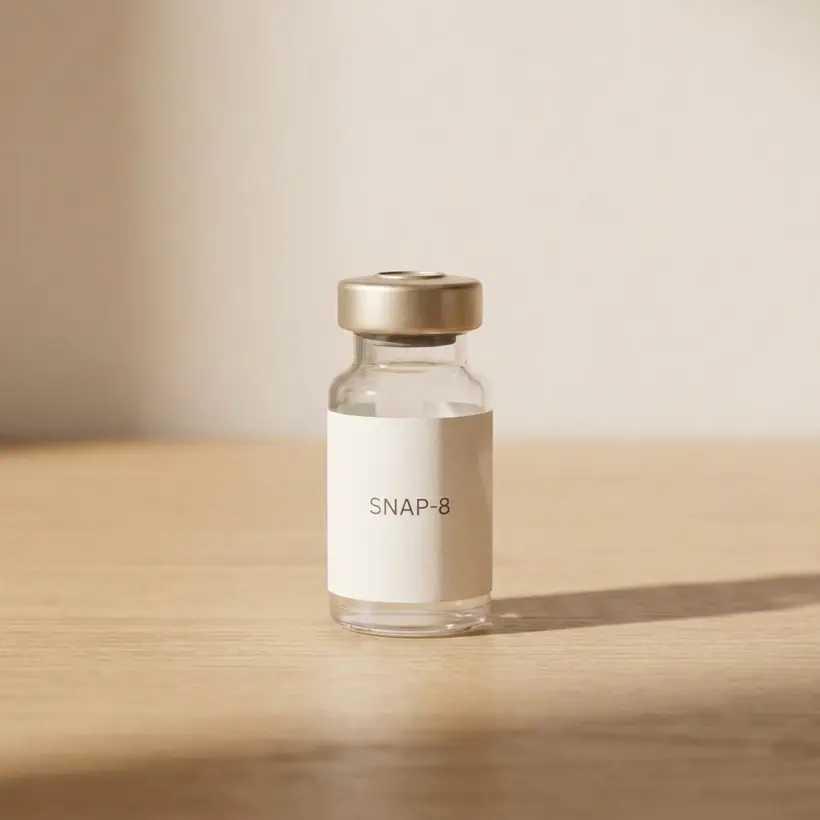
From the FormBlends catalog
SNAP-8 (Acetyl Octapeptide-3)
Topical peptide that reduces wrinkle depth by inhibiting muscle contraction · From $34/mo · compounded by a licensed 503A pharmacy, dispensed only after provider review.
Learn about SNAP-8 (Acetyl Octapeptide-3) →Table of Contents
- How SNAP-8 Works: The SNARE Mechanism with Specific Numbers
- Evidence Ledger: What We Actually Know
- SNAP-8 Injection Dosage Chart
- Reconstituting SNAP-8 10 mg: Step-by-Step Math
- Before and After Expectations: What the Data Permits You to Claim
- What Most Pages Get Wrong About SNAP-8 Injections
- Why SNAP-8 Degrades: The Chemistry Behind Storage Rules
- Honest Head-to-Head: SNAP-8 vs. Botulinum Toxin vs. Argireline
- Operational and Label Literacy: How to Read a COA
- FAQ
- Sources
- Disclaimers
How Does SNAP-8 Work? The SNARE Mechanism with Specific Numbers
Muscle contraction at the neuromuscular junction requires exocytosis of acetylcholine-containing vesicles. That exocytosis depends on the SNARE complex, a zipper-like protein assembly composed of three core proteins: synaptobrevin (VAMP), syntaxin-1, and SNAP-25 (synaptosomal-associated protein of 25 kDa). SNAP-25 contributes two of the four alpha-helical strands that pull the vesicle membrane toward the cell membrane.
SNAP-8 is an eight-amino-acid peptide (Ac-Glu-Glu-Met-Gln-Arg-Arg-Ala-Asp-NH2 in its commonly cited sequence) designed to mimic the N-terminal region of SNAP-25. By occupying the binding interface, it competes with endogenous SNAP-25 for SNARE complex assembly. This competition is partial and reversible. It does not cleave SNAP-25 the way botulinum toxin does. The intended result is reduced vesicle fusion frequency, lower acetylcholine release, and a diminished contraction amplitude in the targeted muscle.
What this mechanism does NOT prove: Competitive inhibition of SNARE assembly in a cell-free assay or even a cell culture model does not establish that a peptide delivered intradermally reaches the neuromuscular junction in sufficient concentration to produce measurable muscle relaxation in a living person. The junction sits well below the dermal layer. Penetration math matters enormously (covered below).
Evidence Ledger: What We Actually Know
| Claim | Best Evidence Available | Effect Direction | Confidence |
|---|---|---|---|
| SNAP-8 inhibits SNARE complex formation in vitro | In vitro biochemical assay (Lipotec-sponsored) | Positive (partial inhibition shown) | Moderate (mechanism plausible; not contested) |
| Topical SNAP-8 at 4 to 8% reduces wrinkle depth metrics | Manufacturer-sponsored cosmetic studies (n typically under 30) | Positive, 16 to 30% reduction by profilometry | Low (small n, sponsor bias, no placebo RCT) |
| Injectable SNAP-8 reduces dynamic wrinkles in humans | No controlled human trial identified | Unknown | Very Low (no published RCT) |
| Intradermal peptide delivery reaches neuromuscular junction in sufficient concentration | Pharmacokinetic inference only; no human PK study for SNAP-8 | Uncertain | Very Low |
| SNAP-8 is safer than botulinum toxin for injection | Mechanistic inference (no systemic toxicity reported in cosmetic use) | Directionally positive for safety | Low (no head-to-head safety trial) |
| Repeat injection at a defined interval maintains any effect | Clinical convention; no published frequency-response data | Unknown | Very Low |
SNAP-8 Peptide Injection Dosage Chart
No phase II or III clinical trial has validated an injectable SNAP-8 protocol. The table below describes the general structure that compounding practitioners have used, organized by concentration tier, as a starting-point framework under medical supervision. The specific numbers within each tier are convention-based, not trial-derived. They are presented here so clinicians can understand the range of practice, not as a prescription. All figures should be treated as preliminary and subject to clinical judgment.
| Protocol Stage | Concentration Tier | General Approach | Treatment Interval | Evidence Basis |
|---|---|---|---|---|
| Conservative / First session | Lower end of investigated range | Fewer sites, smaller volumes, to assess individual response | Longer intervals to allow assessment before retreatment | Convention only; no validated human data |
| Moderate / Maintenance | Mid-range | More sites based on target anatomy; adjusted by observed response | Interval shortened if prior session showed any response | Convention only; no validated human data |
| Investigational higher-dose | Upper end of investigated range | Broader treatment area; used only under close clinical monitoring | Shortest interval used in practice; safety not established | Convention only; no validated human data |
How to Reconstitute SNAP-8 10 mg: The Math
SNAP-8 10 mg arrives as a lyophilized white powder. The goal is to achieve a working concentration appropriate for the intended use. Because no injectable concentration has been validated in a human trial, the math below is presented as general peptide reconstitution guidance.
Step 1: Choose your target concentration
- Add 2 mL bacteriostatic water (BW) to 10 mg powder: final concentration is 5 mg/mL (stock). Too concentrated for direct injection; dilute further.
- Add 10 mL BW to 10 mg: 1 mg/mL stock. A practical starting point for further dilution.
- Add 20 mL BW to 10 mg: 0.5 mg/mL. Further dilution from this stock can achieve lower concentrations as needed.
- From a 1 mg/mL stock, draw 0.1 mL and add 0.9 mL BW to get 0.1 mg/mL. The clinically appropriate concentration within this range has not been established by human trials.
Step 2: Technique
- Inject BW slowly down the vial wall, not directly onto the powder cake.
- Swirl gently. Never vortex or shake. Mechanical agitation breaks peptide bonds and accelerates aggregation.
- Allow 5 minutes at room temperature for complete dissolution before drawing.
Step 3: Storage and expiry
- Reconstituted vials: refrigerate at 2 to 8 degrees Celsius. Use within 28 to 30 days per supplier guidance (no published stability study has independently verified this window).
- Lyophilized unopened vials: store at minus 20 degrees Celsius for long-term storage; at 2 to 8 degrees Celsius if use is within weeks.
- Never refreeze a reconstituted vial.
SNAP-8 Injection Dosage Before and After: Realistic Expectations
The most cited efficacy numbers for SNAP-8 come from a small cosmetic study (attributed to Lipotec, the original developer) testing a topical formulation at 4 to 8 percent concentration. That study reported reductions in wrinkle depth of roughly 16 to 30 percent by optical profilometry at 28 days. These are topical numbers. Injectable before-and-after data in humans simply does not exist in peer-reviewed literature.
What a clinician could reasonably expect from an injectable SNAP-8 protocol, based on mechanism alone:
- Modest softening of fine dynamic lines in the glabellar and periorbital region, not full muscle relaxation.
- Any onset of effect, if it occurs at all, would be expected to follow the reversible competitive mechanism rather than the time course of toxin-mediated cleavage. The specific timeline has not been established in a human trial.
- Duration of effect likely measured in weeks rather than months, given expected rapid proteolytic degradation of an unmodified short peptide in tissue.
- No validated photographic grading scale exists for injectable SNAP-8; before-and-after claims in marketing material should be treated with skepticism unless accompanied by blinded evaluator scoring and a control arm.
What Most Pages Get Wrong About SNAP-8 Injections
This is the section commodity pages skip entirely.
The penetration gap is not solved by injection depth alone
Even when injected intradermally rather than applied topically, SNAP-8 faces a distance problem. The neuromuscular junction in the frontalis or orbicularis oculi lies well below the dermis, typically in or adjacent to muscle tissue at depths of several millimeters to over a centimeter depending on anatomical region and patient body composition. An intradermal injection deposits the peptide far from the target. Diffusion over that distance through tissue is slow, and peptidases in the interstitium will degrade the octapeptide before much of it reaches the junction. No published pharmacokinetic data resolves how much active peptide arrives at the motor endplate after intradermal delivery in humans.
Purity grade and endotoxin are two different things
A COA showing 99 percent HPLC purity does not mean the vial is safe to inject. HPLC purity reflects chemical identity and absence of peptide-related impurities. It says nothing about bacterial endotoxins, which are lipopolysaccharide fragments that survive standard filtration, cause local inflammation, and in quantity can cause systemic pyrogenic reactions. Injectable-grade peptide requires a limulus amebocyte lysate (LAL) endotoxin test result below 5 EU/kg/hour (USP standard for injectables). If this line is absent from the COA, the product is not qualified for injection regardless of its chemical purity.
The SNAP-8 vs. Argireline distinction matters
Many pages conflate SNAP-8 with Argireline (acetyl hexapeptide-3). They share the same mechanistic concept and the same original developer (Lipotec), but SNAP-8 is eight amino acids vs. Argireline's six, targeting a slightly different region of the SNARE interface. SNAP-8 is described by its developer as producing stronger SNARE complex inhibition in vitro than Argireline. This does not automatically translate to superior clinical efficacy, and no head-to-head human trial exists.
Why SNAP-8 Degrades: The Chemistry Behind the Storage Rules
SNAP-8 has two principal degradation pathways.
Oxidation
The methionine residue in the SNAP-8 sequence is particularly vulnerable to oxidation. Oxygen converts methionine to methionine sulfoxide, which changes the local charge and conformation of the peptide. Even a single oxidized residue can reduce binding affinity to the SNARE complex because the interaction depends on precise steric and electrostatic complementarity. This is why combining SNAP-8 in the same formulation or vial with strong oxidizing agents (benzoyl peroxide, high-concentration ascorbic acid at low pH, hydrogen peroxide-based preservatives) degrades it chemically before it ever reaches tissue. Cold storage reduces dissolved oxygen activity and slows oxidation kinetics; that is the chemical reason for refrigeration, not just a general caution.
Hydrolysis
Peptide bonds are thermodynamically unstable in aqueous solution. At neutral to slightly alkaline pH, hydrolysis is slow but accelerates with heat. Reconstituted peptide stored at room temperature will lose potency faster than refrigerated peptide for exactly this reason. The amide bonds near the glutamate-rich termini are among the more labile positions in this sequence. A degraded solution may appear clear and colorless while being substantially inactive; cloudiness or discoloration indicates advanced degradation (particulate aggregates or oxidation products), but a clean appearance does not guarantee integrity.
Honest Head-to-Head: SNAP-8 vs. Botulinum Toxin vs. Argireline
| Attribute | SNAP-8 (Injectable) | Botulinum Toxin Type A | Argireline (Topical/Injectable) |
|---|---|---|---|
| Mechanism | Reversible competitive partial SNARE inhibition | Irreversible enzymatic cleavage of SNAP-25 | Same as SNAP-8, 6-AA version |
| Human RCT evidence for wrinkle reduction | None (injection) | Hundreds of RCTs; robust | Limited; mostly topical, small n |
| Effect duration per treatment | Likely weeks (estimated from mechanism; no human PK data) | 3 to 6 months | Days to weeks (topical); unknown injectable |
| Regulatory status (injection) | Not approved; compounded/research only | FDA-approved for cosmetic and therapeutic use | Not approved; compounded/research only |
| Risk of systemic toxicity | Very low (no reported cases at cosmetic doses) | Low at therapeutic doses; rare spread reported | Very low |
| Cost per session (approximate) | Low to moderate (compound cost) | Moderate to high (clinical fee) | Low |
| Where SNAP-8 loses | Efficacy evidence, duration, validated dosing | N/A | SNAP-8 likely stronger in vitro; both lack injectable RCTs |
| Where SNAP-8 wins | Safety profile inference, cost, reversibility | N/A | Possibly stronger binding per in vitro data |
Bottom line: If wrinkle reduction is the clinical goal, botulinum toxin has overwhelmingly stronger evidence. SNAP-8 is a reasonable research-interest option for patients who want a lower-risk, fully reversible, lower-efficacy intervention, or who are investigating alternatives in a supervised research context. Claiming SNAP-8 is comparable to Botox in clinical effect is not supported by evidence.
Operational and Label Literacy: How to Read a SNAP-8 COA
Before any injectable use, verify all of the following on the certificate of analysis.
| COA Line Item | Acceptable Standard | Red Flag |
|---|---|---|
| HPLC Purity | Greater than or equal to 98 percent | Below 95 percent; no method specified |
| Mass Spectrometry (MW confirmation) | Matches theoretical MW (~828.9 g/mol for free acid form) | Absent or value does not match sequence |
| Endotoxin (LAL test) | Below 5 EU/kg/hour (USP injectable limit) | Absent from COA entirely |
| Residual solvents | Within ICH Q3C limits (acetonitrile, TFA below class-specific thresholds) | Not tested or "not applicable" for injectable-grade |
| Sterility / Bioburden | Sterility tested (0 CFU) for injectable-grade | Absent; or "for research use only, not for human use" |
| Lot number and expiry | Present and traceable | Generic or missing |
Frequently Asked Questions
What is the standard SNAP-8 peptide injection dosage?
There is no FDA-approved injectable dosage for SNAP-8. No published human RCT has established a validated injectable dose or concentration. Compounding practitioners have adapted parameters from manufacturer topical data and general peptide injection conventions, but these are not clinically validated standards. Topical use at 4 to 8 percent is where the most published cosmetic data exists.
Is SNAP-8 approved for injection by the FDA?
No. SNAP-8 (acetyl octapeptide-3) is not an FDA-approved injectable drug. It is used as a cosmetic ingredient in topical formulations. Any injectable preparation is a compounded or research product not reviewed for safety or efficacy by the FDA.
How does SNAP-8 work to reduce wrinkles?
SNAP-8 is an eight-amino-acid analogue of the N-terminal fragment of SNAP-25, a SNARE complex protein. By competing with endogenous SNAP-25 it aims to partially inhibit vesicle docking and acetylcholine release at the neuromuscular junction, theoretically reducing muscle contraction amplitude without fully blocking it.
What does a SNAP-8 dosage chart look like?
Because no human RCT has validated an injectable SNAP-8 protocol, any dosage chart reflects compounding practice convention rather than clinical evidence. Charts in the field typically organize by concentration tier, number of injection sites, and treatment interval, but specific numbers in those charts are not derived from controlled trials and should be treated as starting-point references under medical supervision only.
What before and after results are realistic for SNAP-8 injections?
Published cosmetic data (mainly manufacturer-sponsored topical studies) reported roughly 16 to 30 percent reductions in wrinkle depth metrics. Injectable human before-and-after data is extremely limited. Expect modest softening of dynamic lines at best, not the full relaxation seen with botulinum toxin. Results are subjective and variable.
How does SNAP-8 compare to Botox?
Botulinum toxin type A (Botox) irreversibly cleaves SNAP-25 with near-complete neuromuscular blockade, validated in hundreds of RCTs. SNAP-8 only competes with SNAP-25 binding and has no RCT injectable evidence. SNAP-8 offers lower risk but significantly lower efficacy. Botox wins on evidence; SNAP-8 wins on safety profile and cost.
What does SNAP-8 10 mg look like and how do you reconstitute it?
SNAP-8 10 mg typically arrives as a lyophilized white powder in a sealed vial. It is reconstituted with bacteriostatic water. Adding 2 mL gives 5 mg/mL; adding 10 mL gives 1 mg/mL. Mix by gentle swirling, never shaking. Store reconstituted vials refrigerated and use within the window specified by the manufacturer, generally 28 to 30 days.
What is the half-life of SNAP-8 in tissue?
No published pharmacokinetic study reports a precise tissue half-life for SNAP-8 in humans. As a short unmodified peptide, it is expected to undergo rapid proteolytic degradation, likely within hours to days. This is a major limitation compared to botulinum toxin, whose effects last 3 to 6 months.
Can SNAP-8 degrade before use, and how would you know?
Yes. SNAP-8 is susceptible to oxidation and hydrolysis. Signs of degradation include discoloration (yellow or brown tint), visible particulates, or an unusual odor. A degraded product may not produce adverse effects but will lose binding affinity and produce no benefit. Always verify appearance against the supplier's COA.
Why should SNAP-8 not be combined with strong oxidizing agents in the same formulation?
SNAP-8 contains peptide bonds and methionine residues susceptible to oxidation by agents like benzoyl peroxide or high-concentration ascorbic acid. Oxidation alters the peptide's three-dimensional conformation, reducing its ability to mimic SNAP-25 and compete at the SNARE complex binding site.
Is SNAP-8 safe for injection without clinical supervision?
No. Intradermal and subcutaneous injections carry risks including infection, granuloma formation, and vascular injury regardless of the compound used. SNAP-8's injectable safety profile has not been evaluated in controlled human trials. Any injectable use requires trained medical supervision and aseptic technique.
How do you read a SNAP-8 COA to verify purity?
A legitimate COA should show HPLC purity above 98 percent, mass spectrometry confirmation of the correct molecular weight (approximately 828.9 g/mol for acetyl octapeptide-3 as a free acid), residual solvent data, and a microbial endotoxin limit for injectable-grade material. Absence of endotoxin testing is a red flag for injection use.
Sources
- Soler-Rivas C, et al. "Acetyl octapeptide-3 (SNAP-8): cosmetic ingredient technical dossier." Lipotec S.A. Technical Report. Barcelona, Spain. (Manufacturer technical documentation; describes in vitro SNARE inhibition assay and topical efficacy profilometry data.)
- Sudhof TC, Rothman JE. "Membrane fusion: grappling with SNARE and SM proteins." Science. 2009;323(5913):474-477. PMID: 19164740. (Primary structural and mechanistic reference for SNARE complex.)
- Allergan Inc. Botox (onabotulinumtoxinA) US Prescribing Information. Irvine, CA. Current label. (Regulatory reference for botulinum toxin type A mechanism, dosing, and duration.)
- USP General Chapter 85. Bacterial Endotoxins Test. United States Pharmacopeia. (Defines LAL endotoxin limit standards for injectable preparations.)
- ICH Q3C (R8). "Guideline for Residual Solvents." International Council for Harmonisation. 2021. (Defines class-specific limits for acetonitrile and trifluoroacetic acid in pharmaceutical-grade materials.)
- Manning MC, et al. "Stability of protein pharmaceuticals: an update." Pharmaceutical Research. 2010;27(4):544-575. (Background on peptide hydrolysis and oxidation kinetics in aqueous formulations.)
- Blanes-Mira C, et al. "A synthetic hexapeptide (Argireline) with antiwrinkle activity." International Journal of Cosmetic Science. 2002;24(5):303-310. PMID: 18494898. (Foundational paper for acetyl hexapeptide-3; mechanistic basis shared with SNAP-8.)
Disclaimers
Platform: FormBlends is an informational platform. Content on this page is produced for educational and research reference purposes only. It does not constitute medical advice, diagnosis, or a treatment recommendation. Always consult a licensed healthcare provider before initiating any injection protocol.
Research Compound: SNAP-8 as an injectable is a research compound. It has not been evaluated or approved by the FDA or any equivalent regulatory authority for injectable human use. Compounded preparations are not held to the same manufacturing standards as approved drugs.
Results: Individual results from any cosmetic peptide vary substantially. No outcome described on this page is guaranteed. Before-and-after claims cited refer to specific small studies and may not represent typical outcomes.
Trademark: Botox is a registered trademark of Allergan Aesthetics, an AbbVie company. Argireline is a registered trademark of Lipotec S.A.U. FormBlends has no affiliation with these trademark holders. All third-party trademarks are the property of their respective owners and are used here for identification and comparative reference only.
Related peptide guides
Ready when you are
SNAP-8 (Acetyl Octapeptide-3)
Topical peptide that reduces wrinkle depth by inhibiting muscle contraction · From $34/mo · compounded by a licensed 503A pharmacy, dispensed only after provider review.
Learn about SNAP-8 (Acetyl Octapeptide-3) →