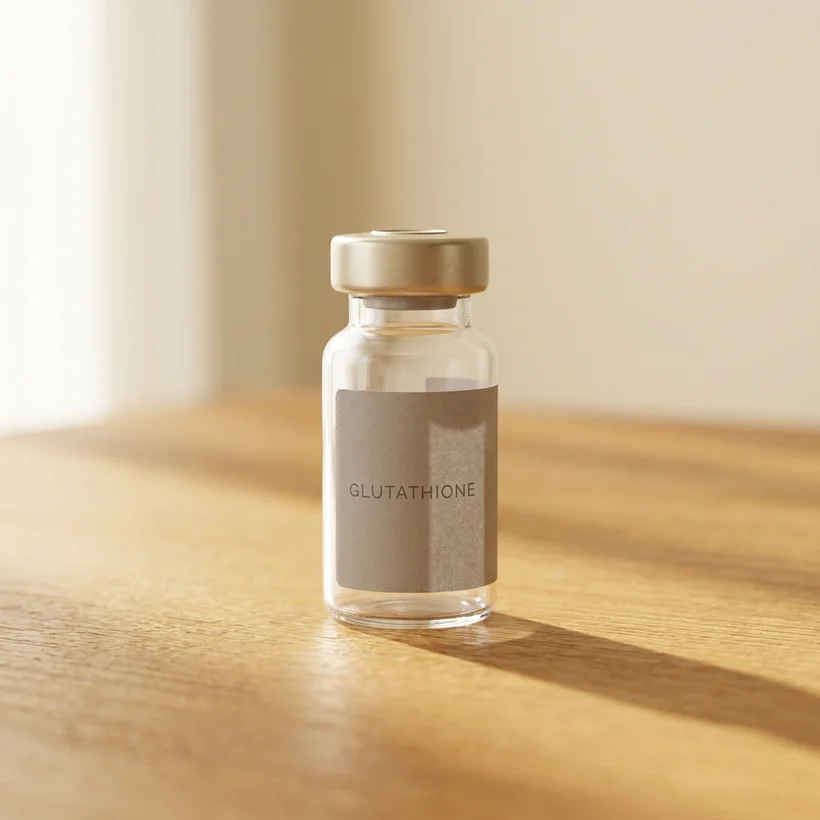
Key Takeaways
- Glutathione is a 307-dalton tripeptide (glycine-cysteine-glutamate); injection bypasses the GI hydrolysis that eliminates most oral bioavailability.
- A standard clinical IV dose in published trials is 600 mg to 1,400 mg per session depending on indication; subcutaneous dosing is not standardized in peer-reviewed literature.
- Adding 3 mL of bacteriostatic water to a 600 mg lyophilized vial yields exactly 200 mg per mL; the free thiol on cysteine oxidizes to pharmacologically inactive GSSG if the reconstituted vial is left warm or exposed to light.
- The strongest clinical evidence supports Parkinson's symptom management and non-alcoholic fatty liver disease (NAFLD); skin-brightening claims rest on small, short-duration trials with low confidence ratings.
- The FDA has specifically warned against IV glutathione for cosmetic skin lightening, citing unverified safety and unregulated compounding sources.
What Is a Glutathione Peptide Injection? (Direct Answer)
A glutathione peptide injection delivers the tripeptide gamma-L-glutamyl-L-cysteinyl-glycine by subcutaneous or intravenous route to achieve blood levels that oral dosing cannot reliably produce. It is used clinically for antioxidant support and liver protection, and off-label for cosmetic skin brightening. Evidence quality varies widely by indication.
Table of Contents
- What exactly is glutathione and why call it a peptide?
- How does injectable glutathione work? Mechanism with real numbers
- Evidence ledger: what the research actually supports
- How to reconstitute glutathione for injection (step-by-step)
- Dosing table: what clinical protocols actually use
- How should reconstituted glutathione be stored, and why?
- What most pages get wrong about glutathione injections
- Honest head-to-head: glutathione injection vs. alternatives
- Label and COA literacy: how to judge your vial before injecting
- Risks, warnings, and what the FDA actually said
- FAQ
What Exactly Is Glutathione and Why Call It a Peptide?
Glutathione (GSH) is the most abundant intracellular non-protein thiol in mammalian cells, with cytosolic concentrations in the millimolar range in most tissues. Its full chemical name is gamma-L-glutamyl-L-cysteinyl-glycine. The "gamma" designation is important: the bond between glutamate and cysteine is an unusual gamma-peptide bond (through glutamate's side-chain carboxyl), not the standard alpha-peptide bond. This unusual linkage is why gamma-glutamyltranspeptidase is the primary enzyme that begins its breakdown, and why GI brush-border hydrolases are not optimized to preserve the intact molecule after oral ingestion.
Check your GLP-1 eligibility
Use our free BMI Calculator to see if you may qualify for provider-reviewed GLP-1 therapy.
Try the BMI Calculator →At 307.32 daltons molecular weight, GSH sits far below the typical therapeutic peptide range of 500 to 5,000 daltons. It functions not as a receptor ligand but as a direct electron donor, a substrate for glutathione peroxidases, and a conjugating agent in Phase II hepatic detoxification. Calling it a peptide is chemically accurate but operationally different from how peptides like BPC-157 or CJC-1295 work.
How Does Injectable Glutathione Work? Mechanism with Real Numbers
The core pharmacology centers on the free thiol (sulfhydryl, -SH) group on cysteine at position 2. This group:
- Directly scavenges reactive oxygen species (ROS) and reactive nitrogen species, donating an electron to neutralize radicals.
- Acts as cofactor for glutathione peroxidase (GPx) enzymes, which reduce hydrogen peroxide and lipid hydroperoxides to water and alcohols.
- Conjugates electrophilic toxins via glutathione S-transferases (GST), enabling biliary or renal excretion. This is the primary mechanism in NAFLD/liver-protection protocols.
- Inhibits tyrosinase activity. Tyrosinase is the rate-limiting enzyme in melanin biosynthesis; GSH chelates the copper ion in tyrosinase's active site and shifts melanin production from darker eumelanin toward lighter phaeomelanin. This is the proposed skin-brightening mechanism, confirmed in cell culture studies, not yet robustly in controlled human trials.
After IV infusion, plasma GSH levels rise sharply within roughly 30 minutes and return toward baseline within a few hours, reflecting rapid cellular uptake rather than a long plasma half-life. Intracellular GSH replenishment is the meaningful endpoint, not sustained plasma concentration. A Parkinson's trial by Hauser et al. (2009, Movement Disorders) using 1,400 mg IV twice weekly showed statistically significant symptom improvement on UPDRS scoring in a pilot randomized controlled design, providing the most rigorous human evidence for CNS benefit at high IV doses.
What this mechanism does NOT prove: Raising systemic GSH does not automatically translate to anti-aging outcomes, immune enhancement, or athletic performance. Those claims extend well beyond the established biochemistry.
Evidence Ledger: What the Research Actually Supports
| Claim | Best Evidence Type | Effect Direction | Confidence | Honest Caveat |
|---|---|---|---|---|
| Parkinson's disease symptom reduction (IV) | Small RCT / pilot (Hauser et al., 2009) | Positive, modest | Moderate | Sample sizes under 20; not replicated in large RCTs |
| NAFLD liver enzyme reduction (IV) | RCT evidence exists; older Italian trials (late 1980s to 1990s) and subsequent hepatology work have examined IV GSH in liver disease | Positive | Moderate | Trials are older and relatively small; long-term outcomes not established |
| Skin lightening / brightening | Small RCTs (Arjinpathana and Asawanonda, 2012; Watanabe et al., 2014) | Positive, short-term | Low | N under 60, short duration (4 to 12 weeks), funding bias risks |
| Peripheral neuropathy (diabetic, IV) | Small RCT (Barbagallo et al., 1999) | Positive | Low | Single small trial, not validated in larger studies |
| Athletic performance / recovery | Mechanistic / very small pilot studies | Mixed | Very Low | No adequately powered RCT; antioxidant supplementation may blunt training adaptations |
| Anti-aging / longevity | Animal and mechanistic only | Speculative positive | Very Low | No human RCT evidence; GSH declines with age but causality not proven |
| Immune enhancement | In vitro and animal | Speculative positive | Very Low | Human clinical data absent |
How to Reconstitute Glutathione for Injection (Step-by-Step)
- Verify the vial. Confirm the powder is white to off-white. Any yellowing before reconstitution indicates oxidation during storage. Discard those vials.
- Calculate your target concentration. Choose a concentration based on your prescribed dose. A common target is 100 mg per mL or 200 mg per mL. For a 600 mg vial: add 6 mL BWI for 100 mg per mL, or 3 mL BWI for 200 mg per mL.
- Clean both vial tops with a fresh alcohol swab and allow 30 seconds to dry. Wet alcohol can carry surface contamination into the vial.
- Draw bacteriostatic water into the syringe. Inject it slowly down the inside wall of the glutathione vial, not directly onto the powder cake. Direct-stream injection can denature the peptide structure and cause incomplete dissolution.
- Swirl gently. Do not shake. Shaking introduces air bubbles and can mechanically damage the molecule. Swirl 15 to 20 seconds until completely clear.
- Inspect. The solution should be completely clear and colorless. A yellow or amber tint means oxidation has already occurred. Cloudiness or visible particles indicate contamination or aggregation. Discard both.
- Label the vial with the date of reconstitution, concentration, and your initials. Store at 2 to 8 degrees Celsius immediately.
Reconstitution Quick-Reference Table
| Vial Size | BWI Volume Added | Resulting Concentration | Volume per 200 mg Dose |
|---|---|---|---|
| 600 mg | 3 mL | 200 mg per mL | 1.0 mL |
| 600 mg | 6 mL | 100 mg per mL | 2.0 mL |
| 1,200 mg | 6 mL | 200 mg per mL | 1.0 mL |
| 1,200 mg | 12 mL | 100 mg per mL | 2.0 mL |
Dosing Table: What Clinical Protocols Actually Use
| Indication | Route | Dose Range Used in Trials | Frequency | Evidence Basis |
|---|---|---|---|---|
| Parkinson's disease | IV | 1,400 mg per session | Twice weekly | Hauser et al., 2009 pilot RCT |
| NAFLD / liver support | IV | 600 mg per session | Daily for several weeks | Older Italian RCT-level work in liver disease populations; see Pizzorno 2014 review for summary |
| Skin brightening | IV | 600 mg to 1,200 mg per session | Weekly | Arjinpathana and Asawanonda, 2012 |
| Compounded SQ (research context) | Subcutaneous | 200 to 400 mg per session | 2 to 3 times weekly | No peer-reviewed RCT for SQ route specifically |
How Should Reconstituted Glutathione Be Stored, and Why?
Lyophilized vials: store at 2 to 8 degrees Celsius, protected from light. Freezing is generally not recommended for lyophilized peptides because freeze-thaw cycling can damage the powder cake structure, though brief cold exposure is less damaging than heat.
Reconstituted with bacteriostatic water: refrigerate immediately, use within 28 days. This 28-day window reflects USP guidance on benzyl alcohol (0.9%) as a bacteriostatic preservative, not on chemical stability of GSH itself.
Reconstituted with sterile water: use within 24 hours. Sterile water lacks any preservative, making microbial contamination the binding constraint.
The Chemistry Behind the Storage Rules
The free thiol group on cysteine has a pKa of approximately 8.3, meaning it exists partly in the reactive thiolate form (S-minus) at physiological pH. Thiolates are potent nucleophiles and reducing agents. In the presence of dissolved oxygen, the oxidation sequence runs: 2 GSH plus O2 produces GSSG (glutathione disulfide) plus H2O2. GSSG is the oxidized, pharmacologically inactive dimer. This reaction accelerates with heat, light (especially UV), and metal ion contamination (iron and copper are catalysts). This is why you store cold, away from light, and why you should never use tap water or unvalidated diluents that may contain metal ions. Even a brief period at room temperature each day compounds the oxidative loss over a 28-day window.
What Most Pages Get Wrong About Glutathione Injections
1. Bioavailability Is Not the Same as Efficacy
Pages correctly note that injection is "more bioavailable" than oral. What they omit: elevated plasma GSH does not automatically equal elevated intracellular GSH. Cells take up GSH via specific transporters (OATP family), and the rate-limiting factor intracellularly is cysteine availability for fresh GSH synthesis via the glutamate-cysteine ligase pathway. Some researchers argue N-acetylcysteine (NAC), by supplying cysteine directly, may rival injection for raising intracellular GSH at far lower cost and risk. That comparison is absent from almost every commercial page.
2. Purity Varies Enormously Between Sources
Pharmaceutical-grade glutathione (USP or EP standard) requires purity above 98% with defined limits on heavy metals and related substances. Research-grade or "gray market" vials have no such standard enforced at the point of sale. Third-party COA testing of peptide research compounds has repeatedly revealed concentrations meaningfully below label claim and occasional heavy metal contamination. There is no reliable way to verify purity by appearance alone.
3. Mixing with Vitamin C Is Not Automatically Synergistic
The mechanism of synergy (ascorbate regenerates GSH from GSSG by reducing it back) is real biochemistry. But mixing two compounds in the same syringe requires pH compatibility (ascorbic acid is strongly acidic, pH roughly 2 to 3 at high concentration), concentration matching, and verified chemical stability data. No published stability study on combined IV GSH plus ascorbate in the same syringe exists in the peer-reviewed literature to the authors' knowledge. Separate administration is the pharmacologically safe default.
4. The Subcutaneous Route Is Largely Unvalidated
Almost all published clinical data comes from IV administration. Subcutaneous glutathione absorption kinetics, bioavailability fraction, and local tolerability have not been characterized in peer-reviewed pharmacokinetic studies. Protocols recommending SQ dosing are extrapolating from IV data, a common but scientifically unsupported practice.
Honest Head-to-Head: Glutathione Injection vs. Alternatives
| Comparison | Glutathione Injection | Alternative | Where Injection Wins | Where Injection Loses |
|---|---|---|---|---|
| vs. Oral GSH (liposomal) | Reliably raises plasma and cellular GSH | Liposomal oral raises levels but to a lesser degree | Magnitude of plasma elevation | Cost, convenience, safety profile |
| vs. N-Acetylcysteine (NAC) oral | Delivers intact tripeptide directly | NAC provides cysteine for endogenous synthesis; well-studied oral form | Immediacy of GSH elevation | NAC has stronger evidence base, far lower cost, FDA-approved formulations |
| vs. Retinoids (for skin) | Modest melanin-pathway modulation | Tretinoin has decades of RCT data for pigment and texture | Tolerability in sensitive skin (no retinoid dermatitis) | Evidence quality, magnitude of effect, durability of results |
| vs. IV alpha-lipoic acid (ALA) | Direct GSH replenishment | ALA recycles GSH and has European approval for diabetic neuropathy | Direct mechanism for hepatic conjugation | ALA has stronger neuropathy RCT data |
Label and COA Literacy: How to Judge Your Vial Before Injecting
A legitimate pharmaceutical or compounded glutathione vial should have the following on its label or accompanying certificate of analysis (COA):
- Stated purity: Look for 98% or above by HPLC. Any COA that does not specify the analytical method (HPLC, UV, NMR) is not verifiable.
- Endotoxin (LAL) test result: Injectable products must pass bacterial endotoxin testing. Acceptable limits for IV products are typically below 5 EU per kilogram per hour (USP standard). A COA without an endotoxin result should not be used injectably.
- Sterility test: Look for USP sterility testing completion. This is separate from endotoxin.
- Heavy metals: Should list limits for lead, arsenic, cadmium, and mercury, especially given that glutathione's thiol group avidly chelates metals and can concentrate them.
- Lot number and expiry: Cross-check that these appear on both the vial and the COA. A mismatch is a red flag for documentation fraud.
- Amino acid identity confirmation: Reputable COAs for peptides include mass spectrometry (MS) confirmation of molecular weight, which for GSH should show 307.32 Da (monoisotopic 306.08 Da).
Risks, Warnings, and What the FDA Actually Said
In 2020, the FDA issued a safety communication warning against IV glutathione injections marketed for skin lightening. The FDA's specific concerns included unverified safety at doses used for cosmetic purposes, risk of severe allergic reactions, kidney dysfunction at high repeated doses (based on case reports), and the proliferation of unlicensed compounders supplying the product. The communication did not ban glutathione outright but flagged the specific cosmetic-lightening use as lacking adequate safety data.
Additional risk considerations:
- Bronchospasm: Case reports exist of bronchospasm with inhaled glutathione; IV risk appears low but is not zero in atopic individuals.
- Thyroid interference: Very high chronic doses have been speculated to reduce thyroid hormone levels based on limited case data. No well-powered trial has confirmed this; it remains a low-frequency concern.
- Antioxidant blunting of training adaptation: A well-established concern with high-dose antioxidants generally (Ristow et al., 2009, PNAS) is that quenching ROS blunts mitochondrial biogenesis signaling. This applies to GSH in principle though has not been tested directly for injectable GSH in athletes.
- Sterile technique failure: The most immediate practical risk. Any failure of aseptic technique during reconstitution or injection can cause local abscess or systemic sepsis.
FAQ
What is a glutathione peptide injection?Glutathione is a tripeptide (glycine-cysteine-glutamate) administered by subcutaneous or intravenous injection to bypass the poor oral bioavailability of the intact molecule. Injectable forms are used in clinical settings for antioxidant support, liver protection, and off-label cosmetic skin-brightening protocols.
How do you reconstitute glutathione for injection?Draw bacteriostatic water into a syringe, inject it slowly down the vial wall, and swirl gently. Never shake. For a typical 600 mg lyophilized vial, adding 3 mL of bacteriostatic water yields 200 mg per mL. Use within 28 days if refrigerated with bacteriostatic water, or within 24 hours if sterile water was used.
What is the standard dose for a glutathione injection?Clinical IV protocols used in published trials range from 600 mg to 1,400 mg per session, two to three times per week depending on indication. Subcutaneous protocols are not standardized in peer-reviewed literature. Lower doses around 200 to 400 mg appear in compounded research contexts. There is no FDA-approved dosing guideline for cosmetic use.
Does bacteriostatic water matter for glutathione reconstitution?Yes. Bacteriostatic water contains 0.9% benzyl alcohol, which inhibits microbial growth and extends the usable window of a reconstituted vial to approximately 28 days when refrigerated. Sterile water for injection lacks this preservative and requires single-use within 24 hours to maintain sterility.
What are the evidence-backed benefits of glutathione injections?The best-supported use is Parkinson's disease symptom management (small RCT data, moderate evidence). Liver protection in NAFLD has moderate RCT support. Skin-lightening effects have low-quality evidence from small short-duration trials. General antioxidant and anti-aging claims remain largely mechanistic with very low clinical trial support.
How should reconstituted glutathione be stored?Store lyophilized vials at 2 to 8 degrees Celsius away from light. Once reconstituted with bacteriostatic water, keep refrigerated and use within 28 days. Glutathione is readily oxidized at room temperature; the free thiol on cysteine reacts with oxygen to form glutathione disulfide (GSSG), which is pharmacologically inactive.
Can glutathione injections be mixed with vitamin C?Some IV protocols combine them, but this requires careful pH and concentration matching. Ascorbic acid is a reducing agent that can partially regenerate oxidized glutathione, which is mechanistically synergistic. However, mixing in the same syringe risks incompatibility if pH differences are large. Separate administration is safer unless compounded under verified conditions.
Is glutathione considered a peptide?Technically yes. Glutathione (gamma-L-glutamyl-L-cysteinyl-glycine) is a tripeptide consisting of three amino acids joined by peptide bonds. However, its molecular weight is only 307 daltons, far smaller than most therapeutic peptides, and it functions primarily as an endogenous antioxidant rather than a receptor ligand.
What does a degraded glutathione vial look like?Fresh lyophilized glutathione powder is white to off-white. Reconstituted solution should be clear and colorless. A yellow or amber tint after reconstitution indicates oxidation to glutathione disulfide (GSSG). Cloudiness or particulate matter suggests microbial contamination or aggregation. Discard any vial showing these signs.
What are the risks of glutathione injections?Risks include injection-site reactions, rare allergic responses, and theoretical thyroid interference at very high chronic doses based on isolated case reports. IV administration carries additional risks of air embolism and infection if sterile technique is not followed. The FDA has warned against IV glutathione for skin lightening due to unverified safety at high cosmetic doses.
How does injectable glutathione compare to oral supplementation?Oral glutathione has poor intact-molecule bioavailability because gastrointestinal enzymes cleave it before absorption. Some studies show oral liposomal glutathione raises blood levels, but to a much smaller degree than IV or subcutaneous injection. For any outcome requiring meaningful systemic blood-level elevation, injection is pharmacokinetically superior.
Is a prescription required for glutathione injections?In the United States, injectable glutathione prepared by a compounding pharmacy requires a valid prescription. It is not FDA-approved as a finished drug product for most indications. Research-grade vials sold without prescription are not intended for human use and carry significant purity and safety risks.
Sources
- Hauser RA, Lyons KE, McClain T, Carter S, Perlmutter D. "Randomized, double-blind, pilot evaluation of intravenous glutathione in Parkinson's disease." Movement Disorders. 2009;24(7):979-983.
- Arjinpathana N, Asawanonda P. "Glutathione as an oral whitening agent: a randomized, double-blind, placebo-controlled study." Journal of Dermatological Treatment. 2012;23(2):97-102.
- Watanabe F, Hashizume E, Chan GP, Kamimura A. "Skin-whitening and skin-condition-improving effects of topical oxidized glutathione: a double-blind and placebo-controlled clinical trial in healthy women." Clinical, Cosmetic and Investigational Dermatology. 2014;7:267-274.
- Barbagallo M, Dominguez LJ, Tagliamonte MR, Resnick LM, Paolisso G. "Effects of glutathione on diabetic neuropathy." European Journal of Clinical Investigation. 1999;29(11):980-986.
- Ristow M, Zarse K, Oberbach A, et al. "Antioxidants prevent health-promoting effects of physical exercise in humans." Proceedings of the National Academy of Sciences. 2009;106(21):8665-8670.
- U.S. Food and Drug Administration. "FDA warns consumers about safety risks of injectable glutathione products for skin lightening." FDA Safety Communication, 2020. fda.gov.
- Pizzorno J. "Glutathione!" Integrative Medicine: A Clinician's Journal. 2014;13(1):8-12. (General GSH physiology review, including summary of IV GSH liver trials.)
- United States Pharmacopeia (USP). General Chapter 1 (Injections and Implanted Drug Products). USP-NF. (Bacteriostatic water, endotoxin, and sterility testing standards.)
- Meister A, Anderson ME. "Glutathione." Annual Review of Biochemistry. 1983;52:711-760. (Foundational biochemistry of GSH synthesis and function.)