Trust Signals
Key Takeaways
- NAD+ is a coenzyme, not a peptide. The phrase "NAD peptide injection" describes a combined longevity protocol; the two components have separate mechanisms and separate evidence bases.
- Human RCTs confirm oral NMN and NR raise blood NAD+ levels (Yoshino et al. 2021; Trammell et al. 2016); whether injectable NAD+ produces superior clinical outcomes versus oral precursors is not established in direct comparisons.
- Reconstitution error is the most common practical failure: using sterile water instead of bacteriostatic water in multi-dose vials risks microbial growth within days.
- NAD+ degrades visibly -- colorless to amber signals oxidative breakdown; discard any solution that is not near-colorless.
- Mixing NAD+ and peptides in one syringe is not validated and risks degradation of both compounds; separate administration is the default safe practice.
What Is a NAD Peptide Injection? (Direct Answer)
Table of Contents
- What exactly are NAD and peptide injections?
- Evidence ledger: what does the science actually support?
- How does NAD+ work at the cellular level?
- How do you reconstitute NAD+ for injection?
- What dose and frequency are used?
- Which peptides are most commonly stacked with NAD injections?
- What most pages get wrong: penetration, purity, and formulation gotchas
- Why does storage and pH matter? The chemistry behind the rules
- Honest head-to-head: NAD injection vs. oral NMN/NR vs. IV infusion
- How to read a COA and judge a product yourself
- Frequently asked questions
What Exactly Are NAD and Peptide Injections?
NAD+ (nicotinamide adenine dinucleotide) is a dinucleotide coenzyme found in every living cell. It functions as a hydride-ion carrier in redox reactions (NAD+/NADH cycling) and as a substrate for sirtuins (SIRT1-7), PARPs, and CD38 -- enzymes involved in DNA repair, gene expression, and calcium signaling. Intracellular NAD+ levels decline with age in human tissue; this has been documented in multiple human biopsy and blood studies.
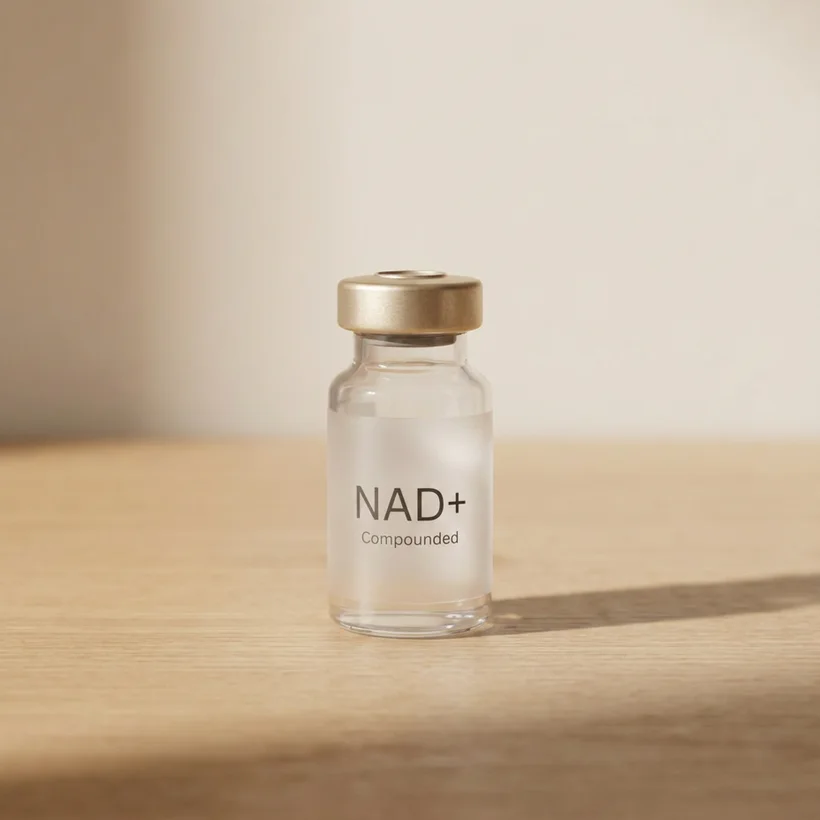
From the FormBlends catalog
NAD+ Peptide Complex
Restore cellular energy and DNA repair capacity · From $179/mo · compounded by a licensed 503A pharmacy, dispensed only after provider review.
View NAD+ Peptide Complex →Longevity peptides in this context typically refers to short amino-acid chains (2-10 residues) believed to modulate gene expression, receptor signaling, or tissue repair. Common co-administration partners include Epitalon (Ala-Glu-Asp-Gly, a synthetic tetrapeptide), BPC-157 (a 15-amino-acid partial sequence of body protection compound), and growth hormone secretagogues such as Sermorelin or CJC-1295/Ipamorelin.
The phrase "NAD peptide injection" does not describe a single pharmaceutical product. It is a protocol term. This distinction matters clinically: the evidence for each component is separate, the stability requirements differ, and regulatory status differs.
Evidence Ledger: What Does the Science Actually Support?
| Claim | Best Evidence Type | Key Reference / Context | Effect Direction | Confidence |
|---|---|---|---|---|
| Oral NMN raises blood NAD+ in healthy adults | Human RCT | Yoshino et al., Science 2021 (n=25 postmenopausal women with prediabetes) | Positive | High |
| Oral NR raises blood NAD+ metabolites | Human RCT | Trammell et al., Nature Comm. 2016; Dollerup et al. 2018 | Positive | High |
| IV NAD+ raises plasma NAD+ acutely | Human pharmacokinetic data | Multiple clinical case series; mechanism well-established | Positive | Moderate |
| NAD+ repletion improves insulin sensitivity in humans | Human RCT | Yoshino et al. 2021 showed muscle insulin signaling improvement with NMN | Modest positive | Moderate |
| Injectable NAD+ outperforms oral precursors on clinical outcomes | No head-to-head human trial | Not studied directly | Unknown | Very Low |
| Epitalon extends lifespan or reduces cancer in rodents | Animal studies | Anisimov et al., multiple publications (St. Petersburg Gerontology group) | Positive in rodents | Low (no human RCT) |
| BPC-157 accelerates tendon/gut healing in rodents | Animal studies | Numerous rodent models; Sikiric et al. series | Positive in animals | Low (limited human data) |
| NAD+ + peptide stacks produce synergistic longevity effects in humans | No controlled data | Theoretical / anecdotal | Unknown | Very Low |
How Does NAD+ Work at the Cellular Level?
NAD+ participates in over 500 enzymatic reactions. Its most discussed longevity-relevant roles operate through two pathways:
Sirtuin activation
Sirtuins (SIRT1-7) are NAD+-dependent deacylases that regulate mitochondrial biogenesis, DNA repair recruitment, and inflammatory gene expression. SIRT1 requires NAD+ as a co-substrate (not just a cofactor); as intracellular NAD+ falls, sirtuin activity falls proportionally. This relationship is well-established in cell biology. What this does NOT prove: that raising peripheral blood NAD+ by injection reliably raises intracellular NAD+ in the target tissues (liver, muscle, brain) at therapeutically relevant concentrations in humans.
PARP substrate
PARP1 (poly ADP-ribose polymerase 1) consumes NAD+ during DNA strand-break repair. Chronic low-level DNA damage -- common with aging and UV exposure -- can deplete local NAD+ stores. NAD+ repletion theoretically maintains PARP1 activity. This mechanism is solid at the cell level; clinical translation to injectable protocols is still inferential.
CD38 competition
CD38, an ecto-enzyme that degrades NAD+, increases with age-related inflammation. Some researchers (Camacho-Pereira et al., Cell Metabolism 2016) have proposed that CD38 upregulation is a primary driver of age-related NAD+ decline. This is a genuinely important mechanistic insight: even if you inject NAD+, elevated CD38 activity may consume it rapidly, limiting net intracellular gain. This caveat is almost never discussed in commercial protocols.
How Do You Reconstitute NAD+ for Injection?
Reconstitution is where the most consequential user errors occur. The steps below reflect standard compounding and research practice.
What you need
- Lyophilized NAD+ powder (from a licensed compounding pharmacy or verified research supplier with COA)
- Bacteriostatic water for injection (contains 0.9% benzyl alcohol as a preservative)
- Alcohol wipes, 1-3 mL syringe, 18-21 gauge needle for drawing, 27-29 gauge needle for injection
Reconstitution math
| Vial Size | Diluent Volume Added | Resulting Concentration | Volume per 50 mg Dose |
|---|---|---|---|
| 100 mg NAD+ | 1.0 mL bacteriostatic water | 100 mg/mL | 0.5 mL |
| 100 mg NAD+ | 2.0 mL bacteriostatic water | 50 mg/mL | 1.0 mL |
| 500 mg NAD+ | 5.0 mL bacteriostatic water | 100 mg/mL | 0.5 mL |
Technique points
- Inject bacteriostatic water slowly down the side of the vial, not directly onto the powder. NAD+ foams and can degrade if sheared aggressively.
- Swirl gently; do not vortex.
- The solution should be colorless to very pale yellow. If it is amber before first use, the source material was already degraded.
- Use bacteriostatic water for multi-dose vials. Sterile water (no preservative) is acceptable for single-use only and should be used the same day.
What Dose and Frequency Are Used in NAD Peptide Injections?
There is no FDA-approved dosing protocol for injectable NAD+. The figures below reflect published human research and current clinical practice conventions, not regulatory guidelines.
| Route | Dose Range Seen in Literature/Clinical Use | Frequency | Evidence Level |
|---|---|---|---|
| IV infusion | 250-1000 mg per session, infused over 2-4+ hours | Daily for 4-10 days (loading), then weekly | Human case series, pharmacokinetic studies |
| Subcutaneous injection | 25-100 mg per dose | Daily to 3x/week | Clinical practice convention; no formal dose-finding RCT |
| Intramuscular injection | 25-50 mg per dose | 3x/week | Clinical convention only |
The slower infusion rate of IV NAD+ is clinically significant. Rate-dependent side effects (nausea, flushing, chest tightness, cramping) are well-documented in clinical observations and are substantially reduced when infusion time is extended. Subcutaneous dosing delivers a lower peak plasma concentration over a longer absorption period, which may inherently reduce infusion-type reactions while also producing a lower Cmax.
Which Peptides Are Most Commonly Stacked With NAD Injections?
| Peptide | Sequence / Type | Claimed Mechanism | Strongest Available Evidence | Reality Check |
|---|---|---|---|---|
| Epitalon | Ala-Glu-Asp-Gly (tetrapeptide) | Telomerase activation, melatonin regulation | Rodent lifespan studies (Anisimov et al.); limited human observational data | No human RCT; rodent data is promising but not directly translatable |
| BPC-157 | 15-amino-acid partial sequence (synthetic) | Angiogenesis, gut mucosal repair, tendon healing | Rodent models (Sikiric et al.); one small human case report series | No completed Phase II or III human RCT published as of 2026 |
| Sermorelin / CJC-1295 | GHRH analogue | Growth hormone secretion stimulation | Human RCTs exist for sermorelin in GH deficiency | Regulatory status: FDA-approved sermorelin was withdrawn; CJC-1295 is research-only |
| Ipamorelin | Pentapeptide GHRP | Selective GH pulse stimulation via ghrelin receptor | Some human pharmacokinetic data; limited clinical outcome RCTs | Research compound; not FDA-approved for general use |
Stacking rationale is typically based on non-overlapping mechanisms, not on human synergy data. Before adding compounds, the honest calculation is: each additional peptide multiplies both the potential benefit and the unknowns about interactions, cumulative side effects, and cost.
What Most Pages Get Wrong: Penetration, Purity, and Formulation Gotchas
1. Injected NAD+ does not equal intracellular NAD+
NAD+ is a large, charged molecule (MW approximately 663 Da, with two phosphate groups carrying negative charges at physiological pH). It does not freely cross cell membranes. Extracellular NAD+ is converted by ecto-enzymes (primarily CD73 and CD38 pathways) to NMN, NR, or Nam before cellular uptake via transporters (Slc12a8 for NMN; equilibrative nucleoside transporters for NR). The practical implication: the relationship between plasma NAD+ post-injection and the intracellular NAD+ level in a specific target tissue is indirect and tissue-dependent. This is almost never stated plainly in protocol guides.
2. Purity matters enormously for injectables and is rarely verified by buyers
Research-grade NAD+ from non-pharmacy sources is frequently sold with certificates showing 98%+ purity by HPLC. What those COAs often omit: endotoxin (lipopolysaccharide) testing. Endotoxins from gram-negative bacterial contamination during manufacturing cause fever, rigors, and potentially sepsis-like reactions when injected. The injectable endotoxin limit per USP standards is below 5 EU/mL for general parenterals, with stricter limits for CNS-adjacent routes. A COA without a LAL (Limulus Amebocyte Lysate) endotoxin test result is inadequate for any injectable compound regardless of purity percentage.
3. Benzyl alcohol accumulation in repeat dosing
Bacteriostatic water contains 0.9% benzyl alcohol. At typical single-dose volumes this is clinically insignificant. In high-frequency, high-volume dosing protocols (daily 2 mL injections over weeks), benzyl alcohol accumulation can become a concern particularly in individuals with hepatic impairment, in neonates (where it is contraindicated), and when multiple bacteriostatic-water-reconstituted compounds are co-administered. This is not a common clinical problem in healthy adults at standard doses, but it is never mentioned in protocol guides.
4. Peptide degradation post-reconstitution is faster than most users expect
BPC-157 and Epitalon, once reconstituted, are generally considered stable for 2-4 weeks at 2-8°C and for a shorter period at room temperature. However, repeated introduction of a drawing needle into a vial introduces oxygen and potential microbial contamination even with bacteriostatic water. Minimize needle entries; use a separate drawing needle each time and replace the stopper if visible coring occurs.
Why Does Storage and pH Matter? The Chemistry Behind the Rules
NAD+ contains a pyrophosphate bond linking two nucleotides (AMP and NMN). This bond is the primary hydrolysis target. The hydrolysis rate accelerates with:
- Elevated temperature: Degradation follows Arrhenius kinetics; even going from 4°C to 25°C meaningfully accelerates breakdown. Lyophilized powder is most stable at -20°C or below.
- Acidic or alkaline pH: NAD+ is most stable near neutral pH (approximately 6-7). The phosphodiester bond hydrolyzes faster below pH 5 and above pH 8. Bacteriostatic water is pH-adjusted to approximately 5.7-6.5, which is within the acceptable range. Mixing with compounds in strongly acidic vehicles (some ascorbate formulations) risks accelerated hydrolysis -- this is the chemical reason not to mix arbitrarily.
- Light exposure: The nicotinamide ring absorbs UV radiation. Photodegradation can occur with prolonged ambient light exposure. Store vials in the original amber/opaque packaging or in a drawer.
- Oxygen: NAD+ can undergo oxidative degradation. The reconstituted solution should not be left open to air. Draw what you need and re-seal the vial promptly.
The color change rule is direct chemistry: NAD+ in its oxidized form is colorless. As it breaks down to products including NAAD (nicotinic acid adenine dinucleotide) and further oxidative species, the solution takes on a yellow-to-amber hue. Amber color = use-it signal, not discard-it hesitation.
Honest Head-to-Head: NAD Injection vs. Oral NMN/NR vs. IV Infusion
| Factor | Subcutaneous NAD+ Injection | Oral NMN or NR | IV NAD+ Infusion |
|---|---|---|---|
| Bioavailability route | Bypasses gut; slower Cmax than IV | Gut absorption; first-pass metabolism; NMN gut-to-NR conversion debated | 100% systemic; highest Cmax |
| Human RCT evidence for raising NAD+ | Indirect (pharmacokinetic inference); no formal RCT | Yes -- Yoshino 2021 (NMN); Trammell 2016 (NR) | Pharmacokinetic case data; no large RCT |
| Side effect profile | Injection site reactions; lower systemic reactions than IV | Generally well-tolerated; GI upset possible at high doses | Nausea, flushing, cramping (rate-dependent) |
| Practical convenience | Requires self-injection or clinical visit | Oral; no training required | Requires clinical setting; 2-4+ hours per session |
| Cost (approximate range) | Moderate-high; requires compounding pharmacy | Low-moderate (OTC) | High; clinic overhead |
| Regulatory simplicity | Prescription required; compounded | Sold as dietary supplement (US) | Prescription required; clinical setting |
| Where the peptide LOSES | No head-to-head advantage over oral proven in humans | Less invasive; better evidence base for the delivery method itself | Highest inconvenience and cost; no proven outcome superiority |
The honest summary: oral NMN and NR have the most rigorous human RCT support for raising NAD+ levels. Subcutaneous injection is a reasonable clinical choice for patients who want to bypass gut absorption, but it cannot claim proven outcome superiority over oral precursors based on current evidence.
How to Read a COA and Judge a NAD+ Injectable Product Yourself
A Certificate of Analysis (COA) for an injectable NAD+ product should contain all of the following. If any are absent, ask explicitly before purchasing or using.
| COA Element | What to Look For | Red Flag |
|---|---|---|
| Identity confirmation | HPLC or LC-MS/MS with retention time matching NAD+ standard | "Identity: conforms" with no method stated |
| Purity | 98%+ by HPLC (area percent); specify what impurities are measured | Purity by UV only; does not identify degradation products |
| Endotoxin test | LAL test result in EU/mg or EU/mL; should be below 1 EU/mg for injectable-grade | No endotoxin test listed at all |
| Sterility | USP sterility test passed, or membrane filtration method stated | No sterility statement |
| Moisture content | Low moisture for lyophilized powder (typically below 5% by Karl Fischer); high moisture accelerates degradation | Not reported |
| Testing laboratory | Third-party, ISO 17025-accredited or USP-recognized lab | In-house testing only; no accreditation |
| Lot number / date | Specific lot traceable to this COA; test date within reasonable shelf life | No lot number; COA is generic or undated |
Frequently Asked Questions
What exactly is a NAD peptide injection?The term blends two distinct compounds: NAD+ (nicotinamide adenine dinucleotide), a coenzyme, and longevity peptides such as Epitalon or BPC-157. They are often co-administered but are chemically unrelated. NAD+ is not itself a peptide; the phrase "NAD peptide injection" is a market convention describing a protocol that combines both.
How do you reconstitute NAD+ for injection?Add bacteriostatic water (not sterile water alone for multi-use vials) to the lyophilized NAD+ powder. A common starting dilution is 1 mL bacteriostatic water per 100 mg NAD+, yielding 100 mg/mL. Draw slowly to avoid foaming. Use within 2 weeks if refrigerated at 2-8°C, and discard if the solution turns yellow-brown.
What dose of NAD+ injection is used in clinical protocols?Published human studies have used IV NAD+ infusions ranging from 250 mg to 1000 mg over several hours. Subcutaneous injection protocols in clinical practice typically range from 25 mg to 100 mg per dose, but these specific subcutaneous doses lack formal RCT-level dose-finding data. Any dosing should be supervised by a licensed clinician.
Which peptides are most commonly stacked with NAD injections?The most commonly co-administered peptides in longevity protocols are Epitalon (a tetrapeptide targeting pineal telomere biology), BPC-157 (gut and connective tissue repair), and Sermorelin or CJC-1295 (growth hormone secretagogues). Each has a separate mechanism and separate evidence base; stacking amplifies cost and unknowns before it amplifies proven benefit.
Can you mix NAD+ and peptides in the same syringe?Generally not recommended without pharmacy validation. NAD+ is chemically reactive and pH-sensitive. Many peptides are also pH-sensitive or have narrow stability windows. Mixing in one syringe risks degradation of one or both compounds before injection. Administer in separate syringes at separate sites unless a compounding pharmacy has validated the combination.
What does degraded NAD+ look like and when should you discard it?Freshly reconstituted NAD+ is colorless to very pale yellow. A deepening yellow or amber color indicates oxidative degradation. Cloudiness or particulate matter also warrants immediate discard. Exposure to light or temperatures above 8°C accelerates this process significantly.
How does subcutaneous NAD+ bioavailability compare to IV infusion?Direct bioavailability comparison data for subcutaneous versus IV NAD+ in humans is limited. IV delivers 100% of the dose systemically and rapidly. Subcutaneous absorption is slower and the fraction reaching the bloodstream intact is not firmly established for NAD+ specifically. The slower Cmax with subcutaneous dosing may actually reduce the flushing and nausea common with IV.
What are the most common side effects of NAD peptide injections?For NAD+ IV infusions, nausea, flushing, chest tightness, and cramping are well-documented and rate-dependent; they diminish with slower infusion. Subcutaneous injection site reactions (redness, transient pain) are the most common local effect. Serious adverse events are rare in published literature but under-reported given the largely non-clinical setting in which these compounds are used.
Is NAD+ injection better than oral NMN or NR supplements?Oral NMN and NR are NAD+ precursors with demonstrated ability to raise blood NAD+ levels in human RCTs (Yoshino et al. 2021 for NMN; Trammell et al. 2016 for NR). Injectable NAD+ bypasses gut metabolism entirely. Whether the higher peak plasma NAD+ from injection translates to better clinical outcomes than oral precursors is not established in head-to-head human trials.
How should NAD+ vials be stored before and after reconstitution?Lyophilized NAD+ powder should be stored at or below -20°C (or at minimum 2-8°C short-term) away from light. After reconstitution with bacteriostatic water, store at 2-8°C and use within approximately 2 weeks. Each freeze-thaw cycle degrades the molecule; do not refreeze reconstituted solution.
Do NAD peptide injections require a prescription?In the United States, injectable NAD+ is typically compounded by licensed 503A or 503B compounding pharmacies and requires a valid prescription from a licensed prescriber. It is not an FDA-approved drug product. Regulatory status varies by country. Using unregulated injectable compounds obtained without a prescription carries significant safety and legal risks.
What should a COA for NAD+ injection contain?A trustworthy Certificate of Analysis should include: identity confirmation (HPLC or mass spectrometry), purity percentage (98%+ for injectable-grade), endotoxin testing result (LAL test, below 1 EU/mg for injectable use), sterility test, moisture content for lyophilized powder, and the testing laboratory's name and accred
Related peptide guides
Ready when you are
NAD+ Peptide Complex
Restore cellular energy and DNA repair capacity · From $179/mo · compounded by a licensed 503A pharmacy, dispensed only after provider review.
View NAD+ Peptide Complex →