
Trust signals
All claims graded by evidence type. No financial relationship with DSIP manufacturers. DSIP is a research compound, not an FDA-approved drug. This page is for educational purposes only.Key Takeaways
- DSIP is a nine-amino-acid neuropeptide (Trp-Ala-Gly-Gly-Asp-Ala-Ser-Gly-Glu) with a molecular weight of approximately 849 Da, originally isolated from rabbit cerebrospinal fluid in 1977 by Schoenenberger and Monnier.
- Human studies supporting sleep benefits used intravenous infusion, not subcutaneous injection. No published RCT has tested subcutaneous DSIP in healthy adults for sleep.
- Reconstituted DSIP in bacteriostatic water degrades at refrigerator temperatures over weeks. Lyophilized powder stored at minus 20 Celsius is the only reliably stable form.
- Research protocol doses most often cited range from 100 to 500 micrograms subcutaneously in the evening. This range derives from IV human data and animal studies, not subcutaneous human pharmacokinetics.
- DSIP is on the WADA prohibited list and is not approved by the FDA, EMA, or TGA for any indication.
What is a DSIP peptide injection and does it work?
A DSIP peptide injection delivers delta sleep-inducing peptide subcutaneously as a research protocol, typically at 100 to 500 micrograms in the evening. Human evidence for sleep benefit comes from small, non-blinded IV infusion studies from the 1980s. Subcutaneous bioavailability data are essentially absent. Confidence in any clinical effect is Low to Very Low.Table of Contents
- How do you reconstitute DSIP peptide?
- What is the correct dose for a DSIP injection?
- How do you perform the injection itself?
- What does the evidence actually show? (Evidence Ledger)
- How does DSIP work at the mechanistic level?
- What most pages get wrong about DSIP
- Why does DSIP degrade and what does that mean practically?
- How does DSIP compare to its real alternatives?
- How to read a DSIP vial label and COA
- Frequently Asked Questions
- Sources
How do you reconstitute DSIP peptide?
DSIP arrives as a lyophilized (freeze-dried) white powder. The goal of reconstitution is to dissolve it in bacteriostatic water (sterile water with 0.9% benzyl alcohol) without denaturing the peptide or introducing contamination.
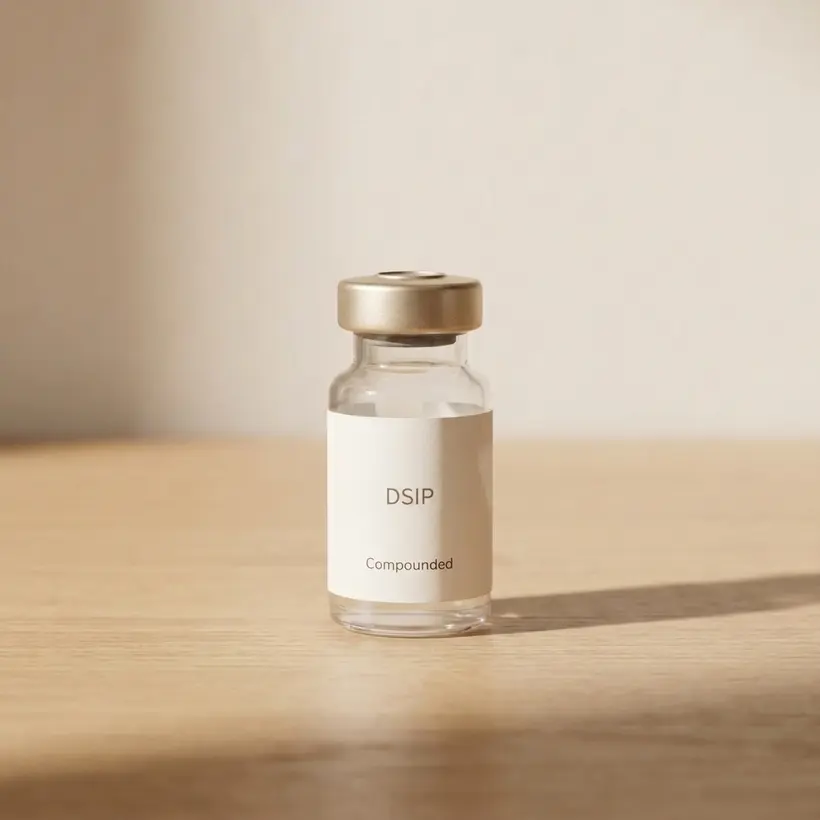
From the FormBlends catalog
DSIP (Delta Sleep-Inducing Peptide)
Restore deep, restorative delta wave sleep · From $179/mo · compounded by a licensed 503A pharmacy, dispensed only after provider review.
View DSIP (Delta Sleep-Inducing Peptide) →Step-by-step protocol:
- Wipe the rubber stopper of both the DSIP vial and the bacteriostatic water vial with a fresh alcohol swab. Allow to air dry for 10 seconds.
- Draw the desired volume of bacteriostatic water into a 1 mL insulin syringe.
- Insert the needle through the stopper of the DSIP vial at an angle and release the water slowly down the inner glass wall. Do not squirt directly onto the powder cake. Direct force causes foaming and can damage the peptide structure.
- Remove the syringe. Swirl the vial gently in a circular motion for 20 to 30 seconds until the powder dissolves completely. Do not vortex or shake.
- The solution should be clear and colorless. Any cloudiness or particulate signals a problem.
Concentration math:
| Vial size | Bacteriostatic water added | Resulting concentration | Volume per 250 mcg dose |
|---|---|---|---|
| 2 mg | 2 mL | 1000 mcg per mL | 0.25 mL (25 units on U-100 syringe) |
| 2 mg | 4 mL | 500 mcg per mL | 0.50 mL (50 units on U-100 syringe) |
| 5 mg | 5 mL | 1000 mcg per mL | 0.25 mL (25 units on U-100 syringe) |
Store reconstituted vials at 2 to 8 Celsius (standard refrigerator). Keep away from light. Do not freeze the reconstituted solution. Label the vial with the reconstitution date.
What is the correct dose for a DSIP injection?
There is no FDA-approved dosing schedule. The following table reflects what appears in published human studies and in commonly referenced research protocols. Treat these as approximate starting points, not clinical prescriptions.
| Context | Dose range | Route | Timing | Evidence basis |
|---|---|---|---|---|
| Human IV studies (1980s sleep research) | 25 mcg to 2 mg total | IV infusion | Evening | Small unblinded studies |
| Subcutaneous research protocol (commonly cited) | 100 to 500 mcg | Subcutaneous | 30 to 60 min before sleep | Extrapolated from IV data, no direct SC pharmacokinetic study |
| Stress or HPA modulation (animal data) | Variable by weight | Intraperitoneal or IV in rodents | Variable | Rodent only |
Critical caveat: Subcutaneous bioavailability of DSIP is not established in published literature. The dose ranges circulating in research communities are extrapolated from IV infusion human data and rodent studies. A 250 to 300 mcg subcutaneous evening dose is the most frequently referenced starting point, but this is not pharmacokinetically validated.
How do you perform the injection itself?
- Supplies needed: 1 mL insulin syringe (27 to 31 gauge, 8 mm needle), alcohol swabs, reconstituted DSIP vial, sharps container.
- Site selection: Pinched subcutaneous tissue in the lower abdomen (at least 5 cm from the navel) or the outer thigh. Rotate sites with every injection.
- Draw the dose: Wipe the vial stopper, insert the needle, draw slightly more than the target volume, tap bubbles to the top, and eject to the exact volume marker.
- Inject: Wipe the injection site with an alcohol swab, let it dry, pinch a fold of skin, insert the needle at 45 to 90 degrees (depending on subcutaneous tissue thickness), release the pinch, inject slowly, withdraw at the same angle, apply gentle pressure. Do not massage.
- Dispose: Needle immediately into a sharps container. Never recap.
What does the evidence actually show? (Evidence Ledger)
| Claim | Best evidence type | Effect direction | Confidence (GRADE) |
|---|---|---|---|
| IV DSIP increases delta sleep in humans | Small uncontrolled human IV infusion studies (Schoenenberger et al., Kastin et al. 1980s) | Positive in some subjects | Low |
| Subcutaneous DSIP improves sleep in healthy adults | No direct published RCT found | Unknown | Very Low |
| DSIP modulates HPA axis / reduces cortisol analog in rodents | Animal (rodent) studies | Directionally positive | Very Low for humans |
| DSIP has analgesic properties | Animal models of pain | Positive in rodents | Very Low for humans |
| DSIP antioxidant effects in cells | In vitro / animal | Positive in some models | Very Low |
| DSIP is generally well tolerated at research doses | Small human IV studies, anecdotal subcutaneous reports | No serious adverse events reported in small studies | Low |
The honest summary: the most credible human data comes from a handful of small IV studies conducted in the 1980s, most prominently by Schoenenberger, Graf, and colleagues in Switzerland, and separately reviewed by Krueger at the National Institutes of Health. These studies are methodologically limited by modern standards. No modern RCT with pre-registration, blinding, and adequate power has tested DSIP via any route for any indication.
How does DSIP work at the mechanistic level?
DSIP is a nonapeptide (9 amino acids: Trp-Ala-Gly-Gly-Asp-Ala-Ser-Gly-Glu). Its molecular weight is approximately 849 Da. Its half-life in plasma following IV administration in early human studies was reported to be in the range of minutes to under an hour, with rapid enzymatic degradation by peptidases in blood and tissues.
Proposed mechanisms (note: most remain unconfirmed in humans):
- Central nervous system modulation: DSIP crosses the blood-brain barrier in animal models via a saturable transport mechanism, though the efficiency in humans is not quantified in published data. Once centrally present, it is proposed to interact with limbic and brainstem circuits that regulate sleep architecture.
- HPA axis interaction: Animal studies suggest DSIP reduces CRH-stimulated ACTH release and may blunt corticosterone responses to stress. The specific receptor responsible is not clearly identified in the literature as of the available evidence base.
- Opioid system modulation: Some rodent data suggest partial interactions with opioid receptor pathways at higher concentrations, which may partly explain reported analgesic effects in animal models.
- Antioxidant activity: In vitro and animal studies suggest DSIP has direct free-radical scavenging properties, possibly via the tryptophan residue at position 1. This does not translate directly to clinical antioxidant benefit.
What the mechanism does NOT prove: A peptide that modulates delta sleep in IV animal and small IV human experiments does not automatically produce the same effect when injected subcutaneously. First-pass enzymatic degradation, subcutaneous peptidase activity, and the lack of measured CNS concentrations after subcutaneous dosing mean the mechanistic story is incomplete.
What most pages get wrong about DSIP
Most DSIP content on supplement and peptide blogs presents the 1980s IV human data as if it directly supports subcutaneous self-injection protocols. There are two compounding problems with this that are almost universally omitted.
1. Route matters enormously for a peptide this small and enzymatically labile. DSIP's plasma half-life in IV studies was measured in minutes in some reports. Subcutaneous injection introduces a depot absorption phase, but the surrounding tissue also contains peptidases that may degrade a significant fraction of the dose before it reaches systemic circulation. No published pharmacokinetic study has measured DSIP plasma concentrations after subcutaneous dosing in humans. The dose you inject subcutaneously and the dose that reaches the CNS are unknown quantities.
2. Purity and source variability is a real problem. DSIP sold as a research compound varies widely in peptide purity. A reputable COA from a third-party analytical laboratory should show purity of 98% or higher by HPLC. Products without this documentation may contain synthesis byproducts including truncated sequences and acetylated impurities that have different (or no) biological activity. Buying on price alone is a direct way to inject an unknown mixture.
3. Benzyl alcohol in bacteriostatic water is not inert at high injection volumes. Benzyl alcohol preservative is safe at the low concentrations used in bacteriostatic water for standard injection volumes. However, injecting very large volumes of bacteriostatic water (not relevant at typical DSIP doses but important for users combining multiple peptides in one syringe) can introduce enough benzyl alcohol to cause local irritation or, at extreme volumes, systemic toxicity. This is not a concern at a 0.25 mL injection but is worth understanding.
Why does DSIP degrade and what does that mean practically?
DSIP contains a tryptophan residue (position 1) and multiple glycine and serine residues. Two degradation pathways matter most in practice.
Oxidation of tryptophan: Tryptophan is one of the most oxidation-prone amino acids. Exposure to light (particularly UV) and dissolved oxygen in solution drives oxidation of the indole ring, producing kynurenine derivatives and hydroxytryptophan. These oxidation products lack the biological activity of intact DSIP. This is why reconstituted DSIP vials should be stored in the dark, and why amber glass vials or foil wrapping matter. Warm temperatures accelerate this reaction. This is the same chemistry that requires many tryptophan-containing peptides and proteins to be stored cold and protected from light.
Peptide bond hydrolysis: In aqueous solution, peptide bonds slowly break in water. This is accelerated by extremes of pH, heat, and repeated freeze-thaw cycles. Bacteriostatic water is near neutral pH, which is optimal, but hydrolysis still proceeds. At refrigerator temperature the rate is slow enough that 4 weeks is a commonly accepted conservative limit. At room temperature, degradation is meaningfully faster.
Practical rules derived from this chemistry:
- Store lyophilized powder at minus 20 Celsius, away from light, until ready to use.
- Once reconstituted, refrigerate and use within 4 weeks. Write the date on the vial.
- Do not leave reconstituted DSIP at room temperature between uses. Get in, get out of the fridge.
- A yellow or brown tint to the solution indicates tryptophan oxidation. Discard it.
- Avoid repeated freeze-thaw of reconstituted solution. If you know you will not use a vial within 4 weeks, consider reconstituting smaller volumes at a time from aliquoted frozen powder.
How does DSIP compare to its real alternatives?
| Agent | Evidence level for sleep | Route | Regulatory status | Half-life | Known safety data | Where DSIP loses |
|---|---|---|---|---|---|---|
| DSIP (research compound) | Low to Very Low (IV human data only) | Subcutaneous (unvalidated) or IV | Not approved. WADA prohibited. | Minutes in plasma (IV data) | Limited, small studies only | Every column except novelty |
| Suvorexant (Belsomra) | High (multiple large Phase 3 RCTs) | Oral | FDA-approved for insomnia | 12 hours | Extensive post-marketing data | Cost, daytime sedation risk |
| Lemborexant (Dayvigo) | High (large Phase 3 RCTs) | Oral | FDA-approved for insomnia | 17 to 19 hours | Extensive post-marketing data | Cost |
| Low-dose doxepin (Silenor) | High (RCT data for sleep maintenance) | Oral | FDA-approved | 15 hours (desmethyldoxepin active metabolite) | Well-characterized | Anticholinergic side effects at higher doses |
| Melatonin (OTC) | Moderate for circadian rhythm disorders, Low for sleep onset insomnia | Oral | OTC supplement (US) | 30 to 50 minutes | Extensive, favorable | Modest effect size in primary insomnia |
| Epithalon (research peptide) | Very Low (animal and small human data) | Subcutaneous or IV | Not approved | Not established in humans | Minimal published data | Same limitations as DSIP |
The honest verdict: for anyone with a clinically diagnosed sleep disorder, approved medications have evidence bases that are incomparably stronger. DSIP is a research compound with an interesting mechanistic story and a thin human evidence base. These are not the same thing as clinical efficacy.
How to read a DSIP vial label and COA
Before injecting any research peptide, evaluate the product against these specific criteria.
| What to check | What a quality product shows | Red flags |
|---|---|---|
| Purity by HPLC | 98% or greater | No purity stated, or "greater than 95%" without the actual chromatogram |
| Molecular weight confirmation | Mass spec result matching 849.86 Da for DSIP | No mass spec, or only a label claim with no analytical data |
| Sterility or endotoxin testing | Endotoxin below standard limits (commonly below 1 EU per mg), sterility confirmed for injectable grade | No endotoxin data. For injection use this is a material safety issue. |
| Lot number traceable to COA | Lot number on vial matches lot number on the COA document | Generic COA not tied to the specific lot you received |
| Third-party testing | COA issued by an independent analytical lab, not the vendor's own lab | COA issued by the seller only |
| Sequence confirmation | Amino acid sequence Trp-Ala-Gly-Gly-Asp-Ala-Ser-Gly-Glu confirmed | No sequence data provided |
Reading the concentration on the label: If a vial states "5 mg DSIP" and you add 5 mL bacteriostatic water, the concentration is 1 mg per mL, which equals 1000 micrograms per mL. On a U-100 insulin syringe, each unit marking equals 10 micrograms. A 250 mcg dose is 25 units on that syringe. Always re-derive this math from first principles rather than trusting pre-calculated tables from forums, because the vial size and water volume you choose may differ.
Frequently Asked Questions
What is the standard dose for a DSIP peptide injection?
Human studies have used doses ranging from roughly 25 micrograms to 2 milligrams intravenously. Most subcutaneous research protocols use 100 to 500 micrograms per injection, typically administered in the evening 30 to 60 minutes before sleep. There is no FDA-approved dose.
How do you reconstitute DSIP peptide?
Add bacteriostatic water slowly down the vial wall, never inject directly onto the lyophilized cake. For a 2 mg vial with 2 mL bacteriostatic water, the concentration is 1 mg per mL (1000 mcg/mL). Swirl gently, do not vortex. Refrigerate and use within 4 weeks.
Where do you inject DSIP peptide?
Subcutaneous injection into pinched abdominal skin or the outer thigh is the most common approach in self-administration research contexts. Rotate sites with each injection to avoid lipodystrophy.
How long does reconstituted DSIP last in the fridge?
Bacteriostatic water extends usable shelf life, but peptide oxidation and hydrolysis still proceed at refrigerator temperatures. A conservative and commonly cited limit is 4 weeks at 2 to 8 degrees Celsius. Lyophilized (dry) DSIP stored at minus 20 Celsius is stable for considerably longer.
What does the evidence actually show for DSIP and sleep?
Early small human IV infusion studies from the 1980s reported increased delta sleep. These were not blinded, placebo-controlled trials by modern standards. No large, well-powered RCT confirms DSIP improves sleep in healthy adults via subcutaneous injection. Evidence is Low to Very Low by GRADE standards.
Can DSIP be mixed with other peptides in the same syringe?
Mixing peptides in a single syringe is generally not recommended. pH differences, charge interactions, and competing degradation pathways can reduce the activity of one or both compounds. There is no published compatibility data for DSIP co-administration with other peptides.
What does degraded DSIP look like?
Visible signs of degradation include cloudiness, particulate matter, or a yellow-brown discoloration in what should be a clear, colorless solution. If you see any of these, discard the vial. A degraded product may still appear clear, so visual inspection alone is not sufficient.
Is DSIP legal to purchase and use?
DSIP is not FDA-approved as a drug, not scheduled as a controlled substance in the United States, and is sold as a research compound. Regulatory status varies by country. It is on the WADA prohibited list under the category of peptide hormones and related substances.
How does DSIP compare to approved sleep medications?
Approved agents like suvorexant, lemborexant, and doxepin have large double-blind RCT evidence bases, known pharmacokinetic profiles, and regulatory safety reviews. DSIP has none of these. For clinical sleep disorders, approved medications are more evidence-supported by a wide margin.
What syringe size is best for a DSIP injection?
A 1 mL insulin syringe with a 27 to 31 gauge needle is the standard choice for subcutaneous peptide injections. The short needle length (typically 8 mm) is appropriate for subcutaneous depth without reaching muscle.
Does DSIP affect cortisol?
Animal and in vitro studies suggest DSIP may modulate the HPA axis and reduce stress-related corticosterone release. One small Russian clinical study reported reductions in stress markers. This evidence is Very Low quality and does not confirm the same effect in humans under controlled conditions.
Sources
- Schoenenberger GA, Monnier M. "Characterization of a delta-electroencephalogram-inducing peptide." Proceedings of the National Academy of Sciences USA, 1977. The original paper isolating and naming DSIP.
- Kastin AJ, Castellanos PF, Banks WA, Coy DH. "Entry of DSIP peptides into rat brain." Pharmacology Biochemistry and Behavior, 1981. Describes CNS transport of DSIP in rodents.
- Krueger JM, Obal F. "Sleep regulatory substances." Sleep, annual review articles, National Institutes of Health. Overview of endogenous sleep-promoting factors including DSIP.
- Graf MV, Schoenenberger GA. "Delta sleep-inducing peptide modulates corticotropin-releasing factor." Neuroendocrinology, 1987. Animal and in vitro data on HPA axis interactions.
- Ekimova IV. "Neuroprotective and cytoprotective effects of DSIP." Neuroscience and Behavioral Physiology, 2014. Russian-language research summarized in English-language abstract; animal and limited human data.
- WADA Prohibited List 2024. Section 2, Peptide Hormones, Growth Factors, Related Substances and Mimetics. World Anti-Doping Agency. Confirms DSIP prohibited status.
- Sharma M, Palacios-Bois J, Schwartz G, et al. "Circadian rhythms of melatonin and cortisol in aging." Biological Psychiatry, 1989. Context for sleep peptide regulatory environment.
- Herring WJ, Snyder E, Budd K, et al. "Orexin receptor antagonism for treatment of insomnia: a randomized clinical trial of suvorexant." Neurology, 2012. Cited for quality contrast with DSIP evidence base.
- United States Pharmacopeia (USP). General Chapter 1 on injections and parenteral products. Standards for sterility, endotoxin, and particulate matter in injectable preparations.
- Powell AC, Bhatt DL. "Benzyl alcohol as a bacteriostatic preservative." Clinical context in pharmaceutical compounding literature. Basis for benzyl alcohol safety notes.
Footer Disclaimers
Platform: FormBlends is an informational resource. Nothing on this page constitutes medical advice, diagnosis, or treatment. Consult a licensed healthcare provider before using any research compound.
Research Compound: DSIP is classified as a research compound. It is not approved by the FDA, EMA, TGA, or any major regulatory agency for human therapeutic use. It is sold for laboratory and research purposes only.
Results: Individual responses to research compounds vary. The evidence reviewed on this page does not guarantee any outcome. Effect sizes and clinical significance are uncertain for subcutaneous DSIP in humans.
Trademark: All product names mentioned are the property of their respective owners. FormBlends has no affiliation with DSIP manufacturers or distributors referenced in this article.
Related peptide guides
Ready when you are
DSIP (Delta Sleep-Inducing Peptide)
Restore deep, restorative delta wave sleep · From $179/mo · compounded by a licensed 503A pharmacy, dispensed only after provider review.
View DSIP (Delta Sleep-Inducing Peptide) →