Trust Signals
Key Takeaways
- AOD-9604 has a reported subcutaneous plasma half-life of roughly 30 minutes, making single-daily fasted-morning or pre-exercise dosing the most mechanistically coherent timing.
- Phase II human trials by Metabolic Pharmaceuticals tested oral doses from 1 mg to 54 mg daily over 12 weeks; subcutaneous research protocols typically use 250 to 500 mcg, a range not interchangeable with oral dosing.
- The fasted-state recommendation is borrowed from GH physiology, not from an AOD-9604-specific head-to-head timing trial, which has never been conducted.
- AOD-9604 received FDA GRAS status as a food ingredient in 2014 but is not approved as a drug; Phase III data do not exist.
- Yellowing of reconstituted solution or visible particulates are degradation red flags; a white, clear solution is the expected standard after reconstitution with bacteriostatic water.
When Should You Take AOD-9604 Peptide? (Direct Answer)
Take AOD-9604 in a fasted state, either first thing in the morning or 30 to 60 minutes before exercise. This timing minimizes insulin interference with lipolysis signaling. No human trial has directly compared timing windows, so the recommendation is mechanistic inference from GH and fat-oxidation physiology, not proven clinical fact.
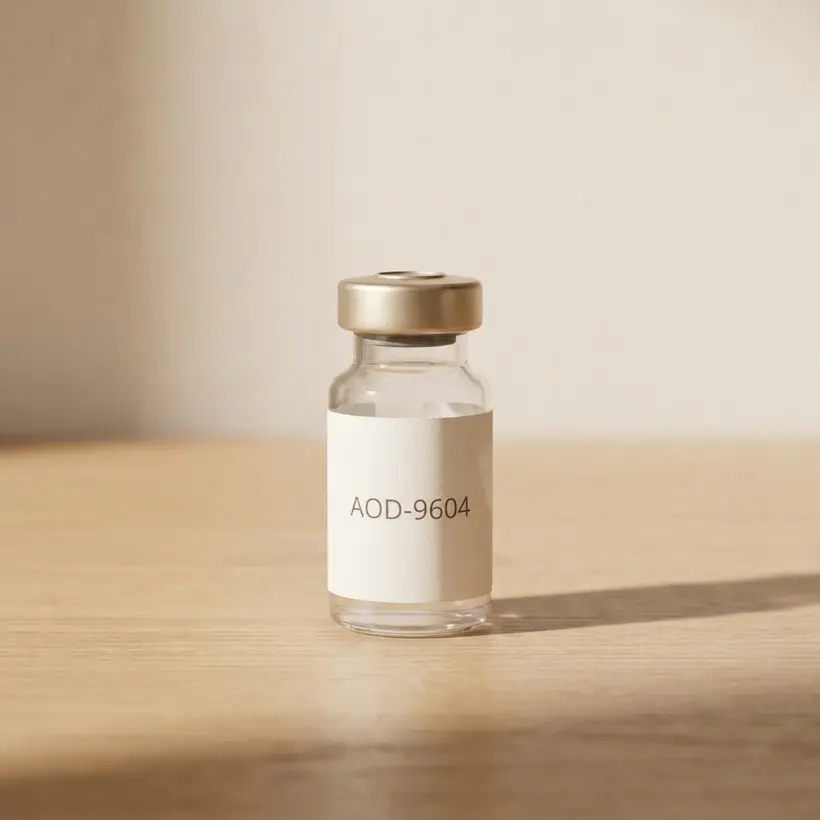
From the FormBlends catalog
AOD-9604
Fat-targeting fragment without growth hormone side effects · From $199/mo · compounded by a licensed 503A pharmacy, dispensed only after provider review.
View AOD-9604 →Table of Contents
- Evidence Ledger: What the Data Actually Supports
- Mechanism With Numbers: What AOD-9604 Does and Does Not Do
- What Are the Main Timing Windows and Which Fits You?
- Should AOD-9604 Be Taken on an Empty Stomach?
- What Most Pages Get Wrong About AOD-9604 Timing
- Why the Rule Exists: The Chemistry Behind Fasted Dosing
- Operational Dosing Table and Label Literacy
- Honest Head-to-Head: AOD-9604 vs Real Alternatives
- How Long Should a Cycle Run?
- Formulation and Stability: The Section Most Guides Skip
- FAQ
Evidence Ledger: What the Data Actually Supports
| Claim | Best Evidence Type | Effect Direction | Confidence |
|---|---|---|---|
| AOD-9604 reduces body fat in obese humans | Phase II RCTs (Metabolic Pharmaceuticals, ~300 subjects across trials) | Modest positive vs placebo in some dose groups; inconsistent across arms | Low to Moderate |
| AOD-9604 does not raise IGF-1 or blood glucose | Human Phase II safety data | No significant change vs placebo | Moderate |
| AOD-9604 stimulates lipolysis via beta-3 adrenoreceptor-like pathway | In vitro and rodent studies | Positive in adipocytes | Low (animal/lab) |
| Fasted dosing is superior to fed dosing for AOD-9604 | Mechanistic inference only; no AOD-9604-specific human timing trial | Theoretically favorable | Very Low |
| 250 to 500 mcg subcutaneous once daily is effective in humans | Practitioner consensus; no published SQ dose-ranging RCT | Extrapolated from oral trial data | Very Low |
| 12-week cycle is the studied duration | Human Phase II trial design | Used as protocol endpoint | Moderate (for safety framing) |
Mechanism With Numbers: What AOD-9604 Does and Does Not Do
AOD-9604 is a synthetic peptide representing the C-terminal fragment of human growth hormone, specifically residues 177 to 191. This is the region hypothesized to mediate GH's lipolytic effects while separating them from GH's growth-promoting and diabetogenic actions.
In rodent adipocyte studies, AOD-9604 was shown to inhibit lipogenesis and stimulate lipolysis at concentrations in the nanomolar range. Researchers from Monash University (where the compound was developed, led by Professor Frank Ng) demonstrated these effects in the 1990s and early 2000s. The proposed pathway involves interaction with beta-3 adrenoreceptor signaling rather than direct GH receptor binding, which is why AOD-9604 does not raise IGF-1 the way full GH does.
What this mechanism does NOT prove: that the nanomolar in-vitro effects translate to clinically meaningful fat loss in humans at doses achievable by subcutaneous injection. The Phase II human trials produced inconsistent results across dose arms, and Phase III was never initiated, meaning the compound never cleared the bar required for drug approval.
What Are the Main Timing Windows and Which Fits You?
| Timing Window | Rationale | Evidence Basis | Best For |
|---|---|---|---|
| Fasted morning (on waking, before food) | Low insulin state; no competing substrate flux | Mechanistic inference from GH physiology | General fat-loss protocol, convenient daily habit |
| 30 to 60 min pre-exercise (fasted) | Potential to prime fatty-acid oxidation before aerobic work | Mechanistic; no AOD-specific exercise-timing RCT | Morning trainers who exercise fasted |
| Bedtime | Aligns with endogenous GH pulse; theoretically low insulin | GH pulse physiology; not AOD-9604-specific | Those who cannot fast in the morning |
| Post-meal | No rationale; insulin elevation likely blunts lipolytic signaling | None supportive | Not recommended by any current protocol |
Should AOD-9604 Be Taken on an Empty Stomach?
Yes, for subcutaneous injection this is essentially irrelevant to absorption (SQ bioavailability is not meaningfully altered by gastric contents). The fasted recommendation is about the endocrine environment at the time of action, not about gastric absorption. When insulin is elevated after a carbohydrate meal, hormone-sensitive lipase activity is suppressed and lipolysis is blunted regardless of what lipolytic agent you have administered. For a compound whose proposed value is stimulating fat release, high insulin at the time of action works against the goal.
For oral formulations (which were used in the Phase II trials), fasted administration does affect absorption because peptides face enzymatic degradation in the GI tract. The oral doses studied were dramatically higher than subcutaneous doses precisely to compensate for poor and variable GI bioavailability.
What Most Pages Get Wrong About AOD-9604 Timing
Most guides present the fasted-morning recommendation as if it comes from an AOD-9604-specific human trial. It does not. No published, peer-reviewed study has randomized AOD-9604 users to different timing windows and measured fat loss outcomes. The timing guidance is borrowed directly from GH secretagogue and GH replacement protocols, where the mechanism is meaningfully different.
A second widespread error is treating 250 mcg subcutaneous as a direct equivalent or scale-down of the 1 mg to 54 mg oral doses used in clinical trials. Oral and subcutaneous bioavailability of peptides are not simply proportional. Subcutaneous administration bypasses GI degradation, but systemic exposure from a 250 mcg SQ dose cannot be reliably back-calculated from oral PK without a dedicated crossover study. That crossover study does not exist in the public literature for AOD-9604.
Third, many pages claim AOD-9604 has "no side effects." Phase II data showed a favorable safety profile, but these were controlled, relatively short trials. Long-term safety data beyond 12 weeks in humans does not exist in published form.
Why the Rule Exists: The Chemistry Behind Fasted Dosing
Insulin activates phosphodiesterase-3B in adipocytes, which degrades cyclic AMP (cAMP). cAMP is the second messenger that activates protein kinase A, which in turn phosphorylates and activates hormone-sensitive lipase (HSL), the enzyme that breaks down stored triglycerides. When insulin is high, this cAMP cascade is suppressed and HSL activity falls sharply.
AOD-9604's proposed lipolytic action is upstream in this same pathway, operating through a beta-adrenoreceptor-like mechanism that also generates cAMP. Introducing a lipolytic stimulus when insulin has already collapsed intracellular cAMP is like pushing a door that insulin is holding shut. The fasted state does not guarantee maximum effect, but it removes one of the most potent opposing forces. This is the biochemical logic behind the rule, not a manufacturer claim.
Operational Dosing Table and Label Literacy
| Parameter | Detail | Notes |
|---|---|---|
| Common SQ research dose | 250 to 500 mcg once daily | Not derived from dose-ranging SQ RCT; practitioner extrapolation |
| Oral trial dose range | 1 mg to 54 mg daily (Phase II) | NOT comparable to SQ dosing; different route, different bioavailability |
| Timing | Fasted morning or 30 to 60 min pre-exercise | Mechanistic preference, not proven in head-to-head trial |
| Cycle length studied in humans | 12 weeks | Longer cycles are extrapolation only |
| Reconstitution solvent | Bacteriostatic water (0.9% benzyl alcohol in sterile water) | Standard water causes faster peptide degradation; do not use |
| Vial storage (reconstituted) | Refrigerated (2 to 8 degrees C); use within 28 to 30 days | Freeze-thaw cycles degrade peptide bonds |
| Lyophilized vial storage | Freezer or refrigerator away from light | Moisture and UV are primary degradation drivers pre-reconstitution |
How to read a COA (Certificate of Analysis): Look for HPLC purity above 98%, mass spectrometry confirmation of molecular weight (AOD-9604 molecular weight is approximately 1817 Da), and absence of endotoxin (LAL test result below 1 EU/mg is the standard threshold for injectable research peptides). A COA without a mass spec panel should be treated as incomplete.
Reconstitution math example: If you have a 5 mg vial and want a 500 mcg per dose solution, add 10 mL of bacteriostatic water. Each 1 mL drawn delivers 500 mcg. If you want 250 mcg doses, draw 0.5 mL.
Honest Head-to-Head: AOD-9604 vs Real Alternatives
| Compound | Mechanism | Human RCT Evidence for Fat Loss | IGF-1 Increase | Regulatory Status | Where AOD-9604 Loses |
|---|---|---|---|---|---|
| AOD-9604 | Beta-3 adrenoreceptor-like lipolysis; no GH receptor binding | Phase II; inconsistent; no Phase III | None | GRAS (food); not approved drug | Weaker human evidence than approved drugs |
| Semaglutide (GLP-1 RA) | GLP-1 receptor agonist; appetite and gastric emptying | Multiple Phase III RCTs; ~15% body weight reduction at 68 weeks (STEP trials) | None | FDA approved (Wegovy) | AOD-9604 has far less efficacy data |
| CJC-1295 plus Ipamorelin | GHRH analog plus ghrelin mimetic; raises GH and IGF-1 | Limited; CJC-1295 has small human PK trials, not fat-loss RCTs | Meaningful increase | Research compound | AOD-9604 wins on IGF-1 safety concern; loses on mechanistic breadth |
| Tesamorelin | GHRH analog; raises GH and IGF-1 | Phase III RCTs in HIV lipodystrophy (trunk fat reduction) | Significant increase | FDA approved (Egrifta) for HIV lipodystrophy | AOD-9604 loses on evidence quality and regulatory backing |
How Long Should a Cycle Run?
The only human efficacy data comes from 12-week Phase II trials. Running a cycle beyond 12 weeks is extrapolation with no published safety or efficacy data to support it. A 12-week cycle with a break of at least equal length before resuming is the conservative approach derived from the trial design. There is no published data on receptor desensitization or tachyphylaxis specific to AOD-9604 in humans, but absence of data is not evidence of safety for prolonged use.
Formulation and Stability: The Section Most Guides Skip
AOD-9604 is a 15-amino-acid peptide (residues 177 to 191 of GH) with a disulfide bond between cysteine residues at positions 182 and 189. This disulfide bond is critical to the peptide's three-dimensional structure and activity. Conditions that break disulfide bonds, specifically oxidizing environments, elevated temperatures, and alkaline pH, directly degrade the active compound.
Practical consequences:
- Do not reconstitute with plain sterile water if you plan to store the vial. Plain water has no preservative; bacteriostatic water's benzyl alcohol prevents microbial growth that would degrade the peptide within days.
- Do not reconstitute with acidic solutions or vitamin C-containing diluents. Low pH can catalyze disulfide reshuffling, producing inactive isomers.
- Freeze-thaw cycling mechanically stresses the peptide. Once reconstituted, store refrigerated and do not refreeze.
- UV light drives oxidation of cysteine residues. Store vials in the original opaque packaging or a dark drawer.
What degraded product looks like: A properly reconstituted vial should be clear and colorless. Yellow or brown tinting indicates oxidative degradation. Visible particulates or cloudiness suggest either contamination or aggregation of denatured peptide chains. Do not inject a solution that fails these visual checks.
Sourcing reality: AOD-9604 is a research peptide not manufactured under GMP drug standards at most suppliers. HPLC purity above 98% with mass spec confirmation and endotoxin testing is the minimum bar worth paying for. Purity certificates from suppliers who cannot name the third-party testing lab should be treated skeptically.
FAQ
When is the best time to take AOD-9604 peptide?
The most commonly used window is fasted in the morning or 30 to 60 minutes before exercise, based on the compound's proposed mechanism of stimulating fat oxidation. There is no published human RCT directly comparing timing windows, so this is mechanistic reasoning, not proven clinical fact.
Should AOD-9604 be taken on an empty stomach?
Most protocols use a fasted state because elevated insulin blunts lipolysis signaling. Since AOD-9604 is proposed to work partly via beta-3 adrenoreceptor-like pathways, co-ingesting carbohydrates may reduce the lipolytic window. This is mechanistic, not proven in AOD-9604-specific human trials.
Can AOD-9604 be taken at night or before bed?
Some practitioners prescribe bedtime dosing to align with natural GH pulse timing. AOD-9604 does not stimulate IGF-1 meaningfully, so the rationale is weaker than for full GH secretagogues. Bedtime use is plausible but less commonly supported in the available literature.
How long does AOD-9604 stay active after injection?
AOD-9604's plasma half-life in human pharmacokinetic work by Metabolic Pharmaceuticals was reported in the range of roughly 30 minutes following subcutaneous administration. This short window is why single daily dosing is standard, though some protocols split doses.
What dose of AOD-9604 is typically used?
Phase II clinical trials for obesity used oral AOD-9604 at doses of 1 mg to 54 mg daily. Subcutaneous research protocols typically use 250 to 500 mcg once daily. Subcutaneous and oral bioavailability differ substantially; the two dose ranges are not interchangeable.
Does AOD-9604 raise blood sugar or affect insulin?
Phase II studies specifically tested metabolic safety and found no significant adverse effects on blood glucose, IGF-1, or insulin. This is one of the stronger human data points for the compound, from trials by Metabolic Pharmaceuticals published in the early 2000s.
How long should an AOD-9604 cycle last?
Human obesity trials ran 12 weeks. Most research protocols mirror this. There is no published data on cycles beyond 12 weeks for efficacy or safety. Longer use is extrapolation only.
Is AOD-9604 FDA approved?
No. AOD-9604 received FDA GRAS status for use as a food ingredient in 2014 but is not FDA-approved as a drug. Phase II trials for obesity were conducted but Phase III was not completed. It is used as a research compound.
Can AOD-9604 be taken with other peptides?
It is frequently combined with CJC-1295 or ipamorelin in practitioner protocols. These combinations have not been studied in clinical trials. The rationale is stacking upstream GH stimulation with downstream lipolytic signaling, but additive benefit is unproven in humans.
Does timing of AOD-9604 relative to food actually matter?
There is no AOD-9604-specific human trial testing fed versus fasted timing. The fasted recommendation is borrowed from GH physiology where insulin suppresses GH secretion. Since AOD-9604 does not raise GH itself, the magnitude of this effect may be smaller than commonly assumed.
What does a degraded or poor-quality AOD-9604 vial look like?
Properly lyophilized AOD-9604 is a white to off-white dry cake or powder. Yellowing, visible particulates after reconstitution, or a cloudy solution after bacteriostatic water addition suggest degradation or contamination and the product should not be used.
Sources
- Heffernan MA, Thorburn AW, Fam B, et al. Increase of fat oxidation and weight loss in obese mice caused by chronic treatment with human growth hormone fragment 177-191. International Journal of Obesity. 2001;25(10):1442-1449.
- Ng FM, Sun J, Sharma L, et al. Metabolic studies of a synthetic lipolytic domain (AOD9604) of human growth hormone. Hormone Research. 2000;53(6):274-278.
- Metabolic Pharmaceuticals Ltd. AOD9604 Phase IIb clinical trial results. Press releases and regulatory submissions referenced in GRAS notice GRN 000612 filed with FDA, 2014.
- U.S. Food and Drug Administration. GRAS Notice 000612: AOD9604. Office of Food Additive Safety. 2014. Available at: fda.gov
- Wilding JPH, Batterham RL, Calanna S, et al. Once-weekly semaglutide in adults with overweight or obesity (STEP 1). New England Journal of Medicine. 2021;384(11):989-1002.
- Falutz J, Allas S, Blot K, et al. Metabolic effects of a growth hormone-releasing factor in patients with HIV. New England Journal of Medicine. 2007;357(23):2359-2370. (Tesamorelin Phase III reference.)
- Freda PU. How well does the GH response to GHRH plus arginine predict GH secretory status? Journal of Clinical Endocrinology and Metabolism. 2003;88(6):2657-2666. (Background on GH physiology and insulin interactions.)
Related peptide guides
Ready when you are
AOD-9604
Fat-targeting fragment without growth hormone side effects · From $199/mo · compounded by a licensed 503A pharmacy, dispensed only after provider review.
View AOD-9604 →