
Trust Signals
Claims are graded by evidence type. No affiliate links. This page cites real human trials, names authors, and concedes where data is absent.Key Takeaways
- In published human IV studies, kisspeptin-54 has a plasma half-life of roughly 28 minutes (Dhillo et al., 2005), meaning short-lived hormonal effects but also rapid washout of most acute side effects.
- The most medically significant side effect is not pain or nausea: it is paradoxical LH suppression caused by continuous or over-frequent dosing via KISS1R tachyphylaxis.
- Comninos et al. (2017, Journal of Clinical Investigation) documented altered limbic brain activity on fMRI after kisspeptin infusion, confirming real neuromodulatory effects beyond the pituitary.
- No long-term human safety trial exists. The longest published studies run days to a few weeks in specialist clinical settings.
- Endotoxin contamination in under-tested research-grade vials is a realistic, underreported risk that causes side effects independent of kisspeptin itself.
What Are Kisspeptin Peptide Side Effects?
In controlled human studies, kisspeptin peptide side effects are generally mild: injection-site reactions, transient flushing, and occasional nausea. The clinically meaningful risk is hormonal: continuous dosing suppresses rather than stimulates LH via receptor desensitization. Long-term safety data do not exist. Research-compound purity adds a separate, real risk.Table of Contents
Evidence Ledger: Kisspeptin Peptide Side Effects
| Claim | Best Evidence Type | Effect Direction | Confidence |
|---|---|---|---|
| Acute LH rise after single subcutaneous or IV dose | Human RCT / controlled infusion (multiple trials, n = 10 to 60 range) | Positive LH response | High |
| LH suppression with continuous kisspeptin infusion (tachyphylaxis) | Human controlled infusion studies and animal models | Paradoxical suppression | High |
| Injection-site reactions, flushing, nausea | Human controlled trials (adverse event reporting) | Present, mild, transient | Moderate |
| Altered limbic brain activity (mood/behavior signal) | Human fMRI study (Comninos et al., 2017, JCI) | Detectable CNS effect | Moderate (single study, small n) |
| No serious adverse events at research doses | Human trials, short duration | No SAEs reported | Moderate (limited follow-up) |
| Long-term safety profile comparable to endogenous kisspeptin | Theoretical / mechanistic only | Unknown | Very Low |
| Oral kisspeptin meaningful absorption in humans | No human PK data | Negligible expected | Very Low |
Mechanism: How Kisspeptin Causes Side Effects, With Numbers
Kisspeptin binds KISS1R (also called GPR54), a Gq-coupled receptor expressed on hypothalamic GnRH neurons. Receptor activation triggers GnRH release, which drives LH and FSH from the pituitary, which drives gonadal sex steroid production. The cascade is real and well established.
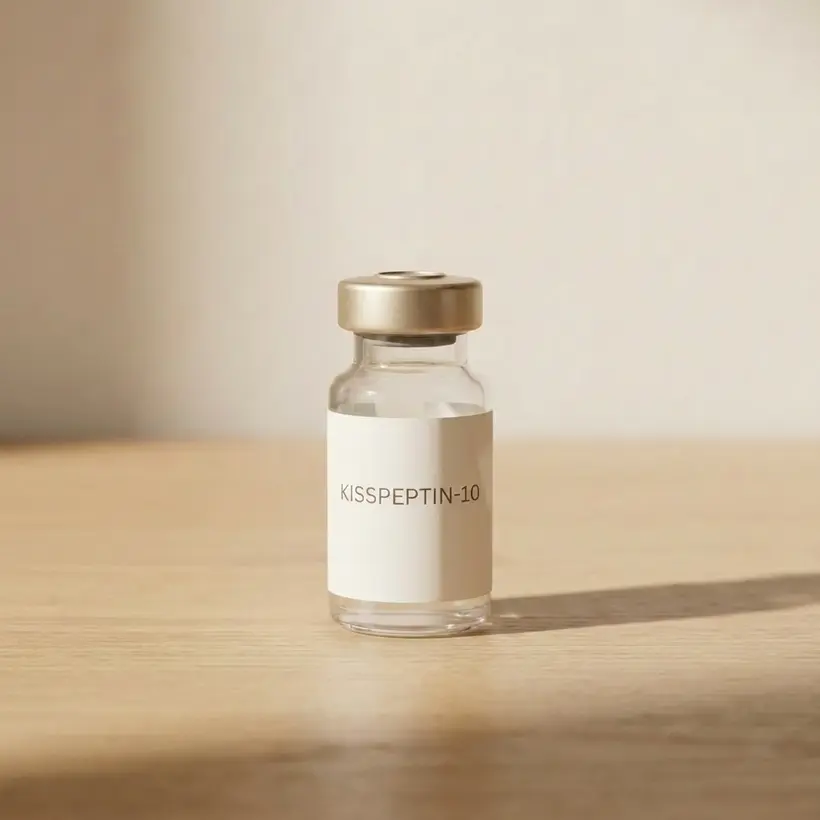
From the FormBlends catalog
Kisspeptin-10
Master regulator of reproductive hormones and sexual arousal · From $49/mo · compounded by a licensed 503A pharmacy, dispensed only after provider review.
Learn about Kisspeptin-10 →Where side effects originate:
- At the receptor: KISS1R desensitizes rapidly under sustained ligand exposure. This is not a theoretical concern. Clinical studies using continuous IV kisspeptin infusion show progressive LH blunting within hours, even at doses that initially produce strong LH pulses.
- At the pituitary: Kisspeptin also has direct pituitary KISS1R expression. The relative contribution of hypothalamic vs. pituitary signaling to observed LH responses varies between individuals and by dose.
- Plasma half-life context: Dhillo et al. (2005) measured kisspeptin-54 plasma half-life at approximately 28 minutes via IV infusion in healthy women. Kisspeptin-10 is cleared faster. These short half-lives mean most acute hormonal side effects resolve within an hour or two of dose administration, but they also mean subcutaneous dosing produces variable, less predictable peak exposures compared to IV.
- CNS penetration: Kisspeptin crosses the blood-brain barrier poorly when administered peripherally. CNS effects observed in fMRI studies (Comninos et al., 2017) may involve peripheral KISS1R signaling feeding into central circuits, or a small fraction of peptide reaching limbic structures, rather than direct central entry. The exact mechanism is not resolved.
What this mechanism does NOT prove: A short plasma half-life does not mean short receptor occupancy or short hormonal consequences. LH pulses triggered by a single dose persist longer than the peptide itself, and downstream testosterone or estrogen changes outlast the LH pulse.
The Tachyphylaxis Problem: What Most Pages Ignore
KISS1R is a G-protein coupled receptor subject to classic agonist-induced internalization and downregulation. When exposed to ligand continuously, the receptor is phosphorylated by GRKs (G-protein coupled receptor kinases), internalized via beta-arrestin, and surface receptor density falls. The net hormonal outcome flips from stimulation to suppression.
This is not speculative. Researchers have deliberately exploited this property to develop kisspeptin analogs for androgen deprivation in prostate cancer. Someone self-administering kisspeptin multiple times per day, or running a continuous pump, may achieve the opposite of their goal: suppressed testosterone rather than elevated testosterone.
Pulsatile dosing, mimicking endogenous kisspeptin release patterns, is required to avoid this. The appropriate inter-pulse interval has not been defined for subcutaneous self-administration. Research protocols vary and cannot be directly translated to self-administration contexts.
Neurological and Mood Effects: Real but Incompletely Characterized
Kisspeptin receptors are expressed in limbic structures including the amygdala and hippocampus. Comninos et al. (2017) conducted a placebo-controlled, crossover study in hypogonadal men using fMRI during kisspeptin infusion. They found altered blood-oxygen-level-dependent (BOLD) signal in limbic regions and reported reduced sexual aversion scores on validated questionnaires. The study was small, conducted in a specific patient population (hypogonadal men), and cannot be generalized to healthy users seeking performance or fertility effects.
Key uncertainty: altered fMRI signal does not define the subjective experience or the clinical significance for a healthy person. The direction of mood effects (anxiogenic vs. anxiolytic, prosexual vs. neutral) in healthy populations has not been studied adequately. Anyone reporting dramatic mood effects from research-grade kisspeptin should also consider that formulation excipients, endotoxins, or nocebo effects could explain the experience.
Side Effect Profile Differences by Sex
Kisspeptin biology differs substantially by sex. In women, hypothalamic kisspeptin neurons in the arcuate nucleus govern GnRH pulse frequency, while anteroventral periventricular (AVPV) neurons appear to drive the preovulatory LH surge. Estradiol has opposite feedback effects on these two populations, meaning the same dose of exogenous kisspeptin will produce different LH responses depending on menstrual cycle phase.
In practical terms: a dose given in the follicular phase may produce a different hormonal perturbation than the same dose in the luteal phase. Research studies in women explicitly control for cycle phase; self-administering users have no reliable way to do this, making hormonal side effects harder to predict in women than in men.
No published head-to-head comparison of male vs. female adverse event rates for exogenous kisspeptin exists.
What Most Pages Get Wrong: Purity, Endotoxins, and Sourcing Reality
The majority of wellness and peptide content focuses on the pharmacological side effects of the peptide itself. A larger practical risk for research-compound users is contaminant-driven side effects that have nothing to do with kisspeptin biology.
Endotoxin contamination: Kisspeptin is produced via solid-phase peptide synthesis. If manufacturing uses inadequately controlled reagents or if lyophilized peptide is processed in non-GMP conditions, bacterial lipopolysaccharide (LPS) contamination is possible. LPS triggers toll-like receptor 4 (TLR4), causing fever, rigors, hypotension, and systemic inflammation at microgram-per-kg concentrations. These symptoms may be attributed to the peptide by users when the peptide itself is the least of the problem.
Sequence errors and truncation products: Mass spectrometry can confirm the correct molecular mass but cannot always distinguish a peptide from its des-amidated or oxidized form, both of which alter receptor binding and pharmacokinetics in ways that could change side effect profiles.
Reconstitution vehicle: Kisspeptin is typically reconstituted in bacteriostatic water or acetic acid solution. Incorrect reconstitution vehicles (plain sterile water without benzyl alcohol in multi-dose vials) can allow microbial growth. Injection of a contaminated vial produces infection or systemic inflammatory side effects that again have nothing to do with kisspeptin's pharmacology.
The Chemistry Behind Dosing Rules
Why continuous infusion suppresses LH: KISS1R desensitization occurs because sustained receptor occupancy activates GRK2/3, which phosphorylate intracellular serine and threonine residues on the receptor. Beta-arrestin then binds these phosphorylated residues, sterically blocking G-protein coupling and triggering clathrin-mediated receptor internalization. New receptor synthesis takes hours to days. This is why the rule "pulse, do not drip" exists. It is not arbitrary caution; it is receptor biology.
Why oral kisspeptin does not work: Kisspeptin-10 is a decapeptide (10 amino acids). Gastric pepsin and small-intestine peptidases, particularly aminopeptidases, cleave peptide bonds rapidly. Even if absorption occurred, first-pass hepatic metabolism would further degrade the peptide. No oral formulation has demonstrated meaningful kisspeptin bioavailability in humans. Oral products claiming kisspeptin activity rely on this claim being unverifiable by the consumer.
Why refrigeration matters: The amide bonds and the C-terminal amidation of kisspeptin are susceptible to hydrolysis, particularly accelerated at higher temperatures and in aqueous solution. Lyophilized powder is substantially more stable than reconstituted solution. Once reconstituted, degradation proceeds at a rate that is faster at room temperature than at 4 degrees C, faster still at room temperature over days. Using degraded peptide does not produce the target pharmacological effect; it may produce different fragment-driven effects or simply nothing, but it does not guarantee freedom from side effects because impurities and fragments are not inactive by default.
Honest Head-to-Head: Kisspeptin vs. Real Alternatives for LH Stimulation
| Feature | Kisspeptin (research) | Clomiphene (SERMcipher) | hCG (prescription) | Gonadorelin (compounded) |
|---|---|---|---|---|
| Regulatory status (US) | No FDA approval; research compound | FDA approved (off-label in men) | FDA approved | Compounded; regulatory scrutiny ongoing |
| Route | Injection (SC or IV) | Oral | Injection (SC/IM) | Injection or intranasal (compounded) |
| Long-term safety data | Absent | Decades of data | Decades of data | Limited for compounded formulations |
| Mechanism site | Hypothalamic (upstream) | Hypothalamic/pituitary (estrogen receptor) | Directly stimulates Leydig cells (LH-like) | Pituitary (GnRH receptor) |
| Tachyphylaxis risk with continuous use | High (KISS1R desensitization) | Low at typical doses | Moderate (LH receptor downregulation) | High (same mechanism, GnRH agonist paradox) |
| Where kisspeptin loses | Kisspeptin loses on: regulatory safety oversight, oral availability, long-term data, and practitioner familiarity. Its upstream mechanism is biologically elegant but confers no proven clinical advantage in self-administration contexts. | |||
Label and COA Literacy: How to Evaluate a Kisspeptin Product
A certificate of analysis (COA) is the minimum document to request before using any research-grade kisspeptin. Here is what each section should contain and what to reject:
| COA Field | Acceptable Standard | Red Flag |
|---|---|---|
| HPLC purity | 98% or above | Below 95%, or HPLC method not stated |
| Mass spectrometry | Observed mass matches theoretical MW of stated peptide (e.g., kisspeptin-10 MW 1301.5 Da) | No MS data, or mass not reported |
| Endotoxin testing | Below 1 EU/mg (or supplier-stated limit with LAL or rFC method named) | Absent, or tested only at batch level without lot number matching your vial |
| Residual solvents | Below ICH Q3C limits for Class 2 or 3 solvents | Not tested, or DMF levels not quantified |
| Sequence confirmation | Amino acid analysis or sequencing confirming correct primary structure | Absent (MW alone does not confirm sequence) |
What degraded kisspeptin looks like: Reconstituted solution should be clear and colorless. Cloudiness, particulates, or yellow discoloration indicate degradation or contamination. Lyophilized powder that has clumped and yellowed has likely been exposed to moisture or heat. Neither form should be used.
Reconstitution math: If a vial contains 5 mg of kisspeptin-10 and you add 5 mL of bacteriostatic water, the concentration is 1 mg/mL (1000 micrograms/mL). Research protocols have used doses in the microgram to low milligram per kg range intravenously. Self-administered subcutaneous doses used in fertility research have varied widely and are not standardized for non-clinical use. Confirm your math before drawing any dose.
Frequently Asked Questions
What are the most common kisspeptin peptide side effects reported in human trials?
In published human IV and subcutaneous studies, the most reported side effects are transient injection-site reactions and mild flushing. A minority of participants in GnRH-stimulation trials reported nausea. Serious adverse events have not been reported in controlled research doses, but data come from short-duration studies in small cohorts.
Can kisspeptin cause hormonal disruption or LH/FSH dysregulation?
Yes. Continuous or high-frequency kisspeptin exposure desensitizes KISS1R (GPR54) and suppresses LH pulsatility, the opposite of the intended effect. This tachyphylaxis has been demonstrated in both animal models and human studies. Pulsatile dosing is required to sustain LH stimulation.
Is kisspeptin safe for long-term use?
There are no published long-term human safety trials for kisspeptin peptide administration outside of specialist reproductive medicine settings. Current evidence is restricted to trials lasting days to weeks. Long-term safety is unknown, and that uncertainty is itself a meaningful risk.
Does kisspeptin cause anxiety or mood changes?
Kisspeptin has neuromodulatory roles beyond reproduction. A 2017 study by Comninos et al. (Journal of Clinical Investigation) found that kisspeptin administration altered limbic brain activity on fMRI and was associated with reduced sexual aversion in hypogonadal men. Mood effects in healthy populations are not well characterized.
What happens if kisspeptin is dosed incorrectly or too frequently?
Overdosing or continuous infusion causes KISS1R downregulation and paradoxical LH suppression. This is the same mechanism used in prostate cancer research to suppress testosterone. Incorrect dosing in a self-administration context carries a real risk of temporarily blunting endogenous LH pulsatility.
Are kisspeptin peptide side effects different between men and women?
Sex differences in kisspeptin sensitivity are well documented. Women show phase-dependent LH responses tied to the menstrual cycle, making dose effects harder to predict. Men show more consistent LH responses to single doses. Sex-specific side effect profiles have not been formally compared in a head-to-head human trial.
What is the bioavailability of subcutaneous kisspeptin-10 or kisspeptin-54?
Subcutaneous bioavailability for kisspeptin peptides has not been precisely quantified in published human pharmacokinetic studies. IV studies show rapid clearance with a short plasma half-life (kisspeptin-54 roughly 28 minutes in Dhillo et al. 2005). Subcutaneous absorption adds variability. Oral bioavailability is negligible due to peptide degradation.
Can I stack kisspeptin with other peptides or hormones safely?
There is no human safety data for kisspeptin combined with GH secretagogues, SARMs, or exogenous testosterone. Combining kisspeptin with testosterone may blunt its LH-stimulating effect via negative feedback. Combinations are untested and represent compounded uncertainty, not doubled benefit.
What should a COA for research-grade kisspeptin show?
A credible certificate of analysis should include HPLC purity (ideally above 98%), mass spectrometry confirmation of the correct molecular weight, and testing for residual solvents and endotoxins. Endotoxin testing is critical because bacterial lipopolysaccharide contamination in injectable peptides causes fever, chills, and inflammatory responses independent of the peptide itself.
How does kisspeptin compare to clomiphene for LH stimulation?
Clomiphene is an FDA-approved selective estrogen receptor modulator with decades of human safety data and oral bioavailability. Kisspeptin requires injection, lacks regulatory approval for self-administration, and has far less long-term safety data. Kisspeptin has a more upstream, physiologically pulsatile mechanism, but that advantage is theoretical in self-administration contexts.
Is kisspeptin legal to buy and use?
In the United States, kisspeptin is not FDA-approved for any indication. It is sold as a research compound. Personal use without a prescription sits in a legal gray area. Regulations vary by country. It is not currently on the WADA prohibited list for most sports, but regulatory status can change.
Sources
- Dhillo WS, Chaudhri OB, Patterson M, et al. Kisspeptin-54 stimulates the hypothalamic-pituitary gonadal axis in human males. Journal of Clinical Endocrinology and Metabolism. 2005;90(12):6609-6615.
- Comninos AN, Wall MB, Demetriou L, et al. Kisspeptin modulates sexual and emotional brain processing in humans. Journal of Clinical Investigation. 2017;127(2):709-719.
- Navarro VM, Castellano JM, Fernandez-Fernandez R, et al. Developmental and hormonally regulated messenger ribonucleic acid expression of KiSS-1 and its putative receptor, GPR54, in rat hypothalamus and potent LH-releasing activity of KiSS-1 peptide. Endocrinology. 2004;145(10):4526-4531.
- Jayasena CN, Comninos AN, Narayanaswamy S, et al. Effects of continuous subcutaneous infusion of kisspeptin-54 on gonadotrophin release in women and men. British Journal of Pharmacology. 2014;171(4):1081-1098.
- Seminara SB, Messager S, Chatzidaki EE, et al. The GPR54 gene as a regulator of puberty. New England Journal of Medicine. 2003;349(17):1614-1627.
- Millar RP, Roseweir AK, Tello JA, et al. Kisspeptin antagonists: unraveling the role of kisspeptin in reproductive physiology. Brain Research. 2010;1364:81-89.
- ICH Q3C(R8) Guideline for Residual Solvents. International Council for Harmonisation. 2021.
- United States Pharmacopeia. Chapter 85: Bacterial Endotoxins Test. USP-NF.
Related peptide guides
Ready when you are
Kisspeptin-10
Master regulator of reproductive hormones and sexual arousal · From $49/mo · compounded by a licensed 503A pharmacy, dispensed only after provider review.
Learn about Kisspeptin-10 →