
Trust Signals
The Promise and Reality Gap
FOXO4-DRI represents perhaps the most selective senolytic compound identified, yet it remains trapped in preclinical purgatory. The peptide's ability to eliminate senescent cells with 11-fold selectivity over healthy cells sounds revolutionary until you realize every data point comes from mice.
Here's what matters: A Dutch research team designed this 30-amino acid peptide to break apart the p53-FOXO4 protein complex that keeps damaged cells alive. When injected into naturally aged mice, treated animals lived 12.5% longer and regrew patches of fur. These results sparked immediate interest in the longevity community, driving prices to $800-2000 per treatment cycle despite zero human safety data.
The molecular design deserves credit. By using D-amino acids arranged in reverse sequence (retro-inverso), researchers created a peptide resistant to enzymatic breakdown while maintaining its binding properties. The TAT cell-penetrating sequence borrowed from HIV allows the peptide to cross cell membranes, theoretically reaching senescent cells throughout the body.
But theoretical reach differs from proven distribution. No one has mapped where FOXO4-DRI actually goes in a living organism beyond kidney and liver measurements in mice.
How FOXO4-DRI Actually Works
Senescent cells survive through a molecular partnership between FOXO4 and p53 proteins. FOXO4 essentially holds p53 hostage in the cell nucleus, preventing it from triggering cell death. FOXO4-DRI acts as a molecular crowbar, prying these proteins apart.
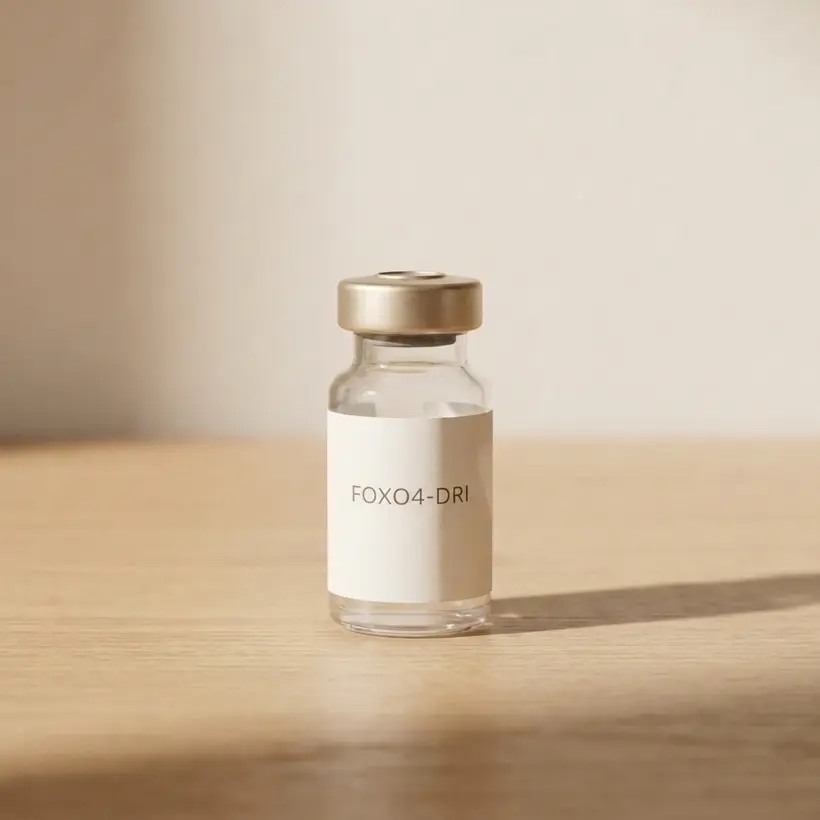
From the FormBlends catalog
FOXO4-DRI
Senolytic peptide that selectively eliminates senescent cells · From $189/mo · compounded by a licensed 503A pharmacy, dispensed only after provider review.
Learn about FOXO4-DRI →The peptide's binding interface mimics amino acids 90-120 of native FOXO4 but binds p53 with higher affinity. Once FOXO4-DRI displaces the natural FOXO4, p53 becomes free to activate apoptosis pathways. The selectivity comes from senescent cells expressing much more FOXO4 than healthy cells.
This mechanism assumes human cells behave like mouse cells. Human FOXO4 shares 94% similarity with its mouse counterpart, but that 6% difference could alter everything from binding kinetics to downstream effects. The original paper acknowledges this limitation in a single sentence buried in supplementary materials.
Laboratory Evidence vs Marketing Claims
| What Studies Actually Show | What Sellers Claim | Reality Check |
|---|---|---|
| 12.5% median lifespan increase in aged mice | "Reverses aging" | Modest extension, not reversal |
| Improved fur density in patches | "Restores youthful appearance" | Limited cosmetic change in mice |
| Better kidney function after chemotherapy | "Protects all organs" | Tested in kidney only |
| Increased running distance on treadmill | "Dramatic performance enhancement" | Statistically significant but modest |
| Thrombocytopenia in treated mice | Often not mentioned | Concerning safety signal |
The Stability Problem Nobody Discusses
FOXO4-DRI faces a fundamental chemistry problem: it wants to clump together. The same properties that allow cell penetration cause the peptide to aggregate at body pH. Most users don't realize their expensive vial starts degrading the moment they add water.
At physiological pH, the positively charged TAT sequences attract each other like magnets, forming inactive clumps. Labs working with FOXO4-DRI report visible cloudiness within hours of reconstitution at neutral pH. Adding acid helps but creates injection site irritation.
Storage presents another challenge. The peptide requires -20°C storage as powder, but repeated freeze-thaw cycles accelerate aggregation. Multiple suppliers report significant activity loss with repeated freezing and thawing, though exact percentages vary based on storage conditions and buffer composition. Yet most protocols suggest storing reconstituted peptide in the freezer between doses.
The methionine residues create an additional weakness. Atmospheric oxygen slowly oxidizes these amino acids, reducing binding affinity. No commercial supplier includes antioxidants in their formulation.
What the Community Actually Reports
Underground forums and private groups paint a mixed picture of FOXO4-DRI use. Users typically follow protocols adapted from mouse studies, scaling doses based on body weight calculations that may not translate accurately between species. The injection-only route limits adoption compared to oral senolytics.
Common patterns emerge from aggregated reports. Some users describe subtle improvements in skin quality and joint comfort after several weeks. Others report no noticeable effects despite completing full cycles. The high cost creates expectation bias, with users wanting to perceive benefits from their investment.
Side effects cluster around injection sites, with redness and swelling frequently mentioned. Some users report flu-like symptoms during initial doses, potentially indicating senescent cell clearance or immune response to the foreign peptide. Platelet counts rarely get monitored despite the thrombocytopenia seen in mice.
Sourcing anxiety dominates discussions. Users debate supplier reliability, share questionable certificates of analysis, and worry about receiving inactive or contaminated product. The lack of simple biomarkers to confirm activity leaves users guessing whether their peptide works.
Duration questions persist. Mouse studies used three injections weekly for several weeks, but human protocols vary wildly. Some advocate continuous use, others suggest quarterly cycles. Without clinical guidance, users experiment on themselves with a molecule that permanently removes cells from their bodies.
Practical Realities of FOXO4-DRI vs Alternatives
Comparing FOXO4-DRI to established senolytics reveals why it remains niche despite superior selectivity. Dasatinib plus quercetin costs 20 times less, comes in pill form, and has actual human trial data showing senescent cell reduction. Fisetin offers similar convenience with ongoing clinical studies.
The injection requirement creates multiple barriers. Users need sterile technique, proper reconstitution skills, and willingness to self-inject. Subcutaneous injection likely reduces bioavailability compared to the intraperitoneal route used in mouse studies, potentially requiring higher doses than expected.
Cost calculations prove sobering. At typical supplier prices, a single treatment cycle costs more than a year of dasatinib plus quercetin. The short half-life necessitates frequent injections, increasing both expense and injection burden. Insurance never covers experimental peptides.
Legal ambiguity adds another layer. While sold as "research chemicals," these peptides occupy a gray zone. Customs seizures occur sporadically. Quality varies dramatically between suppliers operating without regulatory oversight.
Reading Between the Lines of Certificates
Legitimate FOXO4-DRI analysis requires multiple sophisticated tests most buyers can't verify. A proper certificate shows HPLC purity above 95%, mass spectrometry confirming 3533.5 Da molecular weight, and amino acid analysis proving D-amino acid incorporation.
Red flags proliferate. Certificates showing exactly 99.9% purity suggest fabrication, as real measurements include decimal variance. Missing endotoxin data indicates skipped safety testing. Generic templates without batch-specific information mean no actual testing occurred.
Net peptide content often gets ignored but dramatically affects dosing. Peptides retain water and salt from synthesis. A vial labeled "10mg" might contain 8.8mg actual FOXO4-DRI after accounting for these factors. Dosing based on gross weight leads to under-treatment.
The most reliable suppliers provide chromatograms showing single sharp peaks, detailed mass spectra, and quantified impurity profiles. They ship in temperature-controlled packaging and include stability data. These suppliers also charge significantly more, reflecting actual quality control costs.
Human Translation Challenges
Moving from mouse success to human application faces substantial hurdles beyond missing clinical trials. Mice metabolize compounds faster, have different protein expression patterns, and age through different mechanisms than humans.
The senescence patterns differ between species. Mouse senescent cells accumulate primarily in specific organs tested in studies. Human senescence shows more complex tissue distribution. Brain senescence, increasingly linked to neurodegeneration, remains unexplored for FOXO4-DRI due to blood-brain barrier constraints.
Dosing presents fundamental uncertainty. Body surface area scaling suggests lower human doses than simple weight conversion, but optimal senolytic dosing might follow different rules. Too low fails to clear senescent cells. Too high might eliminate beneficial senescent cells involved in wound healing or tumor suppression.
Safety monitoring in humans would require extensive bloodwork absent from mouse studies. Beyond platelet counts, liver enzymes, kidney function, and inflammatory markers need tracking. The permanent nature of cell removal raises stakes compared to reversible interventions.
The Path Forward
FOXO4-DRI occupies an frustrating position in senolytic development. The molecular design showcases elegant solutions to peptide drug challenges. The selectivity surpasses first-generation senolytics. Yet it remains frozen in preclinical limbo while less selective compounds advance through human trials.
Academic investigators face little incentive to fund human studies of an already-published compound. Pharmaceutical companies see limited profit potential in a peptide requiring complex manufacturing. Longevity enthusiasts experiment without medical oversight, generating anecdotes instead of data.
Future development might focus on improved formulations addressing stability issues, oral delivery systems using cell-penetrating peptide technology, or smaller molecules mimicking the key binding interface. Until then, FOXO4-DRI serves primarily as proof that selective senolysis is achievable, even if practical application remains elusive.
For those considering FOXO4-DRI despite the unknowns, minimum precautions include baseline blood work, sterile injection technique, fresh reconstitution for each dose, and realistic expectations grounded in mouse data rather than marketing hype. The peptide might represent the future of selective senolysis, but that future hasn't arrived.
FAQ
What is FOXO4-DRI peptide?
FOXO4-DRI is a 30-amino acid cell-penetrating peptide that disrupts p53-FOXO4 binding to selectively eliminate senescent cells. It contains D-amino acids and a retro-inverso sequence for stability.
Does FOXO4-DRI work in humans?
No published human trials exist. The primary evidence comes from mouse studies showing lifespan extension and organ function improvements. Human use remains experimental.
What dose of FOXO4-DRI is used?
Mouse studies used 5 mg/kg intraperitoneally three times weekly. Human protocols typically extrapolate to lower doses subcutaneously, but this lacks clinical validation.
How long does FOXO4-DRI remain stable?
Lyophilized FOXO4-DRI remains stable for months at -20°C. Reconstituted peptide degrades within days at room temperature due to aggregation and oxidation.
What are the side effects of FOXO4-DRI?
Mouse studies report transient thrombocytopenia and mild kidney dysfunction. Human side effects remain undocumented due to lack of clinical trials.
Can FOXO4-DRI cross the blood-brain barrier?
The TAT cell-penetrating sequence enables cellular uptake but brain penetration remains unconfirmed. Most senolytic effects occur in peripheral tissues.
How does FOXO4-DRI compare to dasatinib and quercetin?
FOXO4-DRI shows greater selectivity for senescent cells but costs significantly more. Dasatinib plus quercetin has human trial data while FOXO4-DRI does not.
What purity should FOXO4-DRI have?
Research-grade FOXO4-DRI should exceed 95% purity by HPLC. Lower purities risk aggregation and immunogenicity from synthesis byproducts.
Is FOXO4-DRI legal to purchase?
FOXO4-DRI remains unregulated in most countries as a research chemical. It lacks approval for human therapeutic use anywhere globally.
How quickly does FOXO4-DRI eliminate senescent cells?
Mouse studies show senescent cell reduction within 10-14 days of treatment initiation. Complete clearance requires 3-4 weeks of intermittent dosing.
Sources
- Baar MP, et al. Targeted Apoptosis of Senescent Cells Restores Tissue Homeostasis in Response to Chemotoxicity and Aging. Cell. 2017;169(1):132-147.
- de Keizer PL. The Fountain of Youth by Targeting Senescent Cells? Trends Mol Med. 2017;23(1):6-17.
- Kirkland JL, Tchkonia T. Senolytic drugs: from discovery to translation. J Intern Med. 2020;288(5):518-536.
- Justice JN, et al. Senolytics in idiopathic pulmonary fibrosis: Results from a first-in-human, open-label, pilot study. EBioMedicine. 2019;40:554-563.
- Hickson LJ, et al. Senolytics decrease senescent cells in humans: Preliminary report from a clinical trial of Dasatinib plus Quercetin in individuals with diabetic kidney disease. EBioMedicine. 2019;47:446-456.
- Zhang L, et al. Cellular Senescence: A Key Therapeutic Target in Aging and Diseases. J Clin Invest. 2022;132(15):e158450.
- Yousefzadeh MJ, et al. Fisetin is a senotherapeutic that extends health and lifespan. EBioMedicine. 2018;36:18-28.
- FDA Guidance for Industry: Estimating the Maximum Safe Starting Dose in Initial Clinical Trials. 2005.
- USP <1> Injections and Implanted Drug Products. United States Pharmacopeia.
Footer Disclaimers
Platform Notice: This content is for educational and informational purposes only. It is not medical advice. Consult a healthcare professional before using any peptide products.
Research Compound Disclaimer: FOXO4-DRI is sold as a research compound only. It is not approved for human consumption or therapeutic use by any regulatory authority.
Results Disclaimer: Individual results may vary. The studies referenced primarily involve animal models. Human safety and efficacy have not been established.
Trademark Notice: FOXO4-DRI and related terms may be subject to trademark or patent protection. FormBlends claims no ownership of these marks.
Related peptide guides
Ready when you are
FOXO4-DRI
Senolytic peptide that selectively eliminates senescent cells · From $189/mo · compounded by a licensed 503A pharmacy, dispensed only after provider review.
Learn about FOXO4-DRI →