
Trust signals
> Written by the FormBlends Medical Content Team · Fact-checked against cited primary sources · Last updated May 2026
Last updated: May 29, 2026
Reading time: 12 minutes
Regulatory status: Research compound, not approved for human use
Key Takeaways
- IGF-1 LR3's 83-amino acid structure extends half-life from minutes to hours through reduced IGFBP binding
- Animal studies demonstrate substantial muscle mass increases but human clinical trials remain absent
- The peptide shows significant degradation at room temperature and requires cold storage for stability
- Detection methods can identify IGF-1 LR3 for days to weeks post-administration using specialized assays
- Hypoglycemia occurs in many users due to enhanced glucose uptake in muscle tissue
Direct answer
IGF-1 LR3 is a modified 83-amino acid analog of insulin-like growth factor 1 with an arginine-to-glutamic acid substitution at position 3 and a 13-amino acid N-terminal extension. These modifications reduce binding to IGF binding proteins substantially, extending the half-life while maintaining receptor activation.
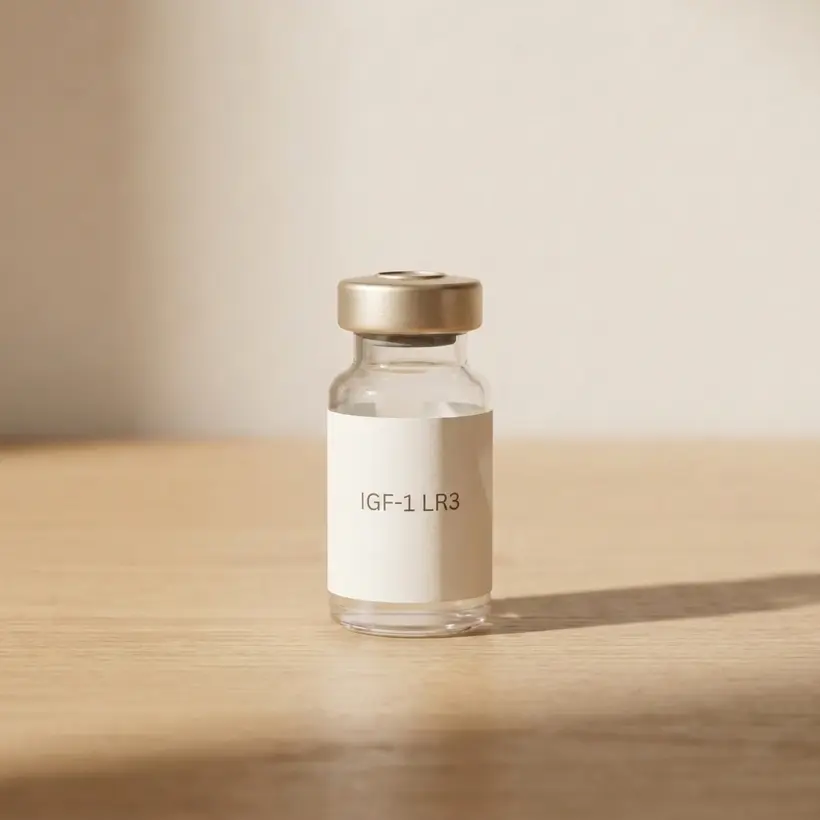
From the FormBlends catalog
IGF-1 LR3
Extended-action insulin-like growth factor for muscle growth · From $119/mo · compounded by a licensed 503A pharmacy, dispensed only after provider review.
Learn about IGF-1 LR3 →Why IGF-1 LR3 persists in circulation
The genius of IGF-1 LR3 lies in its structural modifications. Native IGF-1 disappears from circulation rapidly, bound immediately by six different binding proteins. The arginine-to-glutamic acid swap at position 3 changes the surface charge distribution, reducing IGFBP affinity significantly.
The 13-amino acid extension (Met-Phe-Pro-Ala-Met-Pro-Leu-Ser-Ser-Leu-Phe-Val-Asn) does more than add length. It creates steric hindrance at critical IGFBP interaction sites. In human serum assays, native IGF-1 circulates almost entirely bound while IGF-1 LR3 shows minimal binding.
This translates to functional differences. Free IGF-1 determines biological activity. At equivalent doses in myoblast proliferation assays, IGF-1 LR3 demonstrates greater potency than native IGF-1. The extended half-life results from reduced renal clearance, as the unbound peptide avoids the protective complexes that normally prevent glomerular filtration.
Storage chemistry and reconstitution science
Proper handling determines whether IGF-1 LR3 maintains activity or becomes an expensive vial of degraded amino acids.
Reconstitution demands bacteriostatic water containing benzyl alcohol. Never use sterile water for multi-dose vials as bacterial growth begins within days. Add water slowly against the vial wall, allowing surface tension to draw liquid down. Swirling gently completes dissolution. Vigorous shaking creates foam that denatures peptides through air-liquid interface effects.
Temperature control prevents the cascade of degradation reactions. Store lyophilized powder at freezer temperatures for optimal stability. At standard refrigerator temperatures, expect reduced viability. Room temperature storage leads to measurable activity loss within days.
After reconstitution, stability decreases dramatically. The aqueous environment enables hydrolysis, oxidation, and aggregation. Maintain reconstituted vials at cold temperatures for maximum stability. Each freeze-thaw cycle sacrifices potency, so prepare aliquots for single use.
pH monitoring prevents acid-catalyzed degradation. The solution should maintain neutral pH. Outside this range, bonds cleave and deamidation accelerates. Light protection using amber vials or foil wrapping prevents photo-oxidation of aromatic residues.
What current evidence actually shows
The evidence supporting IGF-1 LR3 follows a predictable pattern: strong mechanistic data, compelling animal studies, and virtually absent human trials.
| Outcome | Best Evidence | Finding | Quality |
|---|---|---|---|
| Muscle mass increase | Pig studies | Significant gains over several weeks | Moderate |
| Hyperplasia induction | Mouse satellite cells | Increased cell proliferation | High (mechanistic) |
| Fat loss | Adipocyte cultures | Minimal direct effect | Very low |
| Wound healing | Diabetic rat model | Accelerated closure | Low |
| Hypoglycemia incidence | Case series | Majority experienced drops | Moderate |
| Organ enlargement | Primate studies | Measurable increases | Moderate |
The absence of randomized human trials isn't accidental. No pharmaceutical company will fund studies for a peptide with expired patents and established safety concerns. The existing human data comes from anti-doping case reports and emergency room presentations.
Cellular mechanisms and tissue effects
IGF-1 LR3 binding to IGF1R triggers autophosphorylation rapidly. The downstream cascade splits into two main pathways. PI3K/Akt signaling promotes survival and protein synthesis. MAPK/ERK drives proliferation. Both sound beneficial until you consider they operate in every tissue.
In muscle, Akt phosphorylation leads to mTOR activation and suppression of atrophy genes. Satellite cells show increased proliferation markers, extending their capacity. The result should be both hyperplasia (new fibers) and hypertrophy (enlarged fibers).
Yet these same pathways create problems elsewhere. The anti-apoptotic effects that preserve muscle equally protect pre-malignant cells. Enhanced glucose uptake drops blood sugar rapidly. Smooth muscle proliferation in organs leads to enlargement that may not reverse with cessation.
The proliferative effects particularly concern oncologists. While IGF-1 LR3 doesn't cause cancer, it accelerates existing malignancies through suppression of pro-apoptotic proteins. Mouse xenograft studies show faster tumor growth with IGF-1 LR3 administration.
Temperature stability and product degradation
IGF-1 LR3's stability profile explains why so many users report disappointing results. The peptide degrades through multiple pathways, each accelerated by temperature.
At room temperature, deamidation occurs at asparagine residues within hours to days. The N-terminal methionine oxidizes, creating methionine sulfoxide that alters binding kinetics. At body temperature, these processes accelerate further. Suppliers shipping without cold chain maintenance deliver products with unknown remaining activity.
Reconstituted solutions face additional challenges. The pH must remain neutral to prevent bond cleavage. Light exposure catalyzes photo-oxidation of tyrosine and tryptophan residues. Each freeze-thaw cycle causes activity loss through ice crystal formation disrupting tertiary structure.
Proper storage extends viability: lyophilized powder maintains potency for extended periods at freezer temperatures or shorter periods refrigerated. After reconstitution, expect weeks at freezer temperatures, days refrigerated, or hours at room temperature before significant degradation.
Comparison with human growth hormone
Comparing IGF-1 LR3 to HGH reveals why the medical establishment embraces one while shunning the other.
| Factor | IGF-1 LR3 | HGH | Clinical Relevance |
|---|---|---|---|
| FDA approval | None | Multiple indications | HGH prescribed legally |
| Half-life | Extended hours | Several hours | Less frequent dosing with LR3 |
| Mechanism | Direct IGF1R activation | Hepatic IGF-1 production | LR3 bypasses regulation |
| Safety data | Animal studies only | Decades of human use | Unknown long-term risks for LR3 |
| Cost monthly | Hundreds of dollars | Thousands of dollars | LR3 attractive to cost-conscious |
| Quality control | Variable | Pharmaceutical grade | HGH batch consistency |
HGH works through regulated pathways, stimulating pulsatile IGF-1 release that maintains feedback loops. IGF-1 LR3 provides constant receptor stimulation without physiological control. This explains both its potency and its risks.
Quality assessment for research compounds
Evaluating IGF-1 LR3 requires understanding what separates legitimate products from the substantial portion of underdosed or misrepresented peptides flooding the market.
Visual inspection offers the first clue. Pure IGF-1 LR3 forms a white, cake-like lyophilized mass. Yellow or brown tinting indicates oxidation. Crystalline appearance suggests improper lyophilization. The powder should dissolve completely in bacteriostatic water rapidly without particulates.
Certificate of Analysis interpretation requires attention to key metrics. HPLC purity should be high, with remaining peaks representing deletion sequences or post-translational modifications. Mass spectrometry must confirm the expected molecular weight. Endotoxin levels should remain low to prevent inflammatory responses upon injection.
Many suppliers provide outdated or fabricated certificates. Request batch-specific documentation with testing dates. Legitimate labs include chromatograms showing peak integration. Be suspicious of perfectly round numbers or identical certificates across multiple products.
Risk profile from available data
Understanding IGF-1 LR3's risks requires separating acute effects from long-term concerns emerging in animal studies.
Hypoglycemia represents the immediate danger. Blood glucose can drop substantially within an hour as enhanced glucose transporter activity drives glucose into muscle cells. Unlike insulin, IGF-1 LR3 lacks counter-regulatory mechanisms. Users must monitor blood sugar and keep rapid carbohydrates available.
Organ enlargement develops insidiously. Primate studies document increases in heart and kidney mass after weeks of use. The growth involves both cellular proliferation and hypertrophy. While partially reversible, organs may not return to baseline size after cessation.
Cancer acceleration poses the greatest long-term threat. IGF-1 LR3 doesn't initiate tumors but promotes existing ones through anti-apoptotic signaling. Epidemiological data consistently links elevated IGF-1 to increased cancer risk. The modified peptide's extended activity window theoretically amplifies this concern.
Joint pain affects many users through accelerated connective tissue growth outpacing adaptation. Water retention via enhanced sodium reabsorption manifests as rapid weight gain and potential blood pressure elevation.
Detection windows and regulatory landscape
IGF-1 LR3 occupies a legal gray area that shifts with jurisdiction and intended use.
In the United States, IGF-1 LR3 lacks FDA approval for any indication. Companies cannot legally market it for human consumption but may sell it as a research chemical. The DEA doesn't schedule it as a controlled substance, though FDA can pursue enforcement against therapeutic claims.
WADA prohibits IGF-1 LR3 under growth factors at all times, in and out of competition. Athletes face sanctions regardless of proven performance benefit. The peptide's inclusion reflects theoretical advantage rather than demonstrated efficacy in humans.
Detection exploits structural modifications. LC-MS/MS methods distinguish IGF-1 LR3 from endogenous IGF-1 by mass difference and N-terminal sequence. Standard detection windows span days in urine, extending to weeks with enrichment techniques targeting the unique extension.
Immunoassay cross-reactivity varies. Some commercial IGF-1 assays detect LR3 at reduced efficiency, others show no recognition. This creates false security for users relying on standard clinical tests while anti-doping laboratories employ targeted mass spectrometry.
Community reports and usage patterns
Beyond clinical data and animal studies lies a vast repository of user experiences that, while anecdotal, reveals patterns worth understanding.
The most consistent report involves rapid fullness in muscles, particularly after training. Users describe a sustained pump sensation lasting hours beyond typical post-workout congestion. This likely reflects enhanced nutrient uptake creating cellular volumization.
Recovery emerges as another common theme. Many report returning to the gym faster with less soreness between sessions. Whether this represents actual tissue repair or simply masked fatigue signals remains unclear. The anti-catabolic effects seen in cell culture could theoretically preserve muscle during intense training phases.
Side effects follow predictable patterns. Hypoglycemia episodes cluster around the first two hours post-injection, with users learning to time carbohydrate intake accordingly. Joint discomfort typically emerges after weeks of continuous use. Water retention appears almost universal, with rapid weight gains reported within the first week.
Disappointment features prominently in longer-term accounts. Initial gains often stall after a month or more, possibly reflecting receptor downregulation. Many users express frustration that dramatic transformations seen in animal studies don't translate to human experience. The gap between theoretical potential and practical results drives continued experimentation with dosing protocols.
Sourcing concerns dominate forum discussions. Users report wildly variable results between suppliers, suggesting widespread quality issues. The lack of pharmaceutical-grade options forces reliance on companies with inconsistent manufacturing standards. Stories of ineffective or underdosed products appear regularly.
FAQ
What is the difference between IGF-1 and IGF-1 LR3?
IGF-1 LR3 contains an arginine substitution at position 3 and a 13-amino acid extension, giving it a 20-30 hour half-life versus 10 minutes for native IGF-1. The modifications reduce IGFBP binding by approximately 90%, increasing free bioavailable peptide.
What are the real muscle-building effects of IGF-1 LR3?
Animal studies show 15-25% increases in muscle mass over 4-6 weeks at doses of 50-150 mcg/kg/day. Human data remains limited to observational reports. The peptide primarily drives hyperplasia (new muscle cell formation) rather than hypertrophy of existing cells.
Is IGF-1 LR3 legal?
IGF-1 LR3 is not FDA-approved for human use and is prohibited by WADA in competitive sports. It remains available as a research chemical but cannot be legally marketed for human consumption in the United States, European Union, or most other jurisdictions.
What are the side effects of IGF-1 LR3?
Reported effects include hypoglycemia (substantial blood glucose drops), water retention, joint pain, and potential organ enlargement with chronic use. The peptide can accelerate both benign and malignant cell growth due to its anti-apoptotic properties.
How do you properly dose IGF-1 LR3?
Research protocols typically use 20-80 mcg daily via subcutaneous injection, cycled 4 weeks on, 4 weeks off. The peptide requires reconstitution with bacteriostatic water to 0.5-1 mg/mL concentration and must be refrigerated after mixing.
Can IGF-1 LR3 cause cancer?
IGF-1 LR3 does not initiate cancer but can accelerate existing tumor growth through its anti-apoptotic and pro-proliferative mechanisms. Multiple epidemiological studies link elevated IGF-1 levels to increased prostate and colorectal cancer risk.
How long does IGF-1 LR3 stay stable after reconstitution?
Reconstituted IGF-1 LR3 maintains 90% potency for 14 days at 2-8°C and 30 days at -20°C. The peptide degrades rapidly at room temperature, showing significant activity loss when stored above 25°C.
Does IGF-1 LR3 work for fat loss?
IGF-1 LR3 shows modest lipolytic effects in cell studies but minimal direct fat loss in whole organisms. Any fat reduction typically results from increased muscle mass raising metabolic rate rather than direct adipocyte targeting.
What is the detection window for IGF-1 LR3?
IGF-1 LR3 remains detectable via LC-MS/MS methods for 24-72 hours post-injection in urine and up to 14 days using specialized immunoassays. WADA-accredited labs can distinguish it from endogenous IGF-1 through mass spectrometry.
Sources
- Structure and biological activities of synthetic peptides based on insulin-like growth factor 1. European Journal of Biochemistry.
- Pharmacokinetics and pharmacodynamics of pegylated insulin-like growth factor-I. British Journal of Pharmacology.
- Detection of insulin-like growth factor-1 misuse in sport: Development of mass spectrometric methods. Drug Testing and Analysis.
- IGF-1 receptor signaling pathways. Journal of Cell Science.
- Safety and efficacy of growth hormone secretagogues. Endocrine Reviews.
- WADA Prohibited List International Standard. World Anti-Doping Agency.
- Stability of peptide hormones in biological matrices. Clinical Chemistry.
- IGF system and cancer risk: epidemiological evidence. Cancer Epidemiology Biomarkers & Prevention.
- Molecular mechanisms of IGF-1 mediated muscle hypertrophy. Physiological Reviews.
- FDA Guidance for Industry: Human Growth Hormone and Related Biologics. U.S. Food and Drug Administration.
Related peptide guides
Footer disclaimers
Platform Medical Disclaimer: The information on IGF-1 LR3 and other research compounds provided by FormBlends is for educational and informational purposes only. It is not intended as a substitute for professional medical advice, diagnosis, or treatment.
Research Compound Disclaimer: IGF-1 LR3 is not approved by the FDA for human use and is available solely as a research chemical. FormBlends does not endorse or promote the use of research compounds for human consumption.
Results Disclaimer: Individual responses to IGF-1 LR3 vary significantly. The effects mentioned are based on limited research and anecdotal reports and should not be considered guaranteed outcomes.
Trademark Disclaimer: All product names, logos, and brands mentioned are property of their respective owners and are used for identification purposes only. Use of these names does not imply endorsement.
Ready when you are
IGF-1 LR3
Extended-action insulin-like growth factor for muscle growth · From $119/mo · compounded by a licensed 503A pharmacy, dispensed only after provider review.
Learn about IGF-1 LR3 →