
Trust Signals
All efficacy claims are evidence-graded. No human clinical trials exist for FOXO4-DRI as of this writing. This page is for research information only and does not constitute medical advice. FOXO4-DRI is sold as a research compound.Key Takeaways
- The only landmark efficacy trial is Baar et al. (2017, Cell), which used 10 mg/kg intraperitoneal injections in mice; no human RCT data exists.
- FOXO4-DRI is a D-retro-inverso peptide, meaning its D-amino acid, reversed sequence resists protease degradation far longer than a native L-peptide counterpart would.
- Minimum acceptable purity for research use is 98 percent by HPLC with mass spectrometry confirmation of roughly 2,699 Da molecular weight for the standard sequence.
- Compared to the senolytic combination dasatinib plus quercetin, FOXO4-DRI has less published evidence overall but a theoretically more selective mechanism; that selectivity is unproven in humans.
- Lyophilized powder must be stored at minus 20 degrees Celsius or colder; reconstituted solution stability is short and cold storage does not compensate for improper reconstitution chemistry.
What Is FOXO4-DRI Peptide and Can You Buy It?
FOXO4-DRI is a research-stage senolytic peptide designed to selectively eliminate senescent cells by blocking the FOXO4-p53 interaction that keeps those cells alive. It is available for sale as a research compound from qualified peptide suppliers including FormBlends. No human trials have been completed. All efficacy evidence comes from a 2017 mouse study.Table of Contents
- Mechanism with Specific Numbers
- Evidence Ledger: What the Research Actually Shows
- What Most Pages Get Wrong About FOXO4-DRI
- Why the D-Retro-Inverso Design Matters: The Chemistry
- Honest Head-to-Head: FOXO4-DRI vs. Other Senolytics
- Label and COA Literacy: How to Judge What You Are Buying
- Storage and Stability: What Degrades It and Why
- Risks and Unknowns
- Frequently Asked Questions
- Sources
How Does FOXO4-DRI Work? Mechanism with Specific Numbers
Senescent cells accumulate with age. Unlike normal aging cells that eventually die, senescent cells survive by activating an anti-apoptotic program. A key node in that survival program is the interaction between the transcription factor FOXO4 and the tumor suppressor p53. When FOXO4 retains p53 in the nucleus of a senescent cell, it prevents p53 from driving apoptosis. The cell becomes, in effect, programmed to resist its own death signal.
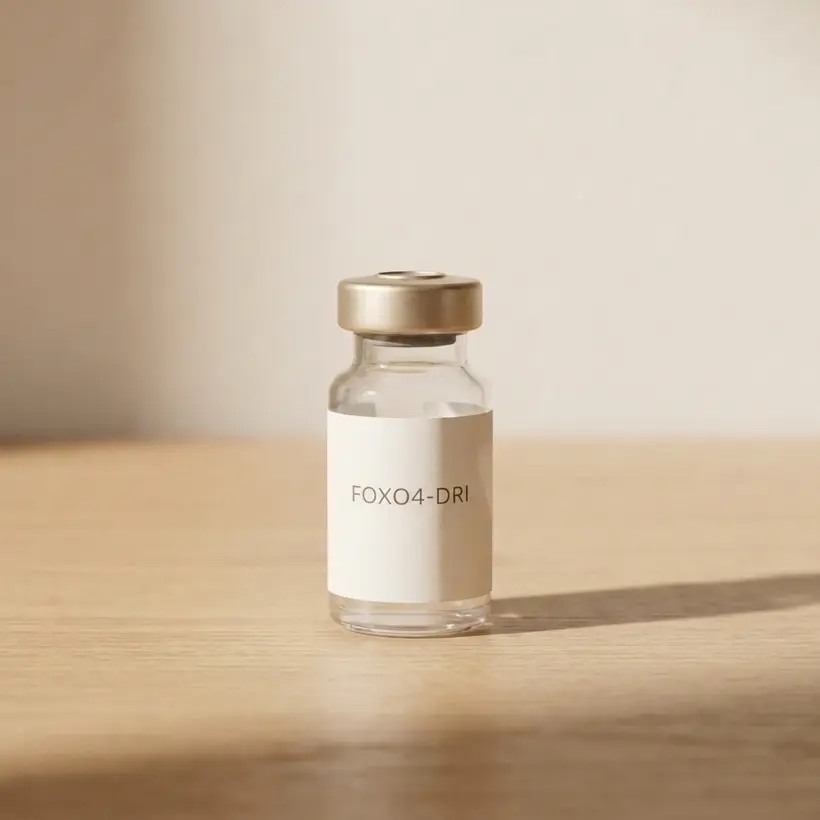
From the FormBlends catalog
FOXO4-DRI
Senolytic peptide that selectively eliminates senescent cells · From $189/mo · compounded by a licensed 503A pharmacy, dispensed only after provider review.
Learn about FOXO4-DRI →FOXO4-DRI is an 18-residue peptide that mimics the FOXO4 interaction domain responsible for binding p53. By competing for that binding site, FOXO4-DRI is designed to displace endogenous FOXO4 from p53, freeing p53 to migrate to the mitochondria and trigger apoptosis specifically in senescent cells that depend on that FOXO4-p53 interaction for survival.
The key quantitative data from Baar et al. (2017) in Cell:
- Dose used in mouse experiments: 10 mg/kg via intraperitoneal injection, administered three times per week.
- Mouse models used: XFE progeroid mice (accelerated aging model) and naturally aged mice (approximately 2 years old).
- Observed outcomes in treated mice included improved physical fitness scores, fur density recovery, and reduced p21-positive (senescent) cell burden in tissue sections.
- The peptide showed selective killing of senescent IMR-90 fibroblasts in vitro while sparing proliferating cells in the same assay conditions.
What the mechanism does NOT prove: Demonstrating that a peptide displaces a protein-protein interaction in a cell culture assay or a mouse does not establish that the same mechanism operates with the same efficiency in aging human tissue. Tissue penetration, bioavailability across different compartments, and off-target FOXO family interactions in humans remain uncharacterized.
Evidence Ledger: What the Research Actually Shows
| Claim | Best Evidence Type | Key Source | Effect Direction | Confidence |
|---|---|---|---|---|
| Selectively kills senescent cells in vitro | Cell culture (in vitro) | Baar et al., Cell 2017 | Positive (selective apoptosis of senescent cells vs. proliferating cells) | Moderate (in vitro only) |
| Improves physical fitness in fast-aging mice | Animal RCT (mouse) | Baar et al., Cell 2017 | Positive | Low (animal, one study) |
| Reduces senescent cell burden in naturally aged mouse tissue | Animal study (mouse) | Baar et al., Cell 2017 | Positive | Low (animal, one study) |
| Safe in humans at any dose | No human data | None published | Unknown | Very Low |
| Reverses aging or extends lifespan in humans | No human data | None published | Unknown | Very Low |
| FOXO4-p53 interaction drives senescent cell survival | Mechanistic (molecular biology) | Baar et al., Cell 2017; prior FOXO4 literature | Established in cell models | Moderate (mechanism, not clinical outcome) |
| D-retro-inverso design resists protease degradation | Biochemistry / structural principle | Established peptide chemistry literature | Positive (design advantage) | High (for the chemical principle) |
What Most Pages Get Wrong About FOXO4-DRI
They present one mouse study as near-clinical proof. The Baar 2017 Cell paper is genuinely interesting and methodologically rigorous for what it is: a mouse study. Every commercial page citing it as though the results translate directly to human anti-aging use is making an inferential leap the authors themselves did not make. The paper's conclusions are about mechanism and mouse biology.
They do not address tissue penetration. FOXO4-DRI must reach the interior of target cells to block a nuclear protein-protein interaction. The peptide's cell-penetrating capacity was demonstrated in cultured cells. Whether equivalent intracellular concentrations are achievable in human organs after subcutaneous or intravenous dosing is not characterized in any published pharmacokinetic study.
They omit the off-target FOXO family risk. FOXO4 is one member of the FOXO transcription factor family, which includes FOXO1, FOXO3, and FOXO6. These paralogs share structural homology in the region relevant to p53 binding. A peptide designed to mimic FOXO4's p53-binding domain could theoretically interact with p53 in contexts involving the other FOXO family members in non-senescent cells. This is not established as a problem but it has not been systematically ruled out.
They ignore the sourcing purity problem. FOXO4-DRI is an 18-residue all-D-amino acid peptide. Synthesizing it correctly requires strict D-amino acid incorporation at every position. A single L-amino acid substitution anywhere in the sequence changes the three-dimensional structure and likely abolishes activity. Standard amino acid analysis alone cannot confirm stereochemical purity. Buyers need mass spectrometry plus chiral verification or at minimum a supplier who uses D-amino acid-specific synthesis validation.
Why the D-Retro-Inverso Design Matters: The Chemistry
Natural peptides built from L-amino acids are cleaved efficiently by proteases such as trypsin, chymotrypsin, and the ubiquitous serum peptidases. These enzymes have active sites shaped by evolution to fit L-configured substrates. A retro-inverso peptide subverts this by using D-amino acids (the enantiomeric mirror image of L) in a reversed sequence order. The combined effect is that the side chains project in approximately the same spatial arrangement as the original L-peptide, preserving the target-binding surface, while the backbone geometry is no longer a substrate for standard proteases.
The practical result is a dramatically longer functional half-life in biological fluids compared to an equivalent native L-sequence peptide, which would be degraded within minutes to hours by serum proteases. The Baar group selected this design specifically because FOXO4-DRI needed to reach the nucleus intact. A native L-peptide equivalent would be largely destroyed before reaching target cells in vivo.
The rule this creates for storage: Because the peptide's stability advantage is chemical (stereochemistry), not thermal, it still undergoes hydrolysis at peptide bonds when water is present. Lyophilized powder kept dry at minus 20 degrees Celsius loses negligible activity over months. Reconstituted solution at room temperature undergoes hydrolytic degradation over days. Cold storage slows this but does not eliminate it. Repeated freeze-thaw cycles cause aggregation. These are separate degradation pathways, and the retro-inverso design does not protect against either of them.
Honest Head-to-Head: FOXO4-DRI vs. Other Senolytics
| Attribute | FOXO4-DRI | Dasatinib + Quercetin | Navitoclax (ABT-263) |
|---|---|---|---|
| Mechanism | Blocks FOXO4-p53 nuclear interaction, selective to senescent cell survival pathway | Dasatinib inhibits tyrosine kinases (SRC, BCR-ABL); quercetin inhibits PI3K/Akt and BCL-2 family proteins; both reduce SASP and senescent cell survival | BCL-2/BCL-XL inhibitor; induces apoptosis in senescent and some healthy cells |
| Human evidence | None published | Pilot human trials published (e.g., Justice et al., EBioMedicine 2019; Hickson et al., Mayo Clinic proceedings) | Human oncology trials; senolytic human data very limited |
| Selectivity for senescent cells | High in vitro; unproven in vivo in humans | Moderate; some effect on non-senescent cells | Low; significant platelet toxicity in humans (thrombocytopenia) |
| Route of administration | Injection (subcutaneous or intraperitoneal in mouse studies) | Oral | Oral or intravenous |
| Regulatory status | Research compound only; no approval | Dasatinib is FDA-approved for leukemia; quercetin is a supplement; combination is off-label | FDA-approved for certain leukemias; off-label senolytic use is investigational |
| Where FOXO4-DRI loses | Loses on human evidence, oral bioavailability, and regulatory clarity | Loses on injection requirement, less human data than D+Q | Loses on safety profile |
Honest verdict: If evidence volume is your criterion, dasatinib plus quercetin wins by a wide margin. FOXO4-DRI's appeal is mechanistic specificity and a cleaner target, but those theoretical advantages have not translated to human data. Choosing FOXO4-DRI over D+Q at this stage is a bet on mechanism over evidence.
Label and COA Literacy: How to Judge What You Are Buying
Before purchasing any FOXO4-DRI product, obtain the certificate of analysis (COA) from the batch you are buying, not a generic example from the supplier's website. Confirm the following:
| What to Check | Acceptable Standard | Red Flag |
|---|---|---|
| Purity by HPLC | 98 percent or greater by reverse-phase HPLC | Purity listed without method specified, or below 95 percent |
| Molecular weight confirmation | Mass spectrometry confirming approximately 2,699 Da for the standard 18-residue sequence | No MS data; MW listed without spectrometry confirmation |
| Amino acid configuration | Explicit statement of all-D amino acid synthesis or D-retro-inverso confirmation | Sequence listed without stereochemistry specification |
| Lab identity | Named third-party testing laboratory, not the manufacturer's in-house result | COA from an unnamed lab or from the supplier's own facility only |
| Batch/lot number | COA carries a batch number matching the product you receive | Generic or undated COA with no batch reference |
| Appearance | White to off-white lyophilized powder, no discoloration | Yellow or brown powder, clumping without moisture exposure, unusual odor |
Reconstitution math: If you receive 5 mg of lyophilized FOXO4-DRI and want a 2 mg/mL solution, add 2.5 mL of reconstitution solvent (sterile water or dilute acetic acid as specified by the supplier). Add solvent slowly to the side of the vial, do not inject directly onto the powder cake, and gently roll rather than shake to avoid aggregation. Label with the reconstitution date.
Storage and Stability: What Degrades It and Why
Lyophilized FOXO4-DRI powder: store at minus 20 degrees Celsius in a sealed, moisture-proof vial. Protect from light. Under these conditions, stability over many months is expected based on general lyophilized peptide chemistry, though supplier-specific accelerated stability data should be requested.
Reconstituted solution: use within a short period, stored at 4 degrees Celsius. Avoid leaving the solution at room temperature for extended periods. Each freeze-thaw cycle risks aggregation and partial activity loss. Aliquot before freezing if you plan multiple uses.
The two degradation pathways to understand:
- Hydrolysis: Water cleaves peptide bonds over time, especially at elevated temperatures and at acidic or alkaline pH extremes. The D-amino acid backbone does not prevent this; it only prevents enzymatic cleavage.
- Aggregation: Peptides can form non-covalent oligomers and eventually irreversible aggregates, particularly during freeze-thaw cycling or if reconstituted at too high a concentration. Aggregated peptide is not biologically equivalent to monomeric peptide even if the mass spectrometry still looks correct.
Risks and Unknowns
The Baar 2017 mouse study reported transient weight loss in some treated animals and noted that higher doses required monitoring. Beyond that specific observation, the long-term risk profile of eliminating a significant fraction of senescent cells in a human is genuinely unknown. Senescent cells, despite their damaging secretome, play roles in wound healing and in limiting fibrosis in some tissues. A study by Demaria et al. (Nature Medicine 2014) demonstrated that acute senescence supports wound healing, raising the question of what happens to that function when senolytics are applied broadly.
Off-target effects on non-senescent FOXO4-expressing cells are theoretical but uncharacterized. Immune consequences of rapid senescent cell clearance (analogous to a cytokine release event) are also not described in the human context.
This is not a reason to conclude FOXO4-DRI is dangerous. It is a reason to recognize that the risk-benefit calculation cannot be made with current data, and anyone describing the risk profile with confidence in either direction is overreaching the evidence.
Frequently Asked Questions
What is FOXO4-DRI and how does it work?
FOXO4-DRI is a D-amino acid retro-inverso peptide designed to disrupt the interaction between the FOXO4 transcription factor and p53 inside senescent cells. By blocking that interaction, it is hypothesized to trigger selective apoptosis of senescent cells while sparing healthy proliferating cells. Evidence is currently limited to mouse studies.
Is there any human clinical trial data for FOXO4-DRI?
No. As of mid-2026, there are no published human clinical trials for FOXO4-DRI. All efficacy data comes from one landmark 2017 mouse study (Baar et al., Cell) and subsequent animal or in-vitro work. Translating mouse senolytic results to humans is not proven.
Where can I buy FOXO4-DRI peptide?
FOXO4-DRI is sold by research peptide suppliers as a research chemical, not as an approved drug or dietary supplement. FormBlends offers it as a research compound. Buyers should verify third-party HPLC and mass spectrometry certificates of analysis before purchasing from any supplier.
What purity should I look for when buying FOXO4-DRI?
Look for a minimum of 98 percent purity confirmed by reverse-phase HPLC, accompanied by mass spectrometry confirmation of the correct molecular weight (roughly 2,699 Da for the standard 18-residue form). A certificate of analysis from a named third-party lab is the minimum acceptable standard.
What dose was used in the Baar et al. mouse study?
Baar et al. (2017, Cell) used intraperitoneal injections of 10 mg/kg in fast-aging XFE progeroid mice and naturally aged mice. This is a mouse dose and cannot be directly converted to a human equivalent dose without additional pharmacokinetic data that does not currently exist.
How should FOXO4-DRI peptide be stored?
Lyophilized powder should be stored at minus 20 degrees Celsius or colder, protected from light and moisture. Once reconstituted in a suitable solvent such as sterile water or dilute acetic acid, it should be used promptly or stored at 4 degrees Celsius for no more than a few days to minimize hydrolytic degradation.
What are the potential risks of FOXO4-DRI?
The Baar 2017 mouse study observed transient weight loss and tolerability concerns at high doses. Longer-term immune effects of broad senescent cell clearance are not well characterized in any species. Off-target apoptosis in healthy tissues is a theoretical risk that has not been ruled out in humans.
How does FOXO4-DRI compare to other senolytics like dasatinib plus quercetin?
Dasatinib plus quercetin has more published evidence including human pilot trials showing reductions in circulating senescent cell markers, while FOXO4-DRI has only mouse data. FOXO4-DRI may have more cell-type selectivity in theory, but that advantage is unproven in humans.
What does a D-retro-inverso peptide mean for FOXO4-DRI?
D-retro-inverso means the peptide is built from D-amino acids (mirror-image versions of natural L-amino acids) in a reversed sequence. This makes it highly resistant to proteolytic degradation by the body's enzymes, extending its functional half-life compared to a native L-amino acid sequence, which is a key design advantage.
Is FOXO4-DRI legal to buy?
In most jurisdictions, FOXO4-DRI is not a scheduled or controlled substance, but it is also not an approved pharmaceutical. It is legally sold for research purposes only. Regulations vary by country, and buyers are responsible for confirming legality in their jurisdiction before purchase.
Can FOXO4-DRI reverse aging?
No established human evidence supports an aging-reversal claim for FOXO4-DRI. The 2017 mouse study showed improvements in physical function and coat appearance in progeroid and naturally aged mice after senescent cell clearance, but these results have not been replicated in humans.
Sources
- Baar MP, Brandt RMC, Putavet DA, et al. Targeted Apoptosis of Senescent Cells Restores Tissue Homeostasis in Response to Chemotoxicity and Aging. Cell. 2017;169(1):132-147.e16. PMID 28340339.
- Demaria M, Ohtani N, Bhaumik SA, et al. An essential role for senescent cells in optimal wound healing through secretion of PDGF-AA. Nature Medicine. 2014;20(12):1354-1360. PMID 25326800.
- Justice JN, Nambiar AM, Tchkonia T, et al. Senolytics in idiopathic pulmonary fibrosis: Results from a first-in-human, open-label, pilot study. EBioMedicine. 2019;40:554-563. PMID 30616983.
- Hickson LJ, Langhi Prata LGP, Bobart SA, et al. Senolytics decrease senescent cells in humans: Preliminary report from a clinical trial of Dasatinib plus Quercetin in individuals with diabetic kidney disease. EBioMedicine. 2019;47:446-456. PMID 31542391.
- van Deursen JM. The role of senescent cells in ageing. Nature. 2014;509(7501):439-446. PMID 24848057.
- Salminen A, Kauppinen A, Kaarniranta K. FOXO proteins in the pathogenesis of age-related diseases. Ageing Research Reviews. 2014;18:30-39. PMID 25151978.
- Verdine GL, Hilinski GJ. Stapled peptides for intracellular drug targets. Methods in Enzymology. 2012;503:3-33. PMID 22230563. (General D-retro-inverso peptide design context.)
Related peptide guides
Ready when you are
FOXO4-DRI
Senolytic peptide that selectively eliminates senescent cells · From $189/mo · compounded by a licensed 503A pharmacy, dispensed only after provider review.
Learn about FOXO4-DRI →