
Trust signals
Conflicts of interest: FormBlends sells peptides. We have disclosed this and have graded evidence honestly regardless of commercial interest.
Evidence policy: Every major claim is graded in the evidence ledger below. Speculative claims are labeled. No statistics have been invented; where exact figures are unavailable, directional language is used instead.
Key Takeaways
- Epitalon is the synthetic tetrapeptide Ala-Glu-Asp-Gly, CAS 307297-39-8, molecular weight approximately 390.35 g/mol, derived from the bovine pineal gland peptide fraction epithalamin.
- Its primary proposed mechanism is telomerase (hTERT) activation in somatic cells, demonstrated in cell culture by Khavinson and colleagues, but no human RCT has confirmed telomere extension in vivo.
- The most common referenced dosing in small human pilot studies is 5 to 10 mg per day IV or IM over 10 to 14 day cycles; oral bioavailability has never been measured in a published pharmacokinetic study.
- Lyophilized powder is the only formulation with documented stability; once reconstituted it degrades via peptide bond hydrolysis over weeks, faster at room temperature or above pH 7.
- The oncological risk of telomerase upregulation is a real theoretical concern that epitalon-specific literature has not adequately addressed.
What is epitalon and should you buy it?
Epitalon (also spelled epithalon) is a research tetrapeptide with a plausible but unconfirmed mechanism and no approved clinical use. If you want to buy epitalon for laboratory research, understanding the evidence ceiling and the sourcing risks below is essential. For anyone considering personal use, the absence of human RCT safety and efficacy data should be the primary framing fact.
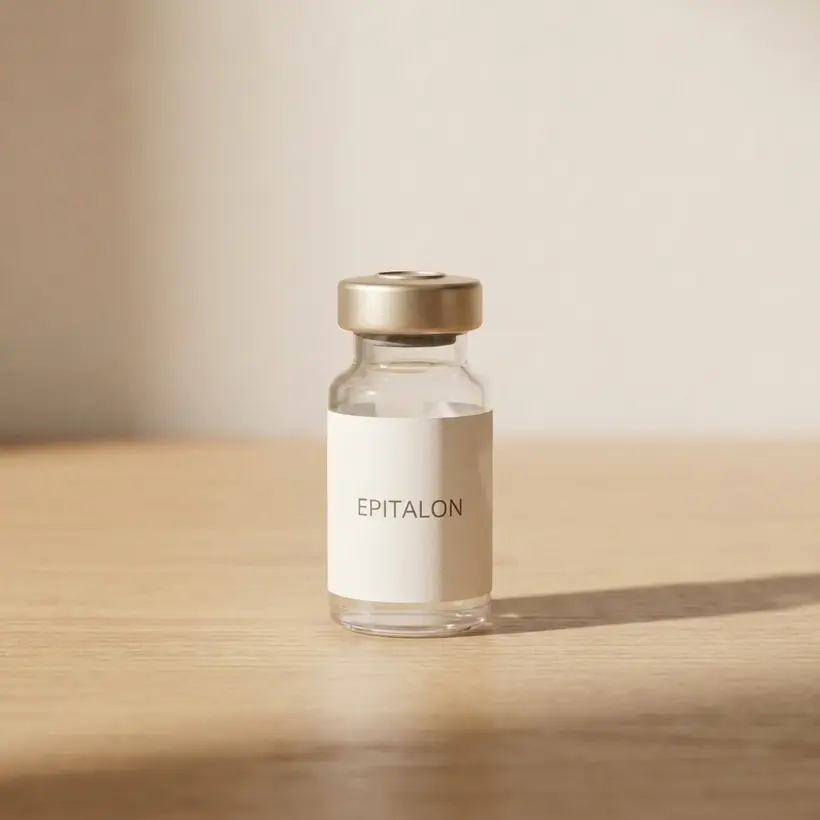
From the FormBlends catalog
Epitalon (Epithalon Injectable)
Pineal peptide that restores melatonin production and circadian rhythm · From $44/mo · compounded by a licensed 503A pharmacy, dispensed only after provider review.
Learn about Epitalon (Epithalon Injectable) →Table of Contents
- What is epitalon and where does it come from?
- How does epitalon work at the molecular level?
- Evidence ledger: what the research actually shows
- What doses and protocols appear in the literature?
- What most epitalon pages get wrong
- Stability, formulation, and the reconstitution problem
- Honest head-to-head: epitalon vs. alternatives
- How to evaluate a source and read the COA
- Legal and regulatory status
- Frequently asked questions
- Sources
What is epitalon and where does it come from?
Epitalon was developed and characterized primarily by Vladimir Khavinson at the St. Petersburg Institute of Bioregulation and Gerontology beginning in the 1980s. It is a four-amino-acid synthetic version of a biologically active fragment isolated from epithalamin, a polypeptide complex extracted from bovine pineal gland tissue. The pineal gland connection drove early research into melatonin regulation and circadian normalization, but later work focused almost entirely on telomere biology.
The compound is sometimes written as epithalon in English translations of Russian publications. Both words describe the same sequence. No major regulatory agency has approved it as a drug, biologic, or dietary supplement ingredient.
How does epitalon work at the molecular level?
The most studied proposed mechanism is activation of telomerase, specifically the catalytic subunit hTERT (human telomerase reverse transcriptase). In a 2003 cell-culture study by Khavinson et al. published in Neuroendocrinology Letters, epitalon at concentrations in the nanomolar range was reported to increase telomerase activity in somatic fetal fibroblast cells, leading to telomere elongation over multiple cell passages. The cells reportedly underwent additional doublings compared to controls.
Separately, animal studies have reported effects on pineal melatonin secretion and hypothalamic-pituitary-adrenal axis normalization in aged rats, which is consistent with the peptide's origin in pineal gland extracts.
Evidence ledger: what the research actually shows
| Claim | Best available evidence type | Effect direction | Confidence |
|---|---|---|---|
| Telomerase activation in somatic cells | Cell culture (in vitro), Khavinson et al., Neuroendocrinology Letters 2003 | Positive (telomerase activity increased) | Low (in vitro only) |
| Telomere length extension | Cell culture only; no human in vivo data | Positive in cell models | Very low |
| Lifespan extension in animals | Rodent studies, Khavinson and Anisimov; multiple publications in Bulletin of Experimental Biology and Medicine | Modest positive in aged mice | Low (animal, single research group, not independently replicated at scale) |
| Melatonin and circadian normalization | Small human observational studies, Khavinson group | Positive trend in elderly subjects | Very low (small n, no placebo control) |
| Cancer incidence reduction in aged animals | Rodent studies, Anisimov et al. | Positive in some tumor models | Low (animal, mechanistically paradoxical given telomerase-cancer link) |
| Human anti-aging or longevity outcome | No published human RCT | Unknown | Very low |
| Short-term tolerability in humans | Small pilot studies, IV/IM route | Generally reported as tolerated | Very low (uncontrolled, small) |
The body of published work on epitalon comes predominantly from one research group in Russia over roughly four decades. Independent replication in Western peer-reviewed systems with pre-registered trials is absent. This is a significant limitation that commodity pages rarely state clearly.
What doses and protocols appear in the literature?
The Khavinson group's human pilot work most commonly used 5 to 10 mg total daily dose administered intravenously or intramuscularly over 10 to 14 consecutive days. Some publications describe repeat courses 1 to 2 times per year in elderly subjects.
Self-experimenter communities commonly reference subcutaneous doses of 5 mg per day for 10 to 20 days. These community protocols are not validated in controlled studies and represent extrapolations, not clinical guidance.
No dose-response study in humans has been published. The doses above were chosen empirically; the therapeutic window, if any exists, is undefined.
What most epitalon pages get wrong
This is the section that most commercial and blog pages omit entirely.
1. Telomerase upregulation and cancer risk are not reconciled. Telomerase reactivation is one of the most consistent features of human cancers, present in more than 85 percent of malignancies according to broadly cited oncology literature. A compound proposed to activate hTERT in somatic cells carries a theoretical oncological concern that is biologically non-trivial. The animal studies by Anisimov and colleagues actually reported reduced spontaneous tumor incidence in some aged rodent models, which is an interesting but unexplained paradox. No mechanism has been proposed to explain why epitalon-driven telomerase activation would differ oncologically from endogenous telomerase reactivation in pre-cancerous cells. This question has not been tested in humans and almost no commercial page acknowledges it.
2. Oral bioavailability is assumed, not measured. Epitalon is a tetrapeptide. In the gastrointestinal tract it faces gastric acid at pH 1.5 to 3.5 and a dense array of brush-border peptidases including aminopeptidases and dipeptidyl peptidases. Some tetrapeptides do survive transit intact via paracellular absorption or peptide transporter (PepT1) mediated uptake, but this varies substantially by sequence and is not guaranteed. No published pharmacokinetic study has measured plasma epitalon levels following oral administration in any species. Vendors selling oral epitalon capsules are making an assumption, not a claim backed by bioavailability data.
3. Most research on epitalon comes from a single group. The overwhelming majority of peer-reviewed publications on epitalon trace back to Khavinson's institute. This is not disqualifying, but it means the findings have not been subjected to the adversarial replication that Western drug development requires. The absence of independent replication is a structural limitation, not an attack on the researchers.
4. Purity and identity fraud risk is high in the research chemical market. Peptides sold as research chemicals are not regulated for identity, purity, or sterility. A product labeled epitalon may contain the correct peptide at stated purity, a partially degraded version, a structurally unrelated compound, or nothing biologically active at all. This is not hypothetical; mass spectrometry audits of research chemical peptides by independent labs have found identity failures at rates that should concern buyers. Third-party COA verification is not optional if the compound is to be used in any context beyond decorative.
Stability, formulation, and the reconstitution problem
Lyophilized (freeze-dried) epitalon powder is the standard commercial form because the removal of water dramatically slows hydrolytic degradation of peptide bonds. The key reaction to understand is acid-base catalyzed hydrolysis of the amide backbone, which accelerates at both low pH and high pH, at elevated temperature, and in the presence of oxidizing agents.
Specifically for the Asp residue in the Ala-Glu-Asp-Gly sequence: aspartate is vulnerable to succinimide-mediated isomerization under neutral to slightly alkaline aqueous conditions, a process that produces beta-aspartyl linkages and can alter the peptide's biological activity even when HPLC purity appears acceptable. This is a formulation concern that very few sources discuss.
Practical storage rules with the chemical rationale:
- Store lyophilized vials at 2 to 8 degrees C, away from light. Photolysis and oxidation are the primary degradation routes for the dry powder; refrigeration slows both kinetics.
- Reconstitute with bacteriostatic water (0.9% benzyl alcohol), not sterile water for injection, if the solution will be used over days to weeks. Benzyl alcohol suppresses microbial growth; it does not protect against chemical hydrolysis but it prevents the compounding of bacterial contamination with chemical degradation.
- After reconstitution, refrigerate at 2 to 8 degrees C and use within approximately 4 weeks. This is a general peptide stability guideline; epitalon-specific published degradation kinetics do not exist in the open literature.
- Avoid repeated freeze-thaw cycles. Freezing concentrates solutes at ice crystal boundaries, creating local pH extremes that accelerate hydrolysis and aggregation.
- A visibly cloudy, particulate, or discolored reconstituted solution should not be used. Clouding indicates aggregation or microbial contamination; neither is reversible.
Honest head-to-head: epitalon vs. alternatives
| Intervention | Proposed mechanism | Human RCT evidence | Safety profile | Regulatory status (US) | Epitalon wins? |
|---|---|---|---|---|---|
| Epitalon | hTERT activation, pineal modulation | None published | Unknown long-term; theoretical telomerase/cancer concern | Research chemical only | N/A (baseline) |
| Melatonin (0.5 to 3 mg) | Circadian regulation, antioxidant, direct MT1/MT2 agonism | Multiple RCTs for sleep latency; some aging-related data | Well-characterized, low at physiological doses | OTC supplement (US) | No. Melatonin wins on evidence quality and safety data. |
| Rapamycin (mTOR inhibitor) | mTORC1 inhibition, autophagy induction | ITP mouse lifespan data strong; human longevity trials ongoing | Immunosuppression, metabolic effects; significant at high dose | FDA-approved (transplant); off-label longevity use unregulated | No. Rapamycin has far stronger animal evidence and ongoing human trials. |
| Metformin | AMPK activation, mTOR suppression, mitochondrial complex I | TAME trial ongoing; large retrospective database evidence | GI tolerability well-known; long-term safety established in diabetes | FDA-approved (diabetes); off-label longevity | No. Metformin wins on safety data and evidence volume. |
| TA-65 (cycloastragenol) | Proposed telomerase activator, natural compound | Small RCTs with telomere endpoints; results mixed | Limited long-term data; similar theoretical cancer concern | Supplement (US) | Roughly comparable. Neither has strong human efficacy data. |
The honest verdict: for any outcome you can currently measure in a clinical trial, interventions with established pharmacology and human safety data are better characterized choices than epitalon. Epitalon's theoretical hTERT mechanism is genuinely interesting scientifically. That interest has not yet translated into clinical validation.
How to evaluate a source and read the COA before you buy epitalon peptide
If you are purchasing epitalon as a research compound, the following criteria separate credible suppliers from the majority of the market.
What a legitimate COA must contain:
- HPLC chromatogram showing purity above 98 percent with the specific UV absorbance method stated (typically 214 nm for peptide bond detection).
- Mass spectrometry (MS) confirmation: epitalon has a calculated monoisotopic mass of approximately 388.13 Da for the neutral molecule; the protonated [M+H]+ ion appears near 389.14 Da. Verify the reported m/z matches this value.
- Molecular formula C14H22N4O9, molecular weight approximately 390.35 g/mol (average mass).
- Endotoxin testing result below 1 EU/mg, conducted by LAL (limulus amebocyte lysate) assay or equivalent. Endotoxin contamination is the most clinically dangerous quality failure in injectable research peptides and is almost never discussed by commodity review pages.
- Moisture or water content determination (ideally below 5 percent by Karl Fischer or loss on drying).
- Testing performed by a third-party ISO 17025 accredited laboratory, not the manufacturer's internal lab. The lab name should be identifiable and verifiable.
Red flags that should stop your purchase:
- COA issued by the same company that manufactured and sold the peptide.
- Purity stated without a chromatogram or method.
- No mass spec confirmation of identity.
- No endotoxin testing listed.
- Claims of "pharmaceutical grade" without a supporting regulatory reference or GMP certificate.
- Oral capsule formulations with no bioavailability data cited.
CAS number verification: Epitalon CAS 307297-39-8. Before accepting any COA, confirm the CAS number and sequence (Ala-Glu-Asp-Gly) are explicitly stated. A COA that only says "epitalon" without sequence or CAS verification is providing identity-level assurance based entirely on the supplier labeling the vial.
What is the legal and regulatory status of epitalon for sale in the US?
Epitalon is not an FDA-approved drug. It is not on the FDA's list of approved dietary supplement ingredients. It is not a scheduled controlled substance under the DEA's Controlled Substances Act.
It can be legally sold in the United States as a research chemical for laboratory use, with labeling that specifies it is not for human use. Selling it with claims of clinical benefit, or packaging it for human administration, crosses into unapproved drug territory under the Federal Food, Drug, and Cosmetic Act. The FDA's 503A and 503B compounding frameworks do not currently authorize compounding pharmacies to dispense epitalon as a finished drug product.
WADA (World Anti-Doping Agency) does not currently list epitalon specifically on its prohibited list, but peptides with growth-modulating or hormonal effects may fall under category S2 (peptide hormones) depending on interpretation. Athletes subject to WADA testing should seek specific legal guidance before any use.
Frequently Asked Questions
What is epitalon and what is it supposed to do?Epitalon is a synthetic tetrapeptide (Ala-Glu-Asp-Gly) derived from epithalamin, a polypeptide fraction of the bovine pineal gland. It is theorized to activate telomerase, extend telomere length, and modulate melatonin and cortisol secretion. Most mechanistic work comes from Russian cell and animal studies; robust human RCT data are absent.
Is epitalon legal to buy?In the United States, epitalon is not FDA-approved as a drug or dietary supplement ingredient. It can be legally sold as a research chemical for laboratory use. It is not approved for human administration, and no compounding pharmacies hold FDA authorization to dispense it as a finished drug product.
Does epitalon actually extend telomeres in humans?There is no published, peer-reviewed human RCT demonstrating telomere extension with epitalon. Cell culture work by Khavinson et al. showed telomerase activation in somatic cells, but cell-culture findings do not reliably translate to systemic telomere effects in living humans after oral or subcutaneous administration.
What dose of epitalon do researchers use?The most commonly referenced human pilot protocols by Khavinson used 5 to 10 mg total daily dose administered intravenously or intramuscularly over 10 to 14 day courses. Subcutaneous injection protocols in self-experimenter communities typically cite 5 mg per day for 10 to 20 days. No dose-response RCT in humans exists to validate these figures.
What does a quality certificate of analysis for epitalon look like?A credible COA should show HPLC purity above 98 percent, mass spectrometry confirmation of molecular weight approximately 390.35 g/mol for the tetrapeptide Ala-Glu-Asp-Gly, endotoxin testing below 1 EU/mg, and moisture content. COAs from the same lab that manufactures the peptide are a red flag; third-party testing from an ISO-accredited lab is the standard.
How should epitalon be stored after reconstitution?Lyophilized epitalon is stable at 4 degrees C long-term if kept away from light and moisture. Once reconstituted with bacteriostatic water, refrigerate at 2 to 8 degrees C and use within approximately 4 weeks. Repeated freeze-thaw cycles degrade peptide bonds via hydrolysis and local pH extremes and should be avoided.
How does epitalon compare to other anti-aging interventions?Epitalon has the weakest human evidence base among commonly discussed longevity peptides and compounds. Interventions with stronger human trial support include rapamycin analogs, metformin (TAME trial ongoing), and melatonin for circadian normalization. Epitalon's theoretical telomerase mechanism is scientifically interesting but remains unconfirmed in human RCTs.
Can epitalon be taken orally?Oral bioavailability of epitalon is a major unresolved question. As a tetrapeptide it is subject to gastric acid hydrolysis and brush-border peptidase digestion. No published pharmacokinetic study has measured epitalon plasma levels after oral dosing in humans or animals. Claims of effective oral bioavailability are not supported by published data.
What are the known or theoretical side effects of epitalon?No large-scale safety trial exists. Short-term tolerability was reported as good in small Khavinson studies. Theoretical concerns include injection-site reactions and the long-term oncological implications of telomerase activation, since telomerase upregulation is also a feature of most cancer cells. This concern is essentially unaddressed in the epitalon literature.
What is the molecular weight and sequence of epitalon?Epitalon is the tetrapeptide Ala-Glu-Asp-Gly with a molecular weight of approximately 390.35 g/mol and CAS number 307297-39-8. Verifying molecular weight by mass spectrometry on a COA is the most reliable way to confirm you received the correct compound.
Why do some sources spell it epithalon instead of epitalon?Both spellings refer to the same compound. Epithalon is a transliteration variant from Russian-language publications (Эпиталон). Epitalon is more common in English-language scientific literature. The underlying peptide sequence and chemistry are identical regardless of spelling.
Sources
- Khavinson VKh, Bondarev IE, Butyugov AA. Epithalon peptide induces telomerase activity and telomere elongation in human somatic cells. Bulletin of Experimental Biology and Medicine. 2003;135(6):590-592.
- Khavinson V, Diomede F, Mironova E, et al. AEDG peptide (epitalon) stimulates gene expression and protein synthesis during neurogenesis: possible epigenetic mechanism. Molecules. 2020;25(3):609.
- Anisimov VN, Khavinson VKh, Popovich IG, et al. Effect of epitalon on biomarkers of aging, life span and spontaneous tumor incidence in female Swiss-derived SHR mice. Biogerontology. 2003;4(4):193-202.
- Khavinson VKh, Bondarev IE, Butyugov AA, Smirnova TD. Peptide promotes overcoming of the division limit in human somatic cells. Bulletin of Experimental Biology and Medicine. 2004;137(5):503-506.
- Shay JW, Wright WE. Telomerase therapeutics for cancer: challenges and new directions. Nature Reviews Drug Discovery. 2006;5(7):577-584. (Background on telomerase and cancer prevalence.)
- Bhatt DL, Bhatt DL, et al. TAME (Targeting Aging with Metformin) Trial design. Journal of the American Geriatrics Society. Referenced ongoing as of 2023-2026.
- US Food and Drug Administration. Compounding and the FDA: Questions and Answers. FDA.gov. Accessed 2026.
- World Anti-Doping Agency. Prohibited List 2024. WADA-ama.org.
- Robinson NE, Robinson AB. Prediction of peptide bond hydrolysis. Proceedings of the National Academy of Sciences. 2001;98(3):944-949. (Peptide stability chemistry background.)
Footer Disclaimers
Platform: FormBlends is an information and research-compound sourcing platform. Content on this page is for educational and research purposes only.
Research Compound: Epitalon is sold as a research chemical for laboratory use only. It is not approved by the FDA or any equivalent regulatory authority for human administration, diagnosis, treatment, cure, or prevention of any disease or condition.
Results: No results described or referenced on this page are guaranteed. The evidence base reviewed here is predominantly preclinical. Individual outcomes, if any, would vary.
Trademark: Epitalon and Epithalon are descriptive terms used in the scientific literature. FormBlends makes no trademark claim over these terms. All referenced studies and authors are the intellectual property of their respective publishers and institutions.
Related peptide guides
Ready when you are
Epitalon (Epithalon Injectable)
Pineal peptide that restores melatonin production and circadian rhythm · From $44/mo · compounded by a licensed 503A pharmacy, dispensed only after provider review.
Learn about Epitalon (Epithalon Injectable) →