
Trust Signals
Evidence standard: Claims graded by study type (human RCT, animal, mechanistic). Speculative claims labeled explicitly. No dose is endorsed as safe or effective for human use.Key Takeaways
- IGF-1 LR3 was engineered with a 13-amino-acid N-terminal extension and an Arg3-to-Gly substitution that reduces IGFBP-3 binding affinity by roughly 1000-fold versus native IGF-1, extending half-life to an estimated 20-30 hours in preclinical data.
- No published human RCT has established a minimum effective or maximum tolerated dose of IGF-1 LR3 in healthy adults; the 40-100 mcg/day range cited online is derived from anecdotal reports and animal pharmacology, not clinical trials.
- Hypoglycemia is the most acutely dangerous dose-dependent risk, because IGF-1 LR3 activates the insulin receptor at supraphysiologic concentrations in addition to its own receptor.
- A credible COA for IGF-1 LR3 must confirm purity greater than 98% by HPLC and identity by mass spectrometry (correct MW approximately 9,117 Da); a percentage alone is not sufficient verification.
- WADA prohibits IGF-1 and analogues under the S2 Peptide Hormones and Growth Factors category; LC-MS/MS assays can distinguish IGF-1 LR3 from endogenous IGF-1 by sequence difference.
What Is the Standard IGF-1 LR3 Dosage?
Table of Contents
- Evidence Ledger: What Each Claim Is Actually Based On
- Mechanism and Pharmacokinetics: Specific Numbers
- IGF-1 LR3 Dosage Protocol Details
- What Most Pages Get Wrong About IGF-1 LR3 Dosage
- Reconstitution, Storage, and Label Literacy
- The Chemistry Behind Storage and Stability Rules
- Head-to-Head: IGF-1 LR3 vs. IGF-1 DES vs. Recombinant Human IGF-1
- Safety Profile and Dose-Dependent Risks
- Anti-Doping and Regulatory Status
- FAQ
- Sources
Evidence Ledger: What Each Claim Is Actually Based On
| Claim | Best Evidence Type | Effect Direction | Confidence |
|---|---|---|---|
| IGF-1 LR3 has longer half-life than native IGF-1 due to reduced IGFBP binding | Biochemical / preclinical animal pharmacology | Confirmed directionally | Moderate |
| IGF-1 LR3 promotes muscle cell hyperplasia and hypertrophy in vitro | In vitro cell studies, animal models | Positive in models | Low (for humans) |
| 40-100 mcg/day is the effective human dosage range | Anecdote, animal extrapolation | No confirmed human efficacy | Very Low |
| Hypoglycemia risk at supraphysiologic doses | Receptor pharmacology (insulin receptor cross-activation); case reports for recombinant IGF-1 | Real risk, dose-dependent | Moderate |
| IGF-1 receptor overexpression in multiple cancers | Human tumor biopsy data, epidemiological studies | Consistent association; causation debated | Moderate |
| 4-6 week cycle prevents receptor downregulation | Anecdote; receptor desensitization plausible from IGF-1R biology | Unquantified in humans | Very Low |
| Post-workout injection optimizes nutrient partitioning | Mechanistic reasoning (GLUT4 translocation); no IGF-1 LR3-specific human RCT | Plausible, unconfirmed | Very Low |
| WADA detection by LC-MS/MS is feasible | Published analytical chemistry (e.g., Thevis et al.) | Confirmed detection method exists | High |
Mechanism and Pharmacokinetics: Specific Numbers
Native IGF-1 is a 70-amino-acid single-chain peptide that circulates predominantly bound to IGFBP-3 and an acid-labile subunit. Free (unbound) IGF-1 has a circulating half-life of roughly 10-16 minutes. Binding to IGFBPs extends effective activity but also limits receptor access.
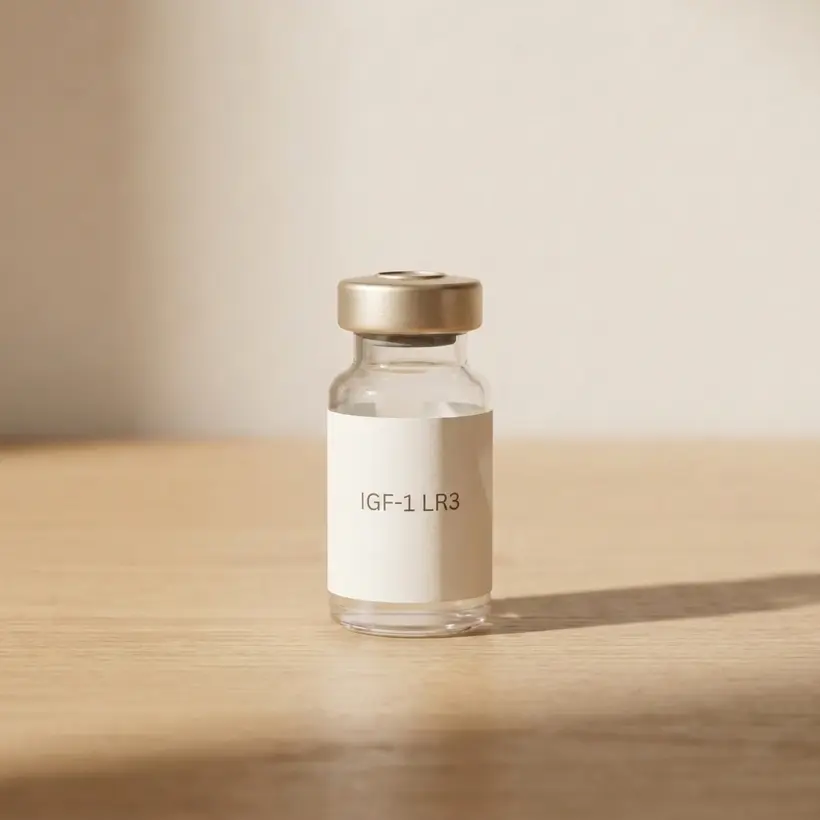
From the FormBlends catalog
IGF-1 LR3
Extended-action insulin-like growth factor for muscle growth · From $119/mo · compounded by a licensed 503A pharmacy, dispensed only after provider review.
Learn about IGF-1 LR3 →If you want the exact units for your own vial, the peptide calculator takes the vial size, the water you add and your dose, and returns the draw in units and millilitres, with a warning when the draw is too small to measure well.
IGF-1 LR3 is a 83-amino-acid recombinant analogue incorporating: (1) a 13-amino-acid N-terminal extension (the "Long" prefix), and (2) substitution of arginine at position 3 with glycine ("R3"). The Arg3-to-Gly substitution is specifically responsible for reducing affinity for IGF binding proteins, particularly IGFBP-3, by approximately 1000-fold relative to native IGF-1, as characterized in binding studies by Tomas et al. and by the original GroPep development data. This leaves IGF-1 LR3 predominantly free in circulation, extending estimated half-life to 20-30 hours in animal pharmacokinetic data.
Affinity for the IGF-1 receptor (IGF-1R) is modestly reduced versus native IGF-1 (estimates suggest roughly 2-3 fold lower binding affinity in vitro), but the prolonged free fraction more than compensates in terms of total receptor exposure time.
At concentrations substantially above physiologic, IGF-1 and its analogues cross-activate the insulin receptor (IR), driving GLUT4 translocation and cellular glucose uptake. This is the mechanistic basis for hypoglycemia risk at high doses. The exact concentration threshold for meaningful IR cross-activation in humans taking IGF-1 LR3 is not established.
IGF-1 LR3 Dosage Protocol Details
| Parameter | Commonly Reported Range | Evidence Basis |
|---|---|---|
| Daily dose | 40-100 mcg | Anecdote / animal extrapolation |
| Cycle length | 4-6 weeks | Anecdote; receptor downregulation rationale |
| Off-cycle period | 4-6 weeks minimum | Anecdote |
| Injection route | Subcutaneous (abdominal, thigh) | Pharmacokinetic convention for peptides |
| Injection timing | Post-workout, fasted or with fast-acting carbohydrates | Mechanistic reasoning only |
| Frequency | Once daily | Consistent with 20-30 hr half-life preclinical data |
The post-workout timing convention is based on the idea that IGF-1 LR3's insulin-like glucose uptake properties, combined with elevated mTOR and AMPK signaling from training, create a favorable nutrient-partitioning window. The supporting logic is mechanistically coherent; it has not been tested in a controlled human trial.
Higher-end doses (above 100 mcg/day) appear in self-report contexts. These carry meaningfully greater hypoglycemia risk and no established additional benefit. Doses above 120 mcg/day have no basis even in animal extrapolation for healthy adults.
What Most Pages Get Wrong About IGF-1 LR3 Dosage
1. Treating the half-life number as if it validates human dosing. The 20-30 hour half-life figure comes from preclinical animal data. It is used in nearly every online protocol to justify once-daily dosing. This is pharmacologically reasonable but not clinically validated. Human clearance could differ materially, particularly given differences in IGFBP concentrations across individuals.
2. Ignoring bioavailability variability by injection site and technique. Subcutaneous injection of peptides produces variable absorption based on tissue perfusion, injection depth, and local lipodystrophy from repeated injections. No site-specific bioavailability study exists for IGF-1 LR3 in humans. The assumption that subcutaneous absorption is consistent and complete is not supported.
3. Presenting "receptor downregulation" cycle length as established fact. The 4-6 week cycle limit is a harm-reduction convention borrowed from analogies with other peptide hormones. IGF-1R downregulation timelines in humans using exogenous IGF-1 LR3 have not been measured. The rule is precautionary and reasonable; it is not established science.
4. Omitting purity and endotoxin risk. IGF-1 LR3 sold outside pharmaceutical GMP channels varies substantially in purity. Bacterial endotoxin contamination (lipopolysaccharide) from E. coli expression systems used in production is a real and underreported safety variable. A clean HPLC trace does not rule out endotoxin contamination; a separate LAL (Limulus amebocyte lysate) endotoxin test is required.
5. Conflating IGF-1 LR3 with IGF-1 DES dosing. These are different molecules with different half-lives and different recommended dose ranges. DES is a truncated variant used at lower doses for local effects. They are not interchangeable.
Reconstitution, Storage, and Label Literacy
Reconstitution math: IGF-1 LR3 is typically supplied as lyophilized (freeze-dried) powder in vials of 1 mg (1000 mcg). To prepare a solution of 100 mcg per 0.1 mL (a convenient insulin syringe dose):
- Add 1.0 mL bacteriostatic water to the 1 mg vial.
- Result: 1000 mcg per 1.0 mL = 100 mcg per 0.1 mL (10 units on a U-100 insulin syringe).
- For a 50 mcg dose: draw 0.05 mL (5 units on U-100 syringe).
Inject bacteriostatic water slowly down the inside wall of the vial; do not inject directly onto the lyophilized cake or shake vigorously. Swirl gently until dissolved.
Storage after reconstitution: Store at 2-8 degrees Celsius (standard refrigerator). Bacteriostatic water formulations are typically stable for 2-4 weeks under these conditions; peptide activity may decline before visible signs of degradation appear. Avoid repeated freeze-thaw cycles: each cycle promotes aggregation and denaturation.
Reading a COA: Minimum required elements for a credible research-grade COA:
| Test | Method | Target Specification |
|---|---|---|
| Purity | HPLC (reverse-phase) | Greater than 98% |
| Identity / molecular weight | Mass spectrometry (ESI-MS or MALDI) | Approximately 9,117 Da |
| Endotoxin | LAL test | Less than 1 EU/mg |
| Sterility (if injectable use intended) | USP sterility test | No growth |
| Appearance | Visual | White to off-white lyophilized powder |
A COA that lists only a purity percentage with no named analytical method, or that lacks endotoxin data entirely, is insufficient for injectable use assessment.
The Chemistry Behind Storage and Stability Rules
Why cold storage: Peptide bonds and secondary structure are stabilized by weak non-covalent interactions (hydrogen bonds, van der Waals forces). Elevated temperature accelerates hydrolysis of peptide bonds and deamidation of asparagine and glutamine residues. IGF-1 LR3 contains multiple asn/gln residues in positions critical to receptor binding. Degradation at room temperature is progressive but not always visually apparent.
Why avoid freeze-thaw cycles: Ice crystal formation during freezing physically disrupts peptide aggregates and tertiary structure. Thawing creates local concentration gradients that promote irreversible aggregation. Each cycle incrementally reduces bioactive fraction. If a single vial will be used over multiple doses within 2-4 weeks, keeping it refrigerated (not frozen) after reconstitution is preferable to repeated freeze-thaw.
Why bacteriostatic water, not sterile water: Benzyl alcohol at 0.9% concentration is bacteriostatic: it disrupts bacterial membrane function without being directly bactericidal at that concentration. Sterile water has no preservative; once punctured, microbial contamination risk increases with each needle entry. The benzyl alcohol does not degrade IGF-1 LR3 at 0.9% concentration under refrigerated conditions, making it the standard diluent for multi-dose peptide vials.
Why avoid mixing with vitamin C (ascorbic acid): Ascorbic acid is a reducing agent with a low pKa. In solution it can reduce disulfide bonds within the IGF-1 LR3 structure. IGF-1's three disulfide bridges (Cys6-Cys48, Cys18-Cys61, Cys47-Cys52) are essential to its tertiary fold and receptor binding capacity. Disruption of these bridges inactivates the peptide. This is the chemical reason peptides are not co-administered in the same syringe with ascorbic acid solutions.
Head-to-Head: IGF-1 LR3 vs. IGF-1 DES vs. Recombinant Human IGF-1 (Mecasermin)
| Feature | IGF-1 LR3 | IGF-1 DES (Des(1-3)IGF-1) | Mecasermin (rhIGF-1, Increlex) |
|---|---|---|---|
| Structure | 83 AA; N-terminal extension + Arg3Gly | 67 AA; N-terminal tripeptide deleted | 70 AA; identical to endogenous IGF-1 |
| Half-life | ~20-30 hrs (animal data) | Under 30 min (in vitro) | ~5.8 hrs (FDA label, in GH-deficient patients) |
| IGFBP binding | ~1000-fold reduced vs. native | ~50-fold reduced vs. native (estimate) | Normal binding |
| Systemic vs. local action | Predominantly systemic | Predominantly local (short window) | Systemic |
| Typical research dose | 40-100 mcg/day (anecdote) | 50-150 mcg local injection (anecdote) | 0.04-0.12 mg/kg twice daily (FDA-approved label) |
| Human clinical trial data | None in healthy adults | None in healthy adults | Yes (FDA-approved for IGF-1 deficiency) |
| Regulatory status | Research compound (not approved) | Research compound (not approved) | FDA-approved drug (Increlex) |
| Hypoglycemia risk | Real; dose-dependent; sustained exposure | Lower due to short half-life | Documented in FDA label; managed with food timing |
| Where IGF-1 LR3 loses | Mecasermin has FDA safety data, standardized GMP manufacturing, and known human PK. IGF-1 LR3 has none of these. For legitimate IGF-1 deficiency, mecasermin is unambiguously superior. | ||
Safety Profile and Dose-Dependent Risks
Hypoglycemia: The most acute risk. IGF-1 analogues activate insulin signaling pathways at supraphysiologic concentrations. The Increlex (mecasermin) FDA prescribing information documents hypoglycemia in a majority of treated patients when not given with food. IGF-1 LR3's extended half-life means hypoglycemia risk is not isolated to the injection window but extends across the dosing interval. Consuming carbohydrates peri-dose is the standard precautionary measure, though optimal carbohydrate quantity is not established for IGF-1 LR3 specifically.
Proliferative risk: IGF-1R is overexpressed in breast, colon, prostate, and several other cancers. Epidemiological data (including the EPIC study) associate higher circulating IGF-1 with increased risk of certain cancers. Whether short-cycle exogenous IGF-1 LR3 at research doses meaningfully elevates this risk is unknown. Individuals with personal or family history of hormone-sensitive malignancy face a theoretically elevated risk that cannot be quantified with available data.
Acromegalic changes: Sustained IGF-1 elevation is the effector mechanism in acromegaly. Jaw, hand, and soft tissue changes require years of exposure at high concentrations (as seen in pituitary adenomas); the relevance to 4-6 week research cycles at modest doses is speculative but not zero.
Joint and soft tissue edema: Reported with IGF-1 axis stimulation, mechanism involves sodium and water retention. Typically reversible on cessation.
Anti-Doping and Regulatory Status
WADA classifies IGF-1 and all analogues under the S2 "Peptide Hormones, Growth Factors, Related Substances and Mimetics" category, prohibited in- and out-of-competition. Detection relies on LC-MS/MS methods that can identify the modified amino acid sequence (specifically the Arg3Gly substitution and N-terminal extension) distinguishing IGF-1 LR3 from endogenous IGF-1. Work by Thevis, Schanzer, and colleagues at the Cologne Anti-Doping Laboratory has characterized detection windows for IGF-1 analogues in urine and serum.
In the United States, IGF-1 LR3 is not FDA-approved and is sold as a research chemical. It is not a scheduled controlled substance under the DEA Controlled Substances Act, but its sale labeled or intended for human use would constitute an unapproved drug under the FD&C Act. Regulatory enforcement actions have targeted suppliers.
FAQ
What is the typical IGF-1 LR3 dosage used in research protocols?
Research protocols in human cell and animal studies have used doses ranging from 20 mcg to 120 mcg per day. Most bodybuilding-context self-report protocols cluster around 40-100 mcg per day. No controlled human dosing trial has established a minimum effective or maximum safe dose in healthy adults.
How long should an IGF-1 LR3 cycle last?
Anecdotal protocols typically run 4-6 weeks, citing receptor downregulation as the reason for cycling off. Formal human data on IGF-1 LR3 cycle duration and receptor desensitization timelines in healthy adults does not exist. The 4-week limit is a precautionary convention, not a clinically validated endpoint.
When should IGF-1 LR3 be injected relative to training?
Post-workout injection is commonly recommended to exploit elevated GLUT4 translocation and nutrient partitioning during the anabolic window. This rationale has mechanistic plausibility but no human RCT confirmation for IGF-1 LR3 specifically.
What sites are used for IGF-1 LR3 injection?
Subcutaneous injection in abdominal or thigh tissue is the predominant method. Intramuscular injection is also reported. Because IGF-1 LR3 has reduced IGFBP binding and a systemic half-life of roughly 20-30 hours, site selection has less pharmacokinetic impact than it does for shorter-acting IGF-1 variants like DES.
Does IGF-1 LR3 require bacteriostatic water for reconstitution?
Yes. Bacteriostatic water (0.9% benzyl alcohol) is strongly preferred over sterile water for multi-dose vials because it inhibits microbial growth. Reconstituted peptide in sterile water should be used within 24-48 hours; bacteriostatic water extends usable life to roughly 2-4 weeks when refrigerated at 2-8 degrees Celsius.
What is the half-life of IGF-1 LR3 compared to native IGF-1?
Native IGF-1 has a circulating half-life of roughly 10-16 minutes when free (unbound to IGFBPs). IGF-1 LR3 was engineered with an N-terminal extension and an Arg-to-Gly substitution at position 3 that reduces IGFBP-3 binding affinity by roughly 1000-fold, extending its half-life to an estimated 20-30 hours in preclinical data.
Is IGF-1 LR3 detectable on anti-doping tests?
WADA prohibits IGF-1 and its analogues under the S2 Peptide Hormones category. Detection methods for IGF-1 LR3 specifically include LC-MS/MS-based assays capable of distinguishing the modified sequence from endogenous IGF-1. Athletes subject to testing should treat any IGF-1 LR3 use as a significant doping violation risk.
What are the main safety concerns with IGF-1 LR3 dosage?
Hypoglycemia is the most immediately dangerous acute risk due to insulin-like glucose uptake. Longer-term concerns include promotion of existing neoplasia (IGF-1 receptor is overexpressed in multiple cancers), acromegalic-like tissue changes at high sustained doses, and joint or soft tissue edema. None of these risks have been formally quantified in human trials of IGF-1 LR3.
How does IGF-1 LR3 dosage differ from IGF-1 DES dosage?
IGF-1 DES is shorter-acting (half-life under 30 minutes in vitro) and is typically used at lower absolute doses injected locally pre-workout for site-specific effects. IGF-1 LR3 acts systemically and is dosed once daily. The two are not interchangeable on a microgram-per-microgram basis.
Can IGF-1 LR3 be stacked with growth hormone?
Combining exogenous IGF-1 LR3 with growth hormone creates parallel and potentially additive anabolic signaling, but also multiplies hypoglycemia risk and unquantified long-term proliferative risks. There are no human safety or efficacy data for this combination. The pharmacological rationale exists; the evidence base does not.
How do I read a COA to verify IGF-1 LR3 purity?
A credible COA should report purity by HPLC (target greater than 98%), identity confirmation by mass spectrometry showing the correct molecular weight of approximately 9,117 Da, and absence of endotoxin (LAL test, target less than 1 EU/mg). A COA that only states a purity percentage without naming the analytical method is insufficient.
What does degraded IGF-1 LR3 look like and how do I avoid using it?
Degraded reconstituted IGF-1 LR3 may appear cloudy, develop visible particulates, or show color change from clear to yellowish. Lyophilized powder that has clumped or turned yellow-brown before reconstitution suggests oxidation or moisture exposure. Functional degradation can occur before visible changes; strict cold-chain maintenance and avoidance of repeated freeze-thaw cycles are the practical safeguards.
Sources
Related peptide guides
Ready when you are
IGF-1 LR3
Extended-action insulin-like growth factor for muscle growth · From $119/mo · compounded by a licensed 503A pharmacy, dispensed only after provider review.
Learn about IGF-1 LR3 →