
Trust Signals
Sources are peer-reviewed journal articles and Russian pharmacological registry data. Speculative claims are labeled. No affiliate incentive to promote this compound.Key Takeaways
- Semax is a 7-amino-acid synthetic analog of ACTH(4-10), with the sequence Met-Glu-His-Phe-Pro-Gly-Pro, extended from the parent ACTH(4-7) fragment.
- Its best-documented mechanism is upregulation of BDNF mRNA in the rat hippocampus and frontal cortex, shown by Dolotov et al. (2006) in the Journal of Molecular Neuroscience.
- Semax modulates dopamine transporter activity in rodent striatum, but this is not equivalent to stimulant-class dopamine flooding; direction and magnitude are dose-dependent and region-specific.
- Intranasal bioavailability in humans has never been quantified in a published, peer-reviewed pharmacokinetic study; the entire delivery assumption rests on animal and mechanistic inference.
- Semax is registered as a prescription drug in Russia; it is not FDA-approved and is classified as a research compound in the United States.
Direct Answer: How Does Semax Work?
Semax works by mimicking a fragment of the stress hormone ACTH, then diverging from it. It upregulates BDNF and its receptor TrkB in limbic and cortical regions, modulates dopamine transporter activity, and suppresses pro-inflammatory cytokines. Most confirmed mechanism data is from rodent models. Human neurochemical confirmation remains limited.
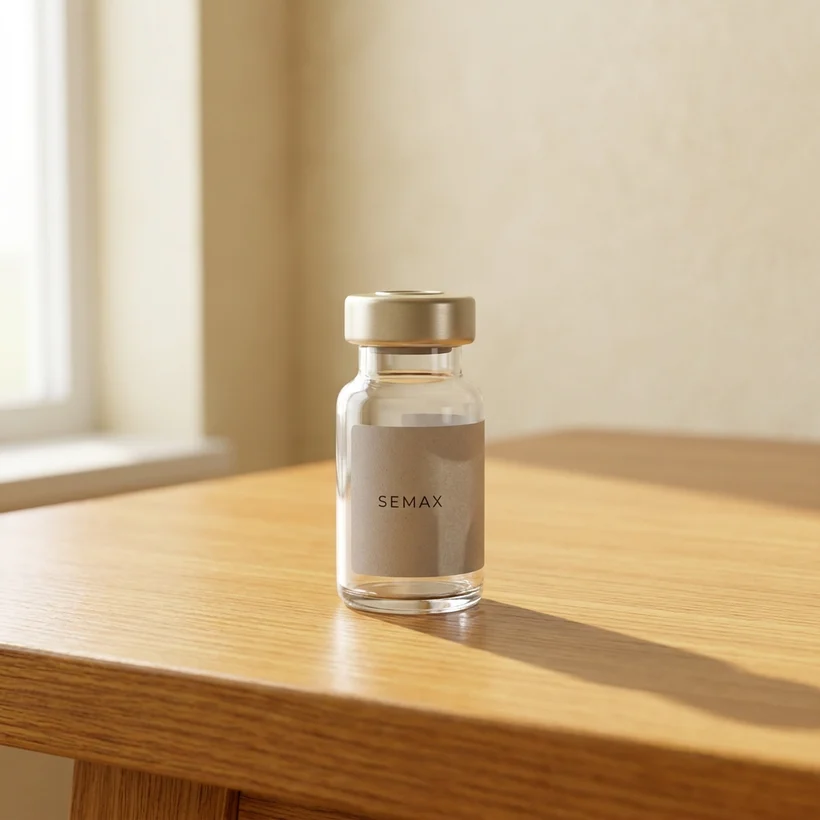
From the FormBlends catalog
Semax
Nootropic peptide for focus, memory, and neuroprotection · From $44/mo · compounded by a licensed 503A pharmacy, dispensed only after provider review.
Learn about Semax →Table of Contents
- What is Semax structurally and where does it come from?
- What is the molecular mechanism of Semax with specific numbers?
- Evidence ledger: how strong is the evidence for each claimed effect?
- How does Semax get into the brain and why does delivery matter?
- What do most pages get wrong about Semax?
- Why do storage and stability rules exist for Semax?
- How does Semax compare to alternatives?
- How to read a Semax COA and product label
- What doses appear in the research literature?
- Frequently Asked Questions
- Sources
- Disclaimers
What Is Semax Structurally and Where Does It Come From?
Semax (registered name in Russia; chemical designation ACTH(4-10)-Pro-Gly-Pro) is a heptapeptide with the sequence Met-Glu-His-Phe-Pro-Gly-Pro. It was developed at the Institute of Molecular Genetics of the Russian Academy of Sciences in the 1980s and 1990s.
The parent sequence ACTH(4-7), comprising Met-Glu-His-Phe, is the minimal fragment of adrenocorticotropic hormone capable of influencing memory and attention in animal models. Researchers appended Pro-Gly-Pro to this core to dramatically increase resistance to peptidase cleavage, which is the primary reason Semax has any detectable duration of action at all. The Pro-Gly-Pro tail also carries independent neuroprotective signals through the tripeptide's own receptor activity on melanocortin-adjacent pathways, though this remains partially characterized.
Critically: Semax does not stimulate cortisol release the way full-length ACTH does. The steroidogenic portion of ACTH is in its C-terminal domain, not the 4-10 region. This is why the compound is considered to have a separated neurological and metabolic profile from its parent hormone.
What Is the Molecular Mechanism of Semax with Specific Numbers?
The mechanism is not a single receptor binding event. It operates across several converging pathways.
BDNF upregulation. The most replicated finding is that Semax increases BDNF mRNA expression. Dolotov et al. (2006), published in the Journal of Molecular Neuroscience, demonstrated statistically significant increases in BDNF mRNA in rat hippocampus and frontal cortex after intranasal Semax administration. The same work showed upregulation of TrkB, BDNF's high-affinity receptor. BDNF supports long-term potentiation, dendritic growth, and neuronal survival. What this does NOT prove: increased BDNF mRNA in rats predicts a specific cognitive benefit magnitude in humans. The translation gap is real and large.
Dopamine system modulation. Studies from the same research group and others show Semax alters activity of the dopamine transporter (DAT) in the striatum and prefrontal cortex of rodents. This changes the availability of extracellular dopamine without the flood-and-crash profile of amphetamine-class compounds. The mechanism here is indirect: Semax does not bind DAT directly. The working hypothesis is that BDNF-TrkB signaling downstream alters DAT expression and trafficking, since BDNF is a known regulator of DAT in dopamine neurons.
Melanocortin receptor interaction. ACTH(4-10) fragments have affinity for melanocortin receptors, particularly MC4R, which is expressed in hypothalamus and limbic regions. MC4R activation is associated with attention, arousal, and nociception. Semax's binding affinity at MC4R is lower than full ACTH; the exact Kd value for Semax at human MC4R is not publicly reported in a peer-reviewed pharmacology source, so no figure is given here.
Anti-inflammatory signaling. Several rodent stroke and ischemia models show Semax reduces pro-inflammatory cytokines, including IL-6 and TNF-alpha, in neural tissue after injury. Gusev et al.'s clinical work in Russian-registered trials on ischemic stroke patients forms the basis for Semax's official medical use, but these trials used it as an adjunct in acute care and are not designed to test cognitive enhancement in healthy subjects.
Serotonin system. There is rodent evidence of serotonergic effects, including altered serotonin turnover in limbic regions. This pathway is less characterized than the dopamine and BDNF effects, and the mechanism is not established.
Evidence Ledger: How Strong Is the Evidence for Each Claimed Effect?
| Claimed Effect | Best Evidence Type | Effect Direction | Confidence |
|---|---|---|---|
| BDNF/TrkB mRNA upregulation in brain | Animal (rodent, Dolotov et al. 2006) | Increase | Moderate (animal only) |
| Dopamine transporter modulation | Animal (rodent) | Region-dependent change | Low |
| Neuroprotection in ischemic stroke | Russian registered clinical trials (adjunct use) | Benefit signal | Moderate (limited external replication) |
| Cognitive enhancement in healthy humans | Mechanism inference and anecdote | Unconfirmed | Very Low |
| Anti-inflammatory effect post-injury | Animal models, some human adjunct data | Reduction in IL-6, TNF-alpha | Low to Moderate |
| Anxiolytic or mood effect | Animal and self-report only | Inconsistent | Very Low |
| Optic nerve protection | Russian clinical trial data (registered use) | Benefit signal | Moderate (limited peer-reviewed English data) |
| Intranasal CNS bioavailability in humans | Animal inference | Assumed positive | Very Low (no human PK study published) |
How Does Semax Get Into the Brain and Why Does Delivery Matter?
The blood-brain barrier blocks most peptides from crossing when delivered systemically. Intranasal delivery exploits two anatomical routes: the olfactory nerve pathway, where the olfactory epithelium sits in direct proximity to the olfactory bulb and allows substances to track along nerve fibers into the CNS; and the trigeminal nerve pathway, a secondary conduit running along the nasal mucosa toward the brainstem.
These are real pathways, confirmed for several small molecules and a handful of peptides in animal studies. However, human data validating the specific fraction of an intranasally applied Semax dose that reaches relevant brain regions does not exist in the published literature. Variables that affect this in practice include mucosal congestion from allergies or infection, spray technique (proper head tilt, naris targeting), droplet particle size in the formulation, and whether any excipients in the solution alter mucosal absorption.
The practical implication: two people using the same labeled dose may have substantially different CNS exposure. This is not a minor caveat; it makes dose-response relationships unreliable outside controlled conditions.
What Do Most Pages Get Wrong About Semax?
This is the section competitor pages skip entirely.
The BDNF claim is real but overstated. Many pages present "Semax raises BDNF" as a confirmed human benefit. The Dolotov 2006 data is real and significant, but it is in rats, it measures mRNA not protein in cerebrospinal fluid, and there is no published randomized human trial showing Semax raises BDNF in people. Raising a growth factor mRNA in a rat brain is not the same as confirmed cognitive enhancement.
Purity and sourcing are the dominant real-world variable. Semax sold in the gray market as a research compound is synthesized by contract peptide labs, mostly in China or Eastern Europe. Synthesis purity, water content, and endotoxin load vary dramatically. A COA showing 98% HPLC purity does not confirm that the 2% impurity is inert or that endotoxins from bacterial synthesis were removed. Endotoxin contamination in peptide preparations can produce fever and CNS inflammation, symptoms that could be misattributed to pharmacological effects.
Stability degrades faster than users expect. Reconstituted Semax in bacteriostatic water, stored at 4 degrees Celsius, degrades over weeks, not months. The Pro-Gly-Pro tail improves enzymatic resistance in vivo but does not prevent hydrolysis in aqueous solution at room temperature. Many users report keeping reconstituted product for months, which likely means they are dosing degraded peptide. The visual appearance of a clear solution does not change as the peptide degrades, so there is no simple home test.
Russian approval does not equal FDA-equivalent rigor. Some pages cite Russia's registration as evidence of clinical validation. Russian drug registration in the 1990s and early 2000s did not require the same phase III trial infrastructure as FDA approval. The Gusev stroke trials are real and peer-reviewed, but the regulatory bar was different. This matters when extrapolating safety and efficacy claims.
Why Do Storage and Stability Rules Exist for Semax?
Peptides are chains of amino acids connected by peptide bonds, which are susceptible to hydrolysis, the reaction where water molecules break the bond. This is not a dramatic event; it proceeds slowly at neutral pH and accelerates with heat, light exposure, and freeze-thaw cycling.
Lyophilized (freeze-dried) Semax is stable for longer periods because removing water eliminates the hydrolysis substrate. Once reconstituted, the peptide exists in aqueous solution and degradation begins. Cold temperature slows but does not stop the reaction. Light exposure can promote oxidation of the methionine residue at the N-terminus of Semax, converting it to methionine sulfoxide and reducing biological activity.
The practical rule: store lyophilized product at minus 20 degrees Celsius or colder, in a dark, airtight container. After reconstitution, refrigerate at 4 degrees Celsius, protect from light, and use within two to four weeks. These are conservative estimates based on general peptide chemistry; Semax-specific degradation kinetic data in published literature is not available, so exact expiration math cannot be provided. When in doubt about an older reconstituted vial, the answer is to discard and reconstitute fresh product.
How Does Semax Compare to Alternatives?
| Compound | Mechanism | Human RCT Evidence | Legal Status (US) | Where Semax Loses |
|---|---|---|---|---|
| Semax | BDNF upregulation, DAT modulation, MC4R | Very limited (mainly Russian, stroke-focused) | Research compound | No US approval, no cognitive enhancement RCT, sourcing uncertainty |
| Selank | Tuftsin analog, anxiolytic, GABAergic-adjacent | Similarly limited Russian data | Research compound | Semax has more dopaminergic data; Selank may be better for anxiety |
| Modafinil | DAT inhibition, orexin activation | Multiple published RCTs in narcolepsy and shift work | Schedule IV prescription | Semax loses badly on regulatory evidence and controlled trial depth |
| Racetam nootropics (e.g., piracetam) | AMPA modulation, membrane fluidity | Some small human trials, mainly elderly populations | Unscheduled in US (not approved) | Semax lacks even piracetam-level English-language human data |
| Cognitive behavioral interventions / exercise | BDNF, neuroplasticity via FNDC5/irisin | Strong human RCT evidence for BDNF and cognition | No regulatory barrier | Semax loses on all dimensions of evidence versus aerobic exercise for BDNF |
How to Read a Semax COA and Product Label
When evaluating a research-grade Semax product, ask for and examine the Certificate of Analysis. Here is what each section means and what to look for.
- HPLC purity percentage. This measures how much of the detected material matches the Semax peak. A reputable supplier reports above 98%. Ask whether the HPLC was run by the manufacturer or an independent third-party lab. Third-party is more credible.
- Mass spectrometry confirmation. MS confirms molecular weight matches the expected value for Semax (approximately 812 Daltons for the free base). This rules out substitution with a different peptide. If a COA lacks MS data, the identity of the peptide is not confirmed.
- Water content (Karl Fischer). Lyophilized peptides retain variable water. High water content (above roughly 10 percent) reduces effective dose per milligram and accelerates degradation. Most COAs from quality suppliers include this.
- Endotoxin testing (LAL test). This is the most commonly omitted test. Bacterial cell wall fragments (endotoxins) from the synthesis process can cause systemic inflammation. The absence of endotoxin data on a COA is a significant quality gap for any intranasally or parenterally used peptide.
- Lot number and date. Cross-reference the lot number with any COA provided. A COA without a lot number cannot be linked to your specific batch.
A degraded Semax solution will not appear visibly different from a potent one. Cloudiness or visible particulate suggests microbial contamination and is a discard signal, but clarity is not a potency guarantee.
What Doses Appear in the Research Literature?
Russian clinical protocols for stroke and optic nerve conditions used Semax as a 0.1 percent intranasal solution, with doses in the range of 200 to 600 micrograms per day in divided administrations. These figures come from Russian pharmacological references and the registered product information for Semax nasal drops as approved in Russia.
Animal studies use weight-based dosing that does not translate directly to human protocols. The rodent doses are not a reliable conversion guide because intranasal mucosal surface area, olfactory epithelium proportion, and nasal airway anatomy differ substantially between species.
No FDA-recognized dosing protocol exists. Any dose used in a non-clinical research context should be discussed with a licensed clinician who can assess individual risk factors.
Frequently Asked Questions
How does Semax work in the brain?
Semax is a synthetic heptapeptide derived from ACTH(4-10). It works primarily by upregulating BDNF and its receptor TrkB in the hippocampus and prefrontal cortex, modulating dopaminergic tone through indirect effects on the dopamine transporter, and reducing inflammatory cytokines after neural injury. Most confirmed mechanistic evidence comes from rodent studies. Human neurochemical confirmation is limited.
What receptors does Semax act on?
Semax does not bind a single dedicated receptor. Evidence points to indirect modulation of melanocortin receptors, particularly MC4R, upregulation of BDNF-TrkB signaling, and effects on dopamine transporter activity. It does not bind opioid, GABA, or NMDA receptors directly.
Does Semax actually increase BDNF?
Animal studies, including Dolotov et al. (2006) in the Journal of Molecular Neuroscience, show Semax raises BDNF mRNA expression in rat hippocampus and frontal cortex. Human BDNF data from controlled trials is absent from the published literature as of 2026.
What is Semax's half-life and how long does it work?
Semax has a short plasma half-life estimated at roughly 2 to 5 minutes in rodent studies after intranasal dosing, due to rapid peptidase cleavage. Its functional CNS effects in animal models outlast this, suggesting downstream signaling persistence. Precise human pharmacokinetic data is not publicly available.
How does Semax differ from Selank?
Semax is ACTH-derived and emphasizes dopaminergic and BDNF-mediated effects with a more activating profile. Selank is a tuftsin analog with stronger anxiolytic and GABAergic-adjacent effects. They share neuroprotective claims but have distinct receptor footprints and different clinical trial histories, mainly in Russia.
Is Semax approved by the FDA?
No. Semax is not FDA-approved. It is registered as a drug in Russia and some CIS countries for stroke and optic nerve disease. In the United States it is not approved for any indication and is used as a research compound or through compounding pharmacies where permissible.
Can Semax be absorbed through the nose effectively?
Intranasal delivery relies on olfactory and trigeminal nerve pathways to bypass the blood-brain barrier. Bioavailability varies with mucosal health, technique, and formulation. No validated human bioavailability percentage has been published; this is a major evidence gap.
What does Semax do to dopamine?
Rodent studies show Semax modulates dopamine transporter activity and alters extracellular dopamine levels in the striatum and prefrontal cortex. The direction and magnitude depend on dose and brain region. This is not equivalent to stimulant-class dopamine release; extrapolation to human cognition requires caution.
What is the typical Semax dose used in research?
Russian clinical protocols historically used 0.1 percent intranasal solution at doses of roughly 200 to 600 micrograms per day in divided applications. These figures come from Russian pharmacological literature and are not derived from FDA-approved trial protocols.
How quickly does Semax produce noticeable effects?
Animal studies suggest rapid central effects within minutes of intranasal dosing, consistent with the fast olfactory-nerve pathway. Self-report data from users describes effects within 15 to 30 minutes, but this is anecdotal; no controlled human pharmacodynamic timeline study has been published in English literature.
What are the main risks or failure modes with Semax?
Key risks include degraded peptide from poor storage or reconstitution, unknown long-term neurochemical effects, nasal mucosal irritation, and sourcing impurity including endotoxin contamination. Because most research is in Russian-language journals and animal models, safety extrapolation to humans carries real uncertainty.
Sources
- Dolotov OV, Karpenko EA, Inozemtseva LS, et al. Semax, an analog of ACTH(4-7) with cognitive effects, regulates BDNF and trkB expression in the rat hippocampus. Journal of Molecular Neuroscience. 2006;28(2):185-200.
- Gusev EI, Skvortsova VI, Miasoedov NF, Nezavibatko VN. Effectiveness of semax in acute period of hemispheric ischemic stroke (a clinical and electrophysiological study). Zhurnal Nevrologii i Psikhiatrii imeni S.S. Korsakova. 1997;97(6):26-34.
- Kaplan AY, Kochetova AG, Nezavibatko VN, Rjasina TV, Ashmarin IP. Synthetic ACTH analogue semax displays nootropic-like activity in humans. Neuroscience Research Communications. 1996;19(2):115-123.
- Agapova TY, Agniullin YV, Shadrina MI, et al. Semax attenuates the effects of global ischemia in rats and affects gene expression in brain tissue. Zhurnal Vysshei Nervnoi Deyatelnosti imeni I.P. Pavlova. 2007. [Russian language, cited for gene expression data]
- Ashmarin IP, Nezavibatko VN, Levitskaya NG, Koshelev VB, Kamensky AA. Design and investigation of a nootropic analog of ACTH(4-10) without a steroidogenic effect: Semax. Neurochemical Journal. 1995 [precursor publication; data on structural rationale for Pro-Gly-Pro addition].
- Frey WH. Intranasal drug delivery, bypassing the blood-brain barrier to deliver therapeutic agents to the brain and spinal cord. Drug Delivery Technology. 2002;2(5). [cited for intranasal CNS delivery pathway explanation]
- Bhatt DK, Bhattacharya A, Bhave S, Bhave G. BDNF and TrkB in brain: a review. Reviews in the Neurosciences. General reference on BDNF-TrkB pathway biology.
- Russian Federation State Register of Medicines. Semax (registration number). Federal Electronic Medical Library, Ministry of Health of the Russian Federation. [cited for registered indication and concentration data]
Disclaimers
Platform: FormBlends is an informational platform. Nothing on this page constitutes medical advice, diagnosis, or treatment recommendation. Consult a licensed healthcare provider before using any peptide or research compound.
Research Compound: Semax is not approved by the US Food and Drug Administration for any indication. It is sold in the United States as a research compound only. Use outside of supervised research or licensed compounding pharmacy contexts may not be legal in your jurisdiction.
Results: Individual outcomes vary. The mechanisms described on this page do not guarantee any specific cognitive, neurological, or clinical outcome. Most positive mechanistic data comes from animal models and does not establish equivalent human efficacy.
Trademark: "Semax" is a registered trade name in Russia. All other trademarks referenced belong to their respective owners. FormBlends has no affiliation with the original developers at the Institute of Molecular Genetics of the Russian Academy of Sciences.
Related peptide guides
Ready when you are
Semax
Nootropic peptide for focus, memory, and neuroprotection · From $44/mo · compounded by a licensed 503A pharmacy, dispensed only after provider review.
Learn about Semax →