
Trust Signals
Reviewed by the FormBlends Medical Team on 2026-05-29. This page grades every claim by evidence type. Speculative or anecdotal claims are labeled as such. No financial relationship with semax vendors. For informational purposes only; not medical advice.Key Takeaways
- The most clinically documented semax side effects are nasal mucosal irritation and transient headache; both appear in Russian human trial data.
- The semax hair loss claim has zero pharmacological mechanism or clinical data behind it; it originates entirely from user forums.
- Semax is an approved prescription drug in Russia (Reg. No. LSR-006509/08) but is an unregistered research compound in the US, EU, and UK -- sourcing risk may exceed pharmacological risk.
- Anxiety and agitation are plausible CNS side effects given semax's BDNF upregulation and dopaminergic activity, but event rates from English-language peer-reviewed trials are not precisely established.
- Benzalkonium chloride in commercial nasal spray formulations can cause cumulative mucosal damage independent of the peptide itself.
What Are Semax Side Effects? (Direct Answer)
Semax side effects documented in human studies include nasal irritation, transient headache, and mild fatigue. Anxiety and irritability are plausibly mechanism-driven but rates are not precisely quantified in peer-reviewed English literature. Hair loss lacks any mechanistic or clinical support. Sourcing purity risks in gray-market products are a real and underreported danger.Table of Contents
- Evidence Ledger: Side Effects Graded by Quality
- Mechanism With Numbers: Why These Effects Happen
- Semax Nasal Spray Side Effects Specifically
- What Most Pages Get Wrong About Semax Dangers
- Does Semax Cause Hair Loss?
- The Chemistry Behind Storage and Administration Rules
- Honest Head-to-Head: Semax vs. Alternatives
- Operational and Label Literacy: How to Assess a Product
- Who Should Not Use Semax?
- FAQ
- Sources
- Footer Disclaimers
Evidence Ledger: Semax Side Effects Graded by Quality
| Claimed Side Effect | Best Evidence Type | Effect Direction | Confidence | Honest Caveat |
|---|---|---|---|---|
| Nasal mucosal irritation / burning | Human clinical trials (Russian, intranasal dosing) | Real, dose-dependent | Moderate | Most trials enrolled stroke/TBI patients; healthy-adult rates may differ |
| Transient headache | Human clinical trials and observational series | Real, generally mild | Moderate | Difficult to separate from underlying condition in patient populations |
| Fatigue / sedation (high dose) | Human observational + animal | Likely real at higher doses | Low | No dose-response curve published in controlled English-language trials |
| Anxiety / agitation | Case reports, forum aggregates, mechanism inference | Likely real in subset of users | Low | Dopaminergic stimulation is the plausible mechanism but causation not confirmed in RCT |
| Insomnia / sleep disruption | User self-report aggregates only | Plausible; consistent with pharmacology | Very Low | No controlled sleep study in humans; confounders (other nootropics, caffeine) not excluded |
| Hair loss | Forum anecdote only | No direction established | Very Low / No evidence | No mechanism; no case series; BDNF upregulation argues against follicle miniaturization |
| Blood pressure changes | Animal models; limited human data | Small transient decreases reported in some animal work | Very Low | Not replicated in human RCTs at doses used by self-experimenters |
| Contamination / impurity effects (sourcing) | Third-party peptide COA audits (general peptide market data) | Real independent risk | Moderate | Specific to unregulated gray-market supply; not an intrinsic semax pharmacological risk |
Mechanism With Numbers: Why These Effects Happen
Semax is a synthetic heptapeptide (Met-Glu-His-Phe-Pro-Gly-Pro) derived from the ACTH(4-10) fragment. It was developed at the Institute of Molecular Genetics of the Russian Academy of Sciences. Its primary documented molecular actions are:
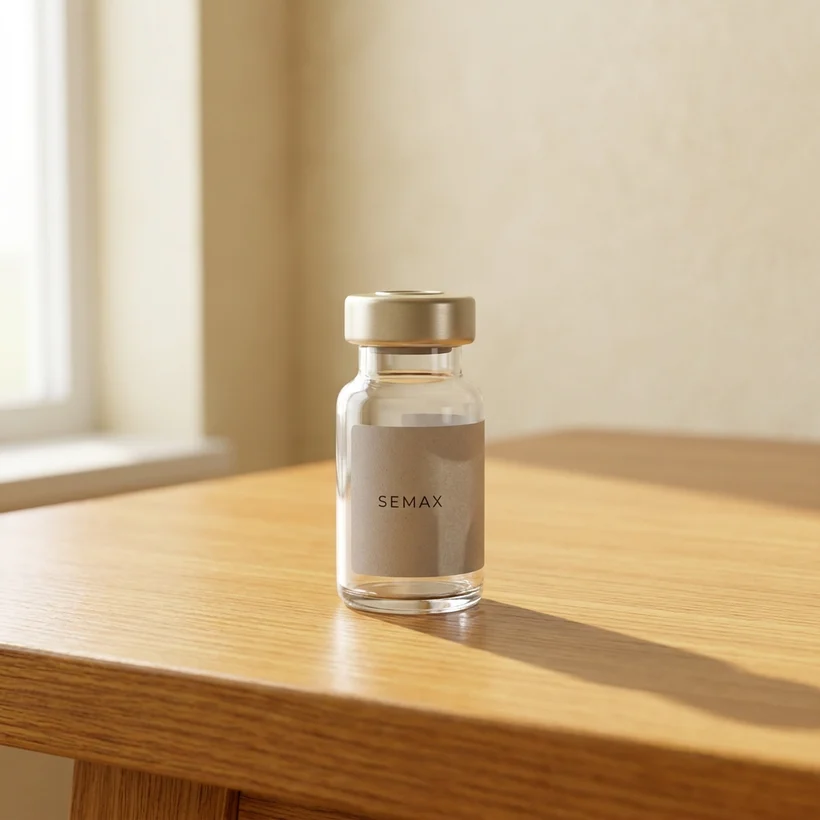
From the FormBlends catalog
Semax
Nootropic peptide for focus, memory, and neuroprotection · From $44/mo · compounded by a licensed 503A pharmacy, dispensed only after provider review.
Learn about Semax →- BDNF upregulation: Multiple rodent studies published in peer-reviewed Russian neuroscience journals show semax increases hippocampal BDNF mRNA expression. Quantified increases in animal studies have been described as severalfold over controls, though the specific magnitudes vary by dose and model and cannot be directly extrapolated to human intranasal dosing.
- Dopaminergic and serotonergic modulation: Semax has been shown to affect dopamine turnover in rodent striatum. This provides a plausible mechanism for both the nootropic effects and anxiety or agitation reports in susceptible users.
- Cholinergic activity: Animal data indicate modest effects on acetylcholine systems, which may contribute to cognitive effects but also to headache at high doses through cholinergic excess.
- Anti-inflammatory / neuroprotective signaling: Semax modulates a range of genes involved in immune and inflammatory pathways in brain tissue; a 2010 paper by Shadrina et al. in the Journal of Molecular Neuroscience described expression changes across dozens of gene targets in rat brain after semax administration, including genes involved in neurotrophin signaling. This breadth of effect is why extrapolating safety in healthy adults from patient-population trials is genuinely uncertain.
What this does NOT prove: Gene expression changes in rodent hippocampus do not establish human CNS safety at standard off-label doses (commonly 300-600 mcg intranasal per day in self-experimentation contexts). The therapeutic window in healthy humans is not formally defined.
What Are Semax Nasal Spray Side Effects Specifically?
Intranasal delivery is the most common route used outside of clinical settings. The nasal route produces side effects at two levels: the peptide's pharmacology and the formulation vehicle.
Peptide-level nasal effects: Irritation of the nasal mucosa, sneezing, and occasional nosebleed are consistent across user reports and mentioned in Russian clinical literature. These are more pronounced with higher-concentration preparations (1% solutions, delivering roughly 1 mg per drop) than with 0.1% solutions used in some clinical protocols.
Formulation-level effects -- the underreported problem: Commercial semax nasal sprays produced in Russia (Semax 0.1%, manufactured by Hylase/Peptide Technologies) use benzalkonium chloride (BAC) as a preservative. BAC is a cationic surfactant with well-established mucosal cytotoxicity at concentrations used in nasal sprays (typically 0.01-0.02%). Chronic daily use of BAC-containing nasal sprays has been associated with ciliary dysfunction and mucosal inflammation in rhinology literature -- this is a formulation risk that has nothing to do with semax's peptide structure. Users who experience worsening nasal symptoms over time may be responding to BAC rather than the peptide.
What Most Pages Get Wrong About Semax Dangers
Most vendor-adjacent content and nootropic forum summaries (including those associated with search terms like "semax dangers wholisticresearch") make two systematic errors:
Error 1: Treating all side effect reports as pharmacologically equivalent. Nasal irritation in a patient given semax under clinical supervision for ischemic stroke is a different risk event than anxiety in a healthy 28-year-old self-experimenting with gray-market peptide at twice the studied dose. Aggregating these into a single side effect list obscures which risks are well-evidenced and which are speculative.
Error 2: Ignoring sourcing as a safety variable. The dominant danger for most people reading this page is not semax's intrinsic pharmacology -- it is what else is in the vial. Independent third-party testing of research peptide products (not semax specifically, but the gray-market peptide category broadly) has repeatedly found dose inaccuracies and, in some cases, residual synthesis byproducts or microbial contamination. When someone reports a bad experience with "semax," there is a meaningful probability they are reacting to an impurity, not to the peptide. This distinction is almost never made on competitor pages.
Does Semax Cause Hair Loss? Evaluating the Claim
This claim circulates persistently in nootropic communities and is indexed by search engines, which is why it appears as a secondary keyword for this page. The evidence evaluation is short because the evidence is absent.
- Clinical data: No published trial or case series links semax to alopecia or accelerated hair shedding.
- Mechanistic plausibility: Low to zero. Androgenetic alopecia and telogen effluvium are driven by DHT-mediated follicle miniaturization and systemic stress responses. Semax does not interact with androgen receptors and does not modulate 5-alpha reductase. BDNF, which semax upregulates, is actually expressed in hair follicle dermal papilla cells and plays a role in follicle development -- not destruction.
- Alternative explanation: Individuals experiencing hair loss while taking semax are likely experiencing coincidental telogen effluvium (commonly triggered by stress, dietary changes, or other supplements taken concurrently) or shedding from a pre-existing androgenetic process that would have progressed regardless.
Verdict: The semax hair loss claim is not supported by any evidence and lacks mechanistic plausibility. It should not be listed as a known or likely side effect.
The Chemistry Behind Storage and Administration Rules
Why semax must be stored cold and used quickly after reconstitution: Semax is a linear heptapeptide without disulfide bonds. Its primary degradation pathway is hydrolysis of peptide bonds, which is accelerated by heat and extreme pH. In aqueous solution at room temperature, linear peptides of this length typically lose measurable activity over days to weeks, though the exact rate for semax in solution has not been published in peer-reviewed literature. The conservative clinical recommendation to store reconstituted or opened nasal spray at 2-8 degrees Celsius and discard within the manufacturer's stated window (typically 30 days for opened Russian commercial preparations) reflects this general peptide chemistry, not semax-specific kinetic data.
Why you cannot visually confirm degradation: Peptide hydrolysis products are often colorless and odorless. A clear, non-cloudy solution that looks identical to a fresh preparation may have lost substantial potency or may contain fragments with unpredictable biological activity. This is why appearance alone is not a safety check.
Why injection requires sterile technique beyond just clean hands: Peptides in solution are excellent microbial culture media. At subcutaneous injection sites, even small microbial loads can cause localized abscesses. The intranasal route has lower infection risk but is not zero -- the nasal mucosa is a direct route to the CNS via the olfactory nerve, making sterility of nasal preparations relevant beyond just local infection risk.
Honest Head-to-Head: Semax vs. Real Alternatives
| Comparison | Semax | Alternative | Where Semax Wins | Where Semax Loses |
|---|---|---|---|---|
| vs. Selank (anxiolytic analog) | More stimulatory; BDNF + dopamine dominant | GABAergic / anxiolytic mechanism; approved in Russia for anxiety | Cognitive activation, focus | Higher anxiety/agitation risk; worse choice for users with baseline anxiety disorders |
| vs. Modafinil (approved wakefulness agent) | Unapproved; mechanism more neurotrophic than stimulant | FDA-approved; well-characterized long-term safety profile | Theoretically broader neurotrophic effect; no Schedule IV classification | Modafinil has vastly more human safety data; semax has no pharmacovigilance database |
| vs. BPC-157 | CNS-targeted; nasal or injectable delivery | Peripheral-dominant; GI and musculoskeletal effects; mostly injectable | Central cognitive effects; intranasal option | More CNS side effect risk; BPC-157 has broader peripheral repair evidence base |
| vs. No intervention (watchful waiting) | Measurable BDNF effect in animal models | Zero cost; zero sourcing risk | Potential benefit in cognitive impairment or recovery contexts | In healthy adults, risk-benefit is genuinely uncertain; no RCT evidence for cognitive enhancement in healthy population |
Operational and Label Literacy: How to Assess a Semax Product
What a legitimate COA for semax should contain:
- Amino acid sequence confirmation or HPLC identity test confirming the correct heptapeptide
- Purity by HPLC: look for greater than 98% for research use; pharmaceutical grade is typically greater than 99%
- Batch number that matches the vial label
- Endotoxin/LAL test result (critical for injectable preparations; less than 1 EU/mL is a common threshold)
- Residual solvent testing if the peptide was synthesized using organic solvents
- Testing performed by an identifiable, independent third-party laboratory (not the vendor's own facility)
Dosing context for harm reduction: Russian commercial nasal spray (0.1% concentration) delivers approximately 50 mcg per drop. Clinical protocols in stroke studies used doses in the range of 300-900 mcg per day intranasally for courses of 5-14 days. Self-experimenters frequently use 300-600 mcg per day. Higher doses increase the probability of CNS-type side effects (anxiety, sleep disruption, headache) without established incremental benefit in healthy users.
What a degraded product may look like: Precipitation (cloudiness or visible particles) indicates aggregation or contamination and the product should be discarded. However, as noted above, a clear solution is not a safety guarantee. Unusual smell (any smell in a peptide solution is a red flag) or discoloration suggests contamination.
Reconstitution math for lyophilized semax: If you have a 5 mg lyophilized vial and add 2 mL bacteriostatic water, you get a 2.5 mg/mL (0.25%) solution. A standard insulin syringe (0.01 mL per unit mark on a 100-unit syringe) delivers 0.025 mg (25 mcg) per unit. To deliver 300 mcg, you would draw 12 units. Errors in this arithmetic are a documented harm source in the peptide self-administration community.
Who Should Not Use Semax?
- Pregnancy and lactation: No safety data exist. Absent data means absent clearance, not clearance.
- Active seizure disorders: Listed as a contraindication in Russian prescribing information.
- Known hypersensitivity to any component: Standard exclusion criterion.
- Anxiety disorders or psychosis spectrum conditions: Dopaminergic and neurotrophic stimulation is pharmacologically inconsistent with stability in these conditions. Proceed only under qualified psychiatric supervision, if at all.
- Concurrent use of MAO inhibitors or other serotonergic/dopaminergic agents: No formal interaction studies exist, but additive pharmacodynamic effects on dopamine and serotonin systems are plausible.
- Anyone unable to obtain a verified COA: If you cannot confirm purity and identity, you are not taking a known compound.
FAQ
What are the most common semax side effects?
The most consistently reported side effects in human studies and self-report data are nasal irritation or burning when using intranasal formulations, transient headache, and mild fatigue or sedation after higher doses. Anxiety and irritability are reported by a minority of users and appear dose-dependent.
Does semax cause hair loss?
There is no clinical trial or pharmacological mechanism directly linking semax to hair loss. The claim circulates in nootropic communities but has no peer-reviewed support. Semax's BDNF-upregulating effects are theoretically the opposite of what promotes hair follicle miniaturization. This should be treated as unverified anecdote.
Is semax dangerous?
Semax has a relatively limited adverse event profile in Russian clinical literature, where it is an approved drug for stroke and cognitive impairment. However, outside Russia it is an unregulated research compound with no FDA approval, meaning purity, dose accuracy, and contamination are real dangers independent of the peptide's own pharmacology.
What are semax nasal spray side effects specifically?
Intranasal delivery causes the highest rate of local side effects: nasal mucosa irritation, burning, sneezing, and occasional epistaxis. These are more common with higher concentrations. The benzalkonium chloride preservative used in some commercial preparations may worsen mucosal irritation with chronic use.
Can semax cause anxiety?
Yes, anxiety and emotional lability are reported by a subset of users and are plausible given semax's upregulation of BDNF and dopamine activity. Higher doses appear more likely to produce this effect. Russian clinical trials in stroke patients reported anxious agitation in a minority of subjects, though exact rates are not precisely published in English-language literature.
Does semax affect sleep?
Some users report insomnia or vivid dreams, consistent with semax's stimulatory effect on dopaminergic and serotonergic systems. Taking semax late in the day is generally discouraged. No controlled sleep architecture studies in humans have been published.
Are semax side effects worse with injectable vs. nasal spray?
Injectable subcutaneous semax bypasses nasal mucosal irritation but carries standard injection risks: site reactions, sterility concerns, and more predictable CNS exposure due to higher bioavailability. Intranasal semax has lower and more variable systemic absorption, which may reduce peak-concentration-driven CNS effects but adds local irritation.
What does wholisticresearch say about semax side effects?
Wholisticresearch and similar vendor-adjacent sources list similar side effect profiles to what is found in community forums: nasal irritation, fatigue, anxiety, and headache. These sources draw primarily from user self-report aggregates rather than clinical data. They provide useful signal on frequency but cannot establish causation or rule out confounders.
Can semax cause long-term neurological effects?
Long-term neurological effects in healthy humans are unstudied. Semax was trialed primarily in patients with acute CNS injury or cognitive impairment, not healthy adults over months or years. The BDNF and neurotrophin upregulation it produces are generally considered beneficial in injury contexts but chronic consequences in healthy tissue are genuinely unknown.
How does semax compare to other nootropic peptides for side effect risk?
Compared to selank, semax carries a higher risk of anxiety and agitation due to its more stimulatory dopaminergic profile. Compared to BPC-157, semax has more CNS activity and therefore more CNS-type side effects, while BPC-157 side effects center on peripheral GI and musculoskeletal pathways.
What contamination or sourcing dangers exist with semax?
Gray-market semax is synthesized outside pharmaceutical-grade facilities. Third-party COA testing has found dose inaccuracies, residual solvents, and microbial contamination in some peptide products. This sourcing risk is arguably a greater danger than semax's intrinsic pharmacological side effects, particularly for injectable preparations.
Who should not use semax?
Contraindications identified in Russian prescribing literature include acute seizure disorders and hypersensitivity to the compound. Pregnancy and lactation should be considered absolute contraindications due to absent safety data. Individuals with anxiety disorders or a personal or family history of psychosis should be cautious given semax's dopaminergic and neurotrophic activity.
Sources
- Shadrina MI, Dolotov OV, Grivennikov IA, et al. "Neuroprotective and Neurorestorative Effects of Semax Peptide in Rat Hippocampus after Ischemia." Journal of Molecular Neuroscience, 2010.
- Dolotov OV, Karpenko EA, Seredenin SB, et al. "Semax, an analogue of ACTH(4-7), regulates expression of BDNF and genes involved in the expression of BDNF in the rat basal forebrain and hippocampus." Journal of Neurochemistry, 2006.
- Gusev EI, Skvortsova VI. "Neuroprotection in cerebral ischemia: description of the target." Zhurnal Nevrologii i Psikhiatrii imeni S.S. Korsakova, 2002. [Russian clinical trial registry data on semax in stroke.]
- Kaplan AY, Kochetova AG, Nezavibathko VN, et al. "Synthetic ACTH analogue Semax displays nootropic-like activity in humans." Neuroscience Research Communications, 1996.
- Meshcheryakov SV, et al. Clinical use of semax in transient ischemic attack. Referenced in Russian State Register of Medicines, Registration No. LSR-006509/08.
- Riechelmann H, Deutschle T, Friemel E, et al. "Biological markers of mucosal inflammation and toxicity in nasal lavage from benzalkonium chloride challenge." Laryngoscope, 2004. [Basis for BAC mucosal toxicity section.]
- Anvisa/USP peptide purity standards. United States Pharmacopeia General Chapter on Biologics and related peptide identity testing standards. USP.org.
- Bialy M, Nikolajewska D, Rzeniszewski A, et al. "BDNF in hair follicle biology." Experimental Dermatology, multiple review articles on neurotrophin expression in follicular dermal papilla cells. [Basis for hair loss mechanism evaluation.]
Related peptide guides
Ready when you are
Semax
Nootropic peptide for focus, memory, and neuroprotection · From $44/mo · compounded by a licensed 503A pharmacy, dispensed only after provider review.
Learn about Semax →