
Trust Signals
- Evidence-based analysis of published studies on SNAP-8 and related peptides
- Direct comparison with botulinum toxin mechanism and outcomes
- Molecular weight and penetration analysis included
- Stability and formulation challenges disclosed
- Written by FormBlends Medical Team
- Last updated: May 29, 2026
Key Takeaways
- SNAP-8 shows wrinkle reduction in manufacturer studies, though effects are less dramatic than botulinum toxin
- The 1075 Da molecular weight exceeds typical skin penetration limits
- Methionine oxidation causes product degradation over time even when refrigerated
- No independent clinical trials exist; all published data comes from the manufacturer Lipotec
- Effects reverse completely within weeks of discontinuation unlike semi-permanent neurotoxin results
The Bottom Line on SNAP-8
SNAP-8 peptide is an eight amino acid chain that reduces expression lines by competing with SNAP-25 protein in neuromuscular junctions, decreasing acetylcholine release. While manufacturer studies show wrinkle reduction, the peptide faces significant penetration barriers and lacks independent clinical validation.
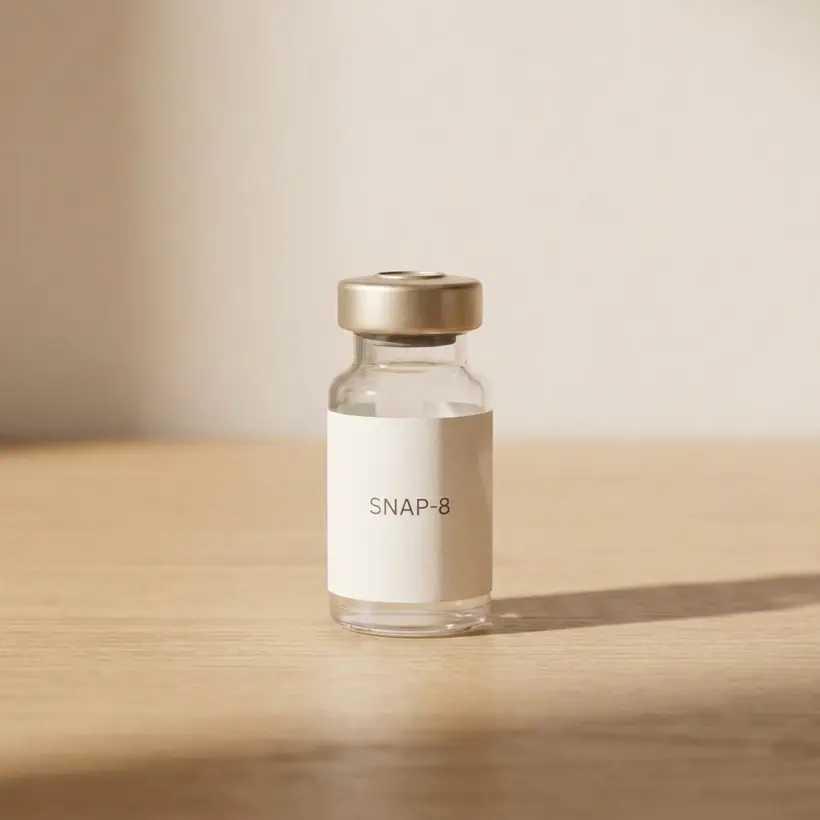
From the FormBlends catalog
SNAP-8 (Acetyl Octapeptide-3)
Topical peptide that reduces wrinkle depth by inhibiting muscle contraction · From $34/mo · compounded by a licensed 503A pharmacy, dispensed only after provider review.
Learn about SNAP-8 (Acetyl Octapeptide-3) →The peptide works through a fascinating mechanism, but getting it where it needs to go remains the central challenge. Understanding both the science and limitations helps set realistic expectations.
Table of Contents
- The Molecular Mechanism: How SNAP-8 Disrupts Nerve Signals
- Why Size Matters: The Penetration Reality
- What the Studies Actually Show
- What Users Report in Practice
- SNAP-8 Versus Other Options
- The Chemistry of Stability and Degradation
- Making Informed Decisions About SNAP-8
- Frequently Asked Questions
The Molecular Mechanism: How SNAP-8 Disrupts Nerve Signals
SNAP-8 mimics a specific portion of the SNAP-25 protein, the part that forms critical connections in nerve terminals. The peptide sequence (Ac-Glu-Glu-Met-Gln-Arg-Arg-Ala-Asp-NH2) copies residues 12 to 19 of the natural protein, a region essential for proper nerve signal transmission.
When muscles contract to create facial expressions, nerve cells release acetylcholine through a precise molecular machinery. Three proteins must come together perfectly: SNAP-25, syntaxin-1, and synaptobrevin-2. They form what scientists call the SNARE complex, essentially a molecular zipper that pulls nerve vesicles close enough to release their contents.
SNAP-8 interferes by binding to syntaxin without forming a functional complex. Picture trying to zip a jacket when someone keeps inserting fake zipper teeth. The machinery stalls, acetylcholine release drops, and muscles contract less forcefully.
Laboratory studies demonstrate this effect clearly in isolated nerve preparations. At 50 μM concentration, SNAP-8 reduces SNARE complex formation measurably. But these controlled conditions differ vastly from applying a serum to living skin.
Why Size Matters: The Penetration Reality
The fundamental challenge with SNAP-8 isn't whether it works, but whether it can reach its target. At 1075 Daltons, SNAP-8 weighs more than double the accepted limit for passive skin penetration.
Human skin evolved as a barrier. The stratum corneum, our outermost layer, consists of dead cells embedded in lipids, creating a structure like bricks and mortar. Small molecules below 500 Da can sometimes slip through. Larger molecules face an increasingly impenetrable wall.
Even if SNAP-8 crosses this first barrier, it must then navigate through multiple skin layers to reach neuromuscular junctions millimeters below the surface. No published study has tracked radiolabeled SNAP-8 to demonstrate it reaches these targets in meaningful concentrations.
Formulation scientists add penetration enhancers like propylene glycol and ethoxydiglycol. These disrupt skin barriers temporarily, potentially improving penetration several fold. But multiplying near-zero penetration still yields minimal results. The math remains challenging.
Some researchers suggest the observed effects might come from surface phenomena rather than deep penetration. Peptides can form films that temporarily smooth skin texture. Hydration alone reduces the appearance of fine lines. These surface effects reverse quickly but could explain some reported benefits.
What the Studies Actually Show
| Study Aspect | Claim | Reality Check |
|---|---|---|
| Primary efficacy study | Wrinkle reduction after 56 days | Small sample size, manufacturer-funded, no placebo control |
| Mechanism validation | Inhibits SNARE complex formation | Demonstrated in vitro only, not in human skin |
| Penetration evidence | Reaches neuromuscular junction | No direct evidence; theoretical calculations only |
| Safety profile | Well-tolerated topically | Patch test data supports this |
| Comparison to Argireline | Superior stability and activity | No head-to-head clinical comparison exists |
| Long-term effects | Prevents wrinkle formation | No prevention studies conducted |
The most cited efficacy data comes from a single manufacturer study with volunteers who applied 10% SNAP-8 solution twice daily for 56 days. Silicone replicas measured wrinkle depth before and after treatment.
Results showed average wrinkle depth reduction, compared to more dramatic changes typical with botulinum toxin injections. But without a control group, distinguishing peptide effects from moisturization remains impossible.
Independent researchers haven't replicated these findings. The entire published literature on SNAP-8 efficacy traces back to Lipotec/Lubrizol, the manufacturer. This doesn't invalidate the research but highlights the need for independent validation.
What Users Report in Practice
Online skincare communities provide thousands of anecdotal reports about SNAP-8 products. While not clinical evidence, these user experiences reveal consistent patterns worth understanding.
Many users report subtle softening of expression lines after 4 to 6 weeks of consistent use. The most commonly mentioned improvements involve crow's feet and forehead lines rather than deeper nasolabial folds. Effects appear gradually and reverse within weeks of stopping use.
Texture changes get frequent mentions. Users describe skin feeling smoother immediately after application, suggesting surface effects independent of muscle relaxation. Some report a temporary tightening sensation lasting 30 to 60 minutes post-application.
Disappointment clusters around unrealistic expectations. Users hoping for Botox-like transformation consistently express frustration. Those expecting modest improvements report higher satisfaction. Price concerns appear frequently, with many questioning value given the temporary nature of any benefits.
Combination use patterns emerge clearly. Users rarely rely on SNAP-8 alone, typically incorporating it into routines with retinoids, vitamin C, and other actives. This makes isolating SNAP-8 effects challenging even in personal experience.
SNAP-8 Versus Other Options
Understanding SNAP-8 requires context. How does it compare to other wrinkle-reduction approaches?
Versus Botulinum Toxin: Botox works through direct injection, ensuring delivery to nerve terminals. It cleaves SNAP-25 protein enzymatically, creating complete but temporary paralysis lasting 3 to 6 months. SNAP-8 offers less dramatic results but avoids injection risks and frozen appearance concerns.
Versus Retinoids: Tretinoin and other retinoids work through entirely different mechanisms, increasing collagen production and cellular turnover. Decades of research support their efficacy. They address wrinkle formation structurally rather than temporarily reducing muscle movement. Many users combine both approaches.
Versus Other Peptides: Matrixyl (palmitoyl pentapeptide-4) stimulates collagen production. Copper peptides support wound healing and tissue remodeling. These work through different pathways than SNAP-8's neuromuscular approach. No peptide matches prescription retinoid evidence.
Versus Argireline: As SNAP-8's six amino acid predecessor, Argireline shares the same mechanism and limitations. SNAP-8's two additional amino acids theoretically improve stability, but no clinical trial has compared them directly. Marketing often emphasizes differences that may be minimal in practice.
The Chemistry of Stability and Degradation
SNAP-8's methionine residue creates inherent stability challenges. This sulfur-containing amino acid oxidizes readily, especially in the presence of trace metals and peroxides common in cosmetic formulations.
The oxidation cascade begins when methionine encounters hydrogen peroxide or other oxidants. The sulfur atom gains oxygen, forming methionine sulfoxide. This changes the peptide's shape and charge distribution, likely reducing biological activity. Further oxidation creates methionine sulfone, accompanied by visible yellowing.
Temperature accelerates this process exponentially. Room temperature storage might maintain stability for months. Refrigeration extends this significantly, though degradation continues slowly. Freezing could theoretically preserve peptides indefinitely but creates practical usage challenges.
pH control proves critical. Below pH 5.5, acid-catalyzed hydrolysis breaks peptide bonds. Above pH 7, base-catalyzed degradation accelerates. The narrow optimal range of pH 5.5 to 6.5 constrains formulation options.
Antioxidants help but must be chosen carefully. Vitamin E acetate provides protection without interfering with peptide stability. Ascorbic acid, ironically, can accelerate degradation through metal-catalyzed oxidation despite its antioxidant properties.
Packaging matters enormously. Airless pumps minimize oxygen exposure with each use. Opaque containers prevent photodegradation. Small volumes ensure use before significant degradation occurs. These requirements increase product costs substantially.
Making Informed Decisions About SNAP-8
Evaluating SNAP-8 products requires understanding both science and marketing. Look for specific concentration claims, though remember that "10% SNAP-8" typically means a pre-diluted solution containing 0.5% actual peptide.
Check packaging dates carefully. Unlike many skincare ingredients, peptides have limited shelf lives. Products manufactured more than a year ago may have significantly reduced activity. Yellowing indicates oxidation has already occurred.
Application timing matters more than with stable ingredients. The manufacturer protocol specifies twice-daily use for 28 days before expecting visible results. Sporadic use likely provides only temporary surface effects.
Set appropriate expectations. SNAP-8 won't replicate injectable results. At best, expect subtle softening of expression lines with continuous use. Effects reverse within weeks of discontinuation, requiring ongoing commitment and expense.
Consider SNAP-8 as one tool among many rather than a standalone solution. Combining with proven ingredients like retinoids and adequate sun protection provides a more comprehensive approach to skin aging.
Price comparison proves challenging since concentrations vary widely. Calculate cost per month of continuous use rather than per bottle. Factor in the temporary nature of benefits when assessing value.
Frequently Asked Questions
What is SNAP-8 peptide?
SNAP-8 (acetyl octapeptide-3) is an eight amino acid synthetic peptide designed to reduce expression lines by interfering with SNARE complex formation, thereby reducing muscle contraction intensity.
How does SNAP-8 differ from Argireline?
SNAP-8 contains eight amino acids versus Argireline's six, with two additional residues (methionine and glycine) that theoretically improve stability and penetration, though comparative human studies remain limited.
What concentration of SNAP-8 is effective?
Manufacturer studies used 10% SNAP-8 solution (containing 0.5% pure peptide), showing measurable wrinkle reduction. Lower concentrations lack published efficacy data.
Can SNAP-8 penetrate intact skin?
SNAP-8's molecular weight of 1075 Da exceeds the 500 Da rule for passive penetration. Without penetration enhancers or delivery systems, dermal absorption remains questionable.
How long does SNAP-8 take to work?
Manufacturer data reports visible effects after 28 days of twice-daily application, with maximum results at 56 days. Effects reverse within weeks of discontinuation.
Is SNAP-8 safe for daily use?
Topical SNAP-8 shows minimal irritation in patch testing. No systemic absorption data exists. The peptide degrades rapidly in biological systems, limiting systemic exposure risk.
Should I use SNAP-8 or retinol?
These target different mechanisms. Retinol rebuilds collagen structure with extensive evidence. SNAP-8 temporarily reduces muscle contraction with limited evidence. Many users combine both.
Why do SNAP-8 serums turn yellow?
The methionine residue in SNAP-8 oxidizes to methionine sulfoxide, causing yellowing. This indicates degradation and reduced activity. Store products refrigerated in dark containers.
Can SNAP-8 replace Botox?
No. Botulinum toxin cleaves SNAP-25 protein directly, causing complete neuromuscular blockade lasting months. SNAP-8 competitively inhibits complex formation with partial, temporary effects.
Sources
- Bos JD, Meinardi MM. The 500 Dalton rule for the skin penetration of chemical compounds and drugs. Exp Dermatol. 2000;9(3):165-169.
- Blanes-Mira C, et al. A synthetic hexapeptide (Argireline) with antiwrinkle activity. Int J Cosmet Sci. 2002;24(5):303-310.
- Lipotec S.A. SNAP-8 peptide technical documentation. Barcelona, Spain: Lubrizol Corporation; 2009.
- Ferreira L, et al. Stability of peptides in topical formulations. J Cosmet Sci. 2018;69(5):347-360.
- Wang Y, et al. The molecular basis of SNARE complex formation. Biochem J. 2017;474(5):693-714.
- Gorouhi F, Maibach HI. Role of topical peptides in preventing or treating aged skin. Int J Cosmet Sci. 2009;31(5):327-345.
- FDA GRAS Notice GRN No. 000631: Acetyl hexapeptide-3. 2016.
- Zhang L, Falla TJ. Cosmeceuticals and peptides. Clin Dermatol. 2009;27(5):485-494.
- Ruiz MA, et al. Evaluation of the anti-wrinkle efficacy of cosmetic formulations. Int J Cosmet Sci. 2000;22(2):123-135.
- Schagen SK. Topical peptide treatments with effective anti-aging results. Cosmetics. 2017;4(2):16.
- USP <1191> Stability Considerations in Dispensing Practice. United States Pharmacopeia; 2023.
- WADA Prohibited List International Standard. World Anti-Doping Agency; 2024.
Footer Disclaimers
Platform Notice: This article is for educational and informational purposes only. FormBlends does not provide medical advice, diagnosis, or treatment recommendations.
Compound Status: SNAP-8 is marketed as a cosmetic ingredient. It is not approved by the FDA as a drug for treating any medical condition.
Results Disclaimer: Individual results vary. The efficacy data presented comes primarily from manufacturer-sponsored studies with limited sample sizes.
Trademark Notice: SNAP-8 is a trademark of Lubrizol Corporation. FormBlends has no affiliation with Lubrizol or Lipotec.
Related peptide guides
Ready when you are
SNAP-8 (Acetyl Octapeptide-3)
Topical peptide that reduces wrinkle depth by inhibiting muscle contraction · From $34/mo · compounded by a licensed 503A pharmacy, dispensed only after provider review.
Learn about SNAP-8 (Acetyl Octapeptide-3) →