
Trust Signals
Key Takeaways
- Humanin is a 21-amino-acid mitochondria-derived peptide (MDP) encoded within the mitochondrial 16S rRNA locus, with endogenous blood levels in the low nanomolar range that decline with age.
- No validated human clinical dosing protocol exists. Animal studies have used intraperitoneal and subcutaneous doses ranging from roughly 0.1 mg/kg to 10 mg/kg, but direct extrapolation to humans is not scientifically supported.
- The analog HNG (Ser14Gly humanin) demonstrates roughly 1000-fold greater potency than native humanin in certain cell-based neuroprotection assays, making native humanin doses non-interchangeable with HNG doses.
- Oral bioavailability of unmodified humanin is expected to be negligible because gastrointestinal proteases degrade unprotected peptides before systemic absorption.
- A credible certificate of analysis (COA) for humanin must show HPLC purity above 95% and mass spectrometry confirmation near 2887 Da; single-method purity claims are insufficient for injectable research use.
What Is the Humanin Peptide Dosage Range Used in Research?
No human clinical dose for humanin has been established. In preclinical research, humanin has been administered to rodents by intraperitoneal, subcutaneous, intranasal, and intracerebroventricular routes at doses broadly ranging from 0.1 mg/kg to 10 mg/kg depending on the model, route, and endpoint. Translating these figures to a human equivalent dose is not straightforward and carries very low evidential confidence. Researchers investigating humanin in human-adjacent contexts are working with endogenous circulating concentrations in the picomolar to low nanomolar range, not with exogenous pharmacological doses.
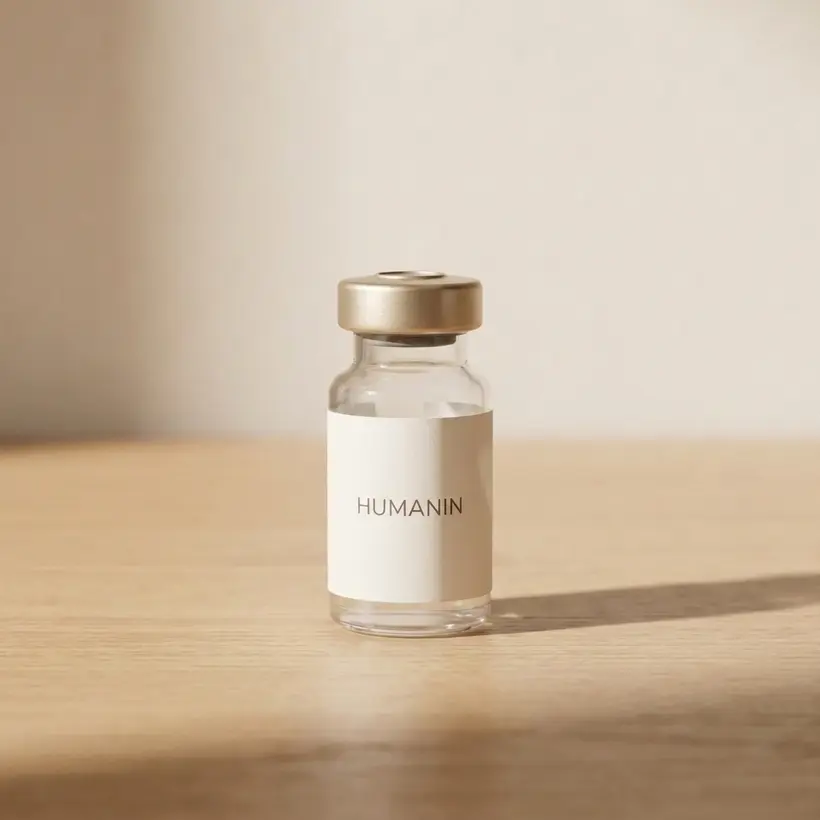
From the FormBlends catalog
Humanin
Mitochondria-derived peptide with broad cytoprotective effects · From $69/mo · compounded by a licensed 503A pharmacy, dispensed only after provider review.
Learn about Humanin →If you want the exact units for your own vial, the peptide calculator takes the vial size, the water you add and your dose, and returns the draw in units and millilitres, with a warning when the draw is too small to measure well.
Table of Contents
- What Is the Humanin Peptide Dosage Range Used in Research?
- Evidence Ledger: What Does the Data Actually Show?
- How Does Humanin Work? Mechanism With Specific Numbers
- What Most Pages Get Wrong About Humanin Dosage
- Why Oral Humanin Almost Certainly Does Not Work
- How to Read a Humanin COA and Reconstitution Math
- Humanin vs. Its Real Alternatives: Honest Head-to-Head
- Stability, Storage, and Formulation Gotchas
- Dosing Table: What Preclinical Literature Describes
- FAQ
- Sources
Evidence Ledger: What Does the Data Actually Show?
| Claim | Best Evidence Type | Effect Direction | Confidence |
|---|---|---|---|
| Humanin is neuroprotective in Alzheimer's cell models | Multiple in vitro studies, several rodent models | Protective | Moderate (animal/cell) |
| HNG is roughly 1000x more potent than native humanin in cell neuroprotection assays | Cell-based assay (Hashimoto et al., 2001) | Greater potency | Low (cell only) |
| Endogenous humanin levels decline with age in humans | Observational human cross-sectional studies (Yen et al., IGF-axis work) | Decline with age | Moderate (observational) |
| Humanin activates JAK2/STAT3 via gp130-containing receptor complex | Cell signaling studies, multiple labs | STAT3 activation confirmed | Moderate (mechanistic) |
| Exogenous humanin improves insulin sensitivity in rodent diabetes models | Rodent studies | Positive metabolic effect | Low (animal only) |
| Humanin extends lifespan or healthspan in humans | No human RCT evidence | Unknown | Very low (speculative) |
| Subcutaneous humanin is safe and well-tolerated in humans at any dose | No published human safety trial | Unknown | Very low |
| Humanin reduces amyloid-beta toxicity in rodent brain models | Multiple rodent studies | Reduction in toxicity markers | Low (animal) |
How Does Humanin Work? Mechanism With Specific Numbers
Humanin is a 21-amino-acid peptide (molecular weight approximately 2887 Da for native humanin) encoded by a small open reading frame within the 16S rRNA region of the mitochondrial genome. It circulates in human blood at concentrations reported in the low nanomolar range in young adults, with cross-sectional data suggesting a decline with advancing age.
Primary receptor complex: Humanin binds a trimeric receptor composed of CNTFR-alpha, WSX-1, and gp130. Binding to this complex activates JAK2, which phosphorylates STAT3. STAT3 then translocates to the nucleus and drives transcription of survival and anti-apoptotic genes. This pathway is well characterized in cell studies and consistent across multiple independent laboratories.
Additional binding partners: Humanin also interacts with IGFBP-3, blocking IGFBP-3-mediated apoptosis in cancer and neuronal cell models. It binds BAX directly in some cell systems, preventing mitochondrial outer membrane permeabilization. A third interaction with the formyl peptide receptor-like 1 (FPRL1) has been described in inflammatory contexts.
What this does NOT prove: Receptor activation in cell culture at nanomolar concentrations does not establish that exogenously administered humanin reaches target tissues at sufficient concentrations in a living human to replicate those effects. Bioavailability, tissue distribution, and target engagement after subcutaneous injection in humans are all uncharacterized.
HNG specifics: The Ser14Gly substitution in HNG appears to increase receptor binding affinity substantially. Hashimoto and colleagues reported roughly 1000-fold greater potency in neuronal cell death inhibition assays. This means 1 microgram of HNG is not equivalent to 1 microgram of native humanin, a point most dosing discussions online ignore entirely.
What Most Pages Get Wrong About Humanin Dosage
Most blogs and peptide vendor pages present specific numerical dosing protocols (often 2 mg to 4 mg subcutaneously per injection, several times per week) as if these figures come from clinical trials. They do not. These numbers originate from informal community extrapolation from rodent data or from vendor interest in providing a usable protocol. Presenting them as validated doses is misleading.
A second common error is treating humanin and HNG as equivalent and interchangeable at the same dose. Because HNG's reported potency in cell assays is orders of magnitude greater, naive dose equivalence assumptions are scientifically unsound.
Third, many pages assert that humanin is well-tolerated because "no side effects have been reported." The absence of reported adverse events in informal self-experimentation communities is not the same as a clean safety profile from controlled dose-escalation studies. Immunogenicity, effects on the gp130 signaling axis (which is broadly expressed across multiple tissue types), and long-term consequences are simply unstudied in humans.
Why Oral Humanin Almost Certainly Does Not Work
Humanin is an unmodified linear peptide. The gastrointestinal environment exposes any ingested peptide to multiple protease classes, including pepsin in the stomach and a range of pancreatic serine proteases and brush-border peptidases in the small intestine. A 21-amino-acid unprotected peptide would be expected to be cleaved to single amino acids and small dipeptides well before significant absorption can occur. This is not unique to humanin; it is the fundamental bioavailability problem shared by virtually all unmodified therapeutic peptides and the reason that insulin, GLP-1 agonists, and similar agents require injection or engineered oral formulations.
No enteric coating, nanoparticle encapsulation, or protease-resistant modification for oral humanin has been described in peer-reviewed literature. Oral humanin products are likely delivering amino acid fragments at best.
How to Read a Humanin COA and Reconstitution Math
What a credible COA must contain:
| Parameter | Minimum Acceptable Standard | Why It Matters |
|---|---|---|
| HPLC purity | Greater than 95% area | Confirms peptide is not predominantly impurities or truncated sequences |
| Mass spectrometry (MS) | Observed mass within 1 Da of theoretical (~2887 Da for native humanin) | Confirms the correct peptide was synthesized, not an analog or contaminant |
| Endotoxin (LAL test) | Below 1 EU/mg for injectable research use | Bacterial endotoxin from synthesis causes fever and inflammatory reactions |
| Peptide content (quantitative) | Reported as mg peptide, not mg lyophilized powder | Lyophilized powder contains water and counterions; true peptide content is typically 70% to 90% of gross weight |
Reconstitution math: If a vial is labeled "5 mg" and you reconstitute with 2.5 mL of bacteriostatic water, the resulting concentration is 2 mg/mL. A 0.5 mL draw delivers 1 mg. Always verify whether the label weight reflects peptide content or gross lyophilized weight. A 5 mg gross weight vial with 80% peptide content actually contains 4 mg of humanin peptide, changing all downstream dose calculations.
Humanin vs. Its Real Alternatives: Honest Head-to-Head
| Compound | Evidence Base | Human Clinical Data? | Route | Where Humanin Loses | Where Humanin Has Interest |
|---|---|---|---|---|---|
| Humanin | Cell and animal models; limited human observational | No RCTs | Subcutaneous (research) | No validated human dose, no safety data | Mitochondria-specific origin, multiple cell-death pathways |
| MOTS-c | Cell, animal, some early human metabolic data | Very limited; one small human study on exercise | Subcutaneous | Also lacks validated human dose | Stronger metabolic/exercise research signal than humanin |
| SS-31 (Elamipretide) | Animal strong; Phase II/III human trials in heart failure and Barth syndrome | Yes, Phase II/III data available | Subcutaneous | Humanin loses badly on clinical evidence depth | Humanin has broader CNS-relevant cell data |
| NAD+ precursors (NMN, NR) | Multiple human RCTs for NAD+ biomarker elevation | Yes, multiple small RCTs | Oral (NR/NMN) | Humanin has no comparable human trial body | Mechanistically distinct; different target biology |
| Semaglutide (GLP-1) | Large Phase III RCTs; FDA approved | Yes, extensive | Subcutaneous or oral | Humanin loses on every evidence dimension for metabolic endpoints | Humanin's CNS neuroprotection angle has no GLP-1 parallel |
Stability, Storage, and Formulation Gotchas
Why cold storage matters chemically: Peptides degrade primarily through hydrolysis (peptide bond cleavage, accelerated by heat and moisture) and oxidation (particularly at methionine, cysteine, or tryptophan residues). Humanin contains a methionine at position 1, making it susceptible to oxidation to methionine sulfoxide. This modification can reduce or abolish biological activity without changing the peptide's appearance or gross weight. Storing lyophilized humanin at minus 20 degrees Celsius substantially slows both hydrolysis and oxidative degradation by reducing molecular mobility and water activity.
Reconstitution solvent choice: Bacteriostatic water (0.9% benzyl alcohol) is preferred for multi-dose vials because benzyl alcohol provides antimicrobial protection. Sterile water without preservative should be used for single-dose preparations only. Acetic acid solutions (0.1% to 1%) are sometimes used for peptides that aggregate at neutral pH, though humanin-specific aggregation behavior in solution is not extensively published.
Freeze-thaw cycles: Each freeze-thaw cycle promotes aggregation in peptide solutions by exposing hydrophobic residues as the ice lattice forms and breaks. Aggregated peptide may retain partial mass but loses receptor binding activity. Aliquoting into single-use volumes before freezing is a standard mitigation.
What degraded product looks like: In solution, aggregated or oxidized humanin may appear as cloudiness or visible particulates. Lyophilized degraded product is often indistinguishable visually from intact peptide, which is why COA mass confirmation matters, not just visual inspection.
Dosing Table: What Preclinical Literature Describes
This table summarizes dose ranges described in published animal research. These are NOT human dosing recommendations. They are provided for scientific literacy only.
| Model | Route | Dose Range Reported | Endpoint Studied | Evidence Grade |
|---|---|---|---|---|
| Rodent Alzheimer's models | Intracerebroventricular, intraperitoneal | Micrograms to low mg/kg range | Neuronal survival, amyloid-beta toxicity | Low (animal) |
| Rodent ischemia models | Intraperitoneal | Low mg/kg range | Cell death markers | Low (animal) |
| Rodent diabetes/metabolic models | Subcutaneous, intraperitoneal | Low to moderate mg/kg range | Insulin sensitivity, beta-cell survival | Low (animal) |
| Cell culture (in vitro) | Media addition | Picomolar to nanomolar (native); femtomolar to picomolar (HNG) | Cell survival, apoptosis inhibition | Low (cell only) |
FAQ
What is the typical humanin peptide dosage used in research?
Animal studies have used doses ranging from roughly 0.1 mg/kg to 10 mg/kg depending on the route and model. The few published human-relevant data points involve endogenous circulating levels in the low nanomolar range, not exogenous dosing. No validated human clinical dosing protocol exists yet.
Is humanin safe for human use at research doses?
Formal human safety trials are absent. Rodent studies have not flagged acute toxicity at moderate doses, but chronic safety, immunogenicity, and off-target effects in humans are unknown. Treating animal-derived tolerability data as human safety confirmation is a significant logical error.
What route of administration is used for humanin?
Preclinical research has used intracerebroventricular, intraperitoneal, subcutaneous, and intranasal routes. Subcutaneous is the most commonly discussed for systemic delivery. Oral bioavailability is expected to be negligible due to protease degradation in the gut.
How long does humanin stay active in the body?
Humanin is a 21-amino-acid peptide with no published validated half-life data from human pharmacokinetic studies. Peptides of this size are typically cleared within minutes to hours. The analog HNG has modestly improved potency in cell studies but its human pharmacokinetics remain unpublished.
What is HNG and how does it differ from native humanin?
HNG (Gly14-Humanin) is a synthetic analog where serine at position 14 is replaced by glycine. Cell-based studies report roughly 1000-fold greater neuroprotective potency versus native humanin in some assays. Whether this translates to proportionally greater efficacy or safety in humans is unproven.
Does humanin work orally?
Almost certainly not at therapeutic levels. As an unmodified 21-amino-acid peptide, humanin would be degraded by gastrointestinal proteases before meaningful absorption. No enteric-coated or modified oral formulation has been validated in published literature.
What are the proposed mechanisms of humanin?
Humanin binds the trimeric CNTFR-alpha/WSX-1/gp130 receptor complex to activate JAK/STAT3 signaling. It also interacts with IGFBP-3, BAX, and FPRL1/FMLP receptors. These mechanisms are established in cell and animal models; their clinical relevance in humans is not yet confirmed.
How should humanin peptide be stored?
Lyophilized humanin should be stored at minus 20 degrees Celsius or colder, protected from light and moisture. Once reconstituted in bacteriostatic water, use within a short window (typically within 2 to 4 weeks when refrigerated) and avoid repeated freeze-thaw cycles, which can promote aggregation and oxidation.
How do I read a humanin COA?
A credible COA should show purity above 95% by HPLC, mass confirmation by MS matching the molecular weight of approximately 2887 Da for native humanin, and ideally endotoxin testing below 1 EU/mg for injectable use. Single-method purity claims without MS confirmation are insufficient.
Is humanin the same as MOTS-c?
No. Both are mitochondria-derived peptides encoded in mitochondrial DNA, but they are distinct peptides with different sequences, receptors, and primary research areas. MOTS-c (16 amino acids) has a stronger body of metabolic and exercise research than humanin.
What conditions has humanin been studied for?
Preclinical research has examined humanin in models of Alzheimer's disease, ischemia, diabetes-related cell death, and aging. Human clinical trials are either absent or in very early phases. No condition currently has a humanin-based approved therapy.
Where does humanin come from naturally?
Humanin is encoded by a small open reading frame within the 16S ribosomal RNA region of the mitochondrial genome. It is produced by mitochondria and circulates at low nanomolar concentrations in blood. Levels are reported to decline with age in observational studies.
Sources
- Hashimoto Y, Niikura T, Tajima H, et al. A rescue factor abolishing neuronal cell death by a wide spectrum of familial Alzheimer's disease genes and Abeta. Proceedings of the National Academy of Sciences. 2001;98(11):6336-6341.
- Yen K, Mehta HH, Kim SJ, et al. The mitochondrial derived peptide humanin is a regulator of lifespan and healthspan. Aging (Albany NY). 2020;12(12):11185-11199.
- Lee C, Yen K, Cohen P. Humanin: a harbinger of mitochondrial-derived peptides? Trends in Endocrinology and Metabolism. 2013;24(5):222-228.
- Guo B, Zhai D, Cabezas E, et al. Humanin peptide suppresses apoptosis by interfering with Bax activation. Nature. 2003;423(6938):456-461.
- Muzumdar RH, Huffman DM, Atzmon G, et al. Humanin: a novel central regulator of peripheral insulin action. PLoS ONE. 2009;4(7):e6334.
- Kim SJ, Xiao J, Wan J, Cohen P, Yen K. Mitochondria-derived peptides as novel regulators of metabolism. Journal of Physiology. 2017;595(21):6613-6621.
- Tajima H, Niikura T, Hashimoto Y, et al. Evidence for in vivo production of Humanin peptide, a neuroprotective factor against Alzheimer's disease-related insults. Neuroscience Letters. 2002;324(3):227-231.
- Sreekumar PG, Ishikawa K, Spee C, et al. The mitochondrial-derived peptide humanin protects RPE cells from oxidative stress, senescence, and mitochondrial dysfunction. Investigative Ophthalmology and Visual Science. 2016;57(3):1238-1253.
Footer Disclaimers
Related peptide guides
Ready when you are
Humanin
Mitochondria-derived peptide with broad cytoprotective effects · From $69/mo · compounded by a licensed 503A pharmacy, dispensed only after provider review.
Learn about Humanin →