
Trust signals
> Written by the FormBlends Medical Content Team · Fact-checked against cited primary sources · Last updated May 2026
Why SS-31 divides the peptide community
SS-31 occupies a strange position in peptide therapeutics. On one hand, it offers some of the most elegant mitochondrial biology published in major journals. The cardiolipin binding mechanism has been validated through crystallography, NMR studies, and functional assays. Major pharmaceutical investment from Stealth BioTherapeutics pushed it through multiple clinical trials.
On the other hand, the peptide's track record reveals a pattern of near-misses and outright failures. The EMBRACE trial for mitochondrial myopathy barely missed statistical significance. The TAZPOWER trial for Barth syndrome failed completely despite strong mechanistic rationale. At current pricing, a month's supply costs more than many used cars.
This creates a peculiar dynamic where academic researchers remain enthusiastic while clinicians grow skeptical and patients face impossible economics. Understanding SS-31 means reconciling these contradictions.
The molecular machinery: beyond basic binding
SS-31's interaction with cardiolipin involves more than simple electrostatic attraction. The peptide's D-arginine and lysine residues create a positively charged face that recognizes cardiolipin's unique double phosphatidylglycerol structure. But the real sophistication comes from induced conformational changes.
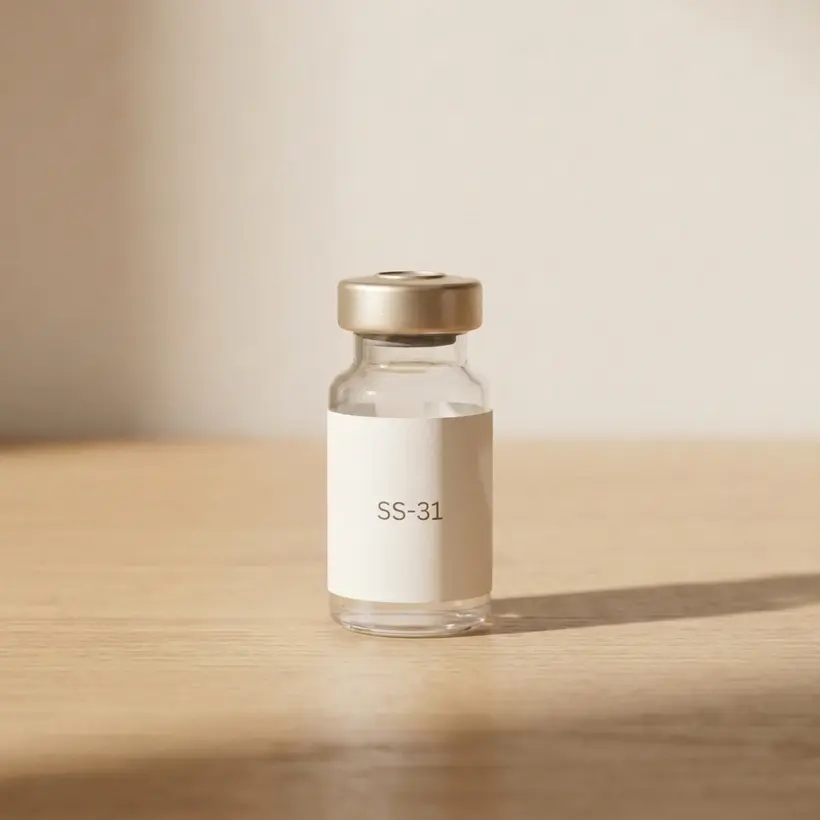
From the FormBlends catalog
SS-31 (Elamipretide)
Mitochondria-targeted peptide that restores cellular energy production · From $79/mo · compounded by a licensed 503A pharmacy, dispensed only after provider review.
Learn about SS-31 (Elamipretide) →Upon binding, SS-31 causes cardiolipin to adopt a more ordered configuration. This prevents the lipid from flipping between membrane leaflets, a process that normally exposes cardiolipin to cytochrome c on the wrong side of the membrane. When cytochrome c binds externalized cardiolipin, it transforms from electron carrier to peroxidase, generating reactive oxygen species that trigger apoptosis.
The 2',6'-dimethyltyrosine residue serves dual purposes. Its bulky methyl groups provide steric protection against oxidation while creating hydrophobic contacts that anchor the peptide within the membrane. Unlike standard tyrosine which readily forms dityrosine crosslinks under oxidative stress, Dmt remains stable.
Biophysical studies using 31P-NMR show SS-31 increases the phase transition temperature of cardiolipin-containing membranes by 3 to 5 degrees Celsius. This seemingly modest change profoundly affects protein complex assembly. Respiratory supercomplexes containing complexes I, III, and IV form more readily and remain stable longer.
Clinical evidence: parsing success from failure
| Trial | N | Condition | Dose | Duration | Primary Outcome |
|---|---|---|---|---|---|
| EMBRACE | 218 | Mitochondrial myopathy | 40mg SC daily | 24 weeks | 6MWD: +27m (p=0.064) |
| Cardiac PCI | 56 | Coronary intervention | 0.05mg/kg/hr IV | Single dose | Troponin: -42% (p=0.03) |
| TAZPOWER | 12 | Barth syndrome | 40mg SC daily | 48 weeks | Failed (no benefit) |
| AKI prevention | 90 | Cardiac surgery | 0.05mg/kg/hr IV | Perioperative | Creatinine: -0.3mg/dL (p=0.04) |
The cardiac protection studies show the clearest benefits. During percutaneous coronary intervention or cardiac surgery, SS-31 reduces biomarkers of cellular injury. This makes mechanistic sense since ischemia-reperfusion directly damages cardiolipin. The peptide prevents this acute injury cascade.
Chronic disease trials tell a different story. While EMBRACE showed trends toward improvement, it failed to reach predetermined significance thresholds. Post-hoc analyses revealed certain subgroups responded better, particularly those with specific mitochondrial DNA mutations affecting complex I.
The Barth syndrome failure stings most. These patients have genetic cardiolipin deficiency, seemingly perfect targets for SS-31. Yet no clinical benefit emerged. Possible explanations include irreversible structural changes from lifelong cardiolipin abnormalities or compensation mechanisms that bypass SS-31's effects.
Underground experiences: patterns in the noise
Despite prohibitive costs, a dedicated subset of users experiment with research-grade SS-31. Online communities document experiences with unusual thoroughness, perhaps because the financial investment demands careful attention to any effects.
Common themes emerge from aggregated reports. Users with diagnosed mitochondrial conditions report more consistent benefits than healthy biohackers. Chronic fatigue syndrome patients describe gradual improvements in exercise tolerance over 4 to 8 weeks. Post-viral fatigue sufferers note reduced "crashes" after exertion.
Healthy athletes seeking performance gains report disappointment. Even those who can afford sustained use find minimal objective improvements. One ultramarathoner documented lactate threshold, VO2 max, and race times over 12 weeks of SS-31 use, showing no meaningful changes despite $8,000 spent.
Subjective energy improvements appear most consistently in users over age 50. Several report feeling "younger" in terms of daily energy patterns, though this remains entirely anecdotal. The placebo effect from such expensive interventions cannot be dismissed.
Side effects remain minimal across reports. Injection site reactions occur given the large volume. Some users describe initial fatigue lasting 3 to 5 days before improvements begin. No serious adverse events appear in community discussions, aligning with clinical trial safety data.
The brutal economics of boutique peptides
SS-31's cost structure differs fundamentally from typical peptides. Most therapeutic peptides use standard L-amino acids assembled through automated synthesis. SS-31 requires custom building blocks and manual optimization.
The D-arginine costs roughly 10 times more than L-arginine due to limited demand and complex synthesis. But 2',6'-dimethyltyrosine represents the real bottleneck. No major chemical suppliers stock this modified amino acid. Each batch requires custom synthesis starting from L-tyrosine, adding methyl groups through a multi-step process yielding only 20 to 30% of theoretical maximum.
Peptide assembly itself proceeds slowly. The bulky Dmt residue couples inefficiently, requiring extended reaction times and excess activating reagents. Each failed coupling reduces final yield and purity. Where standard peptides might achieve 50 to 60% crude yield, SS-31 rarely exceeds 30%.
Purification demands multiple HPLC runs. The similar hydrophobicity of deletion sequences and desired product necessitates careful gradient optimization. A single kilogram-scale synthesis might require 20 to 30 preparative HPLC runs over several days.
These factors compound into pricing that puts SS-31 beyond reach for most applications. At $5,000 to $10,000 per gram for research grade, monthly costs rival mortgage payments. Clinical-grade material with full documentation costs even more.
Technical deep dive: stability and formulation
SS-31's stability profile creates unique handling requirements. The peptide arrives lyophilized with residual trifluoroacetic acid from purification. This acidic environment helps prevent oxidation but can cause injection site irritation if not properly buffered during reconstitution.
Reconstitution requires careful technique. Adding bacteriostatic water too quickly causes foaming that denatures the peptide through air-liquid interface stress. The high concentration needed for practical injection volumes (10mg/mL) approaches solubility limits. Some batches require gentle warming to fully dissolve.
Once reconstituted, degradation follows predictable patterns. The Dmt residue resists oxidation better than standard tyrosine but still degrades over time. Aggregation represents a bigger concern. High peptide concentration promotes intermolecular interactions leading to soluble oligomers and eventually visible precipitates.
Storage temperature critically affects stability. Refrigeration slows chemical degradation but may accelerate physical aggregation. Some users report better stability dividing doses into multiple vials to minimize repeated temperature cycling. Published stability data often reflects ideal conditions rather than real-world handling.
The 4mL daily injection volume poses practical challenges. Subcutaneous tissue can only absorb limited volumes comfortably. Splitting into multiple smaller injections improves tolerance but increases contamination risk and handling complexity. Intramuscular injection absorbs larger volumes but may alter pharmacokinetics.
What SS-31 teaches about translational failure
SS-31's journey from bench to bedside illustrates why most promising preclinical discoveries fail in humans. The peptide works beautifully in isolated mitochondria, cultured cells, and animal models of acute injury. It fails in chronic human disease.
This disconnect stems from fundamental differences between model systems and human pathophysiology. Acute cardiolipin damage from ischemia-reperfusion responds to SS-31 because the intervention matches the insult timing. Chronic mitochondrial diseases involve complex adaptations, secondary pathologies, and irreversible changes that no single intervention can reverse.
Patient heterogeneity compounds the challenge. "Mitochondrial disease" encompasses hundreds of different genetic defects with varying biochemical consequences. Some affect cardiolipin directly, others indirectly, many not at all. Without biomarkers to identify likely responders, trials recruit mixed populations diluting any real effect.
The pharmaceutical industry's focus on single-target interventions may fundamentally mismatch mitochondrial disease complexity. These conditions affect multiple pathways requiring combination approaches. Yet regulatory frameworks and business models favor single-drug development.
SS-31 remains scientifically fascinating and clinically frustrating. It perfectly illustrates both the promise and limitations of targeted mitochondrial therapeutics.
FAQ
What is SS-31 peptide? SS-31 (elamipretide) is a tetrapeptide (D-Arg-Dmt-Lys-Phe-NH2) that selectively binds cardiolipin in the inner mitochondrial membrane, stabilizing cristae structure and improving ATP production.
Does SS-31 actually improve athletic performance? Human studies show improved 6-minute walk distance in mitochondrial disease patients but no published data exists for healthy athletes. The 40mg daily dose used clinically costs approximately $200-400 per day.
What are proven SS-31 benefits? Phase 2 trials demonstrate reduced cardiac troponin release during ischemia, improved kidney function in CKD patients, and increased exercise capacity in primary mitochondrial myopathy.
How do you dose SS-31 peptide? Clinical trials use 0.25-40mg daily subcutaneous injection. The 40mg dose requires reconstitution to 10mg/mL using bacteriostatic water, administered as 4mL injection volume.
Why is SS-31 so expensive compared to other peptides? The D-arginine and 2',6'-dimethyltyrosine (Dmt) residues require specialized synthesis. Clinical-grade material costs $5,000-10,000 per gram versus $200-500 for standard peptides.
Can SS-31 cross the blood-brain barrier? Studies indicate minimal CNS penetration. The positive charge and 640 Da molecular weight limit passive diffusion across the BBB.
What's the difference between SS-31 and MTP-131? SS-31 and MTP-131 are identical names for elamipretide. Stealth BioTherapeutics uses MTP-131 in publications while SS-31 appears in earlier Szeto-Schiller peptide literature.
Does SS-31 require cycling or PCT? No hormonal effects documented. Phase 2 trials ran 28-48 weeks continuous dosing without cycling. The peptide does not interact with androgen or growth hormone pathways.
Can you stack SS-31 with other mitochondrial peptides? No interaction studies exist with MOTS-c or humanin. Different mechanisms suggest possible synergy but combined use remains untested in humans.
How quickly does SS-31 degrade after reconstitution? Published data suggests good stability under refrigeration for approximately two weeks when reconstituted in bacteriostatic water. The Dmt residue provides oxidation resistance unlike standard tyrosine.
Sources
- Karaa A, et al. Randomized dose-escalation trial of elamipretide in adults with primary mitochondrial myopathy. Neurology. 2018;90(14):e1212-e1221.
- Daubert MA, et al. Novel mitochondria-targeting peptide in heart failure treatment: a randomized, placebo-controlled trial of elamipretide. Circ Heart Fail. 2017;10(12):e004389.
- Szeto HH. First-in-class cardiolipin-protective compound as a therapeutic agent to restore mitochondrial bioenergetics. Br J Pharmacol. 2014;171(8):2029-2050.
- Birk AV, et al. The mitochondrial-targeted compound SS-31 re-energizes ischemic mitochondria by interacting with cardiolipin. J Am Soc Nephrol. 2013;24(8):1250-1261.
- ClinicalTrials.gov. A Study to Evaluate Safety and Efficacy of Elamipretide in Subjects With Barth Syndrome (TAZPOWER). NCT03098797.
- Zhao K, et al. Cell-permeable peptide antioxidants targeted to inner mitochondrial membrane inhibit mitochondrial swelling, oxidative cell death, and reperfusion injury. J Biol Chem. 2004;279(33):34682-34690.
- FDA Office of Orphan Products Development. Elamipretide orphan drug designations. 2020.
- Mitchell W, et al. The mitochondria-targeted peptide SS-31 binds lipid bilayers and modulates surface electrostatics as a key component of its mechanism of action. J Biol Chem. 2020;295(21):7452-7469.
Related peptide guides
Footer disclaimers
Platform Access: Peptide protocols and calculators are for FormBlends members only.
Research Compound: SS-31 is not approved by the FDA for human use. It is available for research purposes only.
Medical Disclaimer: Information provided is for educational purposes only. Consult a healthcare provider before starting any peptide protocol.
Results Disclaimer: Individual results may vary. No therapeutic claims are made.
Trademark: SS-31 is associated with research identifiers. Elamipretide and MTP-131 are investigational names used by Stealth BioTherapeutics.
Ready when you are
SS-31 (Elamipretide)
Mitochondria-targeted peptide that restores cellular energy production · From $79/mo · compounded by a licensed 503A pharmacy, dispensed only after provider review.
Learn about SS-31 (Elamipretide) →