
Trust signals
Reviewed against the Egrifta SV (tesamorelin) prescribing information (Theratechnologies, FDA-approved labeling), USP guidelines on sterile compounding, and primary pharmacokinetic literature. Last updated 2026-05-29. This page does not constitute medical advice.Key Takeaways
- The FDA-approved Egrifta SV protocol injects 2.2 mL sterile water diluent into a 2 mg vial to yield approximately 0.9 mg/mL; the first 0.5 mL draw is discarded, and the remaining 1.8 mL delivers 1.8 mg (close to the 2 mg dose after accounting for residual volume).
- Reconstituted tesamorelin must be refrigerated at 2 to 8 degrees Celsius and, per the branded labeling, used within 24 hours; bacteriostatic water may extend research-grade stability but formal third-party data on compounded versions is sparse.
- Rolling, not shaking, is mandatory because mechanical shear disrupts the alpha-helical structure required for GHRH receptor binding.
- Never freeze reconstituted tesamorelin; ice crystal formation physically cleaves the 44-amino-acid chain, producing inactive fragments.
- Tesamorelin is the only FDA-approved GHRH analog for any indication; all other sources are research compounds or compounded preparations with variable purity.
Direct answer: how do you reconstitute tesamorelin?
Inject the supplied sterile water diluent slowly down the inside wall of a 2 mg lyophilized tesamorelin vial, roll gently until clear, draw the solution, and inject subcutaneously into the abdomen within 24 hours. Never shake. Keep refrigerated after mixing. The entire process takes under three minutes once supplies are assembled.Table of Contents
- What is tesamorelin and why does reconstitution matter?
- What supplies do you need before reconstituting tesamorelin?
- Step-by-step tesamorelin reconstitution instructions
- Tesamorelin storage after reconstitution: the exact rules
- How tesamorelin works: mechanism with specific numbers
- Evidence ledger: what the data actually shows
- What most reconstitution pages get wrong
- Honest head-to-head: tesamorelin vs. alternatives
- Label and COA literacy: how to judge your vial
- FAQ
- Sources
- Footer disclaimers
What is tesamorelin and why does reconstitution matter?
Tesamorelin is a synthetic analog of endogenous growth hormone-releasing hormone (GHRH 1-44). Its chemical modification, a trans-3-hexenoic acid group added to the N-terminus of the native 44-amino-acid GHRH sequence, stabilizes the molecule against dipeptidyl peptidase IV (DPP-IV) cleavage at the Tyr1-Ala2 bond, meaningfully extending plasma half-life relative to unmodified GHRH. The FDA approved it in 2010 under the brand name Egrifta (later reformulated as Egrifta SV) for reduction of excess abdominal fat in adults with HIV-associated lipodystrophy.
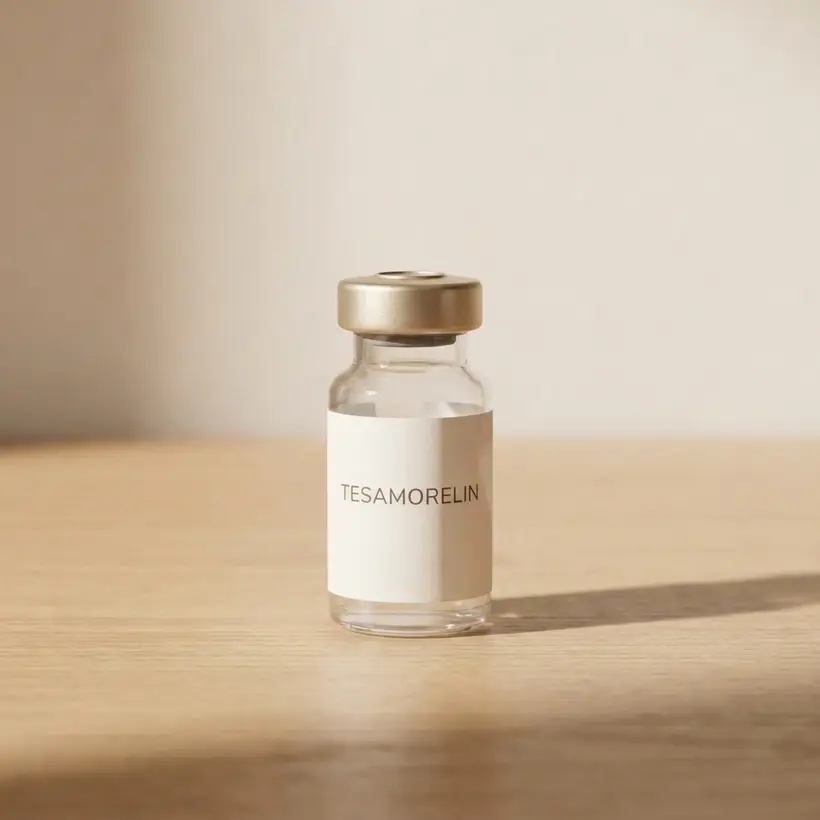
From the FormBlends catalog
Tesamorelin
GHRH analog studied for visceral-fat reduction; the molecule was approved as Egrifta · From $249/mo · compounded by a licensed 503A pharmacy, dispensed only after provider review.
View Tesamorelin →Because tesamorelin is a polypeptide with a molecular weight of approximately 5,135 daltons, it cannot be formulated as an oral tablet; stomach acid and peptidases hydrolyze it before absorption. It is therefore supplied as a lyophilized (freeze-dried) powder that must be reconstituted immediately before subcutaneous injection. Getting reconstitution wrong, whether by using the wrong diluent, shaking instead of rolling, or storing improperly, directly impairs bioactivity.
What supplies do you need before reconstituting tesamorelin?
For the branded Egrifta SV kit, all critical components are supplied. For research-grade or compounded vials, you must assemble them yourself.
| Item | Branded Egrifta SV | Research or compounded vial |
|---|---|---|
| Tesamorelin lyophilized vial | Supplied (2 mg) | Purchased separately; confirm mg labeling |
| Diluent | Sterile water for injection vial (supplied) | Bacteriostatic water for injection (recommended); bacteriostatic saline is suboptimal |
| Syringe for reconstitution | Supplied | 3 mL luer-lock syringe |
| Injection syringe | Supplied (1 mL) | 1 mL insulin syringe, 28 to 31 gauge, 1/2 inch needle |
| Alcohol swabs | Not supplied; obtain separately | Obtain separately |
| Sharps container | Not supplied | Required for safe disposal |
Step-by-step tesamorelin reconstitution instructions
-
Step 1: Prepare your workspace Wash hands thoroughly with soap for at least 20 seconds. Wipe a clean, hard surface with an alcohol swab. Gather all supplies before opening anything.
-
Step 2: Swab the vial stoppers Wipe the rubber stopper of both the tesamorelin vial and the diluent vial with a fresh alcohol swab. Allow to air-dry for 10 to 15 seconds. Do not blow on them or wave to speed drying; introduce no new contamination.
-
Step 3: Draw the diluent For Egrifta SV: use the supplied diluent syringe. For research vials targeting a 1 mg/mL concentration: draw 1 mL of bacteriostatic water per 1 mg of peptide. For a 2 mg/mL concentration: draw 1 mL per 2 mg. Write your target concentration on the vial with a permanent marker before you start so there is no confusion later.
-
Step 4: Inject diluent along the vial wall, not directly onto the powder Insert the needle at an angle so the tip points toward the glass wall of the tesamorelin vial. Depress the plunger slowly. Directing the stream at the lyophilized cake causes foaming. The liquid should run down the inside of the glass and pool at the bottom beneath the powder cake.
-
Step 5: Roll, do not shake Hold the vial horizontally between both palms and roll gently for 15 to 30 seconds, or swirl very slowly in a circular motion. The lyophilized cake typically dissolves within 30 to 60 seconds. If any undissolved material remains after two minutes of gentle rolling, the vial may be compromised; do not inject cloudy or particulate solutions.
-
Step 6: Inspect the solution Hold the vial against a white background and a light source. A correctly reconstituted solution is clear and colorless (or very faintly yellow for some formulations). Discard if you see: cloudiness, visible particles, flakes, or brown or orange discoloration.
-
Step 7: Draw the injection dose For Egrifta SV: the prescribing information directs drawing 2 mL into the injection syringe, then pushing 0.2 mL out (discarding), leaving 1.8 mL (approximately 1.8 mg given the 0.9 mg/mL concentration). For research vials at 1 mg/mL: draw the volume corresponding to your intended dose (e.g., 1 mL for 1 mg, 2 mL for 2 mg).
-
Step 8: Subcutaneous abdominal injection Pinch an inch of abdominal skin lateral to the navel. Insert the needle at 45 to 90 degrees depending on subcutaneous fat depth. Inject slowly. Withdraw the needle and apply gentle pressure with a clean swab. Do not rub. Rotate injection sites within the periumbilical ring at each administration to minimize lipohypertrophy.
Tesamorelin storage after reconstitution: the exact rules
| State | Temperature | Maximum duration | Source/basis |
|---|---|---|---|
| Lyophilized, sealed vial | Room temperature, up to 25 degrees C (77 F) | Until expiration date on label | Egrifta SV prescribing information |
| Lyophilized, sealed vial (alternative) | 2 to 8 degrees C (refrigerator) | Until expiration date | Egrifta SV prescribing information |
| Reconstituted with supplied sterile water | 2 to 8 degrees C (refrigerator) | 24 hours | Egrifta SV prescribing information |
| Reconstituted with bacteriostatic water (research/compounded) | 2 to 8 degrees C (refrigerator) | Commonly cited as up to 28 days; formal stability data for compounded versions is limited | Compounding practice convention; not FDA-validated for tesamorelin |
| Reconstituted, any form | Frozen (below 0 degrees C) | Do not freeze | Egrifta SV prescribing information; physical chemistry of peptide aggregation |
Why 24 hours for the branded product? The sterile water supplied with Egrifta SV contains no antimicrobial preservative. Without benzyl alcohol or another preservative, a single vial puncture introduces a sterility risk, and the peptide itself has limited hydrolytic stability in aqueous solution at any temperature above freezing. The 24-hour window is a conservative but scientifically justified limit for a preservative-free formulation.
Why the 28-day convention with bacteriostatic water? Benzyl alcohol at 0.9% inhibits microbial growth, addressing the sterility concern over multiple draws. However, peptide chemical stability (hydrolysis and deamidation of susceptible residues) continues independent of microbial concerns. The 28-day figure is widely used in peptide compounding practice but is extrapolated from general GHRH peptide behavior, not from published tesamorelin-specific stability assays at those conditions. Treat it as a practical maximum, not a guarantee.
How tesamorelin works: mechanism with specific numbers
Tesamorelin binds the pituitary GHRH receptor (GHRHR), a class B G-protein-coupled receptor. Binding activates adenylate cyclase, raises intracellular cAMP, and triggers pulsatile GH secretion from somatotroph cells. The downstream IGF-1 elevation drives lipolysis in visceral adipocytes.
In the pivotal Phase 3 trials supporting FDA approval (Falutz et al., NEJM 2007 and two subsequent confirmatory trials), tesamorelin 2 mg/day produced a statistically significant reduction in visceral adipose tissue (VAT) measured by CT scan at 26 weeks: the mean VAT reduction was approximately 18% compared to placebo, with a between-group difference of roughly 49 cm2 in the primary trial (n=412 in pooled analysis). IGF-1 levels increased roughly 80 to 100% from baseline in treated subjects.
Plasma half-life of tesamorelin after subcutaneous injection is approximately 26 to 38 minutes (range across studies), substantially longer than native GHRH (which is cleaved within 2 to 5 minutes by DPP-IV in plasma). The trans-3-hexenoic acid modification blocks DPP-IV at the Tyr1-Ala2 bond, which is where endogenous GHRH is rapidly inactivated.
What the mechanism does NOT prove: Pulsatile GH elevation in healthy, non-lipodystrophic subjects has not been shown in RCTs to produce clinically meaningful changes in body composition, performance, or longevity. The VAT reduction evidence exists specifically in HIV-associated lipodystrophy. Extrapolation to general anti-aging or performance use is mechanistically plausible but evidentiary unsupported at the RCT level.
Evidence ledger: what the data actually shows
| Claim | Best evidence type | Effect direction | Confidence |
|---|---|---|---|
| Tesamorelin 2 mg/day reduces VAT in HIV-associated lipodystrophy | Human RCT (Phase 3, n over 400 pooled, Falutz et al.) | Positive, approximately 18% VAT reduction vs. placebo | High |
| Tesamorelin raises IGF-1 in treated subjects | Human RCT | Positive, roughly 80 to 100% increase from baseline | High |
| Trans-3-hexenoic acid modification extends half-life vs. native GHRH | Human PK study | Positive (half-life roughly 26 to 38 min vs. 2 to 5 min for native GHRH) | High |
| Tesamorelin improves body composition in non-HIV, non-lipodystrophic adults | Small human studies and one RCT in abdominal obesity (Stanley et al., JCEM 2012) | Modest positive for VAT; effect magnitude smaller than in lipodystrophy population | Moderate |
| Tesamorelin improves cognitive function | Small RCT in older adults (Baker et al., Neurology, single site) | Positive trend for executive function; exploratory | Low |
| Bacteriostatic water extends reconstituted stability to 28 days | Compounding convention; no published tesamorelin-specific assay | Directionally plausible | Very low |
| Tesamorelin reduces all-cause mortality or extends lifespan | No human data | Unknown | Very low |
What most reconstitution pages get wrong
Most guides copy the instruction "use bacteriostatic water" without explaining what bacteriostatic water actually does, why it matters, or where it fails. Here are the four things commodity pages consistently miss.
1. They conflate sterility preservation with chemical stability. Benzyl alcohol prevents microbial growth. It does not stop peptide hydrolysis. Tesamorelin, like all GHRH analogs, undergoes slow deamidation at asparagine residues and hydrolysis at peptide bonds over time in aqueous solution. At refrigerator temperature (4 degrees C) this is slow but not zero. "Up to 28 days" is a microbial safety window, not a potency guarantee.
2. They recommend bacteriostatic saline. Sodium chloride solutions are mildly acidic and introduce chloride ions that can catalyze oxidation at methionine or tryptophan residues in some peptides. Tesamorelin does not contain tryptophan, but its susceptibility to saline-related degradation has not been formally excluded. The Egrifta SV kit uses non-saline diluent, and bacteriostatic water is the safer parallel for research use.
3. They ignore concentration math. If you add 2 mL to a 2 mg vial, you get 1 mg/mL. If you add 1 mL to a 2 mg vial, you get 2 mg/mL. Neither is wrong; what matters is that you know your concentration before you draw up a dose, because a 2x error in concentration is a 2x error in dose. Write the concentration and date on every vial before the cap goes back on.
4. They skip the freeze warning for reconstituted solution. Multiple research forums recommend freezing reconstituted peptides for "long-term storage." For tesamorelin this is counterproductive. Ice crystal formation during freezing disrupts the tertiary structure and can physically sever the peptide chain at conformationally stressed bonds. The branded prescribing information explicitly prohibits freezing the reconstituted product. Use fresh vials for truly long-term storage; keep lyophilized powder, not reconstituted solution, in the freezer if needed.
Honest head-to-head: tesamorelin vs. alternatives for visceral fat or GH axis effects
| Agent | Mechanism | Strongest evidence | Key advantage vs. tesamorelin | Where tesamorelin wins |
|---|---|---|---|---|
| Tesamorelin (Egrifta SV) | GHRH analog, pituitary GH release | Phase 3 RCT in HIV lipodystrophy (FDA-approved) | None in its approved indication | Only approved GHRH analog; pulsatile GH; preserves GH feedback axis |
| Sermorelin | GHRH 1-29 analog | Smaller studies, no Phase 3 RCT for lipodystrophy | Lower cost, widely compounded | Tesamorelin has longer half-life, stronger efficacy data |
| CJC-1295 | GHRH analog (DAC modification) | Small human PK studies only | Once-weekly or biweekly dosing theoretically possible due to longer half-life | Tesamorelin has RCT data; CJC-1295 has no Phase 3 human efficacy trials |
| Ipamorelin (GHRP) | Ghrelin receptor agonist, GH release | Phase 1 studies; no Phase 3 efficacy RCTs | Can be combined with GHRH analogs for additive GH pulse; oral analogs in development | Tesamorelin has regulatory approval and larger dataset |
| Recombinant human GH (somatropin) | Direct GH receptor agonist | Multiple large RCTs across indications | Predictable supraphysiologic dosing; approved for multiple indications including lipodystrophy | Tesamorelin maintains feedback regulation; lower theoretical IGF-1 overshoot risk; lower risk of suppressing endogenous GH axis |
| GLP-1 receptor agonists (semaglutide) | Incretin axis, appetite reduction | Multiple large Phase 3 RCTs for obesity | Far larger evidence base for overall and visceral fat reduction; oral option available | Tesamorelin does not suppress appetite or cause GI side effects; different mechanism entirely |
Honest verdict: For visceral fat reduction in a non-HIV general obesity population, the evidence base for GLP-1 receptor agonists substantially exceeds that for tesamorelin. Tesamorelin's niche is GH-axis stimulation with preserved feedback regulation. Recommending it over semaglutide for general weight loss is not supported by comparative evidence.
Label and COA literacy: how to judge your vial
If you are working with a research-grade or compounded tesamorelin vial (not the branded Egrifta SV kit), the following checklist helps you assess quality before reconstitution.
| What to check | What it means | Red flag |
|---|---|---|
| Stated purity on COA | HPLC purity expressed as a percentage; reputable suppliers report above 98% | No purity figure, or purity listed as "by appearance" only |
| Molecular weight confirmation | Mass spectrometry (MS) data confirming the molecular ion matches tesamorelin (approximately 5,135 Da) | No MS data; MW reported as "theoretical" with no actual measurement |
| Endotoxin (LAL) test result | Endotoxin below 1 EU/mg is required for injectable-grade material; higher levels cause pyrogenic reactions | No endotoxin testing listed; result above 1 EU/mg |
| Amino acid analysis | Confirms correct sequence; detects truncation or substitution errors in synthesis | Absent; especially important for a 44-amino-acid peptide where synthesis errors are more common than in shorter peptides |
| Manufacturer identity | GMP or research-grade facility with an auditable address; check if they will provide the full COA on request, not just a summary | No facility address, no batch number, COA provided only as a generic template |
| Vial appearance before reconstitution | White to off-white lyophilized cake or powder; vial sealed with intact crimp cap | Yellow or brown powder; cake has collapsed into liquid (partial thaw during shipping); compromised or missing crimp seal |
Reconstitution math example: You have a 5 mg vial and want a 1 mg/mL working concentration. Add 5 mL of bacteriostatic water. Each 0.1 mL drawn delivers 0.1 mg. Each 1 mL drawn delivers 1 mg. For a 2 mg daily dose, draw 2 mL. Writing "5 mg/5 mL = 1 mg/mL, date: [today]" on the vial with a lab marker eliminates dosing errors across a multi-week protocol.
FAQ
How do you reconstitute tesamorelin?
Inject the sterile water diluent slowly down the inside wall of the 2 mg lyophilized vial, roll gently between your palms until the powder dissolves completely (usually 30 to 60 seconds), and inspect for clarity before drawing your dose. Do not shake.
What diluent should I use to reconstitute tesamorelin?
The FDA-approved Egrifta SV kit includes its own sterile water diluent and that is what should be used with that product. For research-grade or compounded vials, bacteriostatic water (0.9% benzyl alcohol) is the standard choice because it inhibits microbial growth across multiple draws. Avoid bacteriostatic saline; chloride ions may accelerate oxidative degradation in some peptides.
How long is tesamorelin stable after reconstitution?
The Egrifta SV labeling specifies use within 24 hours when refrigerated at 2 to 8 degrees Celsius. Research-grade vials reconstituted with bacteriostatic water are commonly used for up to 28 days refrigerated, but published tesamorelin-specific stability data for compounded versions is limited. Treat 28 days as a microbial safety convention, not a potency guarantee.
Where is tesamorelin injected?
Subcutaneous injection into the abdominal area, rotating sites within the periumbilical ring. Avoid the navel itself, and avoid areas of active lipodystrophy, bruising, or scarring.
What is the standard tesamorelin dose?
The FDA-approved dose is 2 mg subcutaneously once daily for HIV-associated lipodystrophy. Research protocols have used 1 to 2 mg daily for other body composition or GH-axis endpoints, but none of these indications are FDA-approved.
Can tesamorelin be left at room temperature?
The lyophilized sealed vial can be stored at room temperature up to 25 degrees Celsius before reconstitution. Once reconstituted, refrigerate immediately at 2 to 8 degrees Celsius and use within 24 hours (branded) or up to 28 days (bacteriostatic water, research convention). Never freeze reconstituted solution.
How do I know if my reconstituted tesamorelin has degraded?
A good solution is clear and colorless. Discard if cloudy, particulate, yellow, or brown. Note that chemical degradation (loss of potency) can occur without visible change, which is why respecting storage time limits matters even when the solution looks fine.
Should I shake the vial when reconstituting tesamorelin?
No. Shaking causes foaming and mechanical shear stress that can denature the peptide by disrupting its alpha-helical secondary structure. Roll the vial gently or swirl very slowly until dissolution is complete.
What needle size is used for tesamorelin injections?
A 28 to 31 gauge, 1/2 inch insulin-type needle is appropriate for most adults. Thinner gauge (31G) reduces insertion discomfort but requires slower plunger depression to avoid pressure-related tissue damage.
Is tesamorelin the same as GHRH?
Structurally it is a synthetic analog of endogenous GHRH 1-44 with a trans-3-hexenoic acid group at the N-terminus. Functionally it does the same thing (stimulates pituitary GH secretion via GHRHR), but the modification extends its plasma half-life from roughly 2 to 5 minutes (native GHRH) to approximately 26 to 38 minutes.
Can I mix tesamorelin with other peptides in the same syringe?
There is no published compatibility or stability data for tesamorelin co-administered in the same syringe with other peptides. Different peptides have different optimal pH ranges and degradation kinetics. Separate injections eliminate this uncertainty.
What happens if tesamorelin is injected intramuscularly instead of subcutaneously?
Intramuscular injection is not the approved or studied route. The subcutaneous route provides appropriate slower absorption for a GHRH analog. IM injection alters the pharmacokinetic profile and increases local tissue trauma risk.
Sources
- Theratechnologies Inc. Egrifta SV (tesamorelin for injection) prescribing information. FDA NDA 022505. Available at: FDA.gov.
- Falutz J, Allas S, Blot K, et al. Metabolic effects of a growth hormone-releasing factor in patients with HIV. N Engl J Med. 2007;357(23):2359-2370.
- Stanley TL, Falutz J, Mamputu JC, et al. Effects of tesamorelin on non-alcoholic fatty liver disease in HIV: a randomized, double-blind, multicentre trial. Lancet HIV. 2019;6(12):e821-e830.
- Stanley TL, Feldpausch MN, Oh J, et al. Effect of tesamorelin on visceral fat and liver fat in HIV-infected patients with abdominal fat accumulation. J Infect Dis. 2012;206(8):1171-1178.
- Baker LD, Barsness SM, Borson S, et al. Effects of growth hormone-releasing hormone on cognitive function in adults with mild cognitive impairment and healthy older adults. Arch Neurol. 2012;69(11):1420-1429.
- Ionescu M, Frohman LA. Pulsatile secretion of growth hormone (GH) persists during continuous stimulation by CJC-1295, a long-acting GH-releasing hormone analog. J Clin Endocrinol Metab. 2006;91(12):4792-4797.
- USP General Chapter 797: Pharmaceutical Compounding, Sterile Preparations. United States Pharmacopeia, current revision.
- Frohman LA, Downs TR, Heimer EP, Felix AM. Dipeptidylpeptidase IV and trypsin-like enzymatic degradation of human growth hormone-releasing hormone in plasma. J Clin Invest. 1989;83(5):1533-1540.
Ready when you are
Tesamorelin
GHRH analog studied for visceral-fat reduction; the molecule was approved as Egrifta · From $249/mo · compounded by a licensed 503A pharmacy, dispensed only after provider review.
View Tesamorelin →