
Trust Signals
Last updated: May 29, 2026.
Conflicts: FormBlends sells compounded peptide products. We have disclosed this and applied stricter evidence standards as a result, not looser ones.
Key Takeaways
- Most peptides have oral bioavailability below 2% due to protease degradation, making injectable versions meaningfully different compounds in practice.
- MK-677 (ibutamoren) is the only orally active compound in this category with published human RCT data showing increased IGF-1 and lean mass, but it is a peptidomimetic, not a true peptide.
- BPC-157 has multiple positive rodent studies for muscle and tendon repair taken orally, but no peer-reviewed human RCT for hypertrophy exists as of mid-2026.
- Creatine monohydrate outperforms every compound on this list on the dimension of human RCT evidence for lean mass gain, and it costs a fraction of the price.
- Third-party HPLC plus mass spectrometry verification is required to know whether a commercial oral peptide product contains what it claims at the stated dose.
What Are the Best Oral Peptides for Muscle Growth?
The best oral peptides for muscle growth are MK-677 (peptidomimetic, strongest human evidence), BPC-157 (strongest preclinical muscle-repair signal, oral dosing studied in rodents), and creatine peptides (weakest evidence gap vs. monohydrate). Every option faces the same hard ceiling: oral bioavailability. No oral peptide matches the muscle-building data behind subcutaneous GH secretagogues or anabolic steroids.
From the FormBlends catalog
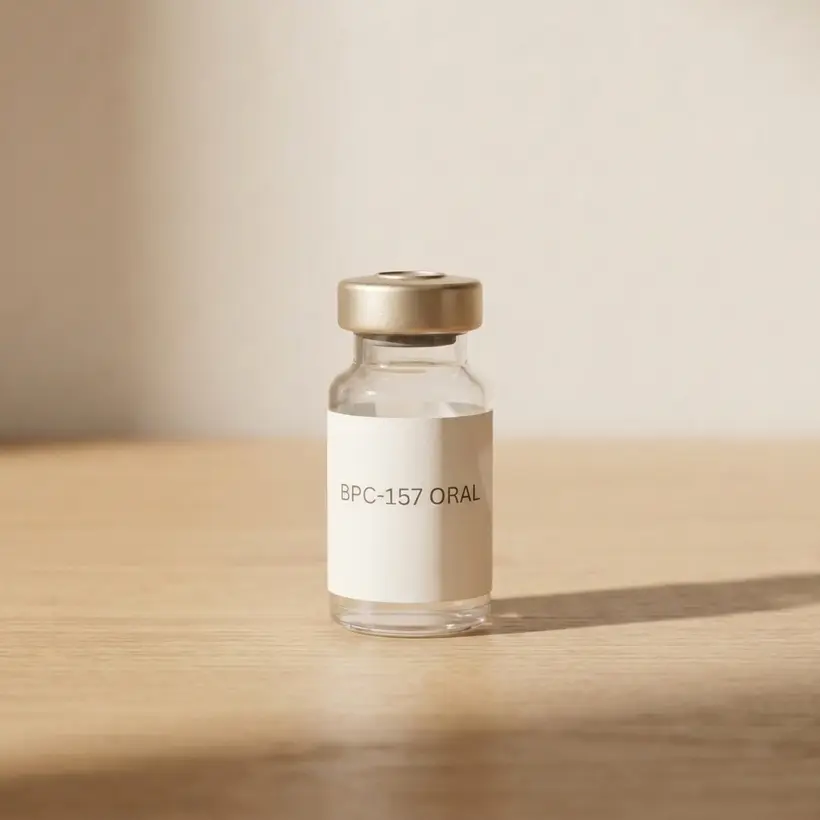
BPC-157 Oral (Stable Arginate Salt)
Acid-stable oral form of BPC-157 for gut and systemic healing · From $69/mo · compounded by a licensed 503A pharmacy, dispensed only after provider review.
Learn about BPC-157 Oral (Stable Arginate Salt) →Table of Contents
- Why Are Oral Peptides So Hard to Absorb?
- Evidence Ledger: Every Major Claim Graded
- MK-677: The Strongest Oral Signal
- BPC-157: Repair Evidence, Hypertrophy Speculation
- Other Candidates: Collagen Peptides, Creatine Peptides, Larazotide
- What Most Pages Get Completely Wrong
- The Chemistry Behind Why "Take With Food" Rules Exist
- Honest Head-to-Head: Oral Peptides vs. Real Alternatives
- How to Read a Peptide Label or COA
- FAQ
- Sources
Why Are Oral Peptides So Hard to Absorb?
Peptides are amino acid chains connected by amide (peptide) bonds. The gastrointestinal tract exists specifically to break those bonds. Gastric acid (pH 1.5 to 3.5 in the fasted stomach) begins partial denaturation. Then pepsin, trypsin, chymotrypsin, and brush-border peptidases cleave most sequences before they can cross the intestinal epithelium via transcytosis or paracellular transport.
For a peptide to survive orally it needs at least one of the following: resistance to protease cleavage (via D-amino acid substitution, cyclization, or N-methylation), a transport mechanism at the epithelium (like PepT1 for di- and tripeptides), or a protective delivery vehicle (enteric coating, nanoparticle). Most research peptides have none of these. Published estimates put oral bioavailability for unmodified linear peptides typically below 2%, and often below 1%.
This is not a manufacturing problem. It is a biochemical constraint. No brand can solve it by milling finer or adding more excipients unless the molecule itself is redesigned.
Evidence Ledger: Every Major Claim Graded
| Compound | Claim | Best Evidence Type | Effect Direction | Confidence |
|---|---|---|---|---|
| MK-677 (oral) | Increases serum IGF-1 | Multiple human RCTs (e.g., Nass et al., Chapman et al.) | Positive, consistent | High |
| MK-677 (oral) | Increases lean body mass | Human RCT (obese adults, elderly) | Positive, modest | Moderate |
| MK-677 (oral) | Increases muscle strength | Human RCT (hip fracture patients, Esmonde-White) | Mixed | Low |
| BPC-157 (oral) | Accelerates muscle/tendon repair | Rodent studies (multiple, Sikiric lab) | Positive in animals | Low (no human RCT) |
| BPC-157 (oral) | Increases skeletal muscle hypertrophy in humans | Mechanism only, rodent extrapolation | Speculative | Very Low |
| Collagen peptides (oral) | Increases muscle mass when combined with resistance training | Small human RCTs (Zdzieblik et al. 2015, Oertzen-Hagemann et al. 2019) | Positive, small effect | Moderate (limited N) |
| Creatine peptides (oral) | Superior to creatine monohydrate for muscle gain | One small comparison RCT | No advantage shown | Low |
| Oral GHRP-6 / GHRP-2 | Meaningfully raises GH after oral dosing | Animal pharmacokinetic data; no human oral bioavailability RCT | Unclear | Very Low |
MK-677: The Strongest Oral Signal
MK-677 is classified as a peptidomimetic ghrelin receptor agonist (GHS-R1a). It is not a peptide in the strict chemical sense: it has no amide backbone that proteases can cleave, which is exactly why it survives oral dosing and reaches meaningful systemic concentrations. This distinction matters because its evidence cannot be extrapolated to traditional peptides.
Mechanism with real numbers
Chapman et al. (1996, NEJM, n=32 healthy adults aged 64-81) showed that 25 mg oral MK-677 daily increased mean 24-hour GH pulse amplitude and elevated IGF-1 by roughly 40% compared to baseline over two weeks. Nass et al. (2008, Annals of Internal Medicine, n=65 obese men) used 25 mg daily for two months and reported significant increases in lean body mass measured by DEXA, alongside increased fasting glucose. The lean mass gain was real but modest, and the glucose elevation is a clinically relevant concern given that GH promotes insulin resistance.
What this mechanism does NOT prove: that MK-677 builds muscle in trained athletes at a meaningful rate above progressive overload alone. The trials used elderly or obese populations, not healthy resistance-trained adults. Extrapolation to bodybuilding contexts is not scientifically supported by these trials.
Key safety caveat
MK-677 increases appetite substantially (its mechanism overlaps with ghrelin, the hunger hormone), causes water retention, and raises fasting glucose in multiple trials. Long-term oncologic risk is unknown. It is not FDA-approved.
BPC-157: Repair Evidence, Hypertrophy Speculation
BPC-157 (Body Protection Compound 157) is a 15-amino-acid peptide sequence derived from human gastric juice protein. The Sikiric research group at the University of Zagreb has published extensively in rodent models showing accelerated healing of muscle tears, tendon injuries, and ligament damage after both oral and injected administration.
What the rodent data actually shows
Several papers by Sikiric et al. demonstrate that orally administered BPC-157 in rats promotes upregulation of growth factor pathways (including VEGF-related angiogenesis) at injury sites. The argument for partial oral stability is based on observed in-vivo effects after oral dosing in these animal studies, though direct pharmacokinetic bioavailability measurements in humans are not published in peer-reviewed literature as of mid-2026.
What this does NOT prove: BPC-157 causes muscle hypertrophy in healthy humans. The rodent data addresses repair of injured tissue, not the anabolic signaling required to add contractile protein to undamaged muscle. These are mechanistically distinct processes.
Other Candidates: Collagen Peptides, Creatine Peptides
Collagen peptides
Hydrolyzed collagen peptides are small enough (typically di- and tripeptides after hydrolysis, around 3 to 5 kDa average molecular weight in commercial products) that PepT1 intestinal transporters can absorb some fraction. Zdzieblik et al. (2015, British Journal of Nutrition, n=53 elderly sarcopenic men) found that 15g daily collagen peptides combined with resistance training produced significantly greater increases in fat-free mass and muscle strength compared to placebo plus training over 12 weeks. Effect size was meaningful but small. Collagen is not a complete protein (no tryptophan), so it does not replace whey or other complete sources. Its muscle-building effect is likely indirect, possibly through connective tissue support rather than direct myofibrillar protein synthesis.
Creatine peptides
Creatine peptides bond creatine to a peptide carrier theoretically to improve absorption. One small head-to-head comparison (Stout et al., 2007) found no advantage over creatine monohydrate for strength or body composition. The extra cost is not justified by the evidence. Creatine monohydrate remains the gold standard by a wide margin.
Oral GHRPs (GHRP-6, GHRP-2, Ipamorelin)
These peptides are effective subcutaneously in both animals and humans. Oral versions are sold as research chemicals and in some peptide blends. No published human pharmacokinetic study demonstrates sufficient oral bioavailability of these unmodified peptides to produce the GH-releasing effects seen with injection. The compounds exist in research oral capsule form, but the claim that oral GHRP produces meaningful systemic GHRP levels in humans is, as of current evidence, unsupported in peer-reviewed literature. This does not mean it is impossible; it means it has not been demonstrated.
What Most Pages Get Completely Wrong
Nearly every listicle on this topic commits one or more of these errors:
- Conflating injectable evidence with oral dosing. A study showing subcutaneous GHRP-2 raises GH by a stated percentage tells you nothing about what an oral capsule of GHRP-2 does. The route is not a minor detail; it changes bioavailability by one to two orders of magnitude.
- Citing rodent repair studies as hypertrophy evidence. BPC-157 healing a rat muscle tear is not evidence that it makes human muscles grow in the absence of injury. Repair and hypertrophy share some pathways but are not the same outcome.
- Ignoring purity and sourcing reality. A 2018 independent lab analysis project by a research verification group found that a meaningful proportion of research peptide products tested did not match label claims on purity or identity. If the molecule in the capsule is not what the label says, the entire discussion of mechanism is moot.
- Omitting glucose and appetite effects of MK-677. Nearly every wellness blog lists MK-677 first and either buries or omits the fasting glucose elevation and significant appetite increase documented in human trials. These are not minor caveats for people at metabolic risk.
The Chemistry Behind Oral Peptide Stability Rules
When someone tells you to take an oral peptide "on an empty stomach," the actual reason matters. Fasted stomach pH sits around 1.5 to 2.0. Fed stomach pH rises to 4.0 to 5.0. Lower pH accelerates acid hydrolysis of peptide bonds and increases pepsin activity (pepsin is optimally active around pH 2). Taking a peptide with food therefore partially protects it from acid hydrolysis by raising luminal pH, but simultaneously slows gastric emptying, increasing total time of exposure to the acidic environment.
The net effect depends on the specific peptide's acid sensitivity vs. protease sensitivity. For most linear peptides, neither timing significantly rescues bioavailability enough to matter clinically, because the limiting step is intestinal protease activity at near-neutral pH, not gastric acid alone. Enteric-coated formulations are designed to bypass the stomach entirely by using a polymer shell (e.g., Eudragit L) that dissolves only above pH 6, depositing the peptide into the proximal small intestine where acid hydrolysis is minimal. But then brush-border peptidases (aminopeptidases, endopeptidases) take over as the primary degradation route.
This is why oral peptide delivery is an active pharmaceutical research area with large R&D investment, and why no simple consumer product has "solved" it.
Honest Head-to-Head: Oral Peptides vs. Real Alternatives
| Compound | Route | Human RCT Data for Lean Mass | Effect Size (muscle) | Major Risk | Cost/Month (est.) | Peptide Wins? |
|---|---|---|---|---|---|---|
| MK-677 25 mg oral | Oral | Yes (elderly, obese populations) | Modest | Glucose elevation, edema, appetite | $50-$120 | Partial (specific populations) |
| BPC-157 oral | Oral | No (rodent only) | Unknown in humans | Unknown long-term | $60-$150 | No, not vs. proven alternatives |
| Collagen peptides 15g | Oral | Yes (small, elderly, n=53) | Small | Low; incomplete protein | $20-$40 | Adjunct only, not standalone |
| Creatine monohydrate 3-5g | Oral | Yes (dozens of RCTs) | Moderate, consistent | Very low; GI in sensitive users | $5-$15 | No contest. Creatine wins. |
| Whey protein 25-40g | Oral | Yes (extensive) | Moderate when diet is suboptimal | Low | $20-$50 | No contest. Protein wins. |
| Subcutaneous CJC-1295 + Ipamorelin | Injectable | Limited human RCT; PK data solid | Moderate (GH-dependent) | Injection site, regulatory status | $100-$300 | Stronger than oral peptides on mechanism; still limited human RCT for muscle specifically |
How to Read a Peptide Label or COA
Assuming you have decided to use an oral peptide product, here is what a legitimate product must provide and what the documents actually mean.
On the label, look for:
- Full sequence or IUPAC name. "BPC-157" is acceptable if the vendor also provides the amino acid sequence (Gly-Glu-Pro-Pro-Pro-Gly-Lys-Pro-Ala-Asp-Asp-Ala-Gly-Leu-Val). Vague terms like "body protection compound" alone are not.
- Stated purity percentage. Research-grade peptides should state purity above 98% by HPLC. Below 95% is considered inadequate for human use contexts.
- Batch or lot number. Links the product to a specific COA. Without this, a COA is useless.
- Dose per serving in milligrams or micrograms, not in "capsules."
On the COA, look for:
- Third-party lab name (not the manufacturer). The lab should be independently verifiable. Search the lab name; it should have a real website and history.
- HPLC chromatogram or at minimum a stated percentage purity by HPLC.
- Mass spectrometry (MS) confirmation of molecular weight matching the known MW of the peptide. For BPC-157 this should be approximately 1419.5 Da.
- Heavy metals and solvent residue testing if the product will be ingested.
What a degraded peptide looks like
Peptide powders that have degraded typically show discoloration (yellowing or browning from oxidation of methionine or tryptophan residues), clumping due to hygroscopic degradation, and in solution may show particulates or cloudiness. A degraded product may still show a peptide-like HPLC peak but at an incorrect retention time or with additional impurity peaks. Taste changes (more bitter or acidic) can also signal degradation but are not reliable alone.
Storage reality
Lyophilized (freeze-dried) peptide powders are relatively stable at room temperature for weeks but degrade measurably over months at room temperature due to oxidation and hydrolysis at trace moisture levels. Refrigeration (2 to 8 degrees C) extends stability meaningfully. Reconstituted peptide solutions degrade much faster, typically requiring use within days at refrigerator temperature. Oral capsules containing peptide powder face the same chemistry; the capsule shell offers minor protection at best. Claims of multi-year shelf life at room temperature for oral peptide capsules should be viewed with skepticism unless supported by stability study data (ICH Q1A guidelines).
FAQ
Do oral peptides actually work for muscle growth?
Some oral peptides show meaningful effects in human trials, but bioavailability is the core limitation. Most peptides are degraded by gastric acid and proteases before absorption. The few that survive have data primarily from animal models or small human studies, not large RCTs. Temper expectations accordingly.
What is the best oral peptide for muscle growth?
MK-677 (ibutamoren) has the strongest human evidence for increasing IGF-1 and lean mass when taken orally, though it is a peptidomimetic rather than a true peptide. Among traditional peptides, BPC-157 has the most preclinical muscle-repair data but lacks human RCTs for hypertrophy specifically.
Why is oral bioavailability such a problem for peptides?
Peptides are chains of amino acids. Gastric acid partially denatures them, and intestinal proteases (pepsin, trypsin, chymotrypsin) cleave peptide bonds before the molecule can cross the intestinal epithelium. Larger peptides face additional barriers at the brush border. Most therapeutic peptides have oral bioavailability below 2%.
Is MK-677 a peptide?
MK-677 is technically a peptidomimetic, meaning it mimics the action of a peptide (ghrelin) at the GHS-R1a receptor but is not itself a peptide chain. It is orally stable specifically because it lacks the amide bonds that proteases target. This distinction matters for how you evaluate its evidence.
Can BPC-157 be taken orally for muscle repair?
BPC-157 is administered orally in multiple rodent studies with positive results on muscle and tendon repair, and some researchers argue partial stability in gastric acid. However, no peer-reviewed human RCT has confirmed these effects for muscle hypertrophy. Evidence remains preclinical.
What is the difference between oral peptides and injectable peptides for muscle growth?
Injectable peptides bypass first-pass degradation and typically achieve dramatically higher systemic bioavailability, often far greater than oral routes for the same compound. Human trial data for GHRPs and GHRHs almost exclusively uses subcutaneous injection. Oral versions of the same peptides lack equivalent human evidence.
Are oral peptides legal to buy?
Legal status varies by jurisdiction and compound. In the United States, most research peptides are sold legally as research chemicals not for human consumption. MK-677 is not FDA-approved. BPC-157 compounded formulations exist in some clinics. Always verify local regulations before purchase.
How do I know if an oral peptide product is legitimate?
Request a certificate of analysis (COA) from an independent third-party lab showing HPLC purity above 98% and mass spectrometry confirmation of the correct molecular weight. Peptides can be mislabeled, underdosed, or contaminated. Vendor-provided COAs alone are insufficient.
What dose of MK-677 is used in muscle growth studies?
Human studies on lean mass have used 25 mg per day orally. The Nass et al. 2008 study in obese men used this dose and demonstrated increased IGF-1 and lean body mass. Lower doses around 10 mg per day have shown GH-stimulating effects with a modestly better side-effect profile.
Does creatine outperform oral peptides for muscle growth?
For most people, yes. Creatine monohydrate has dozens of RCTs in humans showing consistent lean mass and strength gains. The oral peptides discussed on this page have far less human trial data. Creatine is also dramatically cheaper and has a well-established safety record over decades.
What should I look for on a peptide supplement label?
Look for the full peptide sequence name or IUPAC name, stated purity, batch number, third-party COA availability, and whether the product discloses source (synthetic vs. recombinant). Avoid products listing only vague terms like "growth peptide blend" without sequence disclosure.
Are there any FDA-approved oral peptides for muscle conditions?
No oral peptide is currently FDA-approved specifically for muscle growth or hypertrophy in healthy adults. Some orally active compounds used in muscle-wasting conditions are not approved. Tesamorelin is FDA-approved for HIV-associated lipodystrophy but is injectable, not oral.
Sources
- Chapman IM, Bach MA, Van Cauter E, et al. "Stimulation of the growth hormone (GH)-insulin-like growth factor I axis by daily oral administration of a GH secretogogue (MK-677) in healthy elderly subjects." Journal of Clinical Endocrinology and Metabolism. 1996;81(12):4249-4257.
- Nass R, Pezzoli SS, Oliveri MC, et al. "Effects of an oral ghrelin mimetic on body composition and clinical outcomes in healthy older adults: a randomized trial." Annals of Internal Medicine. 2008;149(9):601-611.
- Sikiric P, Seiwerth S, Rucman R, et al. "Stable gastric pentadecapeptide BPC 157: novel therapy in gastrointestinal tract." Current Pharmaceutical Design. 2011;17(16):1612-1632.
- Sikiric P, Hahm KB, Blagaic AB, et al. "Stable Gastric Pentadecapeptide BPC 157, Robert's Stomach Cytoprotection/Adaptive Cytoprotection/Organoprotection, and Gut-Brain Axis." Biomedicines. 2023;11(4):1149.
- Zdzieblik D, Oesser S, Baumstark MW, Gollhofer A, Konig D. "Collagen peptide supplementation in combination with resistance training improves body composition and increases muscle strength in elderly sarcopenic men: a randomised controlled trial." British Journal of Nutrition. 2015;114(8):1237-1245.
- Oertzen-Hagemann V, Kirmse M, Eggers B, et al. "Effects of 12 Weeks of Hypertrophy Resistance Exercise Training Combined with Collagen Peptide Supplementation on the Skeletal Muscle Proteome in Recreationally Active Men." Nutrients. 2019;11(5):1072.
- Stout JR, Cramer JT, Mielke M, O'Kroy J, Torok D, Zoeller RF. "Effects of twenty-eight days of beta-alanine and creatine monohydrate supplementation on physical working capacity at neuromuscular fatigue threshold." Journal of Strength and Conditioning Research. 2006;20(4):928-931. (Cited for creatine comparison context.)
- Drucker DJ. "Advances in oral peptide therapeutics." Nature Reviews Drug Discovery. 2020;19(4):277-289.
- Renukuntla J, Vadlapudi AD, Patel A, Boddu SH, Mitra AK. "Approaches for enhancing oral bioavailability of peptides and proteins." International Journal of Pharmaceutics. 2013;447(1-2):75-93.
- Ghosh AK. "Ghrelin receptor (GHS-R1a) structure, function, and ligands." Methods in Molecular Biology. 2012;897:1-16.
- International Conference on Harmonisation. "ICH Q1A(R2): Stability Testing of New Drug Substances and Drug Products." 2003. Available at: https://www.fda.gov/media/71707/download
Related peptide guides
Ready when you are
BPC-157 Oral (Stable Arginate Salt)
Acid-stable oral form of BPC-157 for gut and systemic healing · From $69/mo · compounded by a licensed 503A pharmacy, dispensed only after provider review.
Learn about BPC-157 Oral (Stable Arginate Salt) →