
Trust Signals
We disclose when evidence is animal-only, when trials are small, and when a peptide loses to an approved alternative. We do not sell the compounds discussed here. No affiliate links influence the rankings.
Key Takeaways
- Tesamorelin is the only GHRH-class peptide with FDA approval and Phase III trial data showing statistically significant visceral fat reduction (roughly 15 to 18 percent) in a specific clinical population (HIV-associated lipodystrophy).
- Combining a GHRH analogue (CJC-1295 without DAC) with a GHRP (Ipamorelin) activates two separate receptor pathways and produces a synergistic GH pulse, but this has been studied mainly in animals and small human GH-secretion studies, not body composition trials.
- Oral bioavailability of research peptides is negligible without specialized delivery systems. Products sold as oral peptides have no human pharmacokinetic confirmation of systemic exposure.
- BPC-157 was removed from the FDA compounding ingredient list in 2022. Its muscle-repair and gut-healing data come almost entirely from rodent studies.
- Chronic supraphysiologic IGF-1 elevation carries a theoretical oncogenic risk that no long-term human peptide trial has yet quantified.
What Are the Best Peptides for Muscle Growth and Fat Loss?
Table of Contents
- Evidence Ledger: All Major Claims Graded
- How Do These Peptides Actually Work? (With Numbers)
- The Top Peptides Ranked by Evidence
- What Most Pages Get Wrong: Bioavailability and Purity
- The Chemistry Behind Storage and Stability Rules
- Honest Head-to-Head: Peptides vs. Real Alternatives
- Label and COA Literacy: How to Judge a Product
- Safety and the Cancer Question
- FAQ
- Sources
Evidence Ledger: All Major Claims Graded
GRADE confidence ratings (High, Moderate, Low, Very Low) reflect the body of evidence for each claim as applied to healthy adults seeking body composition improvement, not necessarily the populations studied.
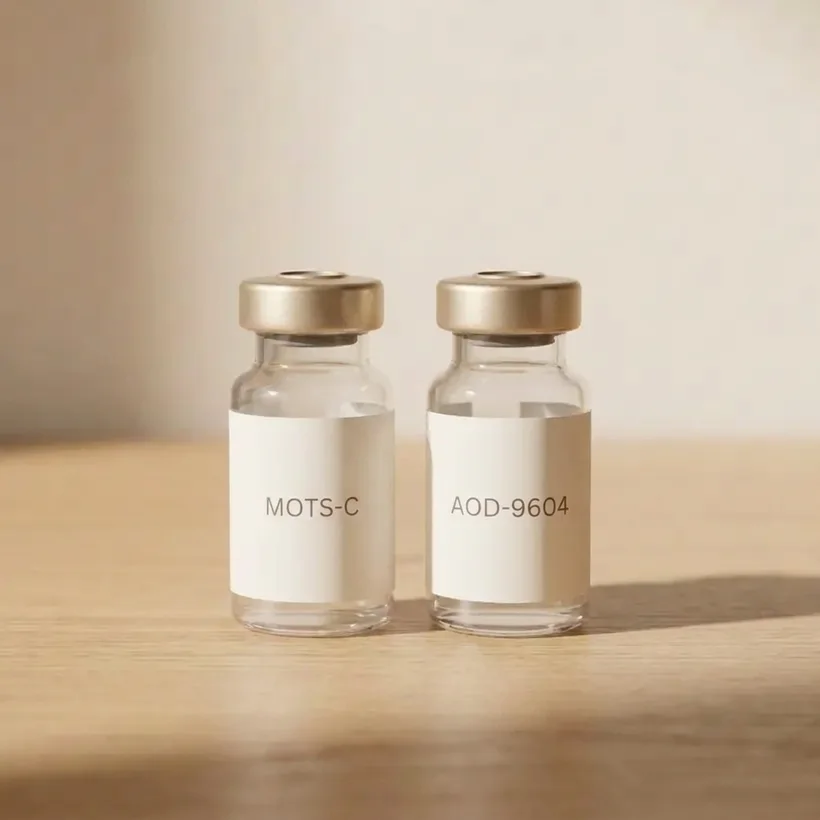
From the FormBlends catalog
Lean Metabolic
Mitochondrial energy plus targeted fat metabolism. · Bundle from $381 · provider-reviewed peptide bundle.
View Lean Metabolic →| Claim | Best Evidence Type | Effect Direction | Confidence (GRADE) |
|---|---|---|---|
| Tesamorelin reduces visceral fat in HIV lipodystrophy | Human RCT, Phase III (Falutz et al., NEJM 2007) | Positive (15 to 18% reduction) | High (in that population) |
| CJC-1295 with DAC raises GH and IGF-1 in healthy adults | Human PK study (Teichman et al., JCEM 2006) | Positive (dose-dependent IGF-1 rise) | Moderate |
| Ipamorelin produces selective GH release without cortisol or prolactin spike | Animal studies; small human GH-secretion data | Positive for selectivity | Low |
| GHRH plus GHRP combination is synergistic for GH pulse | Animal pharmacology; small human GH studies | Positive (additive to synergistic) | Low |
| BPC-157 accelerates tendon and muscle repair | Rodent studies only | Positive in rodents | Very Low (no human RCT) |
| AOD-9604 reduces adipose tissue | Animal studies; one small Phase II human trial (failed primary endpoint) | Neutral to weak positive | Very Low |
| TB-500 (Thymosin Beta-4) improves muscle recovery | Animal studies; no human RCT for body composition | Positive in animals | Very Low |
| GH secretagogues build lean mass in healthy adults | Extrapolation from GH-deficient populations; no adequate RCT in healthy adults | Unclear | Very Low |
How Do These Peptides Actually Work? (With Numbers)
The GH-IGF-1 axis is the central target. Growth hormone is released from the anterior pituitary in pulses controlled by two opposing hypothalamic signals: GHRH (stimulates release) and somatostatin (inhibits release). Research peptides exploit this axis at two distinct receptor sites.
GHRH analogues (CJC-1295, Tesamorelin): Bind the GHRH receptor (GHRHR) on somatotroph cells. The natural GHRH peptide has 44 amino acids and a plasma half-life of roughly 7 minutes due to cleavage by dipeptidyl peptidase IV. Tesamorelin substitutes a trans-3-hexenoic acid group at the N-terminus to resist that cleavage, extending half-life to roughly 30 minutes. CJC-1295 with DAC adds a lysine-maleimide linker that allows covalent binding to circulating albumin, extending half-life to several days. Teichman et al. (JCEM 2006) showed that a single subcutaneous dose of CJC-1295 with DAC raised mean 24-hour GH levels and IGF-1 in healthy adults in a dose-dependent fashion, with peak IGF-1 increases of roughly 2-fold at the higher doses tested. This does NOT prove lean mass accumulation.
GH releasing peptides / ghrelin mimetics (Ipamorelin, GHRP-2, GHRP-6): Act on the ghrelin receptor (GHSR-1a), a G-protein coupled receptor distinct from GHRHR. Ipamorelin is a pentapeptide (Aib-His-D-2-Nal-D-Phe-Lys-NH2) selected for selectivity: unlike GHRP-2 and GHRP-6, it does not significantly elevate cortisol or prolactin at GH-stimulating doses in animal models. GHRP-6 stimulates ghrelin-like appetite signaling, which is why users report hunger as a side effect. The combination of a GHRH analogue and a GHRP can produce a GH pulse roughly 10-fold larger than either agent alone in rodent pharmacology; this is the mechanistic rationale for stacking, but the body-composition endpoint in healthy humans has not been formally tested in an RCT.
BPC-157: A 15-amino-acid partial sequence of body protection compound, a protein found in gastric juice. Its proposed mechanisms include upregulation of growth factor receptors (notably VEGFR and EGFR pathways), promotion of angiogenesis, and modulation of nitric oxide signaling. All mechanism data come from rodent and in vitro studies. There is no verified human tissue pharmacokinetics.
The Top Peptides Ranked by Evidence
1. Tesamorelin (evidence rank: Moderate to High for its approved use). The only peptide here with a completed Phase III program. Falutz et al. published in NEJM in 2007 showing significant visceral adipose tissue reduction versus placebo in HIV-positive patients with lipodystrophy. Extrapolating this to healthy athletes is a meaningful evidence gap.
2. CJC-1295 without DAC (Mod GRF 1-29) plus Ipamorelin (evidence rank: Low). The most commonly referenced research stack because the two receptor pathways are additive, Ipamorelin has a cleaner side-effect profile than GHRP-2 or GHRP-6, and the short-acting form produces a pulse that more closely mimics natural GH physiology than the multi-day flat elevation from DAC versions.
3. GHRP-2 (evidence rank: Low). Has more published human GH-secretion data than Ipamorelin but elevates cortisol and prolactin, reducing its desirability as a long-term tool.
4. BPC-157 (evidence rank: Very Low for humans). Rodent data on tendon, ligament, and gut healing are remarkably consistent across dozens of studies from Sikiric's group in Zagreb. Human translation is unconfirmed. The 2022 FDA action on compounding is a practical and legal barrier.
5. TB-500 (Thymosin Beta-4 fragment) (evidence rank: Very Low for body composition). Animal studies suggest accelerated muscle satellite cell activity and angiogenesis. No human body-composition RCT exists.
6. AOD-9604 (evidence rank: Very Low). A modified fragment of human growth hormone (hGH 176-191) proposed to have lipolytic effects without anabolic or diabetogenic effects of full-length hGH. A Phase II human obesity trial did not meet its primary endpoint. It is on the WADA prohibited list as a peptide hormone, so it is relevant for tested athletes.
What Most Pages Get Wrong: Bioavailability and Purity
This is the section commodity pages skip entirely.
Oral delivery does not work for intact peptides at research doses. The key barriers are: (1) gastric acid and proteases (pepsin, trypsin, chymotrypsin) hydrolyze peptide bonds within minutes of ingestion; (2) molecular weight above roughly 500 daltons is associated with poor passive intestinal permeability (Lipinski's rule of five, extended to peptides); (3) first-pass hepatic metabolism further reduces systemic exposure. CJC-1295 has a molecular weight of roughly 3,647 Da. Ipamorelin is roughly 711 Da. Neither will reach systemic circulation in meaningful quantity via oral ingestion without specialized formulation technology (enteric coating, nanoparticle encapsulation, permeation enhancers) that no current research peptide vendor has validated in humans. Vendors marketing "oral peptides" are selling products with no human pharmacokinetic data confirming systemic exposure.
Purity varies enormously between suppliers. Solid-phase peptide synthesis (SPPS) produces deletion sequences, truncated fragments, and racemized amino acids as impurities. A peptide labeled "98% pure" by an in-house HPLC may still contain endotoxins (lipopolysaccharides from bacterial contamination during synthesis) that cause fever, inflammation, and injection-site reactions. Endotoxin testing requires a limulus amebocyte lysate (LAL) assay, which most vendor COAs do not include. Without it, purity claims are incomplete.
The lyophilized vs. reconstituted distinction matters for dosing math. Vials are typically sold as lyophilized powder in amounts like 2 mg or 5 mg. Reconstitution with bacteriostatic water requires accurate dilution. A common error: adding 1 mL of bacteriostatic water to a 2 mg vial gives 2 mg per mL (2000 mcg per mL). A typical Ipamorelin research dose of 200 mcg is then 0.1 mL on an insulin syringe. Errors here produce 2x or 10x overdoses or underdoses that make self-experimentation results uninterpretable.
The Chemistry Behind Storage and Stability Rules
Why refrigerate after reconstitution? Peptides in aqueous solution undergo hydrolysis (water attacks the peptide bond), oxidation (particularly at methionine and cysteine residues), and aggregation (intermolecular hydrogen bonding that creates insoluble clumps). All three reactions are temperature-dependent. Refrigeration at 2 to 8 degrees Celsius slows reaction rates according to the Arrhenius equation; a rough rule is that reaction rate doubles for every 10-degree Celsius increase in temperature. This is why a reconstituted peptide left at room temperature for several days loses potency that refrigerated storage would preserve over weeks.
Why avoid freeze-thaw cycles? Freezing causes ice crystal formation. Crystals physically shear peptide aggregates and disrupt protein structure. Thawing creates local concentration gradients that promote aggregation before the solution rehomogenizes. Each cycle adds irreversible aggregate content that reduces bioavailable fraction and can increase immunogenicity.
Why keep lyophilized peptides away from moisture? Lyophilization removes water to produce a dry powder that is stable for months to years at appropriate temperatures. Moisture ingress starts the hydrolysis clock. A vial with a compromised septum or stored in a humid environment will show premature degradation visible as discoloration or a change from white powder to a yellowish or gummy residue.
Why avoid mixing with vitamin C? This applies more to some other cosmetic peptides than to most GH secretagogues, but the principle: ascorbic acid is a reducing agent at low pH. Some peptides containing disulfide bonds (like those with cysteine) can be reduced and their structure disrupted in an acidic, high-ascorbate environment. This does not apply uniformly to all peptides but is worth checking per compound.
Honest Head-to-Head: Peptides vs. Real Alternatives
| Comparison | Peptide | Alternative | Where Peptide Wins | Where Peptide Loses |
|---|---|---|---|---|
| Visceral fat loss | Tesamorelin | Semaglutide (GLP-1 agonist) | Fewer GI side effects; preserves more lean mass in some data | Semaglutide has far larger human RCT evidence base; greater absolute fat loss in obesity trials |
| Muscle growth | CJC-1295 plus Ipamorelin | Testosterone replacement therapy (TRT) | Does not suppress endogenous testosterone; no testicular atrophy risk | TRT has decades of human RCT data for lean mass; effect size is substantially larger and better characterized |
| Muscle growth | GH secretagogues | SARMs (e.g., Enobosarm/Ostarine) | Works via a different axis; no direct androgen receptor activity | Ostarine produced measurable lean mass gains (roughly 1 to 3 kg) in Phase II trials; peptide lean mass data in healthy adults is largely absent |
| Injury recovery | BPC-157 | Platelet-rich plasma (PRP) | Easier to administer; lower cost; rodent data consistently positive | PRP has human RCT data (mixed but exists); BPC-157 has zero human RCT data |
| Fat loss, general | AOD-9604 | Phentermine-topiramate | Different mechanism; no cardiovascular stimulant effect | AOD-9604 failed its Phase II primary endpoint; phentermine-topiramate has documented human weight loss data |
Label and COA Literacy: How to Judge a Product
What a legitimate COA must contain:
- Third-party lab name and accreditation number (ISO 17025 or equivalent). A COA from the same company that made the peptide is not independent.
- HPLC purity expressed as a percentage with the method described. Acceptable minimum for research use is generally cited as 98% or greater.
- Mass spectrometry (MS) confirmation of the correct molecular weight. This confirms you have the right peptide, not just a pure impurity.
- Endotoxin result (EU per mg) from a LAL assay. Absence of this field is a red flag.
- Moisture content (Karl Fischer titration). High moisture in lyophilized powder suggests incomplete freeze-drying and predicts faster degradation.
Reconstitution dosing table (examples only, not a protocol recommendation):
| Vial Amount | Bacteriostatic Water Added | Resulting Concentration | Volume for 100 mcg dose | Volume for 200 mcg dose |
|---|---|---|---|---|
| 2 mg (2000 mcg) | 2 mL | 1000 mcg per mL | 0.10 mL (10 IU on insulin syringe) | 0.20 mL (20 IU) |
| 5 mg (5000 mcg) | 2 mL | 2500 mcg per mL | 0.04 mL (4 IU) | 0.08 mL (8 IU) |
| 5 mg (5000 mcg) | 5 mL | 1000 mcg per mL | 0.10 mL (10 IU) | 0.20 mL (20 IU) |
What a degraded product looks like: A lyophilized peptide that has been exposed to moisture or heat may appear yellowish or tan instead of white, or may not fully dissolve on reconstitution. A reconstituted solution that has gone cloudy, developed visible particles, or has a noticeably different odor than fresh solution should be discarded. These changes indicate aggregation, oxidation, or microbial contamination.
Safety and the Cancer Question
The most serious and most underreported risk of chronic GH secretagogue use is the relationship between elevated IGF-1 and cancer biology. IGF-1 activates the PI3K-Akt-mTOR pathway, which promotes cell proliferation and inhibits apoptosis. Large epidemiological cohorts (including the European Prospective Investigation into Cancer and Nutrition, EPIC) have found associations between higher circulating IGF-1 and increased risk of colorectal, prostate, and breast cancers, though causality is not established.
What this means practically: chronic use of GH secretagogues that maintain supraphysiologic IGF-1 levels is operating in territory where the long-term risk has not been studied in healthy people. The theoretical concern is real. No long-term human trial has quantified it for peptide use specifically.
Other documented risks: insulin resistance (GH is counter-regulatory to insulin), fluid retention (GH increases renal sodium reabsorption), carpal tunnel syndrome (a known side effect of GH excess), and injection-site reactions. GHRP-6 users frequently report significant appetite stimulation due to ghrelin receptor activity, which can undermine fat-loss goals.
FAQ
What are the best peptides for muscle growth and fat loss?
CJC-1295, Ipamorelin, BPC-157, and TB-500 have the most discussed human-relevant evidence. For fat loss specifically, AOD-9604 and Tesamorelin have the most targeted data. No peptide clears the bar set by approved anabolics or GLP-1 drugs for sheer effect size.
Do peptides actually build muscle in humans?
Growth hormone secretagogues like Tesamorelin and GHRP-2 raise IGF-1 and GH in human trials, and IGF-1 promotes muscle protein synthesis. Whether that translates to measurable lean mass gains in healthy, well-fed adults is less clear. Most human trials are short and underpowered for body composition as the primary endpoint.
Is CJC-1295 the same as Mod GRF 1-29?
Mod GRF 1-29 is the short-acting version with a half-life of roughly 30 minutes. CJC-1295 with DAC extends the half-life to several days via albumin binding. They are chemically distinct, have different dosing intervals, and create different GH pulse shapes. Many vendors label them interchangeably, which is inaccurate.
Can you take peptides orally instead of injecting?
Oral bioavailability of intact peptides is very low. Gastric proteases cleave peptide bonds rapidly, and molecular weight above roughly 500 Da limits intestinal absorption without specialized carriers. Most research peptides sold as "oral" have no human pharmacokinetic data confirming meaningful systemic exposure.
What is the difference between a GHRH and a GHRP?
GHRH analogues like CJC-1295 act on the GHRH receptor in the pituitary to amplify natural GH pulses. GHRPs like Ipamorelin and GHRP-2 act on the ghrelin receptor (GHSR-1a) and work via a separate, additive pathway. Combining them produces a synergistic GH pulse in some animal studies.
How does Tesamorelin differ from CJC-1295 for fat loss?
Tesamorelin is an FDA-approved GHRH analogue specifically for HIV-associated lipodystrophy with documented Phase III trial data. CJC-1295 has no equivalent human fat-loss trial data. Tesamorelin's regulatory status and documented effect size make it the evidentially stronger choice for visceral fat reduction.
Is BPC-157 safe and legal?
BPC-157 has no FDA approval and no completed Phase III human trials. The FDA removed it from the permissible compounding ingredient list in 2022. Most safety data come from rodent studies. It is not on the WADA prohibited list as of 2025, but its legal status for human use in the US is restricted.
What does a COA tell you about peptide purity?
A legitimate COA from a third-party lab should show HPLC purity (ideally above 98%), mass spectrometry confirmation of molecular weight, and endotoxin testing (LAL assay). A COA issued by the same company that synthesized the peptide is not independent verification. Always look for an ISO-accredited third-party lab name.
How should research peptides be stored?
Lyophilized peptides are stable at room temperature for weeks but degrade faster with heat and moisture. After reconstitution with bacteriostatic water, most peptides should be refrigerated at 2 to 8 degrees Celsius and used within 28 to 30 days. Repeated freeze-thaw cycles accelerate oxidation and aggregation.
Do peptides cause cancer?
Supraphysiologic IGF-1 elevation is associated with increased cancer cell proliferation in epidemiological data. GH secretagogues that chronically raise IGF-1 carry a theoretical oncogenic risk that has not been quantified in long-term human trials. This is the most serious unresolved safety question for chronic peptide use.
What is the best peptide stack for body recomposition?
CJC-1295 without DAC (Mod GRF 1-29) paired with Ipamorelin is the most commonly discussed research stack because the two pathways are additive and Ipamorelin has a cleaner side-effect profile. Evidence quality is Low by GRADE standards. This is not a medical recommendation.
How do peptides compare to SARMs for muscle growth?
SARMs act directly on androgen receptors and in human trials have produced measurable lean mass increases in some studies. GH secretagogue peptides work indirectly via the GH-IGF-1 axis and have smaller, less consistent human lean mass data. SARMs carry their own unapproved-drug risks, but their effect size on muscle is likely larger.
Sources
- Falutz J, et al. "Metabolic Effects of a Growth Hormone-Releasing Factor in Patients with HIV." New England Journal of Medicine. 2007;357(23):2359-2370.
- Teichman SL, et al. "Prolonged Stimulation of Growth Hormone (GH) and Insulin-like Growth Factor I Secretion by CJC-1295, a Long-Acting Analog of GH-Releasing Hormone, in Healthy Adults." Journal of Clinical Endocrinology and Metabolism. 2006;91(3):799-805.
- Sikiric P, et al. "Stable Gastric Pentadecapeptide BPC 157: Novel Therapy in Gastrointestinal Tract." Current Pharmaceutical Design. 2011;17(16):1612-1632.
- US Food and Drug Administration. "FDA Updates and Press Announcements on Compounding." Docket reference to BPC-157 and other bulk drug substances. 2022. Available at: fda.gov
- Khorram O, Laughlin GA, Yen SS. "Endocrine and Metabolic Effects of Long-term Administration of [Nle27]GHRH(1-29)-NH2 in Age-advanced Men and Women." Journal of Clinical Endocrinology and Metabolism. 1997;82(5):1472-1479.
- Raun K, et al. "Ipamorelin, the first selective growth hormone secretagogue." European Journal of Endocrinology. 1998;139(5):552-561.
- Chan JM, et al. "Plasma Insulin-like Growth Factor-I and Prostate Cancer Risk: A Prospective Study." Science. 1998;279(5350):563-566.
- Hankinson SE, et al. "Circulating concentrations of insulin-like growth factor-I and risk of breast cancer." Lancet. 1998;351(9113):1393-1396.
- World Anti-Doping Agency. "2025 Prohibited List." WADA. Available at: wada-ama.org
- Morley JE, et al. "Growth hormone secretagogues: a review." Journal of Endocrinological Investigation. 1999;22(1):72-77.
- Lipinski CA, et al. "Experimental and computational approaches to estimate solubility and permeability in drug discovery and development settings." Advanced Drug Delivery Reviews. 2001;46(1-3):3-26.