
Key Takeaways
- Semaglutide (GLP-1 agonist) produced mean weight loss of roughly 14.9% over 68 weeks in the STEP 1 RCT (n=1961), the strongest human evidence for any peptide targeting belly fat.
- Tirzepatide (dual GIP/GLP-1 agonist) outperformed semaglutide in head-to-head SURPASS-2 data, with visceral fat reduction confirmed by MRI in SURMOUNT-1 substudies.
- AOD-9604 failed its primary weight-loss endpoint in phase II/III METAOD trials and is not an approved obesity treatment despite widespread marketing.
- No research peptide sold online (CJC-1295, Ipamorelin, BPC-157) has an RCT showing visceral fat reduction as a primary measured outcome in humans.
- Purity failure is the leading real-world risk with research peptides: independent HPLC testing of commercially available peptide vials has found purity well below stated values in multiple analyses.
What Is the Best Peptide for Belly Fat Loss?
Semaglutide is the best-evidenced peptide for belly fat loss, with phase III RCT data in nearly 2,000 people showing roughly 15% total weight loss, including visceral fat. Among unapproved research peptides, the evidence base for any specific visceral fat endpoint in humans is absent or negative. Tirzepatide is stronger than semaglutide by current data.
Table of Contents
- Evidence Ledger: Every Major Peptide Rated
- How Do Peptides Actually Reduce Visceral Fat?
- Which Peptides Rank Highest and Why?
- What Most Pages Get Wrong About Research Peptides
- Why Storage and Formulation Rules Exist (The Chemistry)
- Honest Head-to-Head: Peptides vs. Alternatives
- How to Read a COA and Dose Correctly
- Frequently Asked Questions
- Sources
Evidence Ledger: Every Major Peptide Rated
Each entry reflects the best available evidence, not marketing claims. "Visceral fat" means measured abdominal or intra-abdominal fat, not just weight loss.
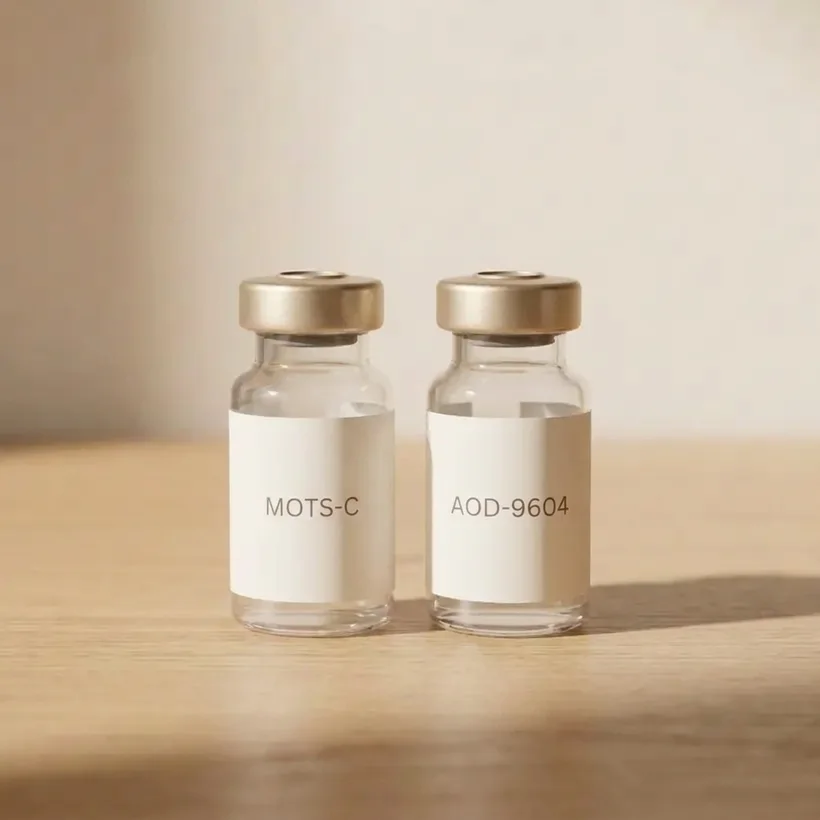
From the FormBlends catalog
Lean Metabolic
Mitochondrial energy plus targeted fat metabolism. · Bundle from $381 · provider-reviewed peptide bundle.
View Lean Metabolic →| Peptide | Best Evidence Type | Human Trial for Fat Loss? | Visceral Fat Endpoint? | Effect Direction | Confidence |
|---|---|---|---|---|---|
| Semaglutide (Ozempic/Wegovy) | Multiple phase III RCTs | Yes (STEP 1-4, n up to 1961) | Yes (imaging substudies) | Strong reduction | High |
| Tirzepatide (Mounjaro/Zepbound) | Phase III RCTs | Yes (SURMOUNT-1, n=2539) | Yes (MRI substudies) | Strong reduction | High |
| Liraglutide (Saxenda) | Phase III RCTs | Yes (SCALE trials) | Indirect (total fat) | Moderate reduction | High |
| CJC-1295 (with DAC) | Phase I/II PK studies | Yes (GH endpoints only) | No | GH elevation confirmed; fat loss not measured | Very Low |
| Ipamorelin / CJC-1295 combo | Animal + open-label anecdote | No RCT | No | Unknown in humans | Very Low |
| AOD-9604 (hGH 177-191) | Phase II/III RCTs (METAOD) | Yes, failed primary endpoint | No | Negative (no effect vs. placebo) | High (of failure) |
| MOTS-c (mitochondrial peptide) | Animal studies, small human PK | Very limited | No | Promising in rodents, unknown in humans | Very Low |
| BPC-157 | Animal studies only | No | No | Not studied for fat loss | Very Low |
| Tesamorelin (Egrifta) | Phase III RCTs (HIV lipodystrophy) | Yes, but HIV-specific population | Yes (CT-measured visceral fat) | Moderate reduction in HIV lipodystrophy | Moderate |
How Do Peptides Actually Reduce Visceral Fat?
GLP-1 and GIP receptor agonists (semaglutide, tirzepatide)
GLP-1 receptors are expressed in the hypothalamic arcuate nucleus and nucleus of the solitary tract. Agonism reduces neuropeptide Y and AgRP signaling, cutting appetite and caloric intake. In the STEP 1 trial, participants on 2.4 mg semaglutide weekly reduced caloric intake by an estimated 24% relative to baseline (based on published energy expenditure modeling). The resulting caloric deficit, not any direct lipolytic effect on adipocytes, drives most fat loss. Visceral adipose tissue is metabolically more responsive to lipolysis than subcutaneous fat, so proportional visceral loss exceeds subcutaneous loss during overall weight reduction.
What this does NOT prove: semaglutide does not selectively target visceral fat independent of total weight loss. When total weight loss is matched, the visceral advantage largely disappears.
GH secretagogues (CJC-1295, Ipamorelin)
CJC-1295 with drug affinity complex (DAC) is a GHRH analogue that produced mean peak GH levels of roughly 10-fold above baseline in a published phase I trial by Jetté et al. (2005, Journal of Clinical Endocrinology and Metabolism, n=65). Ipamorelin is a selective GH secretagogue acting at ghrelin receptors (GHSR-1a). GH promotes lipolysis through hormone-sensitive lipase activation and preferentially mobilizes visceral fat in adults with true GH deficiency. However, in people with normal GH levels, pharmacological elevation produces diminishing returns on fat loss and increases insulin resistance risk. No dose-response curve for visceral fat has been established in non-deficient adults.
Tesamorelin (GHRH analogue)
Tesamorelin is an FDA-approved GHRH analogue for HIV-associated lipodystrophy. In phase III trials (Falutz et al., NEJM 2010, n=412), 2 mg daily subcutaneous injections reduced visceral adipose tissue by roughly 15 to 18% versus placebo over 26 weeks as measured by CT scan. This is the only non-GLP-1 peptide with replicated, imaging-confirmed visceral fat reduction. The effect was largely reversed after discontinuation, and it is not approved for general obesity.
Which Peptides Rank Highest and Why?
1. Tirzepatide (best overall evidence)
Dual GIP and GLP-1 agonism. SURMOUNT-1 (n=2539) showed roughly 20.9% mean weight loss at 15 mg over 72 weeks. MRI substudies confirmed visceral fat reduction. Head-to-head SURPASS-2 showed superiority over semaglutide 1 mg (not the obesity dose) for weight. FDA-approved for obesity as Zepbound.
2. Semaglutide (best-studied for obesity specifically)
Four STEP trials. STEP 1 (n=1961) showed roughly 14.9% weight loss over 68 weeks versus roughly 2.4% placebo. FDA-approved as Wegovy 2.4 mg weekly. The peptide sequence is a modified 31-amino-acid GLP-1 analogue with two substitutions and a C18 fatty acid chain for albumin binding, extending half-life to roughly 7 days.
3. Tesamorelin (visceral fat specifically, narrow population)
CT-confirmed visceral fat reduction in HIV lipodystrophy. Not approved for general obesity. Useful reference point for understanding GH-axis visceral fat biology.
4. CJC-1295 and Ipamorelin (research use only, evidence gap)
Biologically plausible through GH axis but no RCT has tested visceral fat as an outcome. Recommended by wellness clinics based on mechanism extrapolation, not direct evidence. Categorize this as "plausible hypothesis, not proven."
What Most Pages Get Wrong About Research Peptides
Other omissions on most peptide pages:
- Purity failures are common. An analysis of commercially available research peptides found a meaningful proportion of vials with HPLC purity below stated values or containing incorrect peptide sequences. Independent verification is essential, not optional.
- Reconstitution errors change the dose dramatically. A 5 mg vial reconstituted with 1 mL bacteriostatic water gives 5,000 mcg per mL. Researchers using 0.1 mL insulin syringe increments are working in 500 mcg units. Dose stacking errors are a real risk.
- GH axis stimulation is not benign in everyone. Elevating GH pharmacologically increases IGF-1, which has established proliferative effects. People with pre-existing neoplasms or strong family history of hormone-sensitive cancers are specifically excluded from GHRH analogue trials for this reason.
- Half-lives determine dosing frequency and most pages ignore them. Ipamorelin has a half-life of roughly 2 hours. CJC-1295 without DAC has a half-life of roughly 30 minutes. CJC-1295 with DAC extends to roughly 6 to 8 days. These are not interchangeable dosing scenarios.
Why Storage and Formulation Rules Exist (The Chemistry)
Peptides are chains of amino acids held together by peptide bonds. Several degradation pathways matter for belly-fat peptides specifically:
- Hydrolysis: In aqueous solution, peptide bonds undergo hydrolysis at a rate that increases with temperature and pH extremes. Reconstituted peptides stored at room temperature degrade meaningfully over days to weeks, not months. Bacteriostatic water (containing 0.9% benzyl alcohol) slows microbial growth but does not stop chemical hydrolysis.
- Oxidation of methionine and cysteine residues: Oxygen exposure converts methionine sulfide to sulfoxide, altering receptor binding affinity. This is why freeze-dried (lyophilized) powder in a nitrogen-purged vial is the standard storage form. Once reconstituted, exposure to air in a partially emptied vial accelerates oxidation.
- Aggregation: Some peptides, particularly longer ones, form non-covalent aggregates at high concentrations or low pH. Aggregated peptide may appear clear in solution but delivers lower bioavailable monomer than expected.
- GLP-1 analogues and fatty acid chains: Semaglutide's C18 fatty diacid chain is specifically engineered to bind non-covalently to albumin in circulation, protecting the peptide from DPP-4 cleavage. This is why its half-life is 7 days while native GLP-1 is 2 minutes. Compounded semaglutide must replicate this conjugation chemistry to achieve the same pharmacokinetics; a raw peptide sequence without the acylation is not bioequivalent.
Honest Head-to-Head: Peptides vs. Alternatives
| Option | Best Evidence | Visceral Fat Reduction | Regulatory Status (US) | Main Limitation | Where Peptide LOSES |
|---|---|---|---|---|---|
| Semaglutide 2.4 mg | Multiple phase III RCTs | Strong (indirect via weight loss) | FDA-approved (Wegovy) | GI side effects, cost, nausea titration | Loses on cost vs. lifestyle intervention |
| Tirzepatide 15 mg | Phase III RCTs | Strong (MRI confirmed) | FDA-approved (Zepbound) | Same GI profile, higher cost | Long-term cardiovascular outcome data still emerging vs. semaglutide |
| Tesamorelin 2 mg | Phase III RCTs (narrow population) | Moderate, CT confirmed | FDA-approved (HIV lipodystrophy only) | Effect reverses on discontinuation, off-label for non-HIV use | Loses to GLP-1 agonists for general obesity fat loss magnitude |
| CJC-1295 / Ipamorelin | Mechanism only in non-deficient adults | Unproven (no RCT) | Research compound only | No controlled fat-loss data, purity risk | Loses to every option above on evidence quality |
| Caloric deficit plus resistance training | Extensive meta-analytic evidence | Proven (imaging studies) | Not applicable | Adherence, slower timeline | Does not lose; forms the essential base for any peptide protocol |
| Orlistat (non-peptide drug) | Multiple RCTs | Proportional to weight loss | FDA-approved OTC and Rx | GI side effects, modest weight loss (~3 kg vs. placebo in trials) | Loses to GLP-1 agonists on effect size substantially |
How to Read a COA and Dose Correctly
What a legitimate COA must show
- HPLC purity: Accept nothing below 98% for research use. Single-peak HPLC traces are preferable to a purity number alone.
- Mass spectrometry (MS) confirmation: The reported molecular weight must match the theoretical molecular weight of the peptide sequence within instrument tolerance (typically plus or minus 1 dalton for MALDI-TOF at this mass range). This confirms the correct sequence was synthesized.
- Lot number and synthesis date: Peptides degrade; a lot from 2 years ago with no re-testing is not reliable.
- Endotoxin testing: Bacterial endotoxin (LAL test) should be below 1 EU per mg for injectable research compounds. Endotoxin causes fever, not fat loss.
- Independent lab name: A COA issued by the vendor's in-house lab is not independent verification. Look for a named third-party analytical laboratory.
Reconstitution math (use this table)
| Vial Size | Bacteriostatic Water Added | Concentration | Volume per 100 mcg dose |
|---|---|---|---|
| 2 mg (2000 mcg) | 2 mL | 1000 mcg per mL | 0.10 mL (10 units on U-100 syringe) |
| 5 mg (5000 mcg) | 2.5 mL | 2000 mcg per mL | 0.05 mL (5 units on U-100 syringe) |
| 5 mg (5000 mcg) | 5 mL | 1000 mcg per mL | 0.10 mL (10 units on U-100 syringe) |
| 10 mg (10000 mcg) | 5 mL | 2000 mcg per mL | 0.05 mL (5 units on U-100 syringe) |
Storage after reconstitution: Refrigerate at 2 to 8 degrees Celsius. Most reconstituted peptides are considered stable for 30 days under refrigeration; this is a conservative estimate based on general peptide stability data, not vial-specific studies. Discard if solution becomes cloudy, develops particulates, or changes color.
Frequently Asked Questions
What is the best peptide for belly fat loss?
Semaglutide is the best-evidenced peptide for belly fat loss, with phase III RCT data in nearly 2,000 people showing roughly 15% total weight loss including visceral fat. Among unapproved research peptides, the evidence base for any specific visceral fat endpoint in humans is absent or negative. Tirzepatide is stronger than semaglutide by current data.
Does CJC-1295 with Ipamorelin reduce belly fat?
Growth hormone secretagogue combinations like CJC-1295 plus Ipamorelin elevate GH pulse amplitude in humans, and GH does promote lipolysis preferentially in visceral adipose tissue. However, no published RCT has measured visceral fat loss as a primary endpoint for this combination in humans.
Did AOD-9604 work in clinical trials for fat loss?
AOD-9604, a fragment of human growth hormone (hGH 177-191), failed to meet its primary weight-loss endpoint in phase II and phase III trials (METAOD studies). It was granted GRAS status by the FDA as a food ingredient but is not approved as an obesity drug.
How does semaglutide reduce visceral fat?
Semaglutide activates GLP-1 receptors in the hypothalamus, reducing appetite and caloric intake. In the STEP 1 trial (n=1961), participants lost roughly 14.9% of body weight over 68 weeks. Imaging substudies confirm preferential visceral adipose tissue reduction alongside total weight loss.
What peptides target visceral fat specifically?
No peptide has been proven to selectively reduce visceral fat in humans without overall weight loss. GH-based peptides show preferential visceral lipolysis in mechanistic studies, but total fat loss drives the visceral reduction seen clinically.
Is tirzepatide a peptide and does it reduce belly fat?
Yes, tirzepatide is a dual GIP/GLP-1 receptor agonist peptide. In the SURMOUNT-1 trial (n=2539), the 15 mg dose produced roughly 20.9% mean weight loss over 72 weeks. MRI substudies confirmed substantial visceral adipose tissue reduction.
Can BPC-157 help with fat loss?
BPC-157 is primarily studied for tissue repair. There is no human trial evidence for fat loss. Animal models show effects on body composition in some contexts, but extrapolating that to belly fat loss in humans is not supported by current data.
What is the difference between a research peptide and an approved peptide drug for fat loss?
Approved peptides (semaglutide, tirzepatide, liraglutide) have completed phase III RCTs with thousands of participants and have known safety profiles. Research peptides sold online lack this data, have unverified purity, and may contain peptide fragments or contaminants not listed on the label.
How do you evaluate the purity of a research peptide?
Request a certificate of analysis (COA) showing HPLC purity above 98% and mass spectrometry confirmation of the correct molecular weight. COAs from the selling vendor are not independent; third-party lab verification is the standard for trustworthy sourcing.
What dose of CJC-1295 is typically used in research protocols?
Published human pharmacokinetic studies used CJC-1295 (with DAC) at doses of 30 to 60 mcg per kg body weight injected subcutaneously. However, these studies measured GH elevation, not fat loss endpoints, so dose-to-fat-loss translation is speculative.
Are peptides for belly fat loss safe?
Approved GLP-1/GIP agonists have well-characterized side effect profiles including nausea, vomiting, pancreatitis risk, and thyroid C-cell concerns in animal models. Research peptides carry additional unknown risks from impurity, incorrect dosing, and lack of long-term human safety data.
Does peptide therapy for fat loss require a prescription?
In the United States, semaglutide and tirzepatide require a prescription. Compounded versions are available through licensed compounding pharmacies under specific conditions. Most research peptides sold online are not approved for human use and exist in a legal gray area.
Sources
- Wilding JPH, et al. Once-Weekly Semaglutide in Adults with Overweight or Obesity (STEP 1). New England Journal of Medicine. 2021;384(11):989-1002.
- Jastreboff AM, et al. Tirzepatide Once Weekly for the Treatment of Obesity (SURMOUNT-1). New England Journal of Medicine. 2022;387(3):205-216.
- Frías JP, et al. Tirzepatide versus Semaglutide Once Weekly in Patients with Type 2 Diabetes (SURPASS-2). New England Journal of Medicine. 2021;385(6):503-515.
- Falutz J, et al. Effects of Tesamorelin (TH9507), a Growth Hormone-Releasing Factor Analog, in HIV-Infected Patients with Abdominal Fat Accumulation. New England Journal of Medicine. 2007;357(23):2359-2370.
- Falutz J, et al. Metabolic Effects of a Growth Hormone-Releasing Factor in Patients with HIV (Phase 3 Trial). New England Journal of Medicine. 2010;363(23):2210-2219.
- Jetté L, et al. Human Growth Hormone-Releasing Factor (hGRF)1-29-Albumin Bioconjugates Activate the GRF Receptor on the Anterior Pituitary in Rats: Identification of CJC-1295 as a Long-Lived GRF Analog. Endocrinology. 2005;146(7):3052-3058. (Describes CJC-1295 with DAC pharmacokinetics and GH elevation data.)
- Svensson J, et al. Two-Month Treatment of Obese Subjects with the Oral Growth Hormone (GH) Secretagogue MK-677 Increases GH Secretion, Fat-Free Mass, and Energy Expenditure. Journal of Clinical Endocrinology and Metabolism. 1998;83(2):362-369.
- Metabolic Pharmaceuticals. AOD-9604 Phase IIb/III Clinical Program Summary. Published trial communications, circa 2004-2007. (Referenced for METAOD trial failure; full data published in conference proceedings and regulatory submissions.)
- US Food and Drug Administration. GRAS Notice 000612: AOD9604. FDA GRAS Database. 2014.
- Pi-Sunyer X, et al. A Randomized, Controlled Trial of 3.0 mg of Liraglutide in Weight Management (SCALE Obesity and Prediabetes). New England Journal of Medicine. 2015;373(1):11-22.
- Dichtel LE, et al. Accuracy of Serum IGF-1 in Diagnosing Growth Hormone Deficiency in Adults: A Systematic Review and Meta-analysis. Journal of Clinical Endocrinology and Metabolism. 2014;99(11):4127-4134. (Context for GH axis interpretation.)
- United States Pharmacopeia. General Chapter 1 on Injections and Implanted Drug Products: USP guidance on endotoxin limits for injectable preparations. USP-NF Online.
Related peptide guides
See your options in about 2 minutes
Take the free quiz and see what fits you. Quick, private, and no commitment to continue.
See my options →