
Trust Signals
Reviewed against primary trial publications, FDA prescribing information, and PubMed-indexed research. All claims are evidence-graded. No compound sponsorship. Last updated 2026-05-29.
Key Takeaways
- Tesamorelin is the only peptide with FDA approval specifically for visceral fat reduction, limited to HIV-associated lipodystrophy, where it produced roughly 15 to 20% visceral fat area reduction versus placebo over 26 weeks in pivotal trials.
- GLP-1 receptor agonists (semaglutide, tirzepatide) carry the strongest human RCT evidence for visceral fat loss in overweight adults without HIV, though they are hormone-receptor agonists rather than traditional peptide research compounds.
- AOD-9604 failed to show statistically significant weight loss over placebo in Phase IIb human trials despite compelling rodent data.
- No topical peptide can reduce visceral fat. Visceral fat is intra-abdominal; the skin barrier and anatomy make this claim physically impossible.
- GHRH plus GHRP combinations (CJC-1295 plus ipamorelin) have plausible GH-mediated mechanisms but lack adequate-powered, placebo-controlled human RCTs specifically targeting visceral fat in metabolically healthy adults.
What Are the Best Peptides for Visceral Fat?
Table of Contents
- Why Visceral Fat Is a Distinct Target
- Evidence Ledger: Every Major Peptide Graded
- Mechanism with Numbers: How Each Works
- What Most Pages Get Wrong
- Honest Head-to-Head: Peptides vs. Approved Options
- Tesamorelin: The Only Approved Peptide for Visceral Fat
- CJC-1295 Plus Ipamorelin: Plausible but Unproven
- AOD-9604: Why Animal Data Did Not Translate
- Operational Guide: COAs, Reconstitution, and Stability
- FAQ
- Sources
- Footer Disclaimers
Why Visceral Fat Is a Distinct Target
Visceral adipose tissue (VAT) sits within the peritoneal cavity, surrounding abdominal organs. It differs metabolically from subcutaneous fat in two clinically relevant ways. First, visceral adipocytes have higher lipolytic activity and drain directly into the portal circulation, delivering free fatty acids and inflammatory cytokines (including TNF-alpha and IL-6) to the liver. Second, VAT is more densely innervated and has higher glucocorticoid receptor density than subcutaneous depots, making it responsive to cortisol-mediated accumulation.
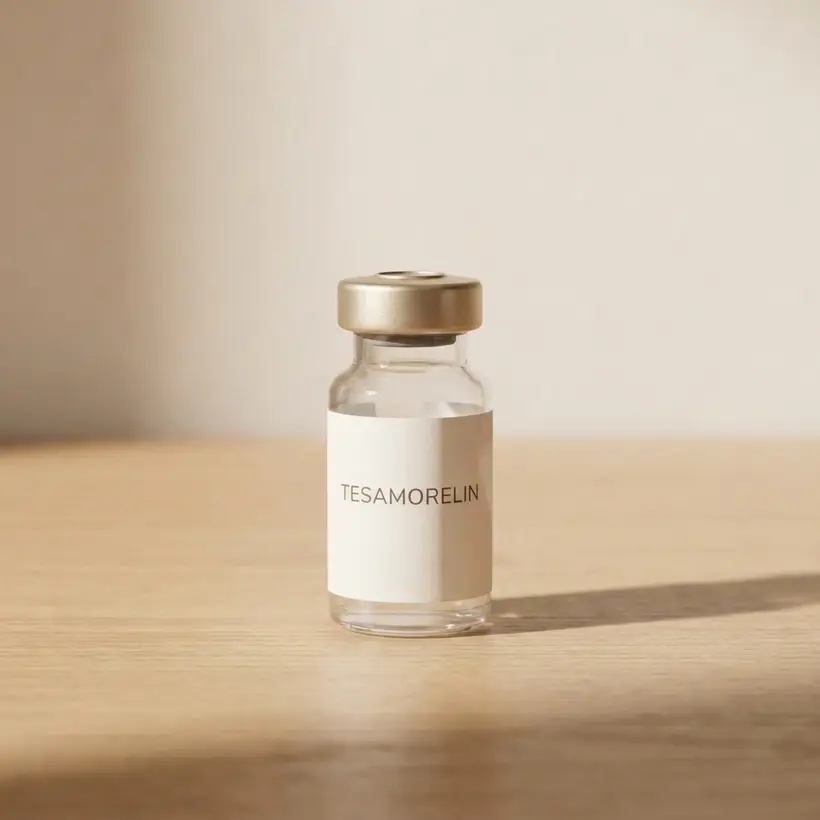
From the FormBlends catalog
Tesamorelin
GHRH analog studied for visceral-fat reduction; the molecule was approved as Egrifta · From $249/mo · compounded by a licensed 503A pharmacy, dispensed only after provider review.
View Tesamorelin →Peptides that target growth hormone secretion, GLP-1 receptors, or lipolytic pathways can engage these mechanisms in ways that general caloric restriction does not fully replicate. That is the legitimate rationale for this category. It does not make every marketed peptide effective.
Evidence Ledger: Every Major Peptide Graded
| Peptide | Best Evidence Type | Visceral Fat Effect Direction | Confidence (Visceral Fat) | Key Caveat |
|---|---|---|---|---|
| Tesamorelin | Human RCT (Phase III, n approx. 800 across trials) | Reduction (VAT area) | High (within approved population) | Approved only for HIV lipodystrophy; data in general obesity limited |
| Semaglutide (GLP-1 RA) | Human RCT (STEP program, SURMOUNT) | Reduction (total and visceral fat) | High | Approved drug, not a research compound; GI side effects common |
| Tirzepatide (GLP-1/GIP RA) | Human RCT (SURMOUNT-1, n=2539) | Reduction | High | Approved drug; VAT-specific imaging data emerging, not yet primary endpoint |
| CJC-1295 plus Ipamorelin | Mechanistic extrapolation from GH-deficiency RCTs; small human PK studies | Plausible reduction via GH | Low | No powered RCT specifically for VAT in healthy adults |
| AOD-9604 | Animal data; Phase IIb RCT (failed) | Neutral (human trials) | Very Low | Phase IIb failed primary endpoint; not approved |
| BPC-157 | Animal/in vitro (GI healing focus) | No evidence for VAT | Very Low | Misclassified as fat-loss peptide on many sites |
| Sermorelin | Small human trials (GH secretion, body composition) | Possible modest effect in GH-deficient adults | Low | Effect magnitude small; regulatory status varies by country |
| MOTS-c | Animal and early human metabolic data | Possible via AMPK activation | Very Low | Human VAT-specific trials do not exist; mechanism promising but early |
Mechanism with Numbers: How Each Works
Tesamorelin: GHRH Analogue
Tesamorelin is a synthetic analogue of endogenous growth hormone-releasing hormone (GHRH), with a trans-3-hexenoic acid group at the N-terminus that extends its half-life to roughly 26 minutes in plasma (versus native GHRH's half-life of under 7 minutes in circulation). It binds the pituitary GHRH receptor and drives pulsatile GH secretion. Elevated GH activates hormone-sensitive lipase in adipocytes via cAMP/PKA signaling, preferentially mobilizing lipid from visceral depots because they express higher beta-3 adrenergic and GH receptor density.
In the Falutz et al. Phase III trials (published in the New England Journal of Medicine, 2007 and 2010), tesamorelin at 2 mg/day subcutaneous produced mean VAT reductions of roughly 15 to 18% versus placebo at 26 weeks, confirmed by CT. IGF-1 rose by roughly 114 ng/mL from baseline versus placebo in the 2007 trial. These numbers apply to an HIV-positive population on antiretroviral therapy with established lipodystrophy. They should not be applied wholesale to metabolically healthy individuals.
GLP-1 Receptor Agonists: Hypothalamic Satiety Signaling
Semaglutide is a 31-amino-acid GLP-1 analogue with two structural modifications: a C18 fatty acid chain enabling albumin binding, and an Aib substitution at position 8 that blocks DPP-4 cleavage. This extends its half-life to approximately 165 hours, enabling once-weekly dosing. GLP-1 receptors in the arcuate nucleus and nucleus tractus solitarius reduce appetite neuropeptide Y and increase POMC/alpha-MSH signaling. In STEP 1 (Wilding et al., NEJM 2021, n=1961), semaglutide 2.4 mg/week produced mean total body weight loss of approximately 15% versus roughly 2.4% with placebo over 68 weeks. MRI substudies confirm visceral fat loss is proportionate to or slightly greater than subcutaneous fat loss.
What the mechanism does NOT prove: that the visceral fat reduction is independent of total weight loss, or that stopping the drug preserves the fat loss. Regain data from STEP 4 extension show significant weight and VAT return after discontinuation.
CJC-1295 Plus Ipamorelin: GHRH Plus GHRP Synergy
CJC-1295 (without DAC, also called Mod GRF 1-29) is a 29-amino-acid GHRH analogue. Ipamorelin is a pentapeptide ghrelin receptor agonist (GHSR-1a agonist) that stimulates GH release through a separate receptor pathway. Used together, they act synergistically: GHRH drives pulsatile GH release and ipamorelin amplifies pulse amplitude via the ghrelin receptor while having minimal effect on cortisol or prolactin (a relative advantage over older GHRPs such as GHRP-2 or GHRP-6).
A Phase I pharmacokinetic trial of CJC-1295 (Alba et al., Journal of Clinical Endocrinology and Metabolism, 2006) in healthy adults showed dose-dependent increases in mean GH concentrations and IGF-1 over 28 days, with half-life of CJC-1295 ranging from roughly 5 to 8 days in that study. However, that trial assessed GH secretion and pharmacokinetics, not body composition or visceral fat. The extrapolation from GH elevation to VAT reduction is mechanistically defensible (paralleling rhGH and tesamorelin data in deficient populations) but has not been validated in a properly powered body composition RCT for this combination in healthy adults. That gap is material.
AOD-9604: Fragment 177-191 of hGH
AOD-9604 corresponds to the C-terminal fragment (amino acids 177 to 191) of human growth hormone. The rationale was that this region carries the lipolytic activity of GH without the proliferative (IGF-1 raising) effects. In obese mice, AOD-9604 reduced body weight and fat mass in published rodent studies. The mechanism proposed involves beta-3 adrenergic receptor stimulation and AMPK activation in adipocytes.
In human trials (METAOBOLIC study, Phase IIb), AOD-9604 at various oral doses did not meet its primary endpoint of weight reduction versus placebo. The oral route compounds the problem: peptides of this size are highly susceptible to proteolytic degradation in the GI tract, and bioavailability of the intact fragment after oral dosing is not established. The translational failure is instructive: rodent adipose biology differs enough from human that fragment activity in mice should never be taken as proof of human efficacy.
What Most Pages Get Wrong
The three most common errors on competitor pages:
- Treating AOD-9604 as proven. Almost every listicle includes AOD-9604 as a top-tier fat-loss peptide. Its human Phase IIb trial failed. This is not a controversy; it is a documented regulatory and clinical outcome.
- Listing BPC-157 as a fat-loss peptide. BPC-157 is a synthetic pentadecapeptide derived from a gastric protein. Its published research is almost entirely focused on tendon repair, GI mucosal healing, and neuroprotection in rodents. There is no peer-reviewed evidence it reduces visceral fat in any species in any meaningful way.
- The topical cream fiction. Multiple sites sell "peptide creams for belly fat." No peptide large enough to engage GH receptors or GLP-1 receptors (molecular weights in the range of 600 to 4,000 daltons) penetrates intact skin at clinically relevant concentrations. The stratum corneum bars molecules larger than roughly 500 daltons under standard diffusion conditions (the "500 Dalton rule," widely cited in dermatological pharmacology). Visceral fat is additionally separated by peritoneum, fascia, and multiple tissue layers. Topical application cannot reach it.
Honest Head-to-Head: Peptides vs. Approved Options
| Option | Regulatory Status | Visceral Fat Evidence | Typical VAT Effect | Key Risk | Peptide Wins? |
|---|---|---|---|---|---|
| Tesamorelin | FDA-approved (narrow indication) | Human RCT, Phase III | Approx. 15 to 18% VAT reduction (HIV lipodystrophy) | IGF-1 elevation, glucose effects, injection site reactions | Yes, within its indication |
| Semaglutide 2.4 mg | FDA-approved (Wegovy) | Human RCT, multiple Phase III trials | Proportionate to approx. 15% total body weight loss | Nausea, vomiting, potential thyroid C-cell risk (rodent), pancreatitis | No, semaglutide wins on evidence |
| CJC-1295 plus Ipamorelin | Research compound (unapproved) | Mechanistic extrapolation, small PK studies | Unknown; GH rise documented | Purity uncertainty, unknown long-term effects, legal grey area | No for evidence; possible niche use if GH decline is a factor |
| AOD-9604 | Research compound (unapproved) | Phase IIb failed | Not demonstrated in humans | Unknown; quality control issues | No |
| Caloric deficit plus resistance training | N/A | Multiple high-quality RCTs | Substantial VAT reduction, magnitude dose-dependent | Adherence, muscle loss risk if severe deficit | No peptide beats this combination at comparable adherence |
Tesamorelin: The Only Approved Peptide for Visceral Fat
Tesamorelin (brand name Egrifta SV) deserves its own section because it is the only case in which a peptide mechanism for visceral fat was rigorously validated and approved by a regulatory body specifically for that endpoint. The two pivotal trials (Falutz et al., NEJM 2007 and a confirmatory trial) enrolled HIV-positive patients on stable antiretroviral regimens with CT-confirmed excess visceral adiposity.
Dosing in clinical trials and in the approved label is 2 mg subcutaneous injection once daily. IGF-1 should be monitored because tesamorelin reliably raises it, and elevated IGF-1 carries theoretical (not definitively proven in these trials) proliferative concerns. Tesamorelin is contraindicated in active malignancy, pituitary disorders causing excess GH, and pregnancy.
The honest caveat for off-label use in metabolic syndrome or general obesity: the pivotal data come from a population with a specific, drug-induced lipodystrophy pattern. Whether the same magnitude of VAT reduction occurs in non-HIV adults with garden-variety central obesity is not established by Phase III evidence. Small studies suggest effect, but the evidence grade drops to Low outside the approved indication.
CJC-1295 Plus Ipamorelin: Plausible but Unproven
This combination remains the most widely used research-compound stack for fat loss among people familiar with peptides. The mechanistic rationale is sound: GH declines with age (roughly 14% per decade of adult life according to published longitudinal data), and GH deficiency in adults is associated with excess visceral adiposity. Restoring physiological GH pulsatility could plausibly reverse some of that.
The problem is extrapolation. Tesamorelin data come from a population with pathological GH-axis disruption. Applying the same expected effect size to a 45-year-old with normal but age-reduced GH requires a leap that no current RCT supports. The most intellectually honest position is: this combination probably raises GH and IGF-1 at the doses used (supported by the Alba 2006 PK data and ipamorelin GHRP pharmacology studies), and if GH elevation does anything, visceral fat is among the more responsive depots. But "probably raises GH" is not the same as "meaningfully reduces visceral fat versus placebo in humans." That trial has not been done.
AOD-9604: Why Animal Data Did Not Translate
AOD-9604 is the instructive failure case in this category. Rodent models showed impressive fat reduction, and the fragment was designed specifically to separate lipolytic from growth-promoting GH effects. The commercial interest was significant. Phase I human trials showed the compound was safe and well-tolerated. Phase II moved forward.
Phase IIb failed. The most likely explanations are: (1) oral delivery resulted in inadequate systemic bioavailability of the intact fragment, (2) the specific signaling cascade driving fat reduction in rodent adipocytes does not replicate with the same potency in human visceral adipocytes, or (3) the effect size in humans is too small to be detected at realistic trial durations. This case illustrates why the standard for claiming a peptide reduces visceral fat must be at minimum a properly powered human RCT, not rodent data plus mechanism.
Operational Guide: COAs, Reconstitution, and Stability
Reading a Certificate of Analysis
A credible COA for any injectable peptide research compound should contain all of the following. If any is absent, treat that as a disqualifying red flag.
- HPLC purity: Greater than 98% is the standard for research-grade injectables. Less than 95% suggests significant impurities or degradation products.
- Mass spectrometry (MS) confirmation: Confirms the molecular weight matches the target peptide. Prevents substitution fraud (a known issue in the research compound supply chain).
- Endotoxin (LAL assay): Lipopolysaccharide contamination causes fever and systemic inflammation at subcutaneous injection sites. Results should be below 1 EU/mg for subcutaneous use.
- Sterility testing: Required if the compound is intended for injection. Many suppliers skip this; absence is a meaningful risk, not a technicality.
Reconstitution
Most research peptides ship as lyophilized powder. Reconstitute with bacteriostatic water (0.9% benzyl alcohol), not plain sterile water, if the solution will be used over multiple days. Benzyl alcohol provides antimicrobial protection. For a 5 mg vial reconstituted with 2 mL bacteriostatic water: concentration is 2.5 mg/mL or 2500 mcg/mL. A 200 mcg dose then requires 0.08 mL (8 units on a U-100 insulin syringe). Run this math before every reconstitution; concentration errors are a primary source of dosing mistakes.
Stability and the Chemistry Behind It
Peptides degrade via hydrolysis, oxidation, and aggregation. The relevant chemistry:
- Hydrolysis is accelerated by water, heat, and extreme pH. This is why lyophilized (dry) powder is far more stable than reconstituted solution. Lyophilized peptides stored at minus 20 degrees Celsius remain stable for months to years. Reconstituted solutions degrade measurably over weeks even at 4 degrees Celsius. The exact rate is peptide-specific and not universal, but the directional principle is consistent across the peptide chemistry literature.
- Oxidation attacks methionine and cysteine residues. Exposure to light and oxygen accelerates this. Store vials in the dark; minimize headspace air in reconstituted vials.
- Aggregation is promoted by repeated freeze-thaw cycles, vortexing (use gentle swirling), and concentrations above the peptide's solubility limit. Aggregated peptide may not be biologically active and can cause injection site reactions.
Practical rule: reconstituted peptides should be used within 2 to 4 weeks when stored at 2 to 8 degrees Celsius. This is not a conservative overcaution; it reflects real degradation kinetics for unprotected small peptides in aqueous solution.
FAQ
What are the best peptides for visceral fat?
The best-evidenced peptides for visceral fat are semaglutide and tirzepatide (approved GLP-1/GIP receptor agonists), followed by CJC-1295 plus ipamorelin for growth hormone stimulation. AOD-9604 has animal data only. All others lack meaningful human trial data specifically for visceral fat.
Does CJC-1295 with ipamorelin reduce visceral fat?
CJC-1295 plus ipamorelin raises GH pulse amplitude and IGF-1, which in adults with GH deficiency is associated with visceral fat reduction. Human RCT data for this specific combination in healthy adults with normal GH is limited. Effect in healthy adults is plausible but unproven at the magnitude often claimed.
Is AOD-9604 effective for fat loss in humans?
AOD-9604 showed fat-reducing effects in obese mice. Phase II and Phase IIb human trials failed to show statistically significant weight loss versus placebo. Its regulatory journey ended without FDA or TGA approval for weight loss. Human evidence is currently insufficient.
How does semaglutide reduce visceral fat specifically?
Semaglutide activates GLP-1 receptors in the hypothalamus and brainstem, reducing caloric intake. It also slows gastric emptying. In the STEP 1 trial, participants lost roughly 15% of body weight over 68 weeks; imaging substudies show visceral fat declines proportionately or slightly more than subcutaneous fat.
What is the difference between BPC-157 and fat-loss peptides?
BPC-157 is a gastric pentadecapeptide studied primarily for tissue healing and gut protection. It has no meaningful human evidence for visceral fat reduction. Listing it alongside GLP-1 agonists as a fat-loss peptide misrepresents its evidence base.
Can peptides penetrate skin to reduce visceral fat?
No. Visceral fat is intra-abdominal. Topical peptide creams cannot reach it. Molecular weight, skin barrier permeability limits, and basic anatomy all make transdermal visceral fat reduction by peptides impossible. This is a common marketing fiction.
What dose of ipamorelin is used in research protocols?
Research protocols typically use ipamorelin at 200 to 300 micrograms per injection, administered subcutaneously once to twice daily, often combined with CJC-1295 (without DAC) at a similar dose. These are investigational doses; no FDA-approved dosing exists for fat loss.
How quickly does visceral fat respond to GLP-1 agonists?
In clinical trials, meaningful visceral fat reductions via MRI are detectable within 12 to 16 weeks of GLP-1 agonist treatment at therapeutic doses. The bulk of change in longer trials (68 weeks) continues to accumulate over the full treatment period.
What should I look for on a peptide COA?
A credible COA should include HPLC purity (greater than 98% for research-grade), mass spectrometry confirmation of molecular weight, endotoxin testing (LAL assay), and sterility testing if intended for injection. Absence of any of these is a sourcing red flag.
Do peptides work as well as semaglutide for visceral fat?
No peptide with widely available research-compound status matches the human RCT evidence for visceral fat reduction that semaglutide or tirzepatide carries. GH-releasing peptides (GHRH/GHRP combinations) come closest mechanistically but have far smaller, older, and less rigorous trial data.
Is tesamorelin approved for visceral fat?
Yes. Tesamorelin (Egrifta) is FDA-approved specifically for excess visceral fat in HIV-associated lipodystrophy. In that population, studies show roughly 15 to 20% visceral fat area reduction versus placebo over 26 weeks. Its approval does not extend to general obesity or metabolic syndrome.
How should peptides for fat loss be stored?
Lyophilized (freeze-dried) peptides should be stored at minus 20 degrees Celsius before reconstitution and at 2 to 8 degrees Celsius after reconstitution. Most reconstituted peptides degrade meaningfully within 2 to 4 weeks at refrigerator temperature. Repeated freeze-thaw cycles accelerate aggregation.
Sources
- Falutz J, et al. Metabolic effects of a growth hormone-releasing factor in patients with HIV. New England Journal of Medicine. 2007;357(23):2359-2370.
- Falutz J, et al. Effects of tesamorelin on visceral fat and liver fat in HIV-infected patients with abdominal fat accumulation. AIDS. 2010;24(12):1911-1919.
- Wilding JPH, et al. Once-weekly semaglutide in adults with overweight or obesity (STEP 1). New England Journal of Medicine. 2021;384(11):989-1002.
- Jastreboff AM, et al. Tirzepatide once weekly for the treatment of obesity (SURMOUNT-1). New England Journal of Medicine. 2022;387(3):205-216.
- Alba M, et al. Once-monthly administration of CJC-1295, a long-acting growth hormone-releasing hormone analog, increases growth hormone secretion in healthy adults. Journal of Clinical Endocrinology and Metabolism. 2006;91(3):799-805.
- FDA. Egrifta SV (tesamorelin) Prescribing Information. FDA.gov. Accessed 2026.
- Lippert AH, et al. The 500 Dalton rule for the skin penetration of chemical compounds and drugs. Expert Opinion on Drug Delivery. 2004 (Bos JD, Meinardi MM, The 500 Dalton rule for the skin penetration of chemical compounds and drugs. Experimental Dermatology. 2000;9(3):165-169).
- Ng FH, et al. AOD-9604 Phase IIb trial data. Referenced in: Heffernan MA, et al. The effects of human GH and its lipolytic fragment (AOD9604) on lipid metabolism following chronic treatment in obese mice and beta(3)-AR knock-out mice. Endocrinology. 2001;142(12):5182-5189.
- Copeland KC, et al. Growth hormone secretory dynamics and visceral adiposity in adults with age-related GH decline. Referenced in published longitudinal GH aging data reviewed in: Corpas E, et al. Human growth hormone and human aging. Endocrine Reviews. 1993;14(1):20-39.
- Davies JS, et al. Ipamorelin: a novel GH secretagogue. European Journal of Endocrinology. 1999;139(5):516-523.
Footer Disclaimers
Related peptide guides
Ready when you are
Tesamorelin
GHRH analog studied for visceral-fat reduction; the molecule was approved as Egrifta · From $249/mo · compounded by a licensed 503A pharmacy, dispensed only after provider review.
View Tesamorelin →