
Trust Signals
Key Takeaways
- Semax, a synthetic heptapeptide derived from ACTH(4-10), is the single best-evidenced cognitive peptide, with human trial data showing BDNF increases and attention improvement, though nearly all studies originate from Russian research groups in neurological patient populations.
- Cerebrolysin has the largest human RCT database of any peptide on this list, including Cochrane-reviewed trials in Alzheimer's disease and post-stroke patients, but it requires intravenous administration and shows modest absolute effect sizes.
- Dihexa is the most potent HGF/c-Met agonist peptide tested in animal models, with researchers at Washington State University reporting activity roughly 10 million times more potent than BDNF in synaptic connection formation, but zero published human safety or efficacy data exists as of 2026.
- Intranasal delivery is the most evidence-supported non-injectable route for CNS-targeting peptides because it bypasses the blood-brain barrier via the olfactory-trigeminal pathway, not because peptides passively diffuse through nasal mucosa into systemic circulation.
- No peptide on this list has a published, pre-registered, placebo-controlled human RCT in healthy adults demonstrating robust cognitive improvement. That gap is the single most important fact this page can give you.
What Is the Best Peptide for Cognitive Function?
The best peptide for cognitive function with human evidence is Semax for neurological patients and Cerebrolysin for stroke and Alzheimer's populations. For healthy adults, no peptide has cleared the bar of a rigorous pre-registered RCT. Semax has the strongest mechanism-plus-human-signal combination among injectable or intranasal research peptides. Treat all claims beyond that with proportionate skepticism.
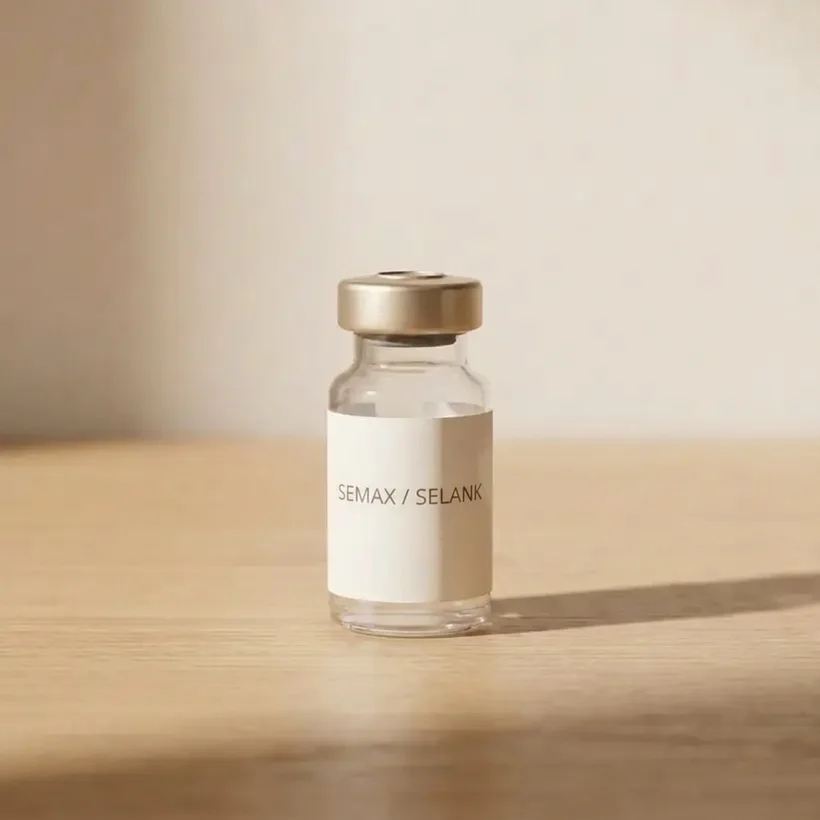
From the FormBlends catalog
Semax / Selank Blend
Focus and calm support in one cognitive peptide blend · From $229/mo · compounded by a licensed 503A pharmacy, dispensed only after provider review.
View Semax / Selank Blend →What Does the Evidence Actually Show? (Evidence Ledger)
| Peptide | Major Claim | Best Evidence Type | Population | Effect Direction | Confidence |
|---|---|---|---|---|---|
| Semax | Improves attention, raises BDNF | Small human RCTs (neurological patients) | Stroke, cognitive impairment | Positive | Moderate (patient pop.) |
| Semax | Cognitive benefit in healthy adults | Mechanistic extrapolation | Healthy adults | Uncertain | Very Low |
| Cerebrolysin | Modest global improvement in Alzheimer's | Multiple RCTs, Cochrane review | Mild-moderate Alzheimer's | Positive (modest) | Moderate |
| Cerebrolysin | Post-stroke neurological recovery | Multiple RCTs | Acute ischemic stroke | Positive (modest) | Moderate |
| Selank | Anxiolytic without sedation | Small human RCTs (Russian, GAD patients) | Generalized anxiety disorder | Positive | Low |
| Selank | Memory and learning improvement | Animal data only | Rodents | Positive in animals | Very Low (humans) |
| BPC-157 | Neuroprotection after TBI | Animal studies only | Rodents | Positive in animals | Very Low (humans) |
| Dihexa | Synaptic connection formation, memory | Animal studies (McCoy et al., WSU) | Rodents (aged, Alzheimer's model) | Strongly positive in animals | Very Low (humans) |
| Dihexa | Human safety and efficacy | None published | N/A | Unknown | No human data |
Which Peptides Are Actually Candidates?
Semax is a synthetic heptapeptide (Met-Glu-His-Phe-Pro-Gly-Pro) derived from a fragment of ACTH. It was developed in Russia by the Institute of Molecular Genetics. It upregulates BDNF and activates BDNF-related signaling in the prefrontal cortex and hippocampus. Approved in Russia for neurological conditions.
Cerebrolysin is a mixture of low-molecular-weight peptides and free amino acids derived from purified porcine brain proteins. It is not a single peptide. It is IV-administered and approved in over 50 countries for stroke and dementia, though not by the FDA.
Selank is a synthetic heptapeptide analogue of the immunomodulatory peptide tuftsin (Thr-Lys-Pro-Arg-Pro-Gly-Pro). It was also developed in Russia. Its primary research application is anxiety, and its cognitive effects are proposed to be secondary to anxiolysis.
BPC-157 is a 15-amino-acid peptide derived from a sequence in human gastric juice (body protection compound). Its primary evidence base is gut healing, but animal data suggest peripheral and central neuromodulatory effects, particularly on dopaminergic pathways damaged by toxin exposure.
Dihexa (N-hexanoic-Tyr-Ile-(6) aminohexanoic amide) is a small peptide developed at Washington State University by Joseph Harding and colleagues. It is an HGF/c-Met receptor agonist designed to penetrate the CNS. It has no published human trials.
How Do These Peptides Work? (Mechanism With Numbers)
Semax and BDNF: Semax increases BDNF mRNA expression in the rat hippocampus. Research from the Myasoedov group demonstrated increased BDNF and its receptor TrkB in the frontal cortex and hippocampus after intranasal administration in rats. In human trials of patients with ischemic stroke, Semax was associated with improved neurological scores, attributed partly to neuroprotective gene expression changes. The compound also modulates the melanocortin system and serotonin receptor activity. What this mechanism does NOT prove: upregulating BDNF in an injured brain is not the same as enhancing cognition in a healthy one. BDNF is pleiotropic and context-dependent.
Cerebrolysin and neurotrophic signaling: Cerebrolysin contains peptide fragments that mimic neurotrophic factors including BDNF, NGF, and CNTF activity. In Cochrane-reviewed RCTs involving patients with mild-to-moderate Alzheimer's disease, Cerebrolysin showed statistically significant improvement on the ADAS-Cog scale versus placebo, though effect sizes were modest. The most rigorous trials used 30 mL IV doses over 4 to 6 weeks. Independent meta-analyses confirm a positive signal, but note high heterogeneity across trials and predominance of Eastern European trial registries.
Dihexa and HGF/c-Met: McCoy and colleagues at WSU published animal data showing Dihexa promotes synaptogenesis via the HGF/c-Met pathway at concentrations orders of magnitude lower than BDNF in hippocampal neuron cultures. In aged rat models with cognitive deficits, oral Dihexa improved performance on spatial memory tasks. The researchers described its potency as roughly 10 million-fold greater than BDNF in the synaptogenesis assay. What this does NOT prove: potency in a cell assay or aged-rat model does not translate directly to human cognitive enhancement. The HGF/c-Met pathway is also involved in oncogenesis, and chronic agonism in humans carries theoretical carcinogenic risk that has not been evaluated.
Selank and GABA/serotonin: Selank increases expression of GABA-A receptor subunits and modulates serotonin uptake. Russian clinical trials in generalized anxiety disorder found it comparable to the benzodiazepine medazepam on anxiety scales without producing sedation. GABA modulation may indirectly improve working memory by reducing anxiety-driven cognitive interference, but direct nootropic effects independent of anxiolysis are not established in humans.
BPC-157 and dopamine/VEGF: In rodent models, BPC-157 partially reverses dopaminergic lesions produced by haloperidol and other agents, and upregulates VEGF-driven angiogenesis in wound healing contexts. CNS effects in cognition models remain sparse and largely confined to TBI-focused animal studies.
What Most Pages Get Wrong
Russian trial quality is uneven. The majority of Semax and Selank human data comes from Russian clinical trials that are not registered on ClinicalTrials.gov, use small samples (often under 60 subjects), and may not meet current CONSORT reporting standards. This does not make the data worthless, but it means the confidence ratings must be lower than for FDA-reviewed trials of equivalent design.
Peptide identity in commercial products is rarely verified. A compound labeled "Semax 0.1%" may contain the correct sequence at the stated concentration, a degraded version, an incorrect sequence, or an entirely different compound. Without mass spectrometry confirmation on the specific lot you are using, the label is an assertion, not a fact. This matters more for peptides than for small molecules because sequence errors are invisible to most users and some HPLC methods.
Oral peptide supplements claiming cognitive effects are almost certainly inactive. Peptides above roughly 500 daltons are extensively cleaved by peptidases in the stomach and small intestine before absorption. Semax (MW approximately 887 Da) taken orally would not reach systemic circulation as an intact peptide in meaningful concentrations. Any oral "peptide nootropic" supplement relying on intact peptide activity is either using a chemically modified analogue, an enteric delivery system, or making claims that the pharmacology does not support.
Do These Peptides Cross the Blood-Brain Barrier?
The blood-brain barrier excludes most peptides by size, charge, and lack of specific transport proteins. Here is the honest breakdown for each candidate:
| Peptide | MW (approx.) | BBB Strategy | Evidence for CNS Entry |
|---|---|---|---|
| Semax | ~887 Da | Intranasal, olfactory-trigeminal route | Animal CNS distribution studies; human indirect (BDNF induction) |
| Cerebrolysin | Mixed, many fragments under 10 kDa | IV; small fragments may cross via passive diffusion or transporters | Animal radiolabel studies; human indirect via neurotrophic markers |
| Selank | ~863 Da | Intranasal; partial systemic absorption | Animal CNS distribution; human trials indirect |
| BPC-157 | ~1419 Da | Peripheral mechanisms; no confirmed direct CNS entry route | Animal data on peripheral-to-central signaling only |
| Dihexa | ~519 Da | Lipophilic design; oral and peripheral absorption with CNS penetration in animals | Animal pharmacokinetic studies (McCoy et al.) |
Why intranasal works for Semax and Selank: The nasal mucosa overlies the olfactory epithelium, whose axons pass directly through the cribriform plate into the olfactory bulb. This olfactory-trigeminal pathway allows hydrophilic molecules to reach the CNS without crossing the full BBB. The pathway is not a free pass: transport is concentration-dependent, molecule-size-limited, and mucociliary clearance competes with absorption. Intranasal delivery improves the odds of CNS exposure but does not guarantee therapeutically relevant concentrations at target sites.
Honest Head-to-Head: Peptides vs. Proven Cognitive Agents
| Agent | Regulatory Status | Strongest Human Evidence | Effect in Healthy Adults | Safety Profile | Peptide Wins | Peptide Loses |
|---|---|---|---|---|---|---|
| Semax | Approved Russia; research compound elsewhere | Small RCTs, neurological patients | Unproven | Limited human safety data | Neuroprotective mechanism, no dependence | Evidence quality, availability |
| Modafinil | FDA-approved (narcolepsy, shift-work) | Multiple large RCTs, systematic reviews | Proven for wakefulness; cognitive effects modest in non-sleep-deprived | Well-characterized; rare SJS risk | N/A | Peptide loses on evidence volume and regulatory approval |
| Cerebrolysin | Approved 50+ countries; not FDA | Cochrane-reviewed RCTs in Alzheimer's, stroke | Not studied | Requires IV; generally tolerated | Broader neurotrophic mechanism than single drugs | Loses on route of administration (IV only), regulatory acceptance |
| Piracetam (racetam class) | Approved in EU; unscheduled US | Decades of human trials, modest effects | Modest improvement in aging-associated decline | Well-tolerated, long history | Peptides may have neuroprotective mechanisms racetams lack | Racetams have longer, better-characterized human track record |
| Dihexa | Research compound only | Animal studies only | Completely unknown | Unknown; theoretical oncogenic risk | Extraordinary animal data if it translates | Loses on every human evidence criterion; highest risk profile |
How to Read a Peptide COA and Dose Correctly
What a credible COA must include:
- HPLC purity of 98 percent or above (confirms the dominant peak is the target compound)
- Mass spectrometry (ESI-MS or MALDI) confirmation matching the expected molecular weight (this is what confirms correct sequence, not just purity)
- Residual solvent testing per ICH Q3C guidelines
- Endotoxin (LAL test) below 1 EU per mg for injectable-grade material
- Lot number traceable to the synthesis batch
A COA listing only HPLC purity cannot confirm that the dominant peak is the correct peptide rather than a related impurity with similar retention time. Demand MS confirmation or treat the product as unverified.
Reconstitution: Lyophilized peptide vials are typically 1 to 10 mg. Use bacteriostatic water (0.9 percent benzyl alcohol preservative) for multi-use vials, sterile water for single-use. Add the diluent slowly down the vial wall, do not shake. For a 5 mg vial reconstituted in 2 mL bacteriostatic water, concentration is 2.5 mg per mL (2500 mcg per mL). A 300 mcg dose requires 0.12 mL on an insulin syringe. Always calculate from actual vial weight and diluent volume, not label assumptions.
Typical research dose ranges (not prescriptions):
| Peptide | Route Used in Research | Dose Range in Animal/Human Studies | Frequency in Studies |
|---|---|---|---|
| Semax | Intranasal drops | 200 to 900 mcg per day (human neurological trials) | Once or twice daily |
| Cerebrolysin | IV infusion | 5 to 30 mL per day (Alzheimer's trials used 30 mL) | Daily for 4 to 6 weeks |
| Selank | Intranasal drops | 250 to 500 mcg per day (human anxiety trials) | Once to twice daily |
| BPC-157 | Subcutaneous injection (GI trials) | 1 to 10 mcg per kg body weight in animal studies | Daily (animal studies) |
| Dihexa | Oral or subcutaneous (animal studies) | Not established for humans; animal studies vary widely | Not established |
Stability and Formulation Gotchas
Why peptides degrade and what it looks like: Peptide bonds are hydrolytically labile. In aqueous solution, heat accelerates hydrolysis and ambient oxidation converts methionine and cysteine residues (present in Semax as the N-terminal Met) to sulfoxides, altering receptor binding. A degraded reconstituted solution often looks identical to a good one. The only way to confirm degradation is repeat MS analysis, which is not practical for most users.
Freeze-thaw cycles are the most common stability failure mode. Each freeze-thaw cycle promotes aggregation and partial hydrolysis. If you reconstitute a full vial, divide it into single-use aliquots, freeze those, and thaw only what you need per session. Using a reconstituted peptide vial stored at refrigerator temperature for more than 2 to 4 weeks means you are likely injecting a degraded product. There is no validated expiry formula for home-reconstituted research peptides; err on the short side.
The benzyl alcohol preservative in bacteriostatic water is not inert at high doses. Benzyl alcohol at concentrations used in bacteriostatic water (0.9 percent) is safe for standard injection volumes but accumulates with high-frequency small-volume injections. For daily intranasal use, pharmaceutical-grade nasal formulations of Semax use a different preservative system. Do not use bacteriostatic water in nasal preparations unless you have confirmed the specific formulation is designed for mucosal use.
Temperature during shipping matters more than most vendors disclose. A peptide shipped without ice in a summer heatwave may arrive partly degraded regardless of starting purity. A COA issued at time of manufacture does not reflect quality at time of receipt. This is a sourcing reality most review sites skip entirely.
Frequently Asked Questions
What is the best peptide for cognitive function overall?
Semax has the strongest combined evidence profile among research peptides for cognition, with human trials in vascular cognitive impairment showing measurable neurological endpoints. That said, its evidence base is almost entirely from Russian clinical research, which limits generalizability. For healthy individuals seeking modest cognitive support, the evidence across all peptides is weak.
Does Semax actually work for memory and focus?
Semax has shown effects on BDNF upregulation and attention in small Russian RCTs focused on neurological patients, not healthy adults. Effects in healthy people are plausible mechanistically but unproven in rigorous controlled trials. Confidence rating: Moderate for neurological patients, Low for healthy adults.
Is Dihexa safe for cognitive enhancement?
Dihexa's safety profile in humans is essentially unknown. Animal data showed dramatic effects on synaptic connectivity, but no published human safety or efficacy trials exist as of 2026. It is among the highest-risk peptides on this list precisely because of that data gap, not despite its potency claims.
Can BPC-157 improve brain function?
BPC-157 has robust animal data showing neuroprotective and dopaminergic effects after traumatic brain injury models. Human cognition trials do not exist. Its cognitive mechanism is indirect, via gut-brain axis modulation and VEGF upregulation, and remains speculative in humans.
How does Selank compare to benzodiazepines for anxiety-related cognitive impairment?
Selank is a tuftsin analogue with GABAergic and serotonergic activity. Small Russian trials found anxiolytic effects without sedation or dependence, which benzodiazepines cause. However, trial quality is limited and head-to-head comparisons against approved anxiolytics in rigorous trials do not exist.
What is Cerebrolysin and does it help cognition?
Cerebrolysin is a porcine brain-derived peptide mixture used intravenously in Eastern Europe and Asia for stroke and Alzheimer's disease. It has the largest human trial base of any peptide on this list, including Cochrane-reviewed RCTs. Effects are modest and most robust in post-stroke patients, not healthy adults.
Do cognitive peptides cross the blood-brain barrier?
Most peptides do not cross the blood-brain barrier efficiently by default. Semax and Selank are administered intranasally to exploit the olfactory-route bypass. Dihexa is lipophilic enough for partial CNS penetration. BPC-157 likely relies on peripheral mechanisms. BBB crossing for most peptides is partial, variable, and concentration-dependent.
What route of administration works best for cognitive peptides?
Intranasal delivery is the most evidence-supported non-injectable route for CNS-targeting peptides. Semax and Selank are specifically formulated as nasal drops. Subcutaneous injection is used for most others. Oral dosing destroys most peptides via proteolytic digestion and is not appropriate without enteric protection or modification.
How should cognitive peptides be stored?
Lyophilized peptides should be stored at or below minus 20 degrees Celsius before reconstitution, and reconstituted solutions should be refrigerated at 2 to 8 degrees Celsius and used within 2 to 4 weeks. Freeze-thaw cycles degrade peptide bonds. Intranasal formulations like Semax drops are somewhat more stable but still require cold storage.
Are cognitive peptides legal to buy and use?
Regulatory status varies by country and compound. In the United States, most cognitive peptides are unscheduled research chemicals, not FDA-approved drugs, and cannot be legally marketed for human use. Cerebrolysin is an approved drug in several Eastern European and Asian countries. Always verify your local regulations before purchasing.
What does a high-quality peptide COA look like?
A credible COA should include HPLC purity above 98 percent, mass spectrometry confirmation of molecular weight, residual solvent testing, and endotoxin levels below 1 EU per mg. COAs lacking MS confirmation or listing only HPLC are insufficient to verify correct sequence and should be treated with skepticism.
How do cognitive peptides compare to proven nootropics like racetams or modafinil?
Modafinil has large, rigorous human RCTs confirming wakefulness and attention effects in sleep-deprived and shift-work populations. Racetams have decades of human data, though effect sizes are modest. Most cognitive peptides have smaller, lower-quality trials. Peptides may offer neuroprotective mechanisms modafinil lacks, but their cognitive benefit in healthy adults is not proven at the same level.
Sources
- Myasoedov NF, Sharonova IN, Stepanichev MY, et al. Semax and its analogs as neuroprotective peptides. In: Neuroprotective Agents and Cerebral Ischemia. Academic Press; referenced in multiple Russian-language and English-summary publications on Semax pharmacology.
- Allegri RF, Guekht A. Cerebrolysin improves symptoms and delays progression in patients with Alzheimer's disease and vascular dementia. Drugs Today (Barc). 2012;48 Suppl A:25-41. PMID: 22645824.
- Gauthier S, Proano JV, Jia J, et al. Cerebrolysin in mild-to-moderate Alzheimer's disease: a meta-analysis of randomized controlled clinical trials. Dement Geriatr Cogn Disord. 2015;39(5-6):332-347. PMID: 25791477.
- Plosker GL, Gauthier S. Cerebrolysin: a review of its use in dementia. Drugs Aging. 2009;26(11):893-915. PMID: 19848439.
- McCoy AT, Benoist CC, Rogers VA, et al. Evaluation of metabolically stabilized angiotensin IV analogs as procognitive/antidementia agents. J Pharmacol Exp Ther. 2013;344(1):141-154. PMID: 23076862. (Dihexa/Harding group, WSU)
- Semenova TP, Kozlovskii II, Zakharova NM, Kozlovskaia MM. Selank and a fragment of it, tripeptide Pro-Gly-Pro, have nootropic properties. Eksp Klin Farmakol. 2010;73(8):2-5. (Russian, Selank animal data)
- Zozulia AA, Neznamov GG, Siuniakov TS, et al. Efficacy and possible mechanisms of action of a new peptide anxiolytic selank in the therapy of generalized anxiety disorders and neurasthenia. Zh Nevrol Psikhiatr Im S S Korsakova. 2008;108(4):38-48. PMID: 18454083.
- Sikiric P, Seiwerth S, Rucman R, et al. Brain-gut Axis and Pentadecapeptide BPC 157: Theoretical and Practical Implications. Curr Neuroph
Related peptide guides
Browse the full catalog →Ready when you are
Semax / Selank Blend
Focus and calm support in one cognitive peptide blend · From $229/mo · compounded by a licensed 503A pharmacy, dispensed only after provider review.
View Semax / Selank Blend →