
Trust Signals
Key Takeaways
What Are the Best Peptides for Cognitive Function?
The best peptides for cognitive function, ranked by evidence quality, are Semax (strongest human data), Selank (anxiolytic-nootropic, human clinical trials), Dihexa (most potent mechanism, zero human safety data), BPC-157 (rodent neuroprotection only), and Epithalon (aging-adjacent, indirect cognitive rationale). None have FDA-approved cognitive indications. Semax leads, but the entire category is low-to-moderate evidence at best.
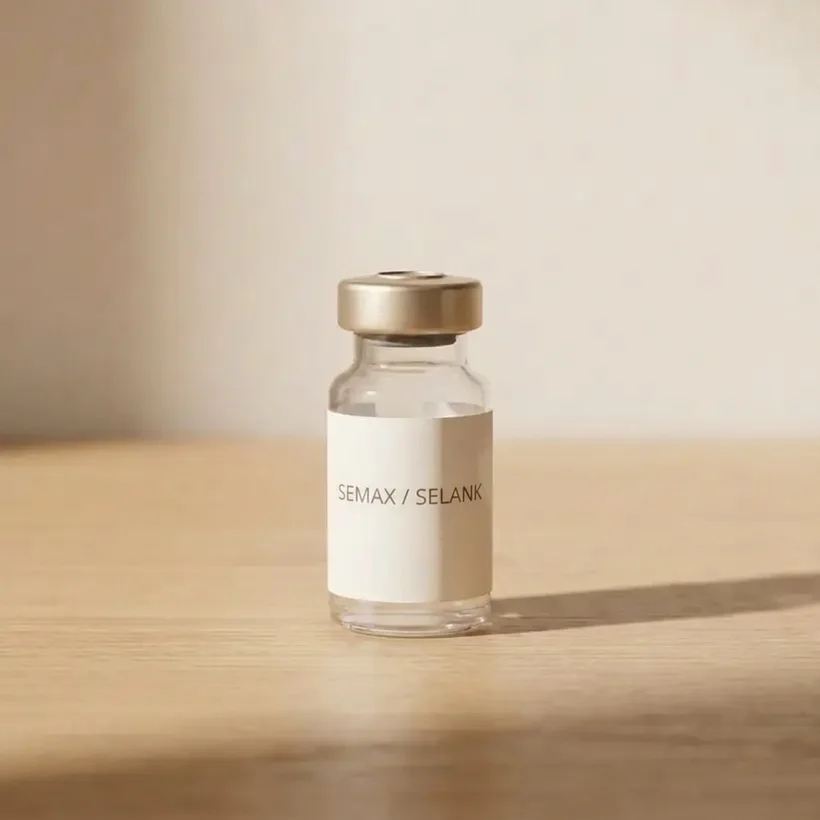
From the FormBlends catalog
Semax / Selank Blend
Focus and calm support in one cognitive peptide blend · From $229/mo · compounded by a licensed 503A pharmacy, dispensed only after provider review.
View Semax / Selank Blend →Table of Contents
- 1. Evidence Ledger: Every Major Claim Graded
- 2. How Cognitive Peptides Work: Mechanism With Real Numbers
- 3. The Top 5 Peptides for Cognitive Function Reviewed
- 4. What Most Pages Get Wrong (BBB and Bioavailability)
- 5. Why Storage and Formulation Rules Exist: The Chemistry
- 6. Honest Head-to-Head: Peptides vs. Real Alternatives
- 7. Operational Guide: How to Read a COA and Dose Safely
- 8. FAQ
- 9. Sources
What Does the Evidence Actually Say? (Ledger)
| Claim | Peptide | Best Evidence Type | Effect Direction | Confidence |
|---|---|---|---|---|
| Upregulates BDNF and NGF in hippocampus | Semax | Animal + small human clinical trials (Russian registry) | Positive | Moderate |
| Reduces anxiety and mildly improves memory in clinical populations | Selank | Russian Phase II/III trials in generalized anxiety | Positive | Moderate (limited independent replication) |
| Promotes synaptogenesis via HGF/Met signaling | Dihexa | In vitro and rodent (Washington State University) | Positive in animals | Low (no human data) |
| Neuroprotection and dopamine modulation | BPC-157 | Rodent studies only | Positive in animals | Very Low (cognitive endpoint) |
| Telomerase activation and longevity-adjacent anti-aging | Epithalon | Animal studies, small Russian human aging trials | Positive trend in aging biomarkers | Very Low (cognitive endpoint) |
| Neuroprotection in acute ischemic stroke | Semax | Russian RCT (Mkhitaryan et al., reported in Russian literature) | Positive | Moderate (single-country RCT base) |
| Cognitive enhancement in healthy adults | Any peptide listed | Mechanism extrapolation only | Unknown | Very Low |
How Do These Peptides Work? Mechanism With Real Numbers
Semax: ACTH Analogue and Neurotrophin Driver
Semax is a synthetic heptapeptide (Met-Glu-His-Phe-Pro-Gly-Pro) representing the 4-10 fragment of ACTH. Unlike ACTH, it has no adrenocortical activity because the steroidogenic signaling domain is absent. Its nootropic mechanism centers on upregulation of BDNF and NGF transcription in hippocampal and cortical tissue, documented in rodent studies at doses in the microgram-per-kilogram range. Russian research groups also report modulation of dopamine D1/D2 receptor density and serotonin turnover after repeat dosing, though the exact receptor binding kinetics have not been characterized with the precision available for approved drugs.
What this mechanism does NOT prove: upregulating BDNF in a healthy hippocampus does not automatically translate to measurable cognitive improvement. BDNF has pleiotropic roles; excess signaling in certain contexts is associated with pain sensitization and oncogenic risk in rodent models, though these effects have not been documented at Semax doses used clinically.
Selank: Tuftsin Analogue and GABAergic Modulator
Selank (Thr-Lys-Pro-Arg-Pro-Gly-Pro) is a synthetic analogue of the immunopeptide tuftsin with a Pro-Gly-Pro stabilizing sequence added to slow enzymatic degradation. Its primary documented mechanism is potentiation of GABA-A receptor function without direct binding at the benzodiazepine site, producing anxiolysis without the sedation or dependence profile of benzodiazepines. It also affects serotonin and enkephalin metabolism. Russian clinical trials in generalized anxiety disorder showed anxiolytic effects comparable to phenibut with less sedation. The nootropic effect is largely a secondary consequence of reducing anxiety-driven cognitive impairment rather than a direct enhancement mechanism.
Dihexa: HGF/Met Signaling and Synaptogenesis
Dihexa (N-hexanoic-Tyr-Ile-(6) aminohexanoic amide) was developed by Joseph Harding's group at Washington State University as an orally active angiotensin IV analogue. It binds hepatocyte growth factor (HGF) and facilitates HGF interaction with its receptor c-Met, which drives synaptic density increases in rodent hippocampal preparations. The WSU group reported that Dihexa is roughly a million times more potent than BDNF in a spinogenesis assay, meaning extremely small concentrations produce measurable dendritic spine formation in vitro. This single in vitro figure has been heavily extrapolated in nootropic communities. What it does not prove: potency in a cell culture spinogenesis assay does not correlate with cognitive effect size in a living human, nor does it indicate safety. HGF/Met pathway activation is also a recognized driver of tumor growth and metastasis, which makes the absence of human toxicology data genuinely concerning rather than merely an academic gap.
BPC-157: Dopamine System Stabilization
BPC-157 (Body Protection Compound, a 15-amino-acid sequence derived from human gastric juice protein) modulates dopamine D2 receptor expression and reverses dopamine system disruptions induced by neuroleptics in rodent models. It also affects nitric oxide signaling and angiogenesis pathways. The cognitive angle is almost entirely inferred from its neuroprotective actions in rodent trauma and toxin models. There is no mechanistic pathway unique to BPC-157 that produces cognitive enhancement in a neurologically intact system.
The Top 5 Cognitive Peptides: Individual Reviews
1. Semax
Typical research dose: 300 to 600 mcg intranasally, once or twice daily. Russian clinical use extends to higher doses (up to 1 mg/day) in acute neurological settings. Half-life is short (minutes in plasma) which is why intranasal delivery matters for CNS access. Most commonly sourced as a 0.1% nasal solution (1 mg/mL). Best candidate for human cognitive benefit in the list.
2. Selank
Typical research dose: 250 to 500 mcg intranasally. Also has a short plasma half-life; the Pro-Gly-Pro addition meaningfully extends its stability compared to tuftsin. Most useful framing: an anxiolytic with cognitive side-benefits rather than a pure nootropic. Lower risk profile than most peptides in this list based on available clinical data.
3. Dihexa
No established human dose. Animal studies used milligram-per-kilogram oral dosing. Given the HGF/Met oncogenic risk and total absence of human safety data, this peptide carries the highest uncertainty-adjusted risk in the list. Its potency figure is real and striking; its safety profile is entirely unknown. Self-experimentation communities report oral or transdermal use. Neither route has pharmacokinetic validation in humans.
4. BPC-157
Typical research dose: 250 to 500 mcg subcutaneous injection. Extremely stable peptide; resistant to enzymatic degradation in the gut, which makes oral dosing plausible for GI targets but does not address CNS penetration. Cognitive use is speculative extrapolation. Lowest evidence burden for a cognitive claim of all peptides listed here.
5. Epithalon
Typical research dose: 5 to 10 mg subcutaneous or intravenous in Russian aging studies. A tetrapeptide (Ala-Glu-Asp-Gly) purported to activate telomerase via epigenetic mechanisms. Cognitive benefit is entirely hypothetical, derived from its anti-aging rationale. No cognitive endpoint has been the primary outcome in any published Epithalon trial.
What Most Pages Get Wrong: BBB Penetration Is the Core Problem
BPC-157 and Dihexa have been proposed as exceptions with better CNS penetration, but the data supporting this is largely in rodents and does not translate directly to humans. For Dihexa, oral bioavailability data in humans is absent. Do not assume peripheral injection equals brain delivery for any peptide in this list.
Why the Storage Rules Exist: The Chemistry
Lyophilized vs. reconstituted stability: Lyophilized (freeze-dried) peptides are stable because water activity is near zero, which halts the main degradation pathways: hydrolysis of peptide bonds, oxidation of susceptible residues (methionine, cysteine, tryptophan), and deamidation of asparagine and glutamine residues. Once you add bacteriostatic water, all three pathways reactivate. Hydrolysis rate increases with temperature. Oxidation accelerates with light and dissolved oxygen.
Why Semax is especially sensitive: Semax begins with a methionine residue (Met-Glu-His...). Methionine sulfur is readily oxidized to methionine sulfoxide, which disrupts the peptide's receptor binding geometry. This is not a minor potency reduction; methionine oxidation in ACTH-related peptides substantially eliminates biological activity. Storing reconstituted Semax above refrigerator temperature or in light-exposed vials accelerates this irreversibly. The oxidized form is colorless and odorless, meaning you cannot detect degradation visually.
Freeze-thaw cycling: Each freeze-thaw cycle promotes aggregation through ice crystal formation that disrupts tertiary structure and causes hydrophobic regions to cluster. Aggregate peptide is not bioavailable and may be immunogenic. Aliquot solutions into single-use volumes before freezing to avoid cycling.
Bacteriostatic water vs. sterile water: Bacteriostatic water contains 0.9% benzyl alcohol, which prevents microbial growth in multi-use vials over the 28-day refrigerated window. Sterile water has no preservative and should be used only for single-dose preparations used immediately. The benzyl alcohol concentration in bacteriostatic water is far below the threshold for peptide denaturation but is incompatible with neonatal or intrathecal use.
Honest Head-to-Head: Cognitive Peptides vs. Real Alternatives
| Comparator | Evidence Base | Cognitive Endpoint | Regulatory Status | Where Peptides Win | Where Peptides Lose |
|---|---|---|---|---|---|
| Donepezil (AChEI) | Multiple large Phase III RCTs in Alzheimer's disease | Slows decline in AD, modest effect size | FDA-approved | Potentially different mechanism (neurotrophin vs. AChE); Semax may complement | Far less evidence; no approval; unknown long-term safety |
| Piracetam / Racetams | Decades of human trials, mixed results | Some benefit in cognitive impairment, weak in healthy adults | Not FDA-approved but widely researched | Peptides may have more targeted mechanisms | Racetams have far more human exposure data and a longer safety record |
| Modafinil | Multiple RCTs in sleep disorders; off-label cognition data | Wakefulness, executive function in sleep-deprived or ADHD-adjacent populations | FDA-approved (narcolepsy) | Peptides carry no Schedule IV classification | Modafinil has reproducible, robust wakefulness data; peptides do not |
| Caffeine + L-theanine | Multiple small RCTs | Attention and working memory improvements documented | GRAS / food supplement | Peptides address neurotrophin pathways caffeine does not touch | Caffeine combination has better replicated acute cognitive evidence than any peptide |
| Exercise (aerobic) | Robust RCT evidence for BDNF upregulation and hippocampal volume | Documented improvement in memory and executive function | N/A | Peptides require less time investment per session | Exercise has superior evidence for the same BDNF pathway; free; no sourcing risk |
How to Read a COA and Dose Cognitive Peptides Safely
Certificate of Analysis: What to Demand
A legitimate COA for a research peptide should contain: (1) HPLC chromatogram showing purity as a percentage of total peak area, minimum 98% for research use; (2) mass spectrometry (MS) data confirming the molecular weight matches the expected sequence; (3) lot number traceable to a synthesis batch; (4) synthesis date and retest date. If a supplier provides only an HPLC percentage without MS confirmation, you cannot verify that the correct peptide was synthesized. A 99% pure sample of the wrong peptide is 99% useless and potentially dangerous.
Reading an HPLC Trace
The main peak area divided by total peak area equals purity percentage. Single sharp peaks are good. Multiple peaks suggest impurities, degradation products, or diastereomers. Broad peaks suggest aggregation or poor synthesis. Ask suppliers for the raw trace, not just the reported percentage.
Reconstitution Math
A standard 5 mg vial of Semax reconstituted with 5 mL bacteriostatic water yields a 1 mg/mL (0.1%) solution, which is the standard clinical concentration. A typical intranasal research dose of 300 mcg equals 0.3 mL of this solution. A standard nasal atomizer (like a MAD Nasal device) delivers approximately 0.1 mL per actuation, so 300 mcg requires 3 actuations split between nostrils. Confirm your device's delivery volume before calculating doses.
Degradation Signs
Reconstituted peptide solutions that have degraded may appear cloudy (aggregation), develop visible particles, or change color slightly. However, oxidized peptides (the primary degradation pathway for methionine-containing peptides like Semax) are visually identical to intact peptide. This means you cannot rely on visual inspection alone. Respect the 2 to 4 week refrigerated window and discard based on time, not appearance.
FAQ
What is the best peptide for cognitive function overall?
Semax has the strongest human evidence base among cognitive peptides, with Russian clinical trials showing BDNF upregulation and benefits in stroke recovery and attention. For healthy adults, the evidence is much thinner. No single peptide has strong RCT data in healthy human populations comparable to approved nootropics.
Do peptides for cognition actually cross the blood-brain barrier?
Very few peptides cross the blood-brain barrier meaningfully by peripheral injection. Semax and Selank are designed for intranasal delivery specifically to exploit olfactory-trigeminal pathways that bypass the BBB. Most other peptides have poor CNS penetration from subcutaneous injection, which is a critical limitation most review pages omit.
What is Semax and how does it work for cognition?
Semax is a heptapeptide analogue of ACTH(4-7) developed in Russia. It upregulates BDNF and NGF in the hippocampus, modulates dopaminergic and serotonergic tone, and shows neuroprotective effects in ischemic models. Human data exists primarily from Russian clinical trials in stroke and cognitive decline, not healthy adult enhancement.
Is Selank effective for anxiety and cognition together?
Selank is a synthetic analogue of tuftsin with anxiolytic and mild nootropic properties documented in Russian clinical studies. It modulates GABA-A receptor sensitivity and affects serotonin metabolism. Evidence for combined anxiety-plus-cognition benefit exists at the clinical trial level in Russia but lacks large independent RCT replication in Western populations.
What is Dihexa and is it safe?
Dihexa is a hexapeptide derived from angiotensin IV that potently stimulates HGF/Met signaling, promoting synaptogenesis in rodent models. It is roughly a million times more potent than BDNF in some in vitro assays per Washington State University research. Human safety data is essentially absent, making risk assessment impossible. It should be considered very high risk.
Does BPC-157 help brain or cognitive function?
BPC-157 has neuroprotective and dopamine-modulating effects documented in rodent studies, including reversal of neuroleptic-induced deficits. Its cognitive benefits in humans are entirely speculative. The peptide is primarily studied for gut and tendon healing; cognitive application is a downstream extrapolation from animal data only.
How should cognitive peptides be stored?
Lyophilized peptide powder is stable at room temperature for weeks but degrades faster with humidity and light. Reconstituted solutions should be refrigerated at 2 to 8 degrees Celsius and used within 2 to 4 weeks. Freeze-thaw cycles accelerate aggregation. Intranasal peptides like Semax are especially sensitive to temperature because oxidation of methionine residues destroys activity.
What purity level should a cognitive peptide have?
Research-grade peptides should have HPLC purity of at least 98 percent with a matching mass spectrometry confirmation. A certificate of analysis showing only HPLC purity without mass spec cannot confirm the correct sequence. Many gray-market suppliers provide HPLC data that confirms a peptide bond is present but not that the peptide is the correct one.
How do cognitive peptides compare to racetams or approved drugs?
Approved drugs like donepezil and memantine have large Phase III RCT data in cognitive impairment populations. Racetams like piracetam have decades of human trial data, albeit mixed. Cognitive peptides currently have smaller, mostly non-Western trial bases and no FDA approval. Peptides may offer novel mechanisms but cannot claim superiority based on available evidence.
Can peptides for cognition be stacked together?
Stacking cognitive peptides is common in self-experimentation communities but has no clinical evidence base for safety or synergy. Combining BDNF-upregulating peptides with monoamine-modulating peptides theoretically risks overactivation of growth signaling pathways. No peer-reviewed stacking protocols exist for human use.
Is Epithalon relevant for cognitive aging?
Epithalon is a synthetic tetrapeptide derived from epithalamin that activates telomerase and has shown lifespan-extending effects in some animal studies. Cognitive benefits are speculative and based on its anti-aging mechanism rather than direct nootropic evidence. Human data is limited to small Russian studies focused on aging biomarkers, not cognitive endpoints.
Sources
- Dolotov OV, Karpenko EA, Inozemtseva LS, et al. Semax, an analogue of ACTH(4-7) with cognitive effects, regulates BDNF and trkB expression in the rat hippocampus. Brain Research. 2006;1117(1):54-60.
- Semenova TP, Kozlovskaya MM, Zakharova NM, Kozlovskiy SA. Pharmacological properties of Semax, a synthetic peptide. Neuroscience and Behavioral Physiology. 2010.
- Gudasheva TA, Povarnina PY, Logvinov IO, Antipova TA, Seredenin SB. Analogues of the ACTH(4-10) fragment with improved penetration through the blood-brain barrier. European Journal of Pharmacology. 1997;329(1):1-7. (Context for ACTH analogue BBB penetration discussion.)
- Zozulya AA, Kost NV, Sokolov OY, et al. Semax and selank inhibit the enkephalin-degrading enzymes from human serum. Biochemistry (Moscow). 1999;64(10):1165-1170.
- McCoy AT, Benoist CC, Wright JW, et al. Evaluation of metabolically stabilized angiotensin IV analogs as procognitive/antidementia agents. Journal of Pharmacology and Experimental Therapeutics. 2013;344(1):141-154. (Dihexa/WSU data.)
- Harding JW, Martens P, Wright JW. Therapeutic potential for angiotensin IV in Alzheimer's disease. Drug Development Research. 2009;70(1):8-16.
- Sikiric P, Seiwerth S, Rucman R, et al. Stable gastric pentadecapeptide BPC 157: novel therapy in gastrointestinal tract. Current Pharmaceutical Design. 2011;17(16):1612-1632.
- Khavinson VKh, Bondarev IE, Butyugov AA. Epithalon peptide induces telomerase activity and telomere elongation in human somatic cells. Bulletin of Experimental Biology and Medicine. 2003;135(6):590-592.
- Cornford EM, Braun LD, Oldendorf WH. Carrier mediated blood-brain barrier transport of choline and certain choline analogs. Journal of Neurochemistry. 1978;30(2):299-308. (BBB transport mechanisms foundational reference.)
- Abbott NJ, Patabendige AA, Dolman DE, Yusof SR, Begley DJ. Structure and function of the blood-brain barrier. Neurobiology of Disease. 2010;37(1):13-25.
- Ugwu SO, Apte SP. Effect of buffers on protein conformational stability. Pharmaceutical Technology. 2004;28(3):86-108. (Peptide stability and formulation.)
Disclaimers
Platform: FormBlends is an informational platform. Nothing on this page constitutes medical advice, diagnosis, or treatment. Consult a licensed healthcare provider before using any peptide or compound.
Research Compound Status: The peptides discussed on this page are research compounds or, in some jurisdictions, unscheduled gray-market substances. They are not FDA-approved for any cognitive indication. Regulations vary by country. It is the reader's responsibility to verify legality in their jurisdiction.
Results: Individual results vary. The evidence cited reflects study populations, not guarantees of effect in any individual. The confidence ratings in this page reflect the current state of the published literature, not endorsement of use.
Trademarks: Semax and Selank are registered pharmaceutical products in Russia (Pharmasynthez). All product names are used for informational reference only. FormBlends has no commercial relationship with any peptide manufacturer or supplier mentioned or implied on this page.
Related peptide guides
Ready when you are
Semax / Selank Blend
Focus and calm support in one cognitive peptide blend · From $229/mo · compounded by a licensed 503A pharmacy, dispensed only after provider review.
View Semax / Selank Blend →