
Trust Signals
Key Takeaways
- CJC-1295 with DAC has a documented half-life of 6 to 8 days in humans (Teichman et al., 2006), making it the most pharmacokinetically characterized GH-releasing peptide on this list.
- No peptide currently has an FDA approval for simultaneous muscle gain and fat loss in healthy adults. Tesamorelin is the closest FDA-approved analog, cleared only for HIV lipodystrophy.
- IGF-1 LR3 bypasses the need for exogenous GH by acting directly at the IGF-1 receptor, with a half-life of roughly 20 to 30 hours versus under 15 minutes for native IGF-1.
- AOD-9604 reached phase 2 trials for obesity but never advanced to phase 3 approval; its body composition evidence in healthy subjects is insufficient.
- Peptide purity from research suppliers varies widely. HPLC purity below 98% means a meaningful fraction of what you inject is not the labeled compound.
What Is the Best Peptide for Muscle Growth and Fat Loss?
Table of Contents
- Evidence Ledger: All Major Peptides Graded
- How GH-Releasing Peptides Actually Work (With Numbers)
- The Ranked List: 6 Peptides Evaluated
- What Most Pages Get Wrong About Peptides for Body Composition
- The Chemistry Behind Storage and Stability Rules
- Honest Head-to-Head: Peptides vs. Real Alternatives
- Operational Guide: Reading a COA and Reconstitution Math
- Safety and Failure Modes Competitors Skip
- FAQ
- Sources
- Footer Disclaimers
Evidence Ledger: All Major Peptides Graded
| Peptide | Best Evidence Type | Muscle Growth Signal | Fat Loss Signal | Confidence |
|---|---|---|---|---|
| CJC-1295 (with DAC) | Phase 1/2 human trial (Teichman 2006, n=65) | Indirect via IGF-1 elevation | Indirect via GH lipolysis | Moderate (mechanism), Low (recomposition) |
| Ipamorelin | Human PK studies, animal efficacy | GH-mediated, indirect | GH-mediated, indirect | Low |
| IGF-1 LR3 | In vitro, animal; no human RCT | Direct receptor agonism | Minimal direct evidence | Low (human), Moderate (mechanism) |
| Tesamorelin | Human RCTs (HIV population) | Indirect via IGF-1 | Visceral fat reduction shown | High (HIV lipodystrophy), Very Low (healthy adults) |
| AOD-9604 | Phase 2 trial (obese adults); halted pre-phase 3 | Minimal | Dose-dependent signal, not confirmed | Low |
| BPC-157 | Animal studies only | Indirect (repair allows training) | None meaningful | Very Low |
How Do GH-Releasing Peptides Actually Work (With Numbers)?
Growth hormone secretagogues fall into two chemical families: GHRH analogs (CJC-1295, tesamorelin) that bind the GHRH receptor on pituitary somatotrophs, and GH secretagogues (ipamorelin, GHRP-6) that bind the ghrelin receptor (GHSR-1a). Both increase GH pulse amplitude, but through different pathways. The combination produces a synergistic effect because the two receptor types use partially independent intracellular signaling cascades.
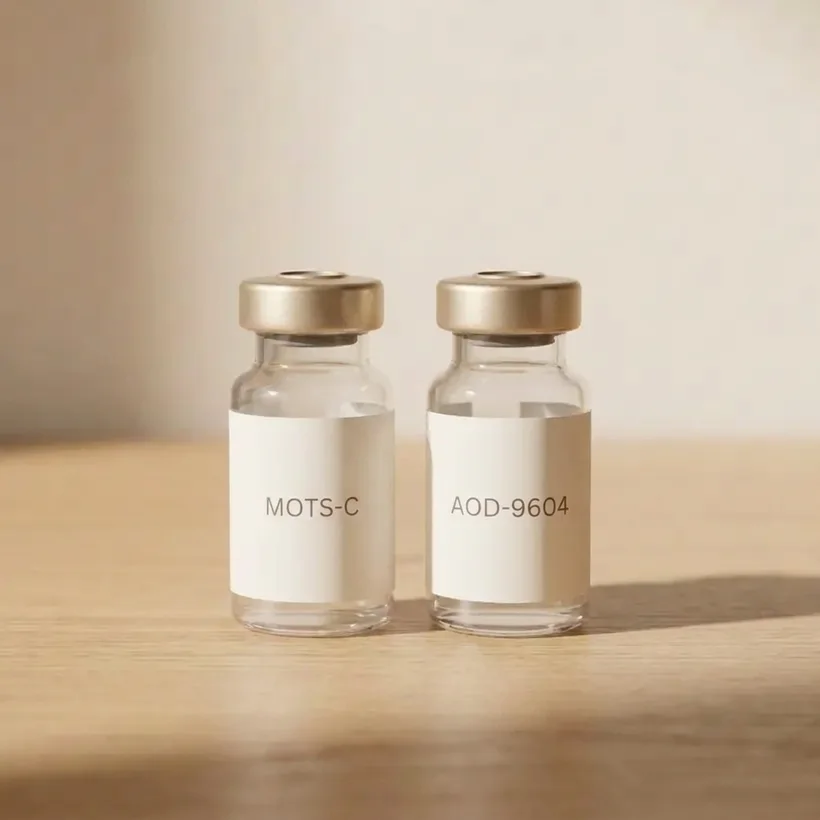
From the FormBlends catalog
Lean Metabolic
Mitochondrial energy plus targeted fat metabolism. · Bundle from $381 · provider-reviewed peptide bundle.
View Lean Metabolic →In the Teichman et al. 2006 phase 2 trial, single doses of CJC-1295 DAC produced a 2-fold to 10-fold increase in GH levels in healthy adults depending on dose, with mean IGF-1 levels remaining elevated for 6 to 8 days. This is the most specific pharmacokinetic data available for any peptide on this list in a peer-reviewed human trial.
GH drives fat loss primarily through lipolysis: GH activates hormone-sensitive lipase in adipocytes, increasing free fatty acid release from triglyceride stores. Muscle anabolism is largely mediated downstream, where GH stimulates hepatic and local IGF-1 production. IGF-1 then activates the PI3K/Akt/mTOR pathway in muscle, promoting protein synthesis and satellite cell proliferation.
The Ranked List: 6 Peptides Evaluated
1. CJC-1295 plus Ipamorelin (Best Combined Rationale)
CJC-1295 extends the duration of GH stimulation. Ipamorelin adds pulse amplitude with a cleaner selectivity profile than GHRP-2 or GHRP-6, which also raise cortisol and prolactin at higher doses. Published human pharmacokinetics exist for CJC-1295 (Teichman 2006). Ipamorelin's human data are primarily safety and PK-focused, from earlier Novo Nordisk development work, not published recomposition trials. The combination is the most clinically rational stack on this list, but "rational" is not the same as "proven."
2. Tesamorelin (Strongest Human Fat Loss Evidence, Narrow Population)
Tesamorelin is a stabilized GHRH analog. Phase 3 RCTs in HIV-positive patients with lipodystrophy showed statistically significant visceral adipose tissue (VAT) reduction (Falutz et al., 2007 and 2010). The FDA approved it in 2010 under the brand name Egrifta. Extrapolating this to healthy adults seeking body recomposition is scientifically unsupported. The lipodystrophy population has fundamentally different metabolic baselines.
3. IGF-1 LR3 (Most Direct Anabolic Mechanism)
Long-arginine-3 IGF-1 has two structural modifications versus native IGF-1: a 13-amino-acid extension at the N-terminus and arginine substituting glutamate at position 3. These changes reduce binding to IGF-binding proteins (IGFBPs) by roughly 2 to 3 orders of magnitude, extending half-life from under 15 minutes to an estimated 20 to 30 hours. The practical result is prolonged receptor activation. All meaningful efficacy evidence is animal or cell-based. No peer-reviewed human RCT measuring lean mass as a primary endpoint exists for IGF-1 LR3 in healthy adults.
4. Ipamorelin Alone (Cleanest GHS Safety Profile)
Among pure GH secretagogues, ipamorelin produces GH release with lower co-stimulation of ACTH and cortisol versus GHRP-2 or hexarelin at equivalent GH-stimulating doses. This selectivity finding comes from animal studies and early human tolerance work. Ipamorelin alone without a GHRH analog produces a smaller, shorter GH pulse. Useful in stacks; weaker as a standalone.
5. AOD-9604 (Fat Loss Only, Weak Evidence)
AOD-9604 is derived from the C-terminal fragment of GH (amino acids 177 to 191). It was designed to retain the lipolytic activity of GH without the growth-promoting effects. Phase 2 trials conducted by Metabolic Pharmaceuticals showed a dose-dependent reduction in body weight in obese subjects, but the effect size was modest and phase 3 development did not occur. The compound has no anabolic mechanism. For recomposition, it is the weakest candidate on this list.
6. BPC-157 (Recovery Tool, Not a Body Composition Agent)
BPC-157 (Body Protection Compound 157) is a 15-amino-acid peptide derived from a sequence found in gastric juice. Its evidence base is animal studies showing accelerated healing of tendons, ligaments, and muscle. The indirect logic for muscle growth is that faster recovery enables more training volume. This is plausible but unquantified in humans. No human RCT has tested BPC-157 for lean mass or fat mass as a primary endpoint.
What Most Pages Get Wrong About Peptides for Body Composition
Nearly every competitor page treats peptide bioavailability as a solved problem. It is not. Three issues are almost never addressed:
Subcutaneous vs. intramuscular absorption variability: GH-releasing peptides are almost always administered subcutaneously. Absorption rate and peak concentration differ meaningfully between individuals based on subcutaneous fat thickness, injection site perfusion, and temperature. This variability is not controlled in most informal use cases and can make dosing unpredictable.
Oral peptide products do not work for these compounds. Peptides with molecular weights above roughly 500 to 1,000 Daltons are degraded by gastric acid and gut peptidases before reaching systemic circulation in meaningful amounts. CJC-1295 has a molecular weight of approximately 3,367 Da. Any oral or sublingual product claiming to deliver CJC-1295 at clinically relevant concentrations has no credible pharmacokinetic evidence to support it.
Research supplier purity is not uniform. Independent testing of research peptides (conducted by organizations like Janoshik, Bruker-based labs, and published community testing projects) has found purity ranging from under 80% to above 99% for products labeled identically. A product at 80% purity means roughly 20% of what you are injecting is unknown impurities. The COA issued by the same supplier who made the product is not independent verification.
The Chemistry Behind Storage and Stability Rules
The rule to store reconstituted peptides at 2 to 8 degrees Celsius and use within roughly 28 days exists because of specific degradation chemistry:
Hydrolysis: Peptide bonds are susceptible to hydrolytic cleavage in aqueous solution. The rate increases with temperature. At refrigerator temperature (4 degrees C), hydrolysis is slowed but not stopped. Asparagine residues are particularly vulnerable to deamidation, converting to aspartate or isoaspartate, which can alter receptor binding.
Oxidation: Methionine, cysteine, and tryptophan residues oxidize in the presence of dissolved oxygen. This is why some manufacturers ship peptides with bacteriostatic water rather than sterile water: the benzyl alcohol preservative slows microbial growth but does not halt oxidation. Minimizing headspace (air) in a vial after each draw reduces oxidative exposure.
Lyophilized powder stability: The freeze-drying process removes water, dramatically slowing both hydrolysis and oxidation. Lyophilized peptides stored at controlled room temperature can remain stable for months to years depending on the specific amino acid sequence and excipients. Once reconstituted, the clock restarts. This is not a best practice suggestion; it is the underlying chemistry that determines shelf life.
Honest Head-to-Head: Peptides vs. Real Alternatives
| Intervention | Muscle Growth Evidence | Fat Loss Evidence | Human RCT Data | Legal Status (US) | Where the Peptide Loses |
|---|---|---|---|---|---|
| CJC-1295 plus Ipamorelin | Indirect, mechanism plausible | Indirect via GH | PK only, no recomposition RCT | Research compound | Loses on every evidence metric vs. approved drugs |
| Tesamorelin (Egrifta) | Limited | Strong (HIV population) | Yes (FDA-approved population) | Prescription (narrow indication) | Loses for healthy adults; no approved indication |
| Semaglutide (Ozempic/Wegovy) | Associated with lean mass loss | Very strong (multiple RCTs, large n) | Yes, multiple large phase 3 | FDA-approved (obesity indication) | Peptides win on muscle preservation rationale; lose on fat loss proof |
| Testosterone (TRT at physiologic dose) | Strong, multiple RCTs | Moderate indirect | Yes | Prescription only (Schedule III) | Peptides lose clearly on muscle growth evidence |
| Resistance training plus caloric deficit | Very strong | Very strong | Extensive | No restrictions | Peptides do not outperform this combination in any confirmed RCT |
Operational Guide: Reading a COA and Reconstitution Math
What a Real COA Must Show
| COA Field | What to Look For | Red Flag |
|---|---|---|
| HPLC Purity | 98% or above | Below 95%, or no chromatogram attached |
| Mass Spectrometry (MS) | Observed MW matches theoretical MW | No MS data, or MW mismatch |
| Testing Laboratory | Third party, independent of supplier | Lab name is same as or affiliated with supplier |
| Lot Number | Matches product label | Generic COA with no lot number |
| Endotoxin Testing | Listed (LAL or equivalent) | Absent; endotoxins cause injection-site inflammation |
Reconstitution Math Example
A vial labeled 2 mg CJC-1295 DAC. You want a 1,000 mcg (1 mg) dose per injection.
- Add 2 mL bacteriostatic water to the vial. Concentration: 1 mg per mL (1,000 mcg per mL).
- A standard insulin syringe marks in units (100 units = 1 mL). Each 10 units on the syringe = 0.1 mL = 100 mcg.
- For a 1 mg dose: draw to the 100-unit mark.
- For a 500 mcg dose: draw to the 50-unit mark.
Changing the diluent volume changes the concentration. Recalculate every time. Dose errors from concentration miscalculation are common and avoidable.
Signs a Reconstituted Peptide Has Degraded
- Visible particulates or cloudiness in solution (peptides should be clear)
- Yellow or brown discoloration (oxidation of aromatic residues)
- Odor change in bacteriostatic water solution
- More than 28 days since reconstitution, even if stored correctly
Safety and Failure Modes Competitors Skip
Glucose dysregulation: GH is a counter-regulatory hormone to insulin. Sustained GH elevation from long-acting secretagogues can increase fasting glucose and reduce insulin sensitivity. Users without baseline labs cannot detect this change. Anyone with prediabetes or family history of type 2 diabetes faces elevated risk.
IGF-1 and neoplasia: Chronically elevated IGF-1 is associated in observational epidemiology with increased risk of certain cancers (prostate, colorectal, breast). This does not establish causation from exogenous peptide use, but anyone with a personal or family history of hormone-sensitive cancers should treat GH-axis manipulation as a meaningful risk rather than a theoretical one.
Water retention and carpal tunnel: GH-mediated sodium retention causes water retention in a subset of users. High-normal or supraphysiologic GH levels are a known cause of carpal tunnel syndrome and joint pain. Both effects are generally dose-dependent and reversible on discontinuation.
Desensitization: Continuous stimulation of GHRH and ghrelin receptors can lead to receptor downregulation. This is the pharmacological rationale behind cycling protocols. The clinical significance in terms of long-term GH axis suppression from research peptide use has not been formally studied in healthy adults.
FAQ
What is the best peptide for muscle growth and fat loss at the same time?
CJC-1295 combined with ipamorelin has the strongest combined rationale: CJC-1295 extends GH pulse duration and ipamorelin selectively triggers GH release without significant cortisol or prolactin elevation. However, no large human RCT has confirmed simultaneous recomposition superior to diet plus training alone.
Is BPC-157 useful for body composition or just injury repair?
BPC-157 evidence is almost entirely animal-based. Its body composition relevance is indirect: faster tendon and muscle repair may allow more consistent training. No human RCT has measured fat mass or lean mass as a primary endpoint for BPC-157.
How long does CJC-1295 take to show results for fat loss?
In the Teichman et al. (2006) phase 2 trial, subjects receiving CJC-1295 DAC showed sustained IGF-1 elevation over multiple weeks. Fat loss timelines in clinical data are not well defined, but GH-driven lipolysis changes typically require at least 8 to 12 weeks to produce measurable body composition shifts.
What is the difference between CJC-1295 with DAC and without DAC?
DAC (Drug Affinity Complex) binds CJC-1295 to albumin, extending its half-life from roughly 30 minutes to 6 to 8 days. Without DAC (also called modified GRF 1-29), the peptide mimics a natural GH pulse with a short half-life and requires more frequent dosing.
Is AOD-9604 actually effective for fat loss in humans?
AOD-9604 completed phase 2 clinical trials for obesity. While early results showed dose-dependent fat reduction, phase 3 trials did not proceed to approval. Current evidence is insufficient to recommend it as a reliable fat loss agent, and it is not FDA-approved for any indication.
Can IGF-1 LR3 build muscle without exogenous GH?
IGF-1 LR3 acts downstream of GH at the receptor level and does not require exogenous GH to exert anabolic effects. It binds IGF-1 receptors with high affinity and has a half-life of roughly 20 to 30 hours due to reduced IGFBP binding, compared to under 15 minutes for native IGF-1.
Are research peptides legal to buy and use?
In the United States, most research peptides discussed here are not FDA-approved drugs and cannot legally be sold for human use. They are sold as research compounds. Regulations vary by country. Consult a licensed physician before using any research peptide.
What should I look for on a peptide COA to verify purity?
A credible COA should show HPLC purity at or above 98%, mass spectrometry confirming the correct molecular weight, and testing from a third-party laboratory independent of the supplier. Absence of any one of these is a red flag.
How do I store reconstituted peptides to prevent degradation?
Reconstituted peptides should be stored at 2 to 8 degrees Celsius (standard refrigerator), kept away from light, and used within 28 days. Lyophilized (freeze-dried) powder is stable at room temperature for weeks but degrades faster once dissolved due to hydrolysis and oxidation of susceptible residues.
What is the biggest risk of using GH-releasing peptides unsupervised?
The primary risks include glucose dysregulation (GH is counter-regulatory to insulin), potential promotion of subclinical neoplastic tissue growth via IGF-1 elevation, water retention, and injection-site reactions. Without baseline labs, users cannot detect early metabolic changes.
Does tesamorelin work for fat loss in non-HIV populations?
Tesamorelin is FDA-approved only for HIV-associated lipodystrophy. Studies in this population showed statistically significant visceral fat reduction. Data in otherwise healthy individuals are limited, and off-label use carries regulatory and safety uncertainty.
Sources
- Teichman SL, Neale A, Lawrence B, et al. Prolonged stimulation of growth hormone (GH) and insulin-like growth factor I secretion by CJC-1295, a long-acting analog of GH-releasing hormone, in healthy adults. J Clin Endocrinol Metab. 2006;91(3):799-805.
- Falutz J, Allas S, Blot K, et al. Metabolic effects of a growth hormone-releasing factor in patients with HIV. N Engl J Med. 2007;357(23):2359-2370.
- Falutz J, Potvin D, Grinspoon S, et al. Effects of tesamorelin, a growth hormone-releasing factor, in HIV-infected patients with abdominal fat accumulation: a randomized placebo-controlled trial with a safety extension. J Acquir Immune Defic Syndr. 2010;53(3):311-322.
- US Food and Drug Administration. Egrifta (tesamorelin for injection) prescribing information. 2010. Available at: fda.gov.
- Johansen PB, Segev Y, Landau D, et al. Growth hormone (GH) hypersecretion and GH receptor resistance in streptozotocin diabetic mice in response to a GH secretagogue. Exp Diabesity Res. 2003;4(2):73-81. [Context for ghrelin receptor pharmacology]
- Svensson J, Lall S, Dickson SL, et al. The GH secretagogues ipamorelin and GH-releasing peptide-6 increase bone mineral content in adult female rats. J Endocrinol. 2000;165(3):569-577.
- Sackmann-Sala L, Ding J, Frohman LA, Kopchick JJ. Activation of the GH/IGF-1 axis by CJC-1295, a long-acting GHRH analog, results in serum protein profile changes in normal adult subjects. Growth Horm IGF Res. 2009;19(6):471-477.
- Clemmons DR. Metabolic actions of insulin-like growth factor-I in normal physiology and diabetes. Endocrinol Metab Clin North Am. 2012;41(2):425-443.
- Heffernan MA, Thorburn AW, Fam B, et al. Increase of fat oxidation and weight loss in obese mice caused by chronic treatment with human growth hormone or a modified C-terminal fragment. Int J Obes Relat Metab Disord. 2001;25(10):1442-1449. [AOD-9604 animal data]
- Sikiric P, Seiwerth S, Rucman R, et al. Stable gastric pentadecapeptide BPC 157: novel therapy in gastrointestinal tract (including therapy of NSAIDs-caused gastrointestinal side-effects) and accelerative wound healing. Curr Pharm Des. 2011;17(16):1604-1617.
- Pollak M. Insulin and insulin-like growth factor signalling in neoplasia. Nat Rev Cancer. 2008;8(12):915-928.
Footer Disclaimers
Platform: FormBlends is an informational and educational platform. Content on this page is for general information purposes only and does not constitute medical advice, diagnosis, or treatment.
Research Compound Notice: The majority of peptides discussed on this page are research compounds not approved by the FDA for human use. They are not dietary supplements. Possession, use, or administration for human use may violate federal, state, or local laws. This page does not encourage or facilitate the purchase or use of unapproved compounds.
Results Disclaimer: No results described or implied on this page are typical or guaranteed. Individual responses to any compound vary based on genetics, health status, diet, training, and many other factors.
Trademark Notice: Egrifta is a registered trademark of Theratechnologies Inc. Ozempic and Wegovy are registered trademarks of Novo Nordisk. All other trademarks are property of their respective owners. FormBlends has no affiliation with these companies.
Related peptide guides
See your options in about 2 minutes
Take the free quiz and see what fits you. Quick, private, and no commitment to continue.
See my options →