
Trust Signals
Key Takeaways
- Tirzepatide (dual GIP/GLP-1 agonist) produced approximately 20.9% mean body weight loss in SURMOUNT-1 at the 15 mg dose, the strongest fat-loss signal of any peptide with large human RCT data.
- CJC-1295 with DAC extends its half-life from roughly 30 minutes to 6 to 8 days via albumin-binding chemistry, enabling once or twice weekly dosing.
- BPC-157 and TB-500 have no published human RCTs for body composition. All body-composition claims rest on rodent data or anecdote.
- A COA without mass spectrometry confirmation does not verify peptide identity, only that something is present at the stated purity by HPLC.
- WADA prohibits GH-releasing peptides (GHRP-2, GHRP-6, CJC-1295, Ipamorelin) under the S2 category. Competitive athletes face detection risk.
What Are the Best Peptides for Fat Loss and Muscle Gain?
The best peptides for fat loss and muscle gain are not a single class. GLP-1/GIP receptor agonists (semaglutide, tirzepatide) have genuine phase 3 human evidence for fat loss. GH-secretagogues (CJC-1295, Ipamorelin) have mechanistic plausibility and small human data for GH elevation but no large body-composition RCTs. BPC-157 and TB-500 have animal evidence only. The gap between these tiers is large.
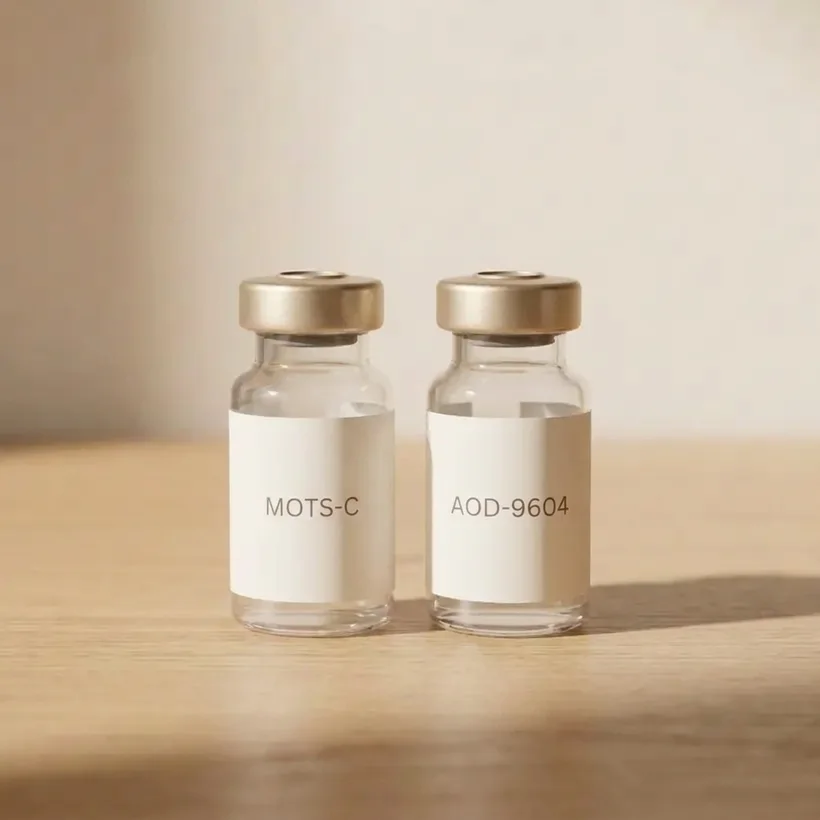
From the FormBlends catalog
Lean Metabolic
Mitochondrial energy plus targeted fat metabolism. · Bundle from $381 · provider-reviewed peptide bundle.
View Lean Metabolic →Table of Contents
- Evidence ledger: every major claim graded
- GLP-1 and GIP peptides: the strongest fat-loss evidence
- GH-secretagogues: CJC-1295, Ipamorelin, and GHRP-6
- BPC-157 and TB-500: what the evidence actually shows
- Mechanism with specific numbers
- What most pages get wrong about research peptides
- Honest head-to-head: peptides vs. approved alternatives
- Label literacy and reconstitution math
- Chemistry behind the storage and compatibility rules
- FAQ
- Sources
How Strong Is the Evidence? A Ledger for Every Major Claim
| Peptide | Claimed Benefit | Best Evidence Type | Key Data Point | Confidence |
|---|---|---|---|---|
| Tirzepatide | Fat loss in obesity | Human RCT (SURMOUNT-1, n=2,539) | ~20.9% body weight loss at 15 mg, 72 weeks | High |
| Semaglutide | Fat loss in obesity | Human RCT (STEP 1, n=1,961) | ~14.9% body weight loss at 2.4 mg, 68 weeks | High |
| CJC-1295 + Ipamorelin | GH and IGF-1 elevation | Small human study (Teichman et al., 2006) | Sustained GH elevation; IGF-1 increase documented | Moderate |
| CJC-1295 + Ipamorelin | Fat loss / muscle gain | Mechanism only; no human body-comp RCT | No controlled outcome data in humans | Very Low |
| GHRP-6 | GH pulse amplification | Multiple small human studies | Dose-dependent GH release shown | Moderate |
| BPC-157 | Muscle recovery / body composition | Rodent studies only | Accelerated tendon healing in rats (Staresinic et al., 2003) | Very Low |
| TB-500 (Thymosin Beta-4) | Muscle recovery | Animal and in vitro data | Actin-sequestering mechanism described; no human body-comp data | Very Low |
| IGF-1 LR3 | Muscle hypertrophy | Animal data; some small human studies in GH deficiency | No RCT in healthy athletes | Low |
GLP-1 and GIP Peptides: Where the Fat-Loss Evidence Is Actually Strong
Semaglutide is a 31-amino-acid GLP-1 receptor agonist with a C18 fatty-diacid chain that enables albumin binding and produces a half-life of approximately 7 days, supporting once-weekly subcutaneous dosing. The STEP 1 trial (Wilding et al., NEJM 2021, n=1,961) showed 14.9% mean body weight reduction over 68 weeks at the 2.4 mg dose versus 2.4% for placebo.
Tirzepatide adds agonism at the GIP receptor alongside GLP-1. SURMOUNT-1 (Jastreboff et al., NEJM 2022, n=2,539) showed 20.9% mean weight loss at 15 mg over 72 weeks. SURMOUNT-5, a head-to-head trial against semaglutide 2.4 mg, reported in 2025 that tirzepatide produced roughly 47% greater relative weight loss.
GH-Secretagogues: CJC-1295, Ipamorelin, GHRP-6
These peptides act upstream of GH itself. CJC-1295 is a GHRH analog. Ipamorelin and GHRP-6 are ghrelin mimetics that act at the GHS-R1a receptor to amplify GH pulses. Teichman et al. (2006, JCEM) demonstrated that CJC-1295 with DAC produced sustained GH elevation and dose-dependent IGF-1 increases in healthy adults, with a half-life of 6 to 8 days.
The mechanistic pathway is real: higher GH stimulates hepatic IGF-1 production; IGF-1 activates PI3K/Akt/mTOR signaling in muscle and suppresses lipolysis inhibition in adipocytes. The gap is in outcome data. No large RCT has tested CJC-1295 plus Ipamorelin against placebo with lean mass and fat mass as primary endpoints in healthy adults. The jump from "raises IGF-1" to "builds muscle and burns fat" is not proven by existing data.
GHRP-6 also stimulates appetite via ghrelin receptor agonism, which directly opposes fat-loss goals. This is a practical failure mode most listicles omit.
BPC-157 and TB-500: What the Evidence Actually Shows
BPC-157 is a 15-amino-acid synthetic peptide derived from a protein found in gastric juice. Its studied mechanisms include upregulation of growth factor expression (VEGF, EGF pathways in rodent models) and accelerated tendon and ligament healing in rats (Staresinic et al., 2003). There are no published phase 2 or phase 3 human RCTs for any body-composition endpoint. The FDA issued warning letters to compounders in 2022 and considers BPC-157 to present "potential risks."
TB-500 (a synthetic analog of Thymosin Beta-4) sequesters G-actin via a LKKTET motif, influencing cell migration and wound healing in animal models. No human controlled trial has measured its effect on muscle mass or fat mass. Body-composition claims for both peptides are extrapolations from injury-recovery rodent data.
Mechanism With Specific Numbers: What Is Actually Happening
GLP-1 receptor agonism: GLP-1 receptors in the hypothalamic arcuate nucleus reduce NPY/AgRP neuronal firing and increase POMC/CART activity, suppressing appetite. GLP-1 also slows gastric emptying, extending satiety. Semaglutide's fatty-acid chain creates a binding half-life with albumin that produces the 7-day plasma half-life enabling weekly dosing.
GHRH analog mechanism (CJC-1295): GHRH binds the GHRH receptor on somatotrophs in the anterior pituitary, elevating cAMP, triggering GH vesicle exocytosis. DAC (Drug Affinity Complex) is a maleimide-linked lysine that forms a covalent bond with cysteine-34 of serum albumin in vivo, extending the circulating half-life from roughly 30 minutes (without DAC) to 6 to 8 days. Albumin itself has a half-life of approximately 19 days, creating a depot.
GHS-R1a (Ipamorelin/GHRP-6): These peptides bind the ghrelin receptor, activating a Gq protein pathway that raises intracellular calcium in pituitary somatotrophs, synergizing with the GHRH-cAMP pathway. Ipamorelin is more GH-selective than GHRP-6 and produces less cortisol and prolactin elevation, which is one reason it is preferred in stacked protocols.
What this mechanism does NOT prove: Elevated IGF-1 in the nanomolar range in a fasted blood draw does not tell you which tissues are responding, whether skeletal muscle protein synthesis is net-positive over 24 hours, or whether the effect persists after receptor adaptation.
What Most Pages Get Wrong About Research Peptides
Bioavailability by route is almost never discussed. Most peptides are too large and too polar to cross gut epithelium intact. Oral bioavailability for peptides like BPC-157 in rodent studies is often cited loosely, but the human oral bioavailability of unmodified peptides above roughly 500 daltons is generally negligible without protective formulation. Subcutaneous injection bypasses this, but "oral BPC-157" products sold over the counter face a fundamental absorption barrier unless specifically engineered (e.g., enteric coating with permeation enhancers).
Purity claims without MS are meaningless for identity. HPLC purity of 99% confirms that 99% of the UV-absorbing material elutes at one retention time. It does not confirm that the molecule is the correct peptide sequence. Only mass spectrometry confirms molecular weight and, in combination with sequencing techniques, identity. A vendor selling CJC-1295 at 99% purity without MS confirmation could be selling a different 30-amino-acid peptide at high purity.
Reconstituted peptides degrade faster than users expect. Once bacteriostatic water is added, peptide bonds become accessible to hydrolysis. Most GH-axis peptides lose meaningful potency within 2 to 4 weeks at 4 degrees Celsius. Freeze-thaw cycling promotes aggregation, a process where monomers form non-covalent oligomers that are biologically inactive. Vials should be aliquoted before freezing if long storage is planned.
GHRP-6 stimulates hunger. Because GHRP-6 is a ghrelin mimetic, it increases appetite in a dose-dependent manner. Using it in a fat-loss protocol without accounting for this creates a direct physiological headwind. Ipamorelin does not carry the same appetite signal at typical research doses, which is mechanistically why it is preferred for recomposition protocols.
Honest Head-to-Head: Peptides vs. Approved Alternatives
| Comparison | Peptide | Alternative | Winner for Fat Loss | Winner for Muscle Gain | Evidence Advantage |
|---|---|---|---|---|---|
| GLP-1 peptide vs. orlistat | Semaglutide (~14.9% weight loss) | Orlistat (~3% weight loss, meta-analysis) | Semaglutide by a large margin | Neither meaningfully | Semaglutide |
| GH-secretagogue vs. retinoid | CJC-1295/Ipamorelin (no fat-loss RCT) | N/A (retinoids are not body-comp agents) | Unclear; no controlled data | No RCT advantage shown | Neither |
| GH-secretagogue vs. resistance training | CJC-1295 + Ipamorelin (IGF-1 elevation shown) | Progressive resistance training (large RCT base) | Training wins for muscle | Training wins clearly | Training by large margin |
| BPC-157 vs. NSAIDs for recovery | BPC-157 (rodent tendon data only) | NSAIDs (human RCTs exist) | NSAIDs have human evidence; BPC-157 does not | Not applicable | NSAIDs |
| Tirzepatide vs. semaglutide | Tirzepatide (~20.9% weight loss) | Semaglutide (~14.9% weight loss) | Tirzepatide (SURMOUNT-5 confirms) | Neither tested for muscle gain | Tirzepatide |
Label Literacy, COA Reading, and Reconstitution Math
Reading a COA: the four things that matter
- HPLC purity: Look for 98% or higher. This tells you purity of the dominant peak, not identity.
- Mass spectrometry (MS): The reported molecular weight should match the theoretical molecular weight of the peptide within instrument tolerance (typically plus or minus 1 Da for small peptides). Without this, you cannot confirm sequence.
- Endotoxin testing: Expressed in EU per mg. Research-grade injectable compounds should be below 5 EU per kg body weight per hour per FDA guidance. Missing endotoxin data is a red flag for injectable use.
- Amino acid analysis or sequence confirmation: Best-in-class suppliers provide this for complex or longer peptides.
Reconstitution math, worked example
| Vial Size | Bacteriostatic Water Added | Concentration | Volume for 250 mcg Dose | Volume for 500 mcg Dose |
|---|---|---|---|---|
| 2 mg | 1 mL | 2,000 mcg/mL | 0.125 mL | 0.25 mL |
| 5 mg | 2 mL | 2,500 mcg/mL | 0.10 mL | 0.20 mL |
| 5 mg | 5 mL | 1,000 mcg/mL | 0.25 mL | 0.50 mL |
| 10 mg | 2 mL | 5,000 mcg/mL | 0.05 mL | 0.10 mL |
Always inject bacteriostatic water slowly down the side of the vial, not directly onto the lyophilized cake. Swirl gently; do not vortex. Label every vial with the date of reconstitution.
What a degraded peptide looks like: Cloudiness or particulate matter in a reconstituted solution suggests aggregation or microbial contamination. A yellow or amber tint in a solution that was previously clear suggests oxidation. Discard and do not use.
Chemistry Behind the Storage and Compatibility Rules
Why lyophilized peptides must stay cold and dry: Peptide bonds are thermodynamically metastable in aqueous conditions. Elevated temperature increases the rate constant for hydrolysis (Arrhenius relationship). In the dry, lyophilized state, water activity is too low for hydrolysis to proceed at meaningful rates. At minus 20 degrees Celsius with desiccant, most research peptides are stable for 12 months or longer. At room temperature in a humid environment, meaningful degradation can occur over weeks even in the dry state.
Why freeze-thaw cycles harm peptides: Ice crystal formation during freezing concentrates solutes and applies mechanical shear to peptide tertiary structure. Repeated cycles accelerate the formation of beta-sheet aggregates, particularly for peptides with hydrophobic residues. These aggregates are not biologically active and do not disaggregate upon warming.
Why bacteriostatic water (not sterile water) for multi-dose vials: Sterile water has no antimicrobial preservative. Benzyl alcohol (0.9%) in bacteriostatic water inhibits bacterial growth in a multi-dose vial. Using sterile water means the vial should be used in a single session; multi-day use risks contamination and injection-site infection.
Compatibility with vitamin C: Ascorbic acid is a reducing agent. Some peptides containing disulfide bonds (cystine bridges) can be partially reduced in the presence of ascorbic acid, disrupting the tertiary structure required for receptor binding. This is not relevant to all peptides (many research peptides lack disulfide bonds) but is worth checking against the specific peptide's structure before mixing in a formulation.
Frequently Asked Questions
What are the best peptides for fat loss and muscle gain simultaneously?
Tirzepatide and semaglutide have the strongest human evidence for fat loss. For muscle preservation during fat loss, BPC-157 and TB-500 have animal and anecdotal support only. No single peptide has large human RCT evidence for both goals simultaneously.
Are GLP-1 peptides like semaglutide approved for fat loss?
Yes. Semaglutide (Wegovy) is FDA-approved for chronic weight management. Tirzepatide (Zepbound) is also FDA-approved for obesity. Both have large phase 3 RCT data. Compounded versions exist but are not FDA-approved products.
Do growth hormone peptides like CJC-1295 and Ipamorelin actually work for body composition?
They raise GH and IGF-1 in humans, which is documented. Whether that translates to meaningful fat loss or muscle gain in healthy adults is not established by large RCTs. The mechanistic evidence is real; the body-composition outcome evidence is weak.
What is the half-life of semaglutide and why does it matter for dosing?
Semaglutide has a half-life of approximately 7 days, which is why once-weekly dosing maintains steady-state plasma levels. Shorter-acting GLP-1 analogs like liraglutide require daily injection because their half-life is roughly 13 hours.
How do I read a certificate of analysis (COA) for a research peptide?
Look for HPLC purity above 98%, mass spectrometry (MS) confirmation of correct molecular weight, and endotoxin testing results. A COA without MS confirmation does not verify the peptide identity, only that something is present at the stated purity.
Is BPC-157 safe for humans?
Human safety data for BPC-157 is extremely limited. Most evidence comes from rat studies. The FDA has not approved it, and in 2022 FDA sent warning letters to compounders. The risk profile in humans is genuinely unknown.
Can peptides replace resistance training for muscle gain?
No. Even the most potent GH-axis peptides require mechanical loading to direct anabolic signaling toward skeletal muscle hypertrophy. In the absence of training, GH elevations promote fat redistribution more than lean mass accrual.
How should research peptides be stored to prevent degradation?
Lyophilized (freeze-dried) peptides are stable for months at minus 20 degrees Celsius. Once reconstituted in bacteriostatic water, most peptides degrade meaningfully within 2 to 4 weeks at 4 degrees Celsius. Freeze-thaw cycles accelerate aggregation and loss of potency.
What is the difference between CJC-1295 with and without DAC?
DAC (Drug Affinity Complex) is a lysine-maleimide linker that binds albumin, extending the half-life of CJC-1295 from roughly 30 minutes to 6 to 8 days. Without DAC, frequent dosing is needed. With DAC, once or twice weekly injection maintains elevated GH pulse patterns.
How does tirzepatide differ from semaglutide for fat loss?
Tirzepatide is a dual GIP and GLP-1 receptor agonist. In the SURMOUNT-1 trial, participants lost approximately 20.9% of body weight at the highest dose versus roughly 14.9% for semaglutide in STEP 1. Head-to-head data now exists from the SURMOUNT-5 trial.
Are peptides detectable on WADA drug tests?
Yes. WADA prohibits GH-releasing peptides including GHRP-2, GHRP-6, CJC-1295, and Ipamorelin under the S2 peptide hormone category. Modern urine and blood testing methods can detect these compounds and their metabolites.
What does reconstitution math look like for a 5 mg peptide vial?
Add 2 mL of bacteriostatic water to a 5 mg vial to get a concentration of 2.5 mg per mL (2500 mcg per mL). A 250 mcg dose then equals 0.1 mL drawn into an insulin syringe. Always label the vial with date of reconstitution.
Sources
- Jastreboff AM et al. "Tirzepatide Once Weekly for the Treatment of Obesity." New England Journal of Medicine 2022;387:205-216. (SURMOUNT-1)
- Wilding JPH et al. "Once-Weekly Semaglutide in Adults with Overweight or Obesity." New England Journal of Medicine 2021;384:989-1002. (STEP 1)
- Teichman SL et al. "Prolonged stimulation of growth hormone (GH) and insulin-like growth factor I secretion by CJC-1295, a long-acting analog of GH-releasing hormone, in healthy adults." Journal of Clinical Endocrinology and Metabolism 2006;91(3):799-805.
- Staresinic M et al. "Gastric pentadecapeptide BPC 157 accelerates healing of transected rat Achilles tendon and in vitro stimulates tendocytes growth." Journal of Orthopaedic Research 2003;21(6):976-983.
- FDA Drug Safety Communication and warning letters regarding BPC-157 compounding, 2022. Available at FDA.gov.
- WADA Prohibited List 2024, Section S2: Peptide Hormones, Growth Factors, Related Substances and Mimetics. Available at wada-ama.org.
- Nass R et al. "Effects of an oral ghrelin mimetic on body composition and clinical outcomes in healthy older adults: a randomized trial." Annals of Internal Medicine 2008;149(9):601-611.
- Freda PU. "Current concepts in the biochemical assessment of the patient with acromegaly." Growth Hormone and IGF Research 2003;13(4):171-184. (IGF-1 axis context)
- Drucker DJ. "The biology of incretin hormones." Cell Metabolism 2006;3(3):153-165. (GLP-1 mechanism review)
- USP General Chapter 1 Injections and Implanted Drug Products. United States Pharmacopeia. (Endotoxin limits and injectable standards)
Related peptide guides
See your options in about 2 minutes
Take the free quiz and see what fits you. Quick, private, and no commitment to continue.
See my options →