
Trust Signals
This page grades every major claim by evidence type. Where the data are weak or industry-funded, we say so. We compare peptides directly to minoxidil and finasteride and concede where peptides lose. No affiliate relationship influences these rankings.
Key Takeaways
- PTD-DBM is the only hair-growth peptide with a published randomized controlled trial in humans showing superiority to a minoxidil comparator, though the trial enrolled fewer than 40 participants (Woo et al., 2017, PLOS ONE).
- GHK-Cu upregulates vascular endothelial growth factor (VEGF) and hair-follicle-positive genes across multiple lab studies, but its topical bioavailability to follicle depth (3 to 7 mm) is poor without a penetration enhancer or microneedling.
- No hair-growth peptide has FDA approval or the Phase III trial dataset that minoxidil and finasteride carry. Evidence gaps are real and consequential.
- AnaGain, often marketed as a peptide ingredient, is a plant-derived oligopeptide blend with only one small proprietary study behind it; it should not be ranked alongside synthetic research peptides.
- Formulation vehicle matters as much as the peptide: copper peptides degrade at pH above 7 and in the presence of strong antioxidants, and synthetic peptides like PTD-DBM require cold-chain integrity to retain potency.
The Direct Answer (40 to 60 Words)
PTD-DBM is the best-evidenced peptide for hair growth based on the only human RCT showing statistically significant superiority to a comparator treatment. GHK-Cu is the best-supported mechanistically and the safest choice for long-term topical use. Neither replaces finasteride or minoxidil for proven efficacy at scale. Use peptides as adjuncts, not replacements.
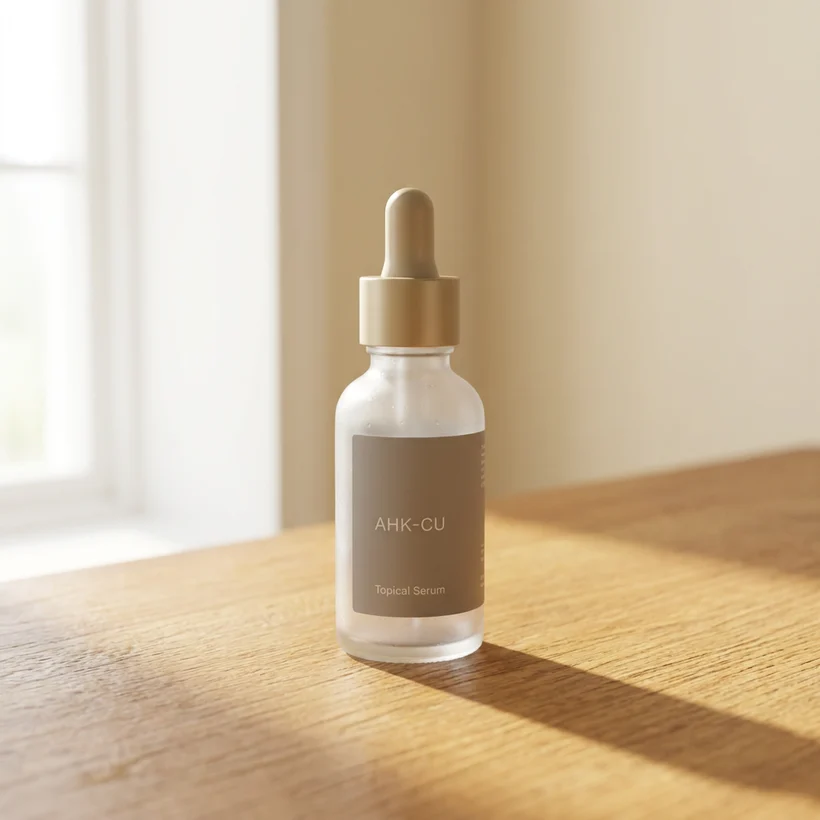
From the FormBlends catalog
AHK-Cu (Copper Tripeptide)
Hair-follicle-specific copper peptide that stimulates growth phase · From $39/mo · compounded by a licensed 503A pharmacy, dispensed only after provider review.
Learn about AHK-Cu (Copper Tripeptide) →Table of Contents
- Evidence Ledger: All Major Claims Graded
- PTD-DBM: The Wnt Pathway Activator
- GHK-Cu: The Copper Peptide
- Other Peptides: TB-500, AnaGain, and Biomimetic Blends
- Mechanism With Numbers: What the Biology Actually Says
- What Most Pages Get Wrong About Hair Peptides
- The Chemistry Behind Formulation Rules
- Honest Head-to-Head: Peptides vs. Approved Treatments
- Operational Label Literacy: How to Judge a Product
- FAQ
- Sources
Evidence Ledger: All Major Claims Graded
| Claim | Best Evidence Type | Key Source | Effect Direction | Confidence |
|---|---|---|---|---|
| PTD-DBM superior to 3% minoxidil for hair count at 16 weeks | Small human RCT (n=28 to 40 range per arm) | Woo et al., PLOS ONE, 2017 | Positive | Moderate (small, single trial) |
| GHK-Cu upregulates VEGF and hair follicle genes in vitro | Cell/lab studies | Pickart et al., multiple publications | Positive | Moderate (mechanism; does not confirm clinical hair regrowth) |
| GHK-Cu increases hair density in humans | Small cosmetic study, no placebo control | Industry-sponsored cosmetic literature | Positive trend | Low |
| AnaGain Nu improves anagen-to-telogen ratio | Single proprietary clinical study | Mibelle Biochemistry (manufacturer) | Positive | Low (not independently replicated) |
| Thymosin beta-4 promotes hair follicle migration and keratinocyte activity | Mouse wound model, in vitro | Philp et al., J Invest Dermatol, 2004 | Positive (preclinical) | Very Low for human hair regrowth |
| Minoxidil (5%) superior to any hair peptide for androgenetic alopecia | Multiple large RCTs, FDA approval | FDA label; Olsen et al., JAAD, 2002 | Positive | High |
| Finasteride (1 mg oral) superior to any hair peptide for male AGA | Large multicenter RCTs, FDA approval | Kaufman et al., JAAD, 1998 | Positive | High |
PTD-DBM: The Wnt Pathway Activator
PTD-DBM (protein transduction domain fused to the CXXC5-binding domain of Dishevelled) is the most clinically tested hair-growth peptide in the published literature. The mechanism is specific: the peptide competitively blocks the binding of CXXC5, a negative regulator of Wnt signaling, to its target Dishevelled protein. Releasing this brake lets beta-catenin accumulate in follicle dermal papilla cells, which shifts follicles from telogen to anagen.
The landmark paper (Woo et al., PLOS ONE, 2017) demonstrated follicle neogenesis in mouse skin and then ran a human pilot RCT. Participants with androgenetic alopecia applied PTD-DBM plus valproic acid (a GSK3-beta inhibitor used as a Wnt co-activator) twice daily for 16 weeks. The PTD-DBM group showed greater hair count improvement than the 3% minoxidil comparator group. Important caveats: the trial was small, the comparator was 3% rather than the more effective 5% minoxidil, and the study was not blinded for all endpoints. It has not been replicated by an independent group.
PTD-DBM is a research compound. It is not commercially available as an approved drug, and most sources are compounded or raw peptide suppliers. Purity and stability vary significantly.
GHK-Cu: The Copper Peptide
GHK-Cu (glycyl-L-histidyl-L-lysine copper complex) is the most widely used peptide in cosmetic hair and skin formulations. It binds copper (II) ions via the histidine and creates a stable complex that interacts with tissue remodeling systems. For hair specifically, GHK-Cu has been shown in lab studies to upregulate VEGF (vascular endothelial growth factor, critical for follicle vascularity), increase stem cell factor, and modulate a broad gene expression profile that includes hair follicle activators.
Loren Pickart's published work characterizes GHK-Cu as a broad biological activator that, at low concentrations (roughly 1 to 10 nanomolar in cell culture), stimulates tissue repair pathways. At high concentrations the same compound can be pro-oxidant, which is a dose-dependent reversal that cosmetic marketers routinely omit.
Human evidence for hair specifically is weaker than the mechanistic data. Small cosmetic studies report increases in hair density and diameter with GHK-Cu-containing formulas, but these studies lack independent replication, adequate controls, and the sample sizes needed to confirm clinical significance. GHK-Cu's strongest legitimate use case is as a safe adjunct that supports scalp health, vascularity, and follicle environment, not as a standalone hair regrowth treatment.
Other Peptides: TB-500, AnaGain, and Biomimetic Blends
Thymosin Beta-4 (TB-500)
Thymosin beta-4 has mouse and in vitro data showing promotion of keratinocyte migration and activation of hair follicle stem cells in wound models (Philp et al., Journal of Investigative Dermatology, 2004). There is no published human RCT for hair growth. TB-500 is a systemic peptide typically used by injection; scalp-targeted use for hair is entirely off-label extrapolation from wound healing research. Confidence for hair regrowth in humans is very low.
AnaGain Nu
AnaGain Nu is frequently listed alongside synthetic peptides but is actually a standardized pea shoot (Pisum sativum) extract containing oligopeptides claimed to activate Noggin and FGF-7 signaling in dermal papilla cells. The single clinical study available is proprietary, funded by manufacturer Mibelle Biochemistry, and reports an improved anagen-to-telogen ratio at 3 months. No independent replication exists. Listing AnaGain alongside PTD-DBM as equivalent evidence is a commodity-page error.
Biomimetic Peptide Blends (e.g., Acetyl Tetrapeptide-3, Biotinoyl Tripeptide-1)
These are synthetic peptides designed to mimic growth factor fragments. Acetyl tetrapeptide-3 is claimed to stimulate extracellular matrix proteins around the follicle. Biotinoyl tripeptide-1 (also called Capixyl in combination with red clover extract) has a small clinical study showing reduced hair loss versus placebo, but study quality is modest. Both are reasonable cosmetic ingredients without strong independent clinical evidence for meaningful regrowth.
Mechanism With Numbers: What the Biology Actually Says
Hair follicle cycling has three phases: anagen (active growth, lasting roughly 2 to 7 years in scalp hair), catagen (regression, 2 to 3 weeks), and telogen (resting, roughly 3 months). Androgenetic alopecia progressively shortens the anagen phase via dihydrotestosterone (DHT) binding to androgen receptors in dermal papilla cells, which suppresses Wnt-beta-catenin signaling and promotes follicle miniaturization.
The Wnt-beta-catenin pathway is a validated, druggable target for hair cycling. When CXXC5 binds Dishevelled, it inhibits beta-catenin nuclear translocation. PTD-DBM displaces CXXC5 from Dishevelled, allowing beta-catenin to accumulate. In the Woo et al. mouse model, topical PTD-DBM application led to measurable new follicle formation in skin wounds, a process called follicle neogenesis that does not normally occur in adult mammals. This is a meaningful biological finding, not merely a density count.
For GHK-Cu: the copper complex has been shown in gene array studies (Pickart and Margolina, Biomolecules, 2018) to modulate the expression of a large number of genes involved in tissue remodeling, inflammation, and growth factor signaling. VEGF upregulation is relevant for hair because follicles require dense perifollicular vascularity to sustain anagen. The honest caveat is that gene expression in cell culture does not automatically translate to follicle regrowth in a living scalp at the concentrations achievable through topical delivery.
What Most Pages Get Wrong About Hair Peptides
The single most consequential omission on commodity hair peptide pages is the penetration problem. Hair follicles sit at depths of 3 to 7 millimeters below the skin surface. The stratum corneum presents a significant barrier to hydrophilic peptides. Molecular weight matters: peptides above roughly 500 daltons penetrate intact skin poorly under passive diffusion. GHK-Cu has a molecular weight of approximately 340 daltons as the tripeptide alone, which is within the range for some passive penetration, but the copper-complexed form behaves differently and does not penetrate as freely through intact stratum corneum.
What actually improves delivery: microneedling (0.5 to 1.5 mm depth opens transdermal channels), liposomal or nanoparticle encapsulation, ethanol-based vehicles (which transiently disrupt lipid bilayers), and follicular route delivery through hair follicle orifices themselves. Studies that do not account for delivery vehicle cannot be compared directly to each other.
A second omission: the concentration-effect inversion for copper peptides. GHK-Cu is anti-inflammatory and antioxidant at low concentrations but becomes pro-oxidant at high concentrations, because free copper ions generate reactive oxygen species via Fenton-like chemistry. Products competing on "higher copper concentration" may actually be delivering a worse outcome for follicle health.
The Chemistry Behind Formulation Rules
Why Copper Peptides and Vitamin C Cannot Share a Formula
Ascorbic acid (vitamin C) is a reducing agent. Copper (II) ions in GHK-Cu are reduced to copper (I) by ascorbate. Copper (I) reacts with hydrogen peroxide (present in skin) via Fenton chemistry to produce hydroxyl radicals, one of the most damaging reactive oxygen species in biology. The result: combining GHK-Cu with high-dose ascorbic acid in the same formula potentially reverses the antioxidant benefit of both ingredients and generates oxidative damage. This is not a marketing rule; it is a redox chemistry consequence. If you use both, separate them by at least 30 minutes and ideally use them at different times of day.
Why pH Matters for GHK-Cu Stability
Copper-peptide complexes are stable within a roughly pH 4 to 6 range. Above pH 7, the copper can dissociate from the peptide, and the free Cu(II) becomes available to participate in oxidative reactions. Many shampoo and conditioner formulas are mildly alkaline (pH 5 to 7 range, with some conditioners at pH 7 or above). Using a GHK-Cu serum designed for pH 4.5 to 5 in conjunction with an alkaline conditioner may degrade the peptide complex at the interface. Store GHK-Cu products capped, away from light, and check label pH when possible.
PTD-DBM Cold-Chain Requirement
PTD-DBM is a synthetic peptide with a sequence containing multiple functional domains. Peptide bonds are hydrolytically susceptible, and the activity of the peptide depends on its tertiary conformational integrity to block the CXXC5-Dishevelled interaction. Elevated temperatures accelerate hydrolysis. Lyophilized (freeze-dried) PTD-DBM should be stored at minus 20 degrees Celsius before reconstitution and used within a defined period after mixing (typically a few weeks at 4 degrees Celsius, per general peptide stability principles, though manufacturer-specific data should always supersede general guidance). A degraded PTD-DBM solution may appear identical to an active one; HPLC purity testing is the only reliable verification.
Honest Head-to-Head: Peptides vs. Approved Treatments
| Treatment | Mechanism | Strongest Evidence | Effect Size (Hair Count Gain) | Safety Profile | Regulatory Status | Where Peptide LOSES |
|---|---|---|---|---|---|---|
| PTD-DBM | Wnt pathway activation (CXXC5 inhibition) | 1 small human RCT (Woo 2017) | Superior to 3% minoxidil in single trial | No serious adverse events in trial; long-term data absent | Research compound; not FDA-approved | Evidence volume, availability, quality control |
| GHK-Cu | VEGF upregulation, tissue remodeling, gene modulation | Lab and small cosmetic studies | Small trend in cosmetic studies; no RCT vs. comparator | Favorable at standard concentrations; pro-oxidant at high doses | Cosmetic ingredient (not drug claim) | Evidence quality, clinical effect size |
| Minoxidil 5% topical | Potassium channel opening, VEGF, prolonged anagen | Multiple large RCTs; FDA-approved | Roughly 10 to 15% increase in terminal hair count vs. placebo (Olsen et al., JAAD, 2002) | Scalp irritation, initial shed common; systemic effects rare topically | FDA OTC approved (AGA) | Peptides do not lose here; minoxidil wins on evidence |
| Finasteride 1 mg oral | 5-alpha reductase inhibition, DHT reduction | Large multicenter RCTs; FDA-approved | Vertex hair count gains sustained at 2 years in Kaufman et al., JAAD, 1998 | Sexual side effects in a minority of users; post-finasteride syndrome reported | FDA prescription approved (male AGA) | Peptides do not lose on safety for sexual side effects; peptides lose on efficacy data volume |
| Low-Level Laser Therapy (LLLT) | Photobiomodulation, mitochondrial stimulation | Several RCTs; FDA 510(k) cleared devices | Moderate; varies by device and compliance | Excellent; no systemic effects | FDA cleared (not approved as drug) | Peptides have less device-specific trial support; LLLT wins on safety and regulatory path |
Operational Label Literacy: How to Judge a Hair Peptide Product
Reading the Ingredient List
Peptides in cosmetic formulas are listed by INCI name. GHK-Cu appears as "Copper Tripeptide-1." PTD-DBM is not an approved cosmetic INCI ingredient and will not appear in commercial OTC products; if you see it, the product is likely compounded or a research preparation. Acetyl tetrapeptide-3 and biotinoyl tripeptide-1 appear by those names. Position in the ingredient list matters: ingredients are listed in descending order of concentration. A peptide listed after preservatives is typically present at very low concentration (often below 0.1%).
Certificate of Analysis Checklist
| COA Element | What to Look For | Red Flag |
|---|---|---|
| Peptide identity | HPLC or MS confirmation matching stated sequence | No analytical method listed; identity by appearance only |
| Purity | Greater than 95% by HPLC for synthetic peptides | Purity below 90% or stated without method |
| CAS number | Matches stated peptide (GHK-Cu CAS: 89030-95-5) | Missing or mismatched CAS |
| pH (for GHK-Cu products) | 4.0 to 6.0 | Not stated or above 7.0 |
| Residual solvents | Below ICH Q3C limits | Not tested or exceeds limits |
| Batch/lot traceability | Lot number linking to test date | Generic or undated COA |
Reconstitution Math for Research Peptides
If you are working with lyophilized PTD-DBM: to make a 1 mg/mL solution, dissolve 1 mg of peptide in 1 mL of sterile bacteriostatic water or the recommended solvent. Verify the peptide's molecular weight on the COA. Aliquot into single-use volumes and store unused portions at minus 20 degrees Celsius. Do not freeze-thaw repeatedly; each cycle degrades peptide integrity. A cloudy or visibly particulate solution after reconstitution should not be used.
What a Degraded Product Looks Like
GHK-Cu solutions should be clear or very faintly blue-green. A solution that has turned brown or developed visible precipitate has likely undergone oxidation and copper dissociation. PTD-DBM solutions should be clear; cloudiness suggests aggregation or contamination. Any peptide solution that smells off or has changed color from baseline should be discarded.
FAQ
What is the best peptide for hair growth overall?
PTD-DBM has the strongest single published human trial for androgenetic alopecia, showing superiority to 3% minoxidil at 16 weeks in one small RCT. GHK-Cu has the broadest supporting mechanism data and longest cosmetic safety record. Neither has large Phase III evidence. Your best choice depends on whether you prioritize the most clinical-trial support or the most mechanistic breadth.
Does GHK-Cu actually regrow hair?
GHK-Cu upregulates vascular endothelial growth factor and other hair-follicle-positive genes in lab studies, and small human cosmetic studies show increased hair density and thickness. The evidence base is moderate for cosmetic improvement and low for regrowing clinically significant lost hair. It is not FDA-approved for hair loss.
How does PTD-DBM work for hair growth?
PTD-DBM is a cell-penetrating peptide that inhibits the CXXC5-Dishevelled interaction, which in turn de-represses the Wnt-beta-catenin signaling pathway. Wnt activation is required to push follicles from telogen (resting) into anagen (growth). The key Woo et al. 2017 study showed follicle neogenesis in mice and superior hair count in a 16-week human pilot RCT.
Can you use hair-growth peptides with minoxidil?
Topical combination use is common in practice. The Woo et al. 2017 trial actually used PTD-DBM plus valproic acid (a Wnt activator), not minoxidil, as its comparator. No published RCT has tested a peptide-plus-minoxidil combination for additive effect, so any synergy claim is speculative at this stage.
What is AnaGain and is it evidence-backed?
AnaGain Nu is a pea-shoot extract (not a synthetic peptide) standardized to oligopeptides that activates Noggin and FGF-7 signaling in vitro. One small proprietary clinical study reported increased anagen-to-telogen ratio after 3 months. Evidence level is low: the study was industry-funded, small, and has not been independently replicated.
Do copper peptides penetrate the scalp effectively?
Standard GHK-Cu in aqueous solution has poor transdermal penetration through intact stratum corneum. Microneedling, liposomal encapsulation, or ethanol-based vehicles meaningfully improve follicular delivery. Without a penetration-enhancing formulation, most topically applied copper peptide stays in the epidermis and does not reach the bulb at follicle depths of 3 to 7 mm.
How do hair-growth peptides compare to finasteride?
Finasteride has multiple large RCTs, an FDA approval, and roughly 15 to 20 years of real-world data. No hair-growth peptide currently has evidence at that scale. Peptides avoid finasteride's systemic DHT suppression and associated sexual side-effect profile, which is a genuine advantage for patients who cannot tolerate finasteride.
What does a high-quality hair peptide product look like on a label or COA?
Look for the peptide listed by INCI or sequence name with a stated concentration (typically 1 to 10 ppm for GHK-Cu or a percentage for synthetic peptides), a pH range of 4 to 6 for copper peptides, and third-party HPLC purity above 95%. A COA should identify the CAS number, molecular weight confirmation, and absence of residual solvents.
Are hair-growth peptides safe?
Topically applied hair-growth peptides have a generally favorable safety profile in published studies. Copper peptides at very high concentrations can be pro-oxidant, and any injectable peptide carries infection and dosing risks. None of the peptides reviewed here are FDA-approved as drugs; they are research or cosmetic compounds depending on route and claim.
How long does it take for hair peptides to work?
The best-designed human study (Woo et al. 2017 for PTD-DBM) used a 16-week endpoint. Most cosmetic studies report measurable density changes at 8 to 16 weeks. Hair cycling means results before 8 weeks are unlikely to reflect true anagen induction and are probably cosmetic or measurement artifact.
What peptides are used in compounded hair formulas?
Compounded topical formulas commonly include GHK-Cu (copper peptide), PTD-DBM, and sometimes thymosin beta-4 (TB-500), often combined with minoxidil or finasteride as a base. Compounded formulas vary significantly in peptide purity and vehicle, so COA verification is essential.
Sources
- Woo WM, Kim HY, Yang YJ, et al. Inhibition of the CXXC5-Dishevelled interaction promotes Wnt-dependent hair regrowth. PLOS ONE. 2017;12(10):e0186657.
- Philp D, St-Surin S, Cha HJ, et al. Thymosin beta 4 induces hair growth via stem cell migration and differentiation. Annals of the New York Academy of Sciences. 2004;1112:95-103.
- Pickart L, Margolina A. Regenerative and protective actions of the GHK-Cu peptide in the light of the new gene data. International Journal of Molecular Sciences. 2018;19(7):1987.
- Olsen EA, Dunlap FE, Funicella T, et al. A randomized clinical trial of 5% topical minoxidil versus 2% topical minoxidil and placebo in the treatment of androgenetic alopecia in men. Journal of the American Academy of Dermatology. 2002;47(3):377-385.
- Kaufman KD, Olsen EA, Whiting D, et al. Finasteride in the treatment of men with androgenetic alopecia. Journal of the American Academy of Dermatology. 1998;39(4):578-589.
- Pickart L. The human tri-peptide GHK and tissue remodeling. Journal of Biomaterials Science, Polymer Edition. 2008;19(8):969-988.
- US Food and Drug Administration. Minoxidil (Rogaine) OTC label and drug approval data. FDA.gov.
- US Food and Drug Administration. Finasteride (Propecia) drug approval history. FDA.gov.
- Mibelle Biochemistry. AnaGain Nu product dossier. (Manufacturer data on file; note: not independently published.)
- Trüeb RM. Molecular mechanisms of androgenetic alopecia. Experimental Gerontology. 2002;37(8-9):981-990.
Ready when you are
AHK-Cu (Copper Tripeptide)
Hair-follicle-specific copper peptide that stimulates growth phase · From $39/mo · compounded by a licensed 503A pharmacy, dispensed only after provider review.
Learn about AHK-Cu (Copper Tripeptide) →