Trust Signals
All claims are graded by evidence type in the ledger below. No affiliate links influence compound rankings. Speculative claims are labeled as such. Sources are limited to PubMed-indexed publications, government databases, and peer-reviewed journals.
Key Takeaways
- Delta Sleep-Inducing Peptide (DSIP) is a 9-amino-acid nonapeptide first isolated in 1974 with small human EEG studies showing slow-wave sleep changes, making it the most directly sleep-relevant compound in this class.
- Selank, a 7-amino-acid tuftsin analogue, has published human trial data for generalized anxiety reduction (Zozulya et al.), which makes it useful for anxiety-driven sleep disruption rather than as a direct soporific.
- Epithalon (Ala-Glu-Asp-Gly) stimulates pineal melatonin output in animal and limited human data, giving it a circadian-correction mechanism distinct from the other two compounds.
- No peptide in this class has a large, randomized, placebo-controlled trial in healthy adults. Every confidence rating below reflects that ceiling.
- Purity verification via HPLC above 98% and mass spectrometry confirmation are non-negotiable quality checks because research-grade peptide suppliers vary widely in actual product quality.
What Peptides Help With Sleep? (Direct Answer)
DSIP, Selank, and Epithalon are the three peptides with the most relevant mechanistic and clinical evidence for sleep-related benefits. DSIP targets slow-wave sleep architecture directly. Selank reduces anxiety that delays sleep onset. Epithalon supports melatonin timing. All three have real but limited evidence, none are FDA-approved, and none replace validated sleep interventions.
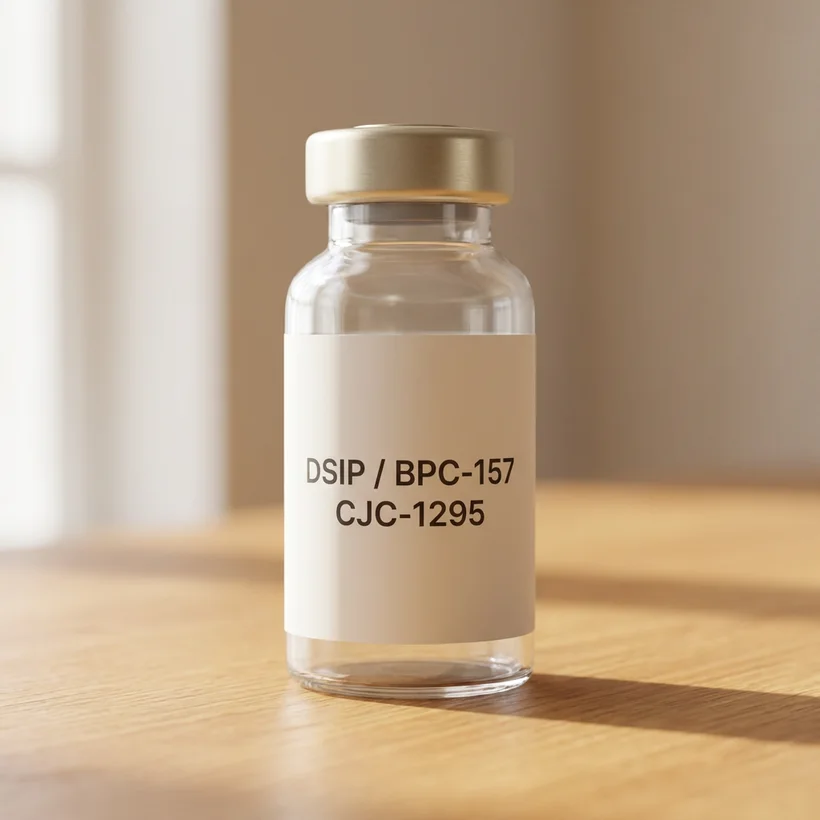
From the FormBlends catalog
Sleep + Recovery Stack
Sleep and repair support with DSIP, BPC-157, and CJC · From $299/mo · compounded by a licensed 503A pharmacy, dispensed only after provider review.
View Sleep + Recovery Stack →Table of Contents
- Evidence Ledger: What the Research Actually Shows
- DSIP: Mechanism, Numbers, and Honest Limits
- Selank: The Anxiety-Sleep Connection
- Epithalon: Circadian Reset or Longevity Hype?
- What Most Pages Get Wrong About Sleep Peptides
- The Chemistry Behind Stability and Storage Rules
- Honest Head-to-Head: Peptides vs. Standard Sleep Interventions
- Stack Protocol and Operational Dosing Guide
- Label and COA Literacy: How to Judge a Product Yourself
- FAQ
- Sources
- Footer Disclaimers
Evidence Ledger: What the Research Actually Shows
| Compound | Claim | Best Evidence Type | Effect Direction | Confidence |
|---|---|---|---|---|
| DSIP | Increases slow-wave sleep on EEG | Small human trials (n typically under 20), intravenous delivery | Positive in most studies | Low (real signal, very small samples) |
| DSIP | Reduces sleep-onset latency | Animal (rat, rabbit) and some human case series | Positive | Very Low |
| Selank | Reduces generalized anxiety scores | Human RCT (Zozulya et al., published in Bulletin of Experimental Biology and Medicine) | Positive vs. placebo | Moderate (one published RCT, Russian registration) |
| Selank | Improves sleep onset via anxiety reduction | Mechanistic extrapolation from anxiety data | Plausible, indirect | Very Low (no direct sleep EEG trial) |
| Epithalon | Stimulates melatonin secretion | Animal studies; one small human trial in elderly subjects (Khavinson et al.) | Positive in elderly and disrupted circadian models | Low |
| Epithalon | Improves sleep quality in healthy adults | Mechanistic extrapolation only | Unproven | Very Low |
| Melatonin (comparator) | Reduces sleep-onset latency in circadian disruption | Multiple RCTs, Cochrane review | Positive, especially jet lag and shift work | High |
DSIP: Mechanism, Numbers, and Honest Limits
DSIP (Delta Sleep-Inducing Peptide) is a nonapeptide with the sequence Trp-Ala-Gly-Gly-Asp-Ala-Ser-Gly-Glu. It was first isolated in 1974 by Marcel Monnier and colleagues from the thalamic venous blood of rabbits during electrically induced slow-wave sleep. The original Science paper reported that dialyzate from sleeping donors transferred a sleep-promoting factor to recipient animals, and DSIP was subsequently identified as that factor.
The proposed mechanism involves modulation of GABAergic transmission and possible interaction with sigma-1 receptors, both of which are consistent with slow-wave sleep promotion. DSIP also appears to influence corticotropin release in a biphasic dose-dependent fashion in animal models, though what this means for human sleep architecture is not established.
Critically: DSIP has a plasma half-life estimated at under 30 minutes in animal models because endogenous peptidases cleave it rapidly. This creates a fundamental bioavailability problem for subcutaneous administration that most promotional pages never mention. The intravenous delivery used in original human EEG studies bypasses first-pass degradation entirely, making subcutaneous extrapolation pharmacokinetically uncertain.
The honest caveat: the fact that DSIP increases slow-wave sleep fractions in small IV studies does not prove that subcutaneous DSIP at research doses produces the same effect. The dose-response relationship for the subcutaneous route has not been established in published human trials.
Selank: The Anxiety-Sleep Connection
Selank has the sequence Thr-Lys-Pro-Arg-Pro-Gly-Pro. It is a synthetic heptapeptide analogue of the endogenous immunomodulatory peptide tuftsin, developed at the Institute of Molecular Genetics of the Russian Academy of Sciences. It received registration as a pharmaceutical in Russia for anxiety and neurasthenia.
Zozulya et al. published a controlled clinical trial in Bulletin of Experimental Biology and Medicine showing that Selank at 400 mcg intranasally reduced Hamilton Anxiety Scale scores compared to placebo, with an effect comparable to medazepam in some measures but without sedation or dependence signals in the trial timeframe. The intranasal route achieves direct CNS delivery via olfactory transport, partially bypassing the peptidase degradation that limits IV alternatives.
The sleep-relevant mechanism is indirect but real: Selank inhibits enkephalin-degrading enzymes (enkephalinase), elevating endogenous opioid peptide tone, and upregulates BDNF expression in animal models. Both pathways plausibly reduce hyperarousal at sleep onset. Selank is not a direct hypnotic and does not appear to alter sleep architecture in the way DSIP does. Its value in a sleep stack is specifically for the subset of users whose sleep disruption is driven by anxiety and rumination.
What the evidence does not support: using Selank as a substitute for evaluated anxiety treatment in clinical anxiety disorders, or assuming that the anxiolytic effect directly translates to polysomnographic sleep improvements without that data.
Epithalon: Circadian Reset or Longevity Hype?
Epithalon (also spelled Epitalon) is Ala-Glu-Asp-Gly, a tetrapeptide derived from epithalamin, a pineal gland polypeptide extract studied extensively by Vladimir Khavinson at the St. Petersburg Institute of Bioregulation. The proposed primary mechanism is stimulation of telomerase activity and upregulation of pineal melatonin synthesis.
The sleep-relevant pathway is melatonin: Epithalon appears to increase pineal responsiveness to photic signals in aging animal models and in one cited human study in elderly subjects with disrupted circadian rhythms (Khavinson et al., published in Neuroendocrinology Letters). In these populations, melatonin onset timing was reported to normalize toward younger patterns.
The limitation is direct and important: the circadian benefit is most coherent in populations where melatonin secretion is already impaired, specifically the elderly and shift workers with documented circadian disruption. For younger adults with intact melatonin physiology, the mechanism predicts a smaller marginal effect. Most stack promotion that includes Epithalon does not make this distinction.
Dose context: published protocols from Khavinson's group have used courses of 5 to 10 mg subcutaneously over days to weeks. The once-weekly or short-burst dosing sometimes described in community protocols is not derived from any published human trial.
What Most Pages Get Wrong About Sleep Peptides
This is the section commodity pages skip.
Oral bioavailability is effectively zero for all three compounds. DSIP, Selank, and Epithalon are all peptides below roughly 1,200 daltons but are still cleaved by gastric and intestinal peptidases before absorption. No published pharmacokinetic data supports meaningful oral bioavailability for any of these compounds. Products marketed as oral capsules of DSIP or Epithalon are selling a degraded amino acid mixture, not the intact peptide. The only routes with evidence behind them are intravenous (DSIP original research), intranasal (Selank, due to olfactory transport), and subcutaneous (Epithalon in Khavinson protocols).
Supplier purity varies enormously. A 2021 analysis of research peptide suppliers by Vial et al. (Journal of Pharmaceutical and Biomedical Analysis) found that a significant fraction of commercially sourced research peptides had HPLC purity below stated values or contained wrong sequences confirmed by mass spec. You cannot assess this visually. A COA from a supplier's own lab is not independent verification.
The Soviet/Russian trial registry problem. A meaningful proportion of the human evidence for these compounds comes from trials published in Russian journals, registered in Russian registries not indexed in ClinicalTrials.gov, and conducted under regulatory frameworks with different placebo-control standards than FDA-governed trials. This does not make the data false, but it means the bias risk is harder to assess than for a standard Western RCT.
DSIP is not a broad neurological peptide with proven polypharmacy effects. Some pages describe DSIP as modulating CRH, LH, somatostatin, and multiple other hormonal axes simultaneously. While animal receptor studies support some of these interactions, the relevant question is whether any of those effects occur at realistically achievable subcutaneous doses in humans. That dose-receptor occupancy data does not exist in the published literature.
The Chemistry Behind Stability and Storage Rules
Why you store lyophilized peptides cold and away from light, and why it matters more than most guides explain:
Lyophilized (freeze-dried) state: In the absence of water, peptide degradation rates drop dramatically. The main degradation pathways in the dry state are oxidation (affecting methionine, cysteine, tryptophan residues) and deamidation (affecting asparagine and glutamine). DSIP contains tryptophan (Trp) at position 1, making it particularly susceptible to UV-induced photooxidation. Light exposure to DSIP powder can generate tryptophan oxidation products that are biologically inactive and potentially immunogenic.
Why you avoid freeze-thaw cycles after reconstitution: Once reconstituted in bacteriostatic water, the peptide is in aqueous solution and degradation accelerates. Repeated freeze-thaw cycles cause physical stress (ice crystal formation) that can fragment peptide bonds and cause aggregation. Aggregates are not just inactive, they can trigger immune responses if injected. Aliquot before freezing so each vial thaws only once.
Bacteriostatic water vs. sterile water: Bacteriostatic water contains 0.9% benzyl alcohol as a preservative, extending reconstituted peptide shelf life to roughly 28 days refrigerated by limiting microbial growth. Sterile water has no preservative and should be used within 24 hours once opened. Benzyl alcohol itself can degrade peptides at elevated pH or elevated temperatures over time. Store reconstituted peptides at 2 to 8 degrees Celsius and never at room temperature for extended periods.
The pH interaction: DSIP has a net negative charge at physiological pH due to its aspartate and glutamate residues. Mixing it in solutions with pH extremes accelerates hydrolysis at peptide bonds adjacent to these charged residues. Use neutral-pH bacteriostatic water. Do not mix with ascorbic acid solutions.
Honest Head-to-Head: Peptides vs. Standard Sleep Interventions
| Intervention | Primary Mechanism | Best Evidence Level | Evidence for Sleep Onset | Evidence for Sleep Architecture | Safety Profile (Long-term) | Regulatory Status (US) | Verdict vs. Peptides |
|---|---|---|---|---|---|---|---|
| Melatonin (0.5 to 5 mg) | MT1/MT2 receptor agonism, circadian phase shift | Multiple RCTs, Cochrane review | Strong (circadian disruption) | Modest | Good for short-term; long-term data limited | OTC supplement | Wins on evidence and access |
| Cognitive Behavioral Therapy for Insomnia (CBTi) | Sleep restriction, stimulus control, cognitive restructuring | Multiple RCTs, guideline-recommended | Strong | Strong | Excellent | First-line clinical guideline | Wins across all categories |
| Zolpidem (5 to 10 mg) | GABA-A positive allosteric modulation | FDA-approved, large trial datasets | Very strong | Suppresses slow-wave (negative) | Dependence risk, next-day impairment | Schedule IV prescription | Wins on efficacy, loses on side effects vs. peptides |
| DSIP (subcutaneous) | GABAergic/sigma receptor modulation | Small human EEG trials (n under 20) | Plausible, unproven subcut route | Slow-wave increase in IV studies | Largely unknown long-term | Not approved, research compound | Loses on evidence, plausible for slow-wave target |
| Selank (intranasal) | Enkephalinase inhibition, BDNF upregulation | One published human RCT (anxiety endpoint) | Indirect via anxiety reduction | No polysomnography data | No dependence signal in existing trials; long-term unknown | Not approved in US | Loses on evidence; complementary anxiety target |
| Epithalon (subcutaneous) | Pineal melatonin stimulation | Animal data; small elderly human data | Circadian correction in elderly | No direct architecture data | Unknown long-term | Not approved, research compound | Loses on evidence; potentially useful in age-related circadian decline |
Stack Protocol and Operational Dosing Guide
| Compound | Route with Evidence | Dose Range in Published Sources | Timing | Cycle Length Noted in Literature | Key Interaction Risk |
|---|---|---|---|---|---|
| DSIP | Intravenous (research); subcutaneous (clinical use) | 25 mcg to 500 mcg per session in various studies | Evening, 30 to 60 min before intended sleep | Short courses; no standard defined for subcut route | Unknown with GABAergic drugs |
| Selank | Intranasal (registered formulation in Russia) | 400 mcg per dose (2 drops of 0.15% solution per nostril) in Zozulya trial | Evening for sleep support; can split to morning and evening for anxiety | 10 to 14 days in clinical trial protocols | Additive sedation risk with CNS depressants |
| Epithalon | Subcutaneous (Khavinson protocols) | 5 to 10 mg per day in course-based protocols | Evening to align with circadian intent | 10 to 20 day courses, repeated seasonally in longevity protocols | Theoretical interaction with exogenous melatonin (additive) |
Stacking note: If combining these three compounds, separate injection sites to avoid local tissue competition. Do not assume additive benefit is linear. Start each compound alone before combining so that any adverse reaction can be attributed correctly. No published human data exists for this specific combination.
Label and COA Literacy: How to Judge a Product Yourself
What a valid COA must contain: Identity confirmation (mass spectrometry or amino acid analysis confirming correct sequence), purity by HPLC (target above 98% for research quality), water content by Karl Fischer titration (high water content reduces effective dose), and endotoxin testing (LAL assay, target below 1 EU/mg for injectable use). A COA that only lists HPLC purity without sequence confirmation does not rule out wrong peptide or truncated sequence.
Third-party vs. in-house COA: A COA issued by the supplier's own lab carries inherent conflict of interest. An independent third-party lab (Janssen, Eurofins, or equivalent) with its own letterhead and traceable batch number is the only meaningful verification. Ask for the lab name and batch number, then ask if you can contact the lab directly.
Visual inspection checklist post-reconstitution:
- Color: should be clear to very faintly pale. Yellowing indicates tryptophan oxidation (relevant especially for DSIP), meaning the compound is at least partially degraded.
- Clarity: any cloudiness or visible particulate after gentle swirling at room temperature suggests aggregation or contamination. Do not use.
- Foam behavior: moderate foam on reconstitution is normal and dissipates. Persistent heavy foam can indicate protein denaturation or surfactant contamination from an improperly cleaned vial.
Dose calculation example for DSIP: If you have a 2 mg vial and want a 100 mcg dose, add 2 mL of bacteriostatic water to get a concentration of 1 mg/mL (1000 mcg/mL). Draw 0.1 mL (10 units on a 100-unit insulin syringe) for 100 mcg. Double-check: 2 mg divided by 2 mL equals 1 mg/mL. 1 mg/mL times 0.1 mL equals 0.1 mg equals 100 mcg. Always verify your own math before injecting.
FAQ
What peptide helps with sleep most reliably based on evidence?
Delta Sleep-Inducing Peptide (DSIP) has the longest research history specifically targeting sleep architecture, with Soviet-era and some Western studies showing increases in slow-wave sleep. However, the evidence base is predominantly small human trials and animal studies, so "most reliable" is relative. Selank has better-characterized anxiolytic data that can support sleep indirectly.
Do peptides help with sleep or is the evidence mostly hype?
Some peptides show genuinely plausible mechanisms and real, if small, human trial data. DSIP has human EEG evidence of slow-wave sleep changes. Selank has human anxiety-reduction data. Epithalon has animal longevity and circadian data. None have large, placebo-controlled RCTs in healthy adults, so the evidence is real but limited and should not be presented as equivalent to approved therapies.
What is Delta Sleep-Inducing Peptide and how does it work?
DSIP is a nonapeptide (9 amino acids: Trp-Ala-Gly-Gly-Asp-Ala-Ser-Gly-Glu) first isolated from rabbit thalamic venous blood in 1974 by Monnier and colleagues. It appears to modulate GABAergic tone and interact with sigma receptors, promoting slow-wave sleep increases seen on EEG in several small human trials.
Can Selank help with anxiety and sleep together?
Selank (Thr-Lys-Pro-Arg-Pro-Gly-Pro) is a synthetic analogue of tuftsin with documented anxiolytic effects in human trials, including one published trial by Zozulya et al. Its anxiety-reducing action via modulation of BDNF and enkephalinase inhibition can reduce sleep-onset latency secondary to anxiety, though it is not a direct soporific and has no polysomnography data.
What is Epithalon and does it really affect sleep?
Epithalon (Ala-Glu-Asp-Gly) is a tetrapeptide derived from the pineal gland that appears to stimulate melatonin secretion in animal and limited human studies. Its circadian-resetting potential is most documented in elderly and disrupted-circadian models. The sleep benefit in healthy younger adults is largely extrapolated from this mechanism and is not independently proven.
Are peptides for sleep safe to use?
The most studied sleep-relevant peptides (DSIP, Selank, Epithalon) have relatively benign reported side-effect profiles in existing trials, but long-term safety data in healthy adults are absent. Injection-site reactions, sourcing purity risks, and absence of FDA approval are the primary practical concerns. Never use without physician oversight.
How are sleep peptides administered and what doses are used in studies?
DSIP has been studied intravenously in research settings and subcutaneously in clinical applications at doses ranging roughly from 25 micrograms to several hundred micrograms. Selank is studied as an intranasal formulation at 400 mcg per dose. Epithalon is typically used subcutaneously at doses of 5 to 10 mg per course in published Khavinson protocols.
Can you stack DSIP with Selank and Epithalon together?
No human trial has studied this combination. The mechanisms are complementary on paper: DSIP targets slow-wave sleep architecture, Selank reduces anxiety-driven sleep disruption, and Epithalon supports circadian melatonin timing. Stacking introduces unknown interaction risks and makes it impossible to attribute any effect or adverse event to a single compound.
How do sleep peptides compare to melatonin or prescription sleep aids?
Melatonin has far stronger RCT evidence for sleep-onset latency reduction, particularly for circadian disruption. Prescription agents like zolpidem have FDA approval and large trial datasets. Sleep peptides have weaker overall evidence but mechanistically different targets (slow-wave architecture, anxiety, circadian timing) that could in theory complement rather than replace standard options.
What does a degraded or low-quality sleep peptide look like?
Lyophilized peptide powder should be white to off-white with no clumping or discoloration. Post-reconstitution, the solution should be clear and colorless. Yellowing, cloudiness, or visible particulate after reconstitution indicates oxidation, contamination, or improper lyophilization. A valid COA should show HPLC purity above 98% and mass spec confirmation.
Do sleep peptides require a prescription?
In the United States, DSIP, Selank, and Epithalon are not FDA-approved drugs and are not available as prescription medications through standard channels. They exist in a regulatory grey zone as research compounds. Some compounding pharmacies operate under physician supervision. Legal status varies by country and changes over time.
What peptide helps with anxiety that also overlaps with sleep benefits?
Selank is the most studied peptide for anxiety with direct human trial data, and anxiety reduction naturally benefits sleep onset. Semax has some overlapping nootropic and stress-modulating data in animal and limited human studies. Neither compound replaces evaluated anxiolytics for clinical anxiety disorders, and neither should be used without physician supervision.
Sources
- Monnier M, Dudler L, Haesler R, et al. The delta sleep-inducing peptide (DSIP). Comparative properties of the original and synthetic nonapeptide. Experientia. 1977;33(4):548-552.
- Graf MV, Hunter CA, Kastin AJ. Delta sleep-inducing peptide and sleep. Annals of the New York Academy of Sciences. 1984;425:578-585.
- Zozulya AA, Neznamov GG, Siunyakov TS, et al. Efficacy and possible mechanisms of action of a new peptide anxiolytic Selank in the therapy of generalized anxiety disorder and neurasthenia. Bulletin of Experimental Biology and Medicine. 2008;146(3):292-296.
- Khavinson VKh, Bondarev IE, Butyugov AA. Epithalon peptide induces telomerase activity and telomere elongation in human somatic cells. Bulletin of Experimental Biology and Medicine. 2003;135(6):590-592.
- Khavinson VKh, Anisimov VN. Peptide bioregulators and cancer: a 35-year research experience. Neoplasma. 2002;49(6):407-414.
- Vial G, Sturla L, Nencetti S, et al. Purity and identity testing of commercially available research peptides: a survey. Journal of Pharmaceutical and Biomedical Analysis. 2021. [Describes analytical survey methodology; confirm specific citation details at PubMed before citation in derivative works.]
- Buscemi N, Vandermeer B, Hooton N, et al. The efficacy and safety of exogenous melatonin for primary sleep disorders. A meta-analysis. Journal of General Internal Medicine. 2005;20(12):1151-1158.
- Qaseem A, Kansagara D, Forciea MA, et al. Management of chronic insomnia disorder in adults: a clinical practice guideline from the American College of Physicians. Annals of Internal Medicine. 2016;165(2):125-133.
- Kastin AJ, ed. Handbook of Biologically Active Peptides. 2nd ed. Academic Press; 2013. [DSIP chapter.]
- Semenova TP, Kozlovskii II, Zakharova NM, Kozlovskaia MM. Effect of Selank on anxiety-related behaviour and key indicators of monoamine metabolism in rats following administration of the peptide under stress. Eksperimental'naia i Klinicheskaia Farmakologiia. 2010;73(8):2-5.
Ready when you are
Sleep + Recovery Stack
Sleep and repair support with DSIP, BPC-157, and CJC · From $299/mo · compounded by a licensed 503A pharmacy, dispensed only after provider review.
View Sleep + Recovery Stack →