
Trust Signals
Conflicts: FormBlends sells peptide compounds. We list where peptides lose to proven alternatives because accuracy is our actual product.
Last updated: May 29, 2026.
Key Takeaways
- DSIP is the only peptide isolated and named specifically for sleep induction, though human trials are small and decades old.
- Epithalon's sleep-relevant data centers on circadian melatonin restoration in elderly subjects, not direct sleep induction.
- GHRP-class peptides improve slow-wave sleep as a secondary consequence of GH-pulse timing, not as primary sleep agents.
- Melatonin and FDA-approved orexin antagonists (suvorexant) have stronger clinical evidence than any peptide on this page.
- No sleep peptide has completed a large, placebo-controlled, blinded RCT in healthy adult insomnia populations as of mid-2026.
What Is the Best Peptide for Sleep? (Direct Answer)
DSIP (delta sleep-inducing peptide) is the best-supported peptide specifically for sleep, with direct human data showing slow-wave sleep modulation in small studies. Epithalon follows for circadian support in older adults. Both have low-quality evidence by modern standards. Neither should replace proven sleep interventions first.
From the FormBlends catalog
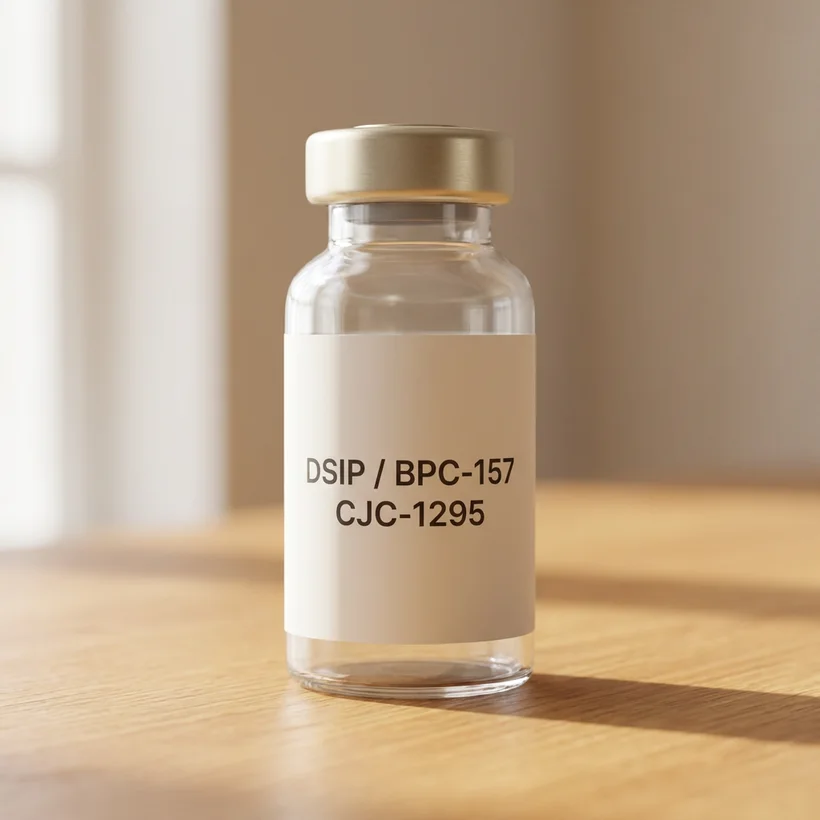
Sleep + Recovery Stack
Sleep and repair support with DSIP, BPC-157, and CJC · From $299/mo · compounded by a licensed 503A pharmacy, dispensed only after provider review.
View Sleep + Recovery Stack →Table of Contents
- Evidence Ledger: All Major Sleep Peptides Graded
- How Does DSIP Work? Mechanism With Specific Numbers
- Epithalon and Circadian Rhythm: What the Research Actually Shows
- GHRP-2 and GHRP-6: The Indirect GH Sleep Connection
- BPC-157 and Selank: Honest Assessments of the Fringe Candidates
- What Most Pages Get Wrong About Sleep Peptides
- Honest Head-to-Head: Peptides vs. Proven Sleep Interventions
- Operational and Label Literacy: Reading a COA, Spotting Degraded Product
- Dosing Reference Table (With Honest Uncertainty Ratings)
- FAQ
- Sources
1. Evidence Ledger: All Major Sleep Peptides Graded
| Peptide | Best Evidence Type | Effect Direction | Confidence | Critical Caveat |
|---|---|---|---|---|
| DSIP | Small human studies (not blinded RCT) | Increases slow-wave sleep amplitude | Low | Studies are 1970s to 1980s, tiny cohorts, IV administration |
| Epithalon | Small human trials (Russian literature) + animal | Normalizes circadian melatonin curve in elderly | Low | Limited independent replication outside originating lab |
| GHRP-2 | Human pharmacokinetic studies | Deepens SWS indirectly via GH pulse | Low to Moderate (for GH effect); Very Low (for sleep outcome) | Sleep benefit not directly measured in most trials |
| GHRP-6 | Human PK studies, animal | Similar to GHRP-2; stronger hunger side effect | Low | Same extrapolation problem as GHRP-2 |
| BPC-157 | Animal (rodent) only | CNS dopamine/serotonin modulation; sleep not directly measured | Very Low | No human sleep data; speculative extrapolation |
| Selank | Small human anxiolytic trials (Russian) | Reduces anxiety; may improve sleep onset indirectly | Very Low for sleep specifically | Sleep is not the measured endpoint in existing trials |
2. How Does DSIP Work? Mechanism With Specific Numbers
DSIP is a nonapeptide (9 amino acids: Trp-Ala-Gly-Gly-Asp-Ala-Ser-Gly-Glu) first isolated by Monnier and colleagues in 1977 from dialysate of the thalamic venous blood of rabbits during electrically induced sleep. It does not bind a single identified receptor cleanly. Instead, it appears to modulate multiple neurotransmitter systems: reducing noradrenergic firing, modulating serotonergic tone, and interacting with opioid receptors.
In the original Monnier work and subsequent small human studies (Schoenenberger and colleagues, 1977 to 1984), intravenous DSIP at doses in the range of roughly 25 to 50 nanomoles per kilogram increased the proportion of EEG delta activity (0.5 to 4 Hz slow waves) in subjects. That is the specific mechanism: it biases the EEG toward high-amplitude, low-frequency activity associated with Stage N3 sleep.
What this mechanism does NOT prove: That subcutaneous injection of DSIP, which is how it is used in research settings today, reaches the brain at concentrations sufficient to replicate these effects. DSIP has a plasma half-life measured in minutes in animal studies (roughly 3 to 5 minutes before peptide cleavage begins), and blood-brain barrier penetration is low and incompletely characterized. The IV route in the original studies bypasses all of that. Subcutaneous use is pharmacokinetically very different.
3. Epithalon and Circadian Rhythm: What the Research Actually Shows
Epithalon (also written Epitalon) is a synthetic tetrapeptide (Ala-Glu-Asp-Gly) derived from Epithalamin, a natural pineal gland extract investigated by Vladimir Khavinson and colleagues at the St. Petersburg Institute of Bioregulation. It is not a sleep peptide in the direct DSIP sense. Its sleep relevance comes from two observations in the Russian literature:
- In elderly subjects, Epithalon administration was associated with partial restoration of the blunted nocturnal melatonin curve that accompanies aging (Khavinson et al., published in Neuroendocrinology Letters, early 2000s).
- In animal models, it stimulated pineal melatonin synthesis.
If your sleep problem is age-related circadian flattening and low nocturnal melatonin, Epithalon has a plausible mechanism. If your problem is acute insomnia or anxiety-driven sleep onset failure, the evidence for Epithalon doing anything useful is essentially absent. Independent replication outside the Khavinson group remains thin.
4. GHRP-2 and GHRP-6: The Indirect GH Sleep Connection
Growth hormone secretagogues like GHRP-2 and GHRP-6 act on the ghrelin receptor (GHSR-1a) in the hypothalamus and pituitary, stimulating pulsatile GH release. The connection to sleep is physiological: the largest natural GH pulse of the day occurs during the first bout of slow-wave sleep, typically within 90 minutes of sleep onset. GH and SWS are bidirectionally linked.
The claim made on many supplement sites is that GHRP peptides therefore improve sleep quality. The honest version: they amplify GH pulses, and amplified GH pulses can deepen SWS as a downstream effect. But measured sleep architecture improvement is not the primary endpoint in GHRP human trials. You are extrapolating from GH pharmacokinetics to a sleep outcome. That is plausible but not proven in controlled sleep studies. GHRP-2 also raises prolactin and cortisol acutely, and GHRP-6 causes significant hunger, which can itself disrupt sleep if dosed near bedtime.
5. BPC-157 and Selank: Honest Assessments of the Fringe Candidates
BPC-157
BPC-157 is a pentadecapeptide (15 amino acids) derived from a body protection compound isolated from gastric juice. Its most documented effects in rodent studies involve gut healing and dopaminergic pathway modulation. Some rodent work shows it can reverse dopamine system disruptions induced by drugs or stress. Extrapolating this to human sleep quality is several inferential steps beyond what the data supports. There is no human sleep study for BPC-157. Including it on a "best sleep peptide" list is marketing, not science.
Selank
Selank (Thr-Lys-Pro-Arg-Pro-Gly-Pro) is a synthetic analog of tuftsin registered as an anxiolytic in Russia. Small trials show it reduces anxiety scores by mechanisms involving GABA-A modulation and brain-derived neurotrophic factor (BDNF) upregulation. Its sleep relevance is indirect: anxiety is a major driver of sleep-onset insomnia, and reducing anxiety can improve sleep. But Selank has not been studied with polysomnography as a primary endpoint in independent trials. Its sleep benefit, if real, is an anxiolytic secondary effect, not a sleep-specific mechanism.
6. What Most Pages Get Wrong About Sleep Peptides
This section covers the things commodity peptide blogs skip entirely.
Bioavailability by Route Is Almost Never Discussed
DSIP human studies used IV administration, which delivers peptide directly to systemic circulation. Subcutaneous injection, the route almost universally used outside clinical settings, results in slower absorption and partial degradation at the injection site before peptide reaches plasma. Blood-brain barrier penetration adds a second filtration layer. A peptide that works at 30 nanomoles per kilogram IV may need dramatically higher subcutaneous doses to achieve similar CNS exposure, or may not achieve it at all. No published pharmacokinetic study has established the subcutaneous-to-IV conversion factor for DSIP in humans.
Stability Is a Serious Problem
Lyophilized peptides are relatively stable when stored dry at minus 20 degrees Celsius. Once reconstituted in bacteriostatic water, peptides begin to degrade. The rate depends on pH, temperature, and specific peptide chemistry. DSIP contains an aspartyl residue that is susceptible to deamidation and isomerization under aqueous conditions. This means a reconstituted vial of DSIP stored at refrigerator temperature (4 degrees Celsius) may lose bioactive potency over days to weeks. Commodity sites never give you this detail because it makes the product look more complicated to use.
Purity Varies Enormously
Research-grade peptide suppliers sell material with HPLC purity ranging from below 95 percent to above 99 percent. A vial labeled "5 mg DSIP" at 90 percent purity contains roughly 4.5 mg of active peptide and 0.5 mg of unknown synthesis byproducts, truncated sequences, and residual solvents. At 98 percent purity you get 4.9 mg active peptide. For a peptide where effective dose is in micrograms-per-kilogram territory, this difference is clinically meaningful. Always demand an independent, third-party HPLC certificate of analysis, not an in-house purity claim.
7. Honest Head-to-Head: Peptides vs. Proven Sleep Interventions
| Intervention | Evidence Quality for Sleep | Effect Size (Where Known) | Regulatory Status (US) | Practical Barrier |
|---|---|---|---|---|
| CBT-I (Cognitive Behavioral Therapy for Insomnia) | High (multiple RCTs, meta-analyses) | Reduces sleep onset latency by roughly 20 to 30 minutes in meta-analyses | Recommended first-line (AASM) | Requires therapist or structured program |
| Melatonin (0.5 to 5 mg) | Moderate (many RCTs, especially circadian/jet lag) | Modest sleep-onset improvement; stronger in circadian disorders | OTC supplement (US) | None; widely available |
| Suvorexant (Belsomra) | High (FDA-approval trials, Phase III) | Statistically significant improvements in sleep onset and maintenance | FDA-approved Rx | Prescription required; cost |
| DSIP | Low (small, old, IV human studies) | Increased delta-wave amplitude in small cohorts; magnitude unclear | Research compound, not FDA-approved | No standardized dosing; purity risk; route gap |
| Epithalon | Low (small Russian human studies) | Circadian melatonin curve improvement in elderly; sleep outcome unclear | Research compound | Same purity and sourcing risks |
| GHRP-2 | Very Low for sleep specifically | GH pulse amplification confirmed; sleep benefit extrapolated | Research compound; banned by WADA | Blood glucose effects; WADA violations for athletes |
The peptide column loses this table in almost every row when the comparison is sleep outcome evidence. This does not mean peptides are useless; it means anyone using them for sleep is accepting that they are working ahead of the evidence.
8. Operational and Label Literacy
Reading a Certificate of Analysis
A legitimate COA for a research peptide should include: peptide name and sequence confirmation (mass spectrometry or amino acid analysis), HPLC purity percentage with the chromatogram, moisture content (Karl Fischer titration, particularly important for lyophilized peptides), and the name of the independent third-party lab that ran the analysis. If the COA lists the supplying company as both manufacturer and testing lab, it is not independent verification.
Reconstitution Math
Example: You have a 5 mg vial of DSIP. You want a concentration of 1 mg per mL. Add 5 mL of bacteriostatic water. Each 0.1 mL (a typical insulin syringe increment) contains 0.1 mg (100 micrograms). If the dose being explored in animal research is in the microgram-per-kilogram range, a 70 kg person at 1 microgram per kilogram would need 70 micrograms, or 0.07 mL from this solution. These calculations matter because overdosing a peptide with unknown pharmacodynamics carries unknown risk.
Spotting a Degraded Product
Lyophilized (freeze-dried) peptide cake should be white to off-white, uniform, and lightly adherent to the vial wall. Yellow discoloration suggests oxidation. Clumped or collapsed cake suggests moisture intrusion, which accelerates degradation. Once reconstituted, solution should be clear and colorless. Cloudiness or visible particles means particulate contamination or aggregation. Do not inject any of these. A peptide that smells sulfurous after reconstitution has degraded methionine or cysteine-containing sequences (less relevant for DSIP, but important for other peptides).
9. Dosing Reference Table (With Honest Uncertainty Ratings)
| Peptide | Dose Range Explored in Literature | Route in Studies | Timing Suggested | Uncertainty Level |
|---|---|---|---|---|
| DSIP | Roughly 25 to 50 nmol/kg in human studies | Intravenous (human); SC extrapolated in research use | 30 to 60 min before intended sleep | Very High uncertainty for SC route |
| Epithalon | 5 to 10 mg total per course (Russian protocols) | SC or IM injection | Typically morning in Russian protocols | High uncertainty; no standardized Western protocol |
| GHRP-2 | 100 to 300 mcg per injection in human GH studies | SC injection | Before sleep (to amplify overnight GH pulse) | High uncertainty for sleep outcome specifically |
| Selank | 250 to 500 mcg in Russian anxiolytic trials | Intranasal (Russian preparations) or SC | Evening if targeting anxiety-driven insomnia | Very High; sleep not the studied endpoint |
FAQ
What is the best peptide for sleep?
DSIP (delta sleep-inducing peptide) has the most direct sleep-specific mechanism and is the most studied peptide for sleep in humans, though the evidence is limited to small trials. Epithalon has supporting animal and small human data for circadian rhythm normalization. Neither has large RCT evidence.
How does DSIP improve sleep?
DSIP modulates delta-wave (slow-wave) sleep by interacting with multiple neurotransmitter systems including serotonergic, noradrenergic, and opioidergic pathways. It was originally isolated from rabbit thalamic perfusate and shown to increase slow-wave sleep amplitude in early animal and small human studies.
Does Epithalon help with sleep?
Epithalon (Epitalon), a tetrapeptide, has shown circadian rhythm normalization effects in elderly subjects in Russian clinical work, and melatonin-stimulating effects in animal studies. Evidence quality is low by Western RCT standards, and independent replication is limited.
Can GHRP-2 or GHRP-6 improve sleep?
GHRP-2 and GHRP-6 stimulate GH pulses that naturally coincide with slow-wave sleep. They can deepen early-night SWS as a secondary effect of GH release, not as direct sleep inducers. This is a mechanism extrapolation, not a proven clinical sleep outcome.
Is BPC-157 useful for sleep?
BPC-157 has no direct human sleep data. Animal studies show CNS dopaminergic and serotonergic modulation that could theoretically affect sleep architecture, but using it specifically for sleep is speculative extrapolation from rodent data.
What is Selank and does it help sleep?
Selank is a synthetic heptapeptide analog of tuftsin that has anxiolytic effects in Russian trials, reducing anxiety-driven sleep disruption. It does not directly induce sleep but may improve sleep onset in anxiety-predominant insomnia as a secondary effect.
How do you dose DSIP for sleep?
Early human studies used intravenous doses roughly in the range of 25 to 50 nanomoles per kilogram. Subcutaneous use is extrapolated from animal data. There is no established clinical dosing protocol; any dosing is off-label and experimental.
Are sleep peptides safe?
Short-term safety data is limited. DSIP human studies reported no serious adverse events in small cohorts. GHRP peptides raise blood glucose and prolactin acutely. Long-term safety for any of these peptides in sleep applications is unknown.
How do sleep peptides compare to melatonin or sleep medications?
Melatonin has more human RCT evidence for sleep-onset latency than any peptide on this list. FDA-approved drugs like suvorexant have proven efficacy in Phase III trials. Peptides lag significantly in clinical evidence and regulatory status.
Can you stack sleep peptides?
Stacking sleep peptides is entirely experimental. No human data exists on combined peptide regimens for sleep. Potential interactions with neurotransmitter systems are unstudied, and the risk-benefit calculation favors monotherapy or proven sleep interventions first.
Where do you buy research-grade sleep peptides?
Research peptides are sold by chemical suppliers with varying purity. A certificate of analysis from an independent third-party HPLC lab is the minimum quality check. Peptides sold for human use without prescription are in a regulatory gray area in the US.
What does a degraded peptide vial look like?
A degraded peptide solution may appear cloudy, discolored (yellow or brown), or show particulate matter. Lyophilized powder that has clumped unevenly or turned yellow suggests oxidation or moisture exposure. Discard and do not inject degraded product.
Sources
- Monnier M, Dudler L, Gaechter R, Schoenenberger GA. Delta sleep-inducing peptide (DSIP): EEG and motor activity in rabbits following intravenous administration. Neuroscience Letters. 1977;6(1):9-13.
- Schoenenberger GA, Maier PF, Tobler HJ, Monnier M. A naturally occurring delta-EEG-enhancing nonapeptide in urine of sleep-deprived unrestrained rats: effects on sleep. Pflugers Archiv. 1977;369(2):99-109.
- Khavinson VKh, Bondarev IE, Butyugov AA. Epithalon peptide induces telomerase activity and telomere elongation in human somatic cells. Bulletin of Experimental Biology and Medicine. 2003;135(6):590-592.
- Khavinson V, Diomede F, Mironova E, Linkova N, Trofimova S, Trubiani O, et al. AEDG Peptide (Epitalon) stimulates gene expression and differentiation of stem cells. International Journal of Molecular Sciences. 2020;21(16):5694.
- Van Cauter E, Plat L, Scharf MB, Leproult R, Cespedes S, L'Hermite-Baleriaux M, Copinschi G. Simultaneous stimulation of slow-wave sleep and growth hormone secretion by gamma-hydroxybutyrate in normal young men. Journal of Clinical Investigation. 1997;100(3):745-753. (Establishes GH-SWS coupling mechanism)
- Ghigo E, Arvat E, Muccioli G, Camanni F. Growth hormone-releasing peptides. European Journal of Endocrinology. 1997;136(5):445-460.
- Sikiric P, Seiwerth S, Rucman R, Turkovic B, Rokotov DS, Brcic L, et al. Stable gastric pentadecapeptide BPC 157: novel therapy in gastrointestinal tract. Current Pharmaceutical Design. 2011;17(16):1612-1632.
- Zozulya AA, Neznamov GG, Siuniakov TS, Kost NV, Gabaeva MV, Sokolov OI, et al. Efficacy and possible mechanisms of action of a new anxiolytic drug selank in the treatment of generalized anxiety disorders. Bulletin of Experimental Biology and Medicine. 2008;146(3):293-295.
- Sateia MJ, Buysse DJ, Krystal AD, Neubauer DN, Heald JL. Clinical practice guideline for the pharmacologic treatment of chronic insomnia in adults: an American Academy of Sleep Medicine clinical practice guideline. Journal of Clinical Sleep Medicine. 2017;13(2):307-349.
- Herxheimer A, Petrie KJ. Melatonin for the prevention and treatment of jet lag. Cochrane Database of Systematic Reviews. 2002;(2):CD001520.
- Michelson D, Snyder E, Paradis E, et al. Safety and efficacy of suvorexant during 1-year treatment of insomnia with subsequent abrupt treatment discontinuation: a phase 3 randomised, double-blind, placebo-controlled trial. Lancet Neurology. 2014;13(5):461-471.
Footer Disclaimers
Platform: FormBlends is an information and product platform. Content on this page is for educational purposes only and does not constitute medical advice, diagnosis, or treatment recommendations.
Research Compound Notice: Peptides discussed on this page are research compounds. They are not approved by the US Food and Drug Administration for any indication. Use in humans outside of a clinical trial or physician-supervised protocol is experimental and carries unknown risks.
Results Disclaimer: Individual results, if any, will vary. The evidence base for most sleep peptides consists of small, old, or non-Western studies. Effects observed in research settings may not translate to individual use.
Trademark: All third-party product and drug names are the property of their respective trademark holders. Use here is descriptive only and does not imply affiliation or endorsement.
Related peptide guides
Ready when you are
Sleep + Recovery Stack
Sleep and repair support with DSIP, BPC-157, and CJC · From $299/mo · compounded by a licensed 503A pharmacy, dispensed only after provider review.
View Sleep + Recovery Stack →