Key Takeaway
Proper LL-37 storage instructions for both lyophilized powder and reconstituted solutions. Learn temperature requirements, shelf life, and signs of degradation.
Quick Answer: LL-37 storage instructions depend on its form. Lyophilized (freeze-dried) LL-37 powder should be stored in a freezer at -4 degrees Fahrenheit (-20 degrees Celsius) or below, where it remains stable for 12 to 24 months. Once reconstituted with bacteriostatic water, store it in a refrigerator at 36-46 degrees Fahrenheit (2-8 degrees Celsius) and use within 28 days .
Why Proper Storage Matters
LL-37 is a 37-amino-acid peptide, and like all peptides, its three-dimensional structure determines its biological activity. Heat, light, moisture, and bacterial contamination can all degrade that structure, reducing potency or rendering the peptide completely inactive .
Improperly stored LL-37 isn't just less effective. It can be a waste of money and, in rare cases, a health risk if bacterial contamination occurs. Following proper storage protocols protects both your investment and your safety.
Storage by Form
Lyophilized (Freeze-Dried) Powder
| Parameter | Recommendation |
|---|---|
| Optimal temperature | -4°F (-20°C) or below |
| Acceptable short-term | 36-46°F (2-8°C) for up to 3 months |
| Shelf life (frozen) | 12-24 months |
| Shelf life (refrigerated) | Up to 3 months |
| Light exposure | Store in original packaging away from light |
| Moisture | Keep sealed. don't open until ready to reconstitute |
Lyophilized peptides are significantly more stable than reconstituted solutions because the removal of water slows chemical degradation reactions. If you receive multiple vials and plan to use them over several months, keep unopened vials in the freezer and move them to the refrigerator 30 minutes before you plan to reconstitute .
View data table
| Category | Clinical Interest Score | Detail |
|---|---|---|
| BPC-157 | 88 | Tissue repair and gut healing |
| TB-500 | 82 | Injury recovery |
| Sermorelin | 78 | Growth hormone support |
| Ipamorelin | 75 | Anti-aging and recovery |
| GHK-Cu | 70 | Skin and tissue repair |
Reconstituted Solution
| Parameter | Recommendation |
|---|---|
| Temperature | 36-46°F (2-8°C) |
| Shelf life | Up to 28 days |
| Solvent | Bacteriostatic water only for multi-dose use |
| Light exposure | Store in a dark area of the refrigerator |
| Freezing | Don't freeze reconstituted solution |
Once you add bacteriostatic water to the powder, the clock starts. The benzyl alcohol preservative in bacteriostatic water inhibits bacterial growth but doesn't stop chemical degradation of the peptide itself. Refrigeration slows this degradation significantly compared to room temperature .
For reconstitution instructions, see our detailed LL-37 how to reconstitute guide.
Best Practices for LL-37 Storage
Refrigerator Placement
Store your reconstituted LL-37 toward the back of the refrigerator, not in the door. Door shelves experience the most temperature fluctuation every time the fridge is opened. The back of a middle shelf provides the most consistent temperature.
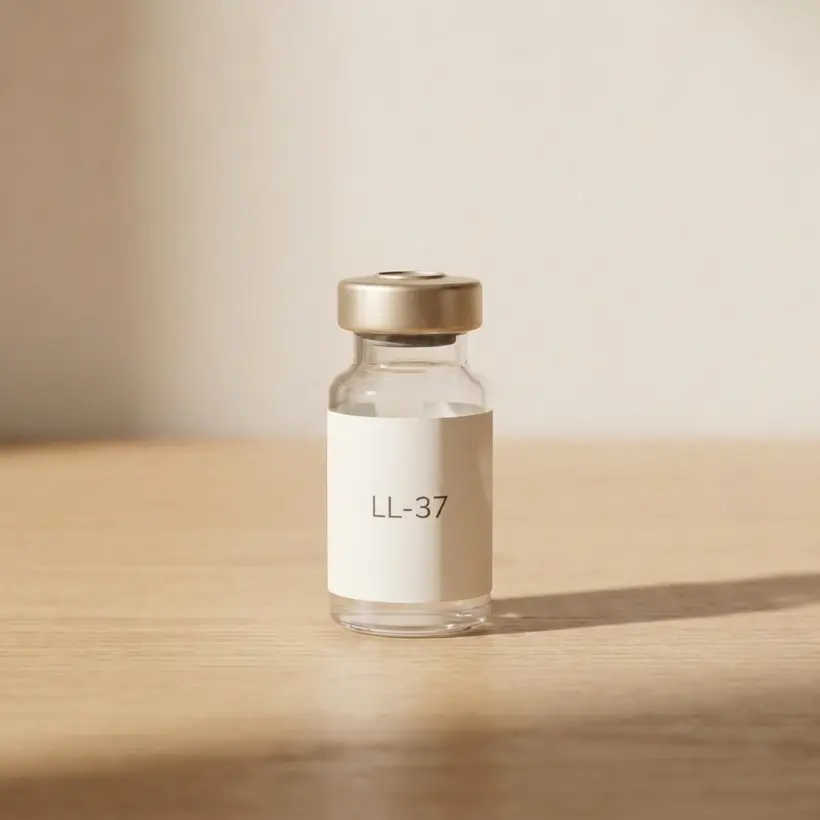
From the FormBlends catalog
LL-37
The body's natural antimicrobial defense peptide · From $199/mo · compounded by a licensed 503A pharmacy, dispensed only after provider review.
View LL-37 →Avoid Temperature Fluctuations
Repeated warming and cooling accelerates peptide degradation. When you take the vial out to draw a dose:
- Have your syringe and alcohol swab ready before removing the vial
- Draw your dose within 1 to 2 minutes
- Return the vial to the refrigerator immediately
- Don't leave the vial sitting on a counter
Protect from Light
UV and visible light can break peptide bonds and trigger oxidation reactions. Keep your LL-37 in its original box or wrap the vial in aluminum foil if the packaging has been discarded. This is especially important if your refrigerator has an interior light that turns on when opened .
Label Your Vials
Write the reconstitution date on each vial with a permanent marker. After 28 days, discard any remaining solution even if it looks fine visually. Peptide degradation products aren't always visible to the naked eye.
Signs of Degraded LL-37
Discard your LL-37 if you observe any of the following:
- Cloudiness or turbidity: A clear solution that becomes cloudy indicates protein aggregation or bacterial contamination.
- Visible particles: Floating specks or sediment suggest degradation or contamination.
- Color change: LL-37 solution should be clear and colorless. Yellow, brown, or any color change is a sign of chemical breakdown.
- Unusual odor: A foul or unusual smell when you remove the cap or insert a needle is a contamination red flag.
- Expired timeline: Even without visible changes, discard reconstituted LL-37 after 28 days.
Traveling with LL-37
If you need to travel with reconstituted LL-37:
- Use an insulated medication travel case with gel ice packs
- Pre-chill the case before placing the vial inside
- Carry it in your carry-on luggage (not checked bags, which can freeze in cargo holds)
- Bring a copy of your prescription or a letter from your physician
- TSA allows medically necessary liquids and syringes with proper documentation
For trips longer than a few days, consider bringing an unreconstituted vial and bacteriostatic water separately. Reconstitute at your destination using a clean hotel room surface and your standard supplies.
Frequently Asked Questions
Can I freeze reconstituted LL-37?
No. Freezing a reconstituted peptide solution causes ice crystal formation that can damage the peptide's structure. This is different from storing lyophilized powder in a freezer, which is recommended. Only freeze the unreconstituted powder form.
What happens if my LL-37 was left out overnight?
If reconstituted LL-37 was left at room temperature for more than a few hours, its potency may be reduced and contamination risk increases. A single brief exposure (under 2 hours) is unlikely to cause significant degradation, but repeated incidents add up. When in doubt, discard the vial and reconstitute a fresh one.
Can I store LL-37 in a mini-fridge?
Mini-fridges can work if they maintain a consistent 36-46 degrees Fahrenheit. Some small dorm-style fridges have wider temperature swings. Use a refrigerator thermometer to verify the temperature stays within range.
How do I know if my lyophilized LL-37 has gone bad?
Properly stored lyophilized LL-37 should appear as a white to off-white powder or cake. If it has turned yellow, brown, or appears wet or clumped, it may have been exposed to moisture or heat. When in doubt, contact your pharmacy.
Does FormBlends provide storage instructions with orders?
Yes. When you receive LL-37 through a FormBlends prescription, your compounding pharmacy includes specific storage and handling instructions with the shipment. Our clinical team is also available to answer questions about proper peptide care.
Get Pharmaceutical-Grade LL-37 with Full Support
At FormBlends, we prescribe LL-37 from licensed compounding pharmacies that ship with proper cold-chain packaging. Our physicians provide complete guidance on storage, reconstitution, and administration.
Disclaimer: This article is for informational purposes only and doesn't constitute medical advice. LL-37 isn't FDA-approved for any medical condition. Always consult with a licensed healthcare provider before beginning any peptide therapy. Individual results may vary.
Ready when you are
LL-37
The body's natural antimicrobial defense peptide · From $199/mo · compounded by a licensed 503A pharmacy, dispensed only after provider review.
View LL-37 →