
Trust Signals
- Analysis based on published studies including primary Russian research
- Evidence grading distinguishes cell culture from human trial data
- Stability and purity limitations disclosed
- Direct comparison to established longevity interventions
- No affiliation with peptide suppliers
The Epithalon Evidence Problem
Epithalon occupies a peculiar position in longevity research. The peptide demonstrates clear telomerase activation in cell cultures, yet decades after discovery, no major research institution has conducted large-scale human trials. This gap between cellular promise and clinical validation defines every practical decision about epithalon use.
The tetrapeptide Ala-Glu-Asp-Gly emerged from Vladimir Khavinson's work at the St. Petersburg Institute of Bioregulation in the 1980s. His team reported mortality reduction in elderly subjects receiving biannual courses, but these studies remain confined to Russian journals with limited peer review. Western researchers have replicated the telomerase findings in vitro but stopped short of human trials.
This creates an evidence asymmetry: robust molecular data showing 2.4-fold telomerase activation meets sparse, methodologically limited human studies. Understanding this disconnect helps explain why epithalon remains a research compound while interventions with weaker mechanisms achieved mainstream acceptance.
Telomerase Numbers That Actually Matter
Cell culture studies provide precise measurements of epithalon's telomerase effects. At 0.1 micromolar concentration, the peptide increases telomerase activity 2.4-fold in human fetal fibroblasts after 96 hours (Khavinson et al., 2003). This translates to approximately 10 additional population doublings before senescence, extending cellular lifespan by 34%.
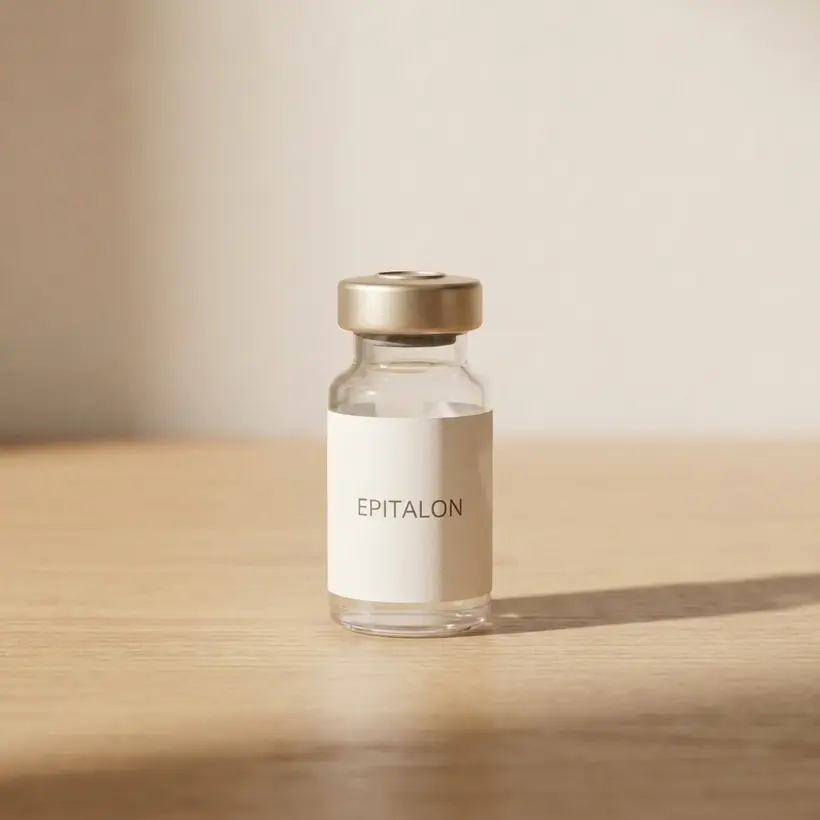
From the FormBlends catalog
Epitalon (Epithalon Injectable)
Pineal peptide that restores melatonin production and circadian rhythm · From $44/mo · compounded by a licensed 503A pharmacy, dispensed only after provider review.
Learn about Epitalon (Epithalon Injectable) →But concentration calculations reveal the bioavailability problem. A standard subcutaneous dose would need to achieve adequate tissue concentrations to match these in vitro effects, yet peptidases begin cleaving epithalon within minutes of injection. The Glu2-Asp3 bond proves especially vulnerable, with plasma half-life likely measured in minutes rather than hours based on similar tetrapeptides.
No published pharmacokinetic studies measure actual tissue concentrations after injection. The assumption that subcutaneous administration achieves the 0.1 micromolar threshold for telomerase activation remains unvalidated. This fundamental gap undermines dosing protocols copied between websites without scrutiny.
Chemistry Explains the Storage Rules
Epithalon's aspartate residue at position 3 creates instability that determines handling requirements. Two degradation pathways compete once the peptide enters aqueous solution:
Aspartate undergoes spontaneous isomerization to isoaspartate through a succinimide intermediate. This reaction accelerates above pH 6 and doubles in rate for every 10°C temperature increase. The isoaspartate form shows no biological activity, effectively destroying the peptide without visible changes.
Simultaneously, the Asp-Gly peptide bond proves unusually susceptible to hydrolysis. This combination means reconstituted epithalon degrades significantly within 30 days at 2-8°C, with faster degradation at room temperature or higher pH.
Lyophilized epithalon remains stable for years at -20°C because these reactions require water. But reconstitution starts an irreversible countdown. Bacteriostatic water's benzyl alcohol prevents microbial growth but doesn't slow chemical degradation. Visual clarity means nothing; degraded epithalon looks identical to fresh material until extreme breakdown causes aggregation.
Reading Between the Lines of Russian Studies
The 12-year Khavinson study followed 79 elderly subjects in St. Petersburg, comparing 41 receiving epithalon to 38 controls. Subjects received 10mg intramuscular injections daily for 10 days, repeated every 6 months. Mortality decreased 1.8-fold in coronary artery disease patients and 1.6-fold overall.
These results seem impressive until examining methodology. No randomization protocol appears in published papers. Control group selection criteria remain undescribed. Blinding procedures, if any, go unmentioned. Most critically, no telomere measurements validate the proposed mechanism.
The melatonin normalization study included just 14 elderly women, measuring urinary 6-sulfatoxymelatonin before and after one epithalon course. Results showed rhythm restoration in subjects with disrupted patterns. But this tiny sample using intramuscular administration barely qualifies as preliminary evidence.
No Western research groups have attempted replication. The absence of epithalon from ClinicalTrials.gov despite decades of availability suggests either lack of interest or unpublished negative results.
What Users Actually Report
Community forums and user reports reveal consistent patterns in epithalon experiences, though these remain anecdotal observations without clinical validation. Most users describe subtle rather than dramatic effects, distinguishing epithalon from peptides with more immediate impacts.
Sleep quality improvements appear most frequently, typically emerging after 7-10 days of use. Users report deeper sleep and easier morning awakening rather than sedation. This aligns with the melatonin normalization seen in Russian studies, though placebo effects cannot be ruled out.
Energy and mood changes follow a bimodal pattern. Some users report increased vitality and mental clarity by week two. Others notice no subjective changes despite completing multiple cycles. This variability might reflect individual differences in baseline telomerase activity or peptide metabolism.
Physical appearance claims prove most questionable. While some report improved skin quality or hair growth after months of cycling, no controlled studies support these observations. The theoretical connection through telomerase seems plausible but remains unproven.
Notably absent: reports of dramatic anti-aging reversal or significant biomarker changes. Users tracking blood work rarely report meaningful differences in standard panels. This matches the subtle, long-term nature of telomerase-based interventions but disappoints those expecting rapid transformation.
Price Reality Check
Epithalon's cost structure reflects multiple factors beyond simple peptide synthesis. Quality suppliers typically price epithalon based on purity levels, manufacturing standards, and market positioning. A standard cycle requires multiple vials, creating substantial total costs for those pursuing regular use.
Manufacturing complexity drives these prices. The tetrapeptide requires four coupling reactions with protection/deprotection steps. Achieving pharmaceutical-grade purity demands multiple HPLC purification runs. Scale remains limited since epithalon lacks FDA approval for any indication.
Compare this to established longevity interventions. Metformin costs under $100 yearly with extensive safety data. Rapamycin runs $200-600 annually with growing human evidence. NAD+ precursors match epithalon's price range but offer oral administration. The cost-per-evidence ratio strongly favors alternatives.
Some users pursue group purchases or overseas suppliers to reduce costs. This introduces quality risks. Without third-party testing, cheaper epithalon may contain synthesis byproducts, incorrect sequences, or degradation products. The savings rarely justify uncertainty about injecting unknown compounds.
COA Red Flags
Certificates of Analysis for epithalon require careful interpretation. Legitimate COAs include specific analytical data:
HPLC purity should exceed 98% with a single dominant peak. Multiple peaks indicate incomplete synthesis or degradation. Retention time must match reference standards. Peak shape matters; broad or tailing peaks suggest column interactions from impurities.
Mass spectrometry confirms molecular weight and identity. But simple MS misses isoaspartate formation, which maintains the same mass. More sophisticated methods like tandem MS or peptide mapping better detect degradation.
Amino acid analysis verifies composition. The Ala:Glu:Asp:Gly ratio should equal 1:1:1:1 within 5% error. Deviations suggest incorrect synthesis or hydrolysis.
Missing data reveals more than included results. Absent bacterial endotoxin testing suggests non-pharmaceutical manufacturing. No residual solvent analysis indicates incomplete quality control. Vague testing dates or batch numbers prevent verification.
Generic COAs recycled across suppliers represent the biggest red flag. Each batch requires unique testing. Identical documents with different company headers guarantee fraudulent documentation.
The Cancer Question Nobody Wants to Address
Telomerase activation presents an uncomfortable paradox at epithalon's core. Evolution silenced telomerase in adult tissues for good reason: active telomerase enables unlimited replication, the hallmark of cancer. Approximately 85% of tumors reactivate telomerase to achieve immortality.
Epithalon's cancer risk remains completely unstudied in humans. No trials have examined whether the peptide accelerates pre-existing tumors or enables malignant transformation. The Russian mortality studies provide false reassurance; their small sample size and short follow-up couldn't detect increased cancer incidence.
Theoretical arguments cut both directions. Optimists note that temporary telomerase activation differs from constitutive expression in cancer. Short epithalon cycles might extend healthy cell lifespan without enabling transformation. Pessimists counter that any telomerase activation in cells harboring mutations could prove catastrophic.
This uncertainty should factor heavily in risk assessment. Unlike rapamycin or metformin, which show anti-cancer properties, epithalon's fundamental mechanism raises red flags. Users essentially gamble that benefits outweigh unknown oncogenic potential.
Practical Protocol Decisions
Despite limited evidence, consistent protocols have emerged from Russian studies and user experience. Standard approaches balance theoretical efficacy with practical constraints:
Dosing typically follows the Khavinson model: 10mg daily for 10-20 days. Some start with 5mg to assess tolerance. The 20mg "aggressive" protocols lack any research support and double costs without clear rationale.
Injection frequency matters for peptide stability. Daily administration from a single reconstituted vial exposes later doses to extended degradation. Some users prepare fresh vials every 5 days, accepting higher costs for potentially better stability.
Cycling recommendations vary from every 3 to 6 months. The Russian studies used 6-month intervals, but this seems arbitrary rather than optimized. More frequent cycling increases costs substantially without evidence of superior outcomes.
Reconstitution calculations prove straightforward: 10mg peptide plus 5mL bacteriostatic water yields 2mg/mL. For 10mg doses, inject 5mL subcutaneously, potentially split between sites for comfort. Refrigerate immediately and use within 30 days maximum.
FAQ
What is epitalon peptide used for? Epitalon is primarily used for theoretical anti-aging purposes based on its ability to activate telomerase in cell cultures. Users typically seek it for longevity, sleep regulation, or immune support, though human clinical evidence remains limited to small Russian studies.
Does epithalon actually lengthen telomeres? In human fibroblast cultures, epithalon increases telomerase activity by 2.4-fold. However, no published human trials measure actual telomere lengthening in vivo. The leap from cell culture telomerase activation to systemic telomere extension remains unproven.
What are the proven benefits of epithalon peptide? The most substantiated benefits come from small human trials showing melatonin rhythm normalization in elderly subjects and reduced mortality in a 12-year observational study. Cell culture studies show telomerase activation and antioxidant effects, but these haven't translated to proven clinical outcomes.
Is epithalon peptide safe? Limited safety data exists from small Russian trials reporting no significant adverse events at 10mg doses over 10-15 days. However, theoretical concerns exist about telomerase activation in pre-cancerous cells. No long-term safety studies have been published.
How do you take epithalon peptides? Standard protocols use 5-10mg daily via subcutaneous injection for 10-20 days, repeated every 6 months. The peptide requires reconstitution with bacteriostatic water to 2mg/mL concentration. Store reconstituted solution at 2-8°C for maximum 30 days.
Why is epithalon so expensive? Epithalon costs reflect complex tetrapeptide synthesis requiring multiple protection/deprotection steps, high purity standards (>98%), and limited manufacturing scale. Pricing varies significantly between suppliers and regions.
Can epithalon cause cancer? No direct evidence links epithalon to cancer, but telomerase activation in cells with existing mutations could theoretically promote tumor growth. The peptide's selectivity for normal versus cancerous cells remains unclear in humans.
How long before epithalon shows results? Subjective improvements in sleep and energy are reported within 2-4 weeks. Biomarker changes like melatonin normalization occur within one 10-day cycle. Any telomere-related effects would theoretically require multiple cycles over years.
Is epithalon better than other anti-aging peptides? Epithalon has a unique telomerase mechanism compared to GHK-Cu (extracellular matrix) or thymosin alpha-1 (immune modulation). However, it lacks the robust human trial data supporting rapamycin or metformin for longevity endpoints.
Sources
- Khavinson VK, Bondarev IE, Butyugov AA. "Epithalon peptide induces telomerase activity and telomere elongation in human somatic cells." Bulletin of Experimental Biology and Medicine. 2003;135(6):590-592.
- Anisimov VN, Khavinson VK. "Peptide bioregulation of aging: results and prospects." Biogerontology. 2010;11(2):139-149.
- Korkushko OV, Khavinson VK, Shatilo VB. "Peptide preparation Epithalon restores melatonin production in old people." Advances in Gerontology. 2004;14:75-81.
- Goncharova ND, Vengerin AA, Khavinson VK. "Pineal peptides restore the age-related disturbances in hormonal functions of the pineal gland and the pancreas." Experimental Gerontology. 2005;40(1-2):51-57.
- PubChem. "Epithalon." National Library of Medicine.
- ClinicalTrials.gov database search for "epithalon" and "epitalon" (no results as of 2024).
- US Patent 6,727,227 B1. "Tetrapeptide revealing geroprotective effect."
Footer Disclaimers
Platform Notice: This article is for educational purposes only and does not constitute medical advice. Consult a healthcare provider before using any peptide compounds.
Research Compound Disclaimer: Epithalon is sold as a research compound not approved for human use by the FDA or other regulatory agencies.
Results Disclaimer: Individual results vary. The studies cited involve specific populations and protocols that may not apply to all users.
Trademark Notice: Epithalon/Epitalon are not registered trademarks of FormBlends. All trademarks belong to their respective owners.
Related peptide guides
Ready when you are
Epitalon (Epithalon Injectable)
Pineal peptide that restores melatonin production and circadian rhythm · From $44/mo · compounded by a licensed 503A pharmacy, dispensed only after provider review.
Learn about Epitalon (Epithalon Injectable) →