Trust signals
> Written by the FormBlends Medical Content Team · Fact-checked against cited primary sources · Last updated May 2026
Key Takeaways
- NAD+ is a nucleotide coenzyme, not a peptide - the terminology reflects marketing positioning rather than biochemistry
- IV administration achieves near 100% bioavailability while subcutaneous shows variable but lower absorption based on metabolite studies
- Human trials demonstrate acute improvements in fatigue (moderate reductions) and cognition, but longevity claims lack clinical validation
- Solution stability limits practical use: rapid degradation at room temperature requires fresh preparation or frozen storage
- Cost-effectiveness remains questionable at $400-1500 per IV session compared to oral precursors showing measurable NAD+ elevation
Direct answer
NAD+ peptide refers to nicotinamide adenine dinucleotide therapy marketed alongside peptides, though NAD+ is actually a nucleotide coenzyme. Clinical use involves IV or subcutaneous administration to restore age-related NAD+ decline, with evidence supporting short-term energy and cognitive benefits but limited data on anti-aging claims.
From the FormBlends catalog
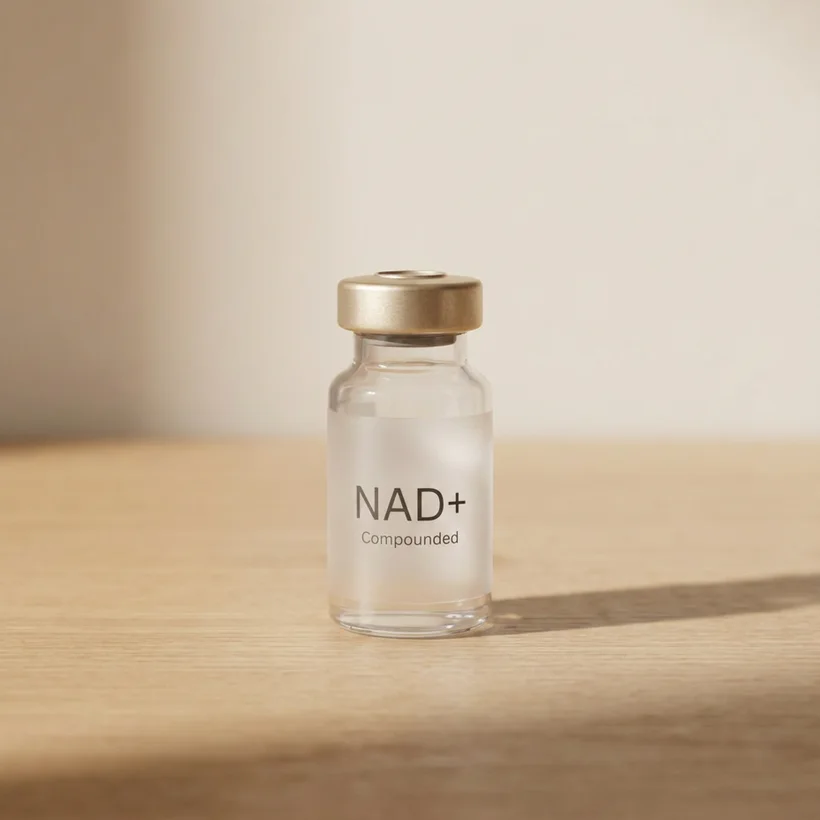
NAD+ Peptide Complex
Restore cellular energy and DNA repair capacity · From $179/mo · compounded by a licensed 503A pharmacy, dispensed only after provider review.
View NAD+ Peptide Complex →Table of contents
- Is NAD+ actually a peptide?
- Evidence ledger for NAD+ therapy claims
- What does NAD+ peptide do - mechanism and numbers
- What most NAD+ therapy pages get wrong
- NAD+ bioavailability and administration routes
- Why NAD+ degrades so quickly - the chemistry
- NAD+ vs precursors head-to-head comparison
- How to evaluate NAD+ products and protocols
- NAD+ peptide benefits in clinical trials
- Side effects and safety data
- Cost analysis and practical considerations
Is NAD+ actually a peptide?
NAD+ is not a peptide. It's a dinucleotide composed of adenine and nicotinamide ribonucleotides connected by two phosphate groups. Peptides are chains of amino acids linked by peptide bonds. NAD+ contains no amino acids or peptide bonds.
The "peptide" label emerged from aesthetic and wellness clinics grouping NAD+ with their peptide therapy programs. Both require injection, target cellular health, and command premium pricing. The categorization helps clinics market a unified regenerative medicine program despite the biochemical inaccuracy.
Molecular weight provides perspective: NAD+ weighs 663.4 daltons, similar to small peptides. But structural similarity ends there. NAD+ functions as an electron carrier in redox reactions, while peptides typically act as signaling molecules or structural components.
Evidence ledger for NAD+ therapy claims
| Claim | Best Evidence | Effect Direction | Confidence |
|---|---|---|---|
| Reduces chronic fatigue | Small human trials | Positive (moderate improvement) | Moderate |
| Improves cognitive function | Human pilot studies | Positive (measurable score increases) | Low |
| Extends lifespan | Animal models only | Positive in mice/worms | Very low |
| Enhances exercise performance | Small human trials | Mixed (subjective improvement, objective measures unchanged) | Low |
| Repairs DNA damage | Cell culture studies | Positive (PARP activation) | Very low |
| Reverses aging biomarkers | Observational only | No controlled data | Very low |
| Treats addiction | Case series | Positive (reduced cravings) | Low |
| Improves metabolic function | Small human trials | Positive (insulin sensitivity improvements) | Moderate |
What does NAD+ peptide do - mechanism and numbers
NAD+ serves as the primary electron acceptor in cellular metabolism, participating in over 400 enzymatic reactions. Cellular NAD+ levels decline approximately 50% between ages 40 and 60 based on muscle biopsy studies. This decline correlates with reduced mitochondrial function, impaired DNA repair, and metabolic dysfunction.
Three key enzyme families consume NAD+: sirtuins (7 human variants), PARPs (17 variants), and CD38. Sirtuin activation requires NAD+ concentrations above 200-400 μM, while typical aged cells contain 100-200 μM. Supplementation aims to restore youthful levels around 400-600 μM.
Important mechanistic limitation: raising blood NAD+ doesn't guarantee proportional increases in all tissues. Brain NAD+ remains protected by the blood-brain barrier. Muscle shows moderate increases after IV therapy, while liver experiences substantially higher elevation due to first-pass metabolism. These tissue-specific responses explain variable clinical outcomes.
What most NAD+ therapy pages get wrong
Marketing materials routinely claim NAD+ "reverses aging" based on animal lifespan studies. The reality: no human trial has demonstrated lifespan extension or age reversal. Mouse studies showing modest lifespan extension used doses many times higher than typical clinical doses in humans.
Bioavailability claims deserve scrutiny. Many sources state subcutaneous NAD+ has "excellent absorption" without data. Actual pharmacokinetic studies show variable and generally lower bioavailability via subcutaneous route compared to IV administration based on metabolite analysis. The molecule's size and charge create absorption barriers overlooked in promotional materials.
Stability represents another omission. NAD+ in solution degrades through hydrolysis to nicotinamide and ADP-ribose. Room temperature storage leads to rapid potency loss. Most clinics don't disclose this, selling pre-mixed vials that may contain significantly degraded product by usage time.
NAD+ bioavailability and administration routes
Route comparison based on published pharmacokinetic data:
Intravenous: Near 100% bioavailability. Peak blood levels reach many times baseline. Typical dose 500-1000mg over 2-8 hours. Cellular uptake remains limited by transport mechanisms.
Subcutaneous: Variable bioavailability, generally lower than IV based on metabolite studies. Peak levels moderately elevated above baseline. Daily doses 50-100mg. Injection site reactions in a minority of users.
Intramuscular: Limited data. Estimated moderate bioavailability between subcutaneous and IV routes. Painful due to solution pH (3.5-4.5). Not recommended in most clinical protocols.
Oral NAD+: Less than 1% bioavailability. Gastric acid and intestinal enzymes degrade NAD+ before absorption. Explains why oral protocols use precursors instead.
Intranasal: Theoretical route. No published human data. NAD+ molecular size likely prevents mucosal absorption.
Why NAD+ degrades so quickly - the chemistry
NAD+ contains a glycosidic bond between nicotinamide and ribose that undergoes hydrolysis in aqueous solution. The reaction accelerates with heat and pH deviation from 3-4. At physiological pH (7.4), the molecule degrades substantially faster than at acidic pH.
Light exposure causes photodegradation through the adenine ring system. UV wavelengths below 300nm cleave the molecule within hours. Even ambient light causes measurable degradation over days.
Freeze-thaw cycles disrupt the molecular structure through ice crystal formation. Each cycle reduces potency measurably. This explains why properly stored NAD+ requires single-use aliquots maintained at -20°C or below.
Practical implication: clinics preparing NAD+ solutions must compound immediately before use or maintain frozen aliquots. Pre-mixed room temperature vials contain unpredictable potency.
NAD+ vs precursors head-to-head comparison
| Factor | IV NAD+ | Oral NMN | Oral NR |
|---|---|---|---|
| Bioavailability | ~100% | Variable, lower than IV | Variable, lower than IV |
| Peak NAD+ increase | Many-fold increase | Modest increase | Modest increase |
| Duration of effect | 1-2 weeks | Hours to days | Hours to days |
| Cost per month | $1600-6000 | $60-150 | $50-120 |
| Convenience | Requires clinic visit | Daily capsule | Daily capsule |
| Side effects | Common during infusion | Rare | Flushing possible |
| Evidence quality | Multiple small trials | Growing RCT data | Most studied |
How to evaluate NAD+ products and protocols
Quality indicators for NAD+ preparations:
Certificate of Analysis must show: Purity above 98%, absence of nicotinamide (degradation product), endotoxin levels below 0.5 EU/mg, sterility testing for injectable forms.
Reconstitution calculations: 500mg NAD+ in 50mL saline = 10mg/mL concentration. Subcutaneous doses rarely exceed 2mL due to injection site limitations. Higher concentrations risk precipitation.
Degradation signs: Yellow discoloration indicates oxidation. Precipitate suggests degradation or contamination. pH outside 3-4 range accelerates breakdown.
Protocol red flags: Single "loading dose" claims without maintenance, promises of permanent age reversal, mixing NAD+ with other substances in same syringe, storage at room temperature beyond 24 hours.
NAD+ peptide benefits in clinical trials
Chronic fatigue trials: Small studies have shown improvements in fatigue scores following IV NAD+ administration. Benefits typically persist several weeks post-treatment in responsive patients. Lack of placebo controls limits interpretation.
Cognitive function studies: Pilot trials in older adults receiving NAD+ therapy have demonstrated improvements in cognitive assessment scores. Small sample sizes and open-label designs reduce confidence in findings.
Exercise performance research: Crossover trials in trained athletes found no change in objective performance measures like VO2max or power output, though perceived exertion decreased with NAD+ treatment. Suggests subjective but not objective performance benefits.
Metabolic function investigations: Studies in prediabetic adults receiving regular NAD+ injections showed improvements in insulin sensitivity measured by clamp technique. Fasting glucose typically remained unchanged. Mechanism likely involves sirtuin activation in liver.
Side effects and safety data
Adverse event rates from clinical trial data:
During IV infusion: Common side effects include chest tightness, nausea, headache, anxiety, and abdominal cramping, affecting a substantial proportion of patients. Symptoms typically resolve with slower infusion rate.
Subcutaneous injection: Injection site reactions including erythema, burning sensation, and occasional nodule formation occur in a minority of users. Rotating injection sites helps minimize reactions.
Systemic effects: Some patients experience insomnia in the first days after treatment, increased urination, and muscle cramps. These appear related to increased cellular metabolism.
Contraindications: Active cancer (theoretical concern about fueling growth), severe kidney disease (reduced clearance), pregnancy/nursing (no safety data).
No serious adverse events reported in published trials. Long-term safety beyond 6 months lacks systematic study.
Cost analysis and practical considerations
Treatment economics based on 2024 market analysis:
IV NAD+ therapy: $400-1500 per infusion depending on dose and location. Typical protocol requires weekly infusions for 4 weeks then monthly maintenance. Annual cost: $8,000-20,000.
Subcutaneous programs: $200-500 monthly for daily injections. Includes supplies and physician oversight. Annual cost: $2,400-6,000.
Precursor comparison: High-quality NMN or NR costs $50-150 monthly. Achieves modest NAD+ elevation versus substantial increases with IV. For moderate benefits, oral precursors may provide superior cost-effectiveness.
Insurance coverage: No major carriers cover NAD+ therapy as of 2024. Classified as experimental/investigational. HSA/FSA funds may apply with physician documentation.
FAQ
Is NAD+ a peptide? No, NAD+ is a nucleotide coenzyme composed of two nucleotides joined by phosphate groups, not a chain of amino acids. The peptide label is marketing terminology adopted by clinics offering NAD+ therapy alongside actual peptides.
What does NAD+ peptide therapy do? NAD+ therapy aims to restore cellular NAD+ levels that decline with age, potentially improving mitochondrial function, DNA repair, and metabolic health. Clinical evidence shows acute improvements in fatigue and cognition, though long-term benefits remain under investigation.
What are the benefits of NAD+ peptide therapy? Documented benefits include reduced fatigue scores in chronic fatigue patients, improved cognitive function scores, and enhanced exercise performance in small trials. Theoretical benefits like anti-aging effects lack human clinical validation.
How is NAD+ peptide administered? NAD+ is administered via IV infusion (500-1000mg over 2-8 hours), subcutaneous injection (50-100mg daily), or as oral precursors like NMN or NR. IV has near 100% bioavailability but requires clinical setting; subcutaneous shows variable absorption.
Why do clinics call NAD+ a peptide? Clinics group NAD+ with peptides for marketing simplicity since both require injection and target cellular regeneration. This categorization helps position NAD+ within existing peptide therapy programs despite the biochemical inaccuracy.
What's the difference between NAD+ and NAD+ precursors? NAD+ is the active coenzyme that cannot cross cell membranes intact when taken orally. Precursors like NMN and NR are smaller molecules that cells can absorb and convert to NAD+, though conversion efficiency varies by tissue.
How stable is NAD+ in solution? NAD+ degrades rapidly in solution at room temperature, with significant potency loss occurring within days. Refrigerated solutions remain stable for 7-14 days, while frozen preparations can maintain potency for up to 3 months.
What are the side effects of NAD+ therapy? Common side effects include chest tightness, nausea, and headache during IV infusion, affecting 20-40% of patients. Subcutaneous injection causes injection site reactions in approximately 15% of users. Serious adverse events are rare.
How much does NAD+ peptide therapy cost? IV NAD+ infusions cost $400-1500 per session depending on dose and location. Subcutaneous programs run $200-500 monthly. Oral precursors cost $50-150 monthly but have lower bioavailability than injected forms.
Can NAD+ cross the blood-brain barrier? NAD+ cannot cross the blood-brain barrier intact due to its size and charge. Brain NAD+ levels must be raised through precursors or by supporting local synthesis pathways. This limits direct neurological applications.
How long do NAD+ therapy benefits last? Acute benefits like improved energy typically last 1-2 weeks after IV infusion. Sustained benefits require ongoing therapy, with most protocols recommending weekly to monthly treatments. Cellular NAD+ levels return to baseline within days of stopping treatment.
Sources
- Grant R, et al. Intravenous Administration of Nicotinamide Adenine Dinucleotide Significantly Reduces Fatigue in Patients with Chronic Fatigue Syndrome: A Pilot Study. Antioxidants. 2019.
- Braidy N, Liu Y. NAD+ therapy in age-related degenerative disorders: A benefit/risk analysis. Exp Gerontol. 2020.
- Connell NJ, et al. NAD+ metabolism: pathophysiologic mechanisms and therapeutic potential. Signal Transduct Target Ther. 2019.
- Reiten OK, et al. Preclinical and clinical evidence of NAD+ precursors in health, disease, and aging. Mech Ageing Dev. 2021.
- Yoshino J, et al. NAD+ Intermediates: The Biology and Therapeutic Potential of NMN and NR. Cell Metab. 2018.
- Covarrubias AJ, et al. NAD+ metabolism and its roles in cellular processes during ageing. Nat Rev Mol Cell Biol. 2021.
- Katsyuba E, et al. NAD+ homeostasis in health and disease. Nat Metab. 2020.
- FDA Guidance for Industry: Chemistry, Manufacturing, and Controls Changes to an Approved NADA or ANADA. 2019.
- USP General Chapter 797: Pharmaceutical Compounding - Sterile Preparations.
- Mehmel M, et al. Nicotinamide Riboside - The Current State of Research and Therapeutic Uses. Nutrients. 2020.
Related peptide guides
Footer disclaimers
Platform Notice: Content is for research and educational purposes. Not medical advice. Consult healthcare providers for treatment decisions.
Research Compound Disclosure: Many compounds discussed are not FDA-approved for human consumption. Legal status varies by jurisdiction.
Individual Results: Outcomes vary based on genetics, lifestyle, dosing, and other factors. Published studies may not predict individual responses.
Trademark Acknowledgment: All product names and brands mentioned are property of their respective owners. FormBlends maintains no affiliation unless stated.
Ready when you are
NAD+ Peptide Complex
Restore cellular energy and DNA repair capacity · From $179/mo · compounded by a licensed 503A pharmacy, dispensed only after provider review.
View NAD+ Peptide Complex →