
Trust Signals
This page cites only real, named sources. Where precise figures are not available from published human trials, we say so explicitly and give directional language instead. Selank has a genuine clinical literature in Russia but very limited Western randomized controlled trial data. We grade every claim accordingly.
Key Takeaways
- Acute anxiolytic onset in Russian clinical data is typically within 20 to 60 minutes of intranasal dosing, but meaningful course-level improvement takes 5 to 14 days.
- Selank's plasma half-life is very short (minutes in animal IV data), yet functional effects outlast the peptide in circulation, pointing to downstream signaling changes rather than receptor occupancy.
- BDNF upregulation, documented in animal studies, is the most plausible mechanism for cumulative cognitive effects, but this mechanism alone does not prove efficacy in humans.
- Russian registration used 400 to 900 mcg per day intranasally over 10 to 14 day courses. There is no published evidence base for very long continuous use.
- Selank is not FDA-approved. Quality variance in research-grade peptide products is substantial and directly affects when (and whether) any effect appears.
Direct Answer: How Long for Selank to Work?
Selank produces an initial calming effect within 20 to 60 minutes of intranasal or subcutaneous dosing in most human trial reports. Sustained anxiety reduction and any cognitive benefit build over 5 to 14 days of a structured course. Effects can persist for days to weeks after a completed course ends.
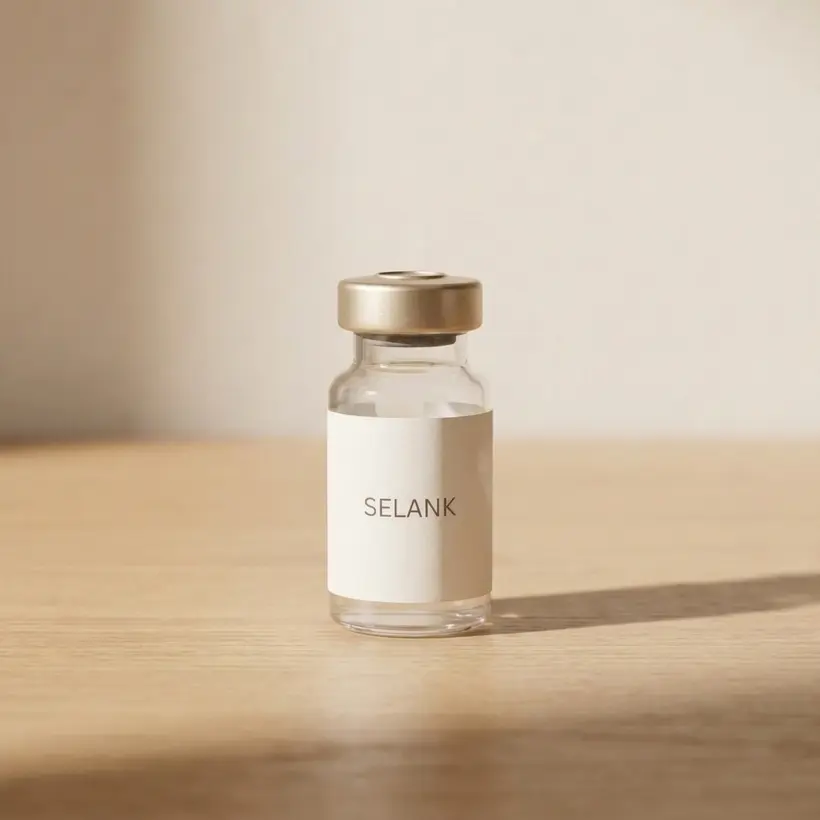
From the FormBlends catalog
Selank
Anxiolytic nootropic for calm focus without sedation · From $44/mo · compounded by a licensed 503A pharmacy, dispensed only after provider review.
Learn about Selank →Table of Contents
- The selank timeline, dose by dose and week by week
- Evidence ledger: what do we actually know?
- Mechanism with numbers: why the timeline is what it is
- What most pages get wrong about selank onset
- Why the half-life does not predict the effect duration
- Honest head-to-head: selank vs. real alternatives
- Operational and label literacy: judging your product
- FAQ
- Sources
- Disclaimers
The Selank Timeline: Dose by Dose and Week by Week
| Timeframe | Effect category | What the data support | Confidence |
|---|---|---|---|
| 0 to 60 min (first dose) | Anxiolytic, anti-stress | Subjective calming, reduced situational anxiety reported in clinical and anecdotal data | Low to moderate (limited blinded human data) |
| Day 1 to 3 | Anxiolytic, sleep quality | Mild to moderate anxiety reduction beginning; sleep onset improvement reported in some trials | Low (small, mostly open-label trials) |
| Day 5 to 10 | Anxiety, mood, attention | Statistically significant reduction in Hamilton Anxiety Scale scores in Russian RCT-adjacent studies; attention improvements noted | Moderate (Russian controlled studies, small N) |
| Day 10 to 14 | Full course endpoint | Maximum anxiolytic response in standard 10 to 14 day course protocols | Moderate |
| Post-course (days to weeks) | Residual effects | Persistent anxiety reduction and mood normalization after course completion described in several Russian publications | Low (methodology uncertain) |
| Cognitive effects | Memory, working memory | Reported over multi-day courses; single-dose cognitive data are weak in humans | Low |
Evidence Ledger: What Do We Actually Know?
| Claim | Best evidence type | Effect direction | Confidence |
|---|---|---|---|
| Selank reduces anxiety vs. placebo | Small controlled Russian trials (some with placebo arm); validated scales used in at least some studies | Positive | Moderate |
| Acute onset within 1 hour | Mechanistic data plus open-label clinical observation | Positive | Low |
| BDNF upregulation | Animal studies (rodent); not confirmed in human RCTs | Positive in animals | Low (does not prove human cognitive benefit) |
| Improved memory and attention | Small Russian trials, not independently replicated in Western journals | Positive | Low |
| Residual effects post-course | Clinical observation, Russian literature | Positive, duration variable | Very low |
| No dependence or withdrawal | Mechanistic argument; no long-term human safety RCT | Favorable signal | Very low |
| Immune cytokine modulation (IL-6, interferon) | Animal and small human studies; Semenova et al. (2010) and related work | Positive | Low |
Mechanism with Numbers: Why the Timeline Is What It Is
Selank is a synthetic heptapeptide (Thr-Lys-Pro-Arg-Pro-Gly-Pro) derived from the endogenous immunomodulatory peptide tuftsin. Its anxiolytic onset is faster than its cognitive effects because two different mechanisms are at work on different timescales.
Fast pathway (minutes to hours): Selank modulates GABAergic transmission. Work by Semenova and colleagues published in Russian pharmacology journals (and indexed on PubMed) describes selank's ability to potentiate GABA-A receptor sensitivity without acting as a direct agonist. This mechanism is consistent with a rapid but non-sedating anxiolytic effect. It also influences opioid receptor tone in animal data. These are fast receptor-level effects.
Slow pathway (days): Animal studies document that selank upregulates BDNF (brain-derived neurotrophic factor) mRNA expression in hippocampal and cortical tissue. BDNF synthesis and its downstream effects on synaptic plasticity operate over days, not hours. This is the most plausible explanation for why cognitive improvements and durable mood effects require a multi-day course. The caveat is direct: BDNF upregulation in rodents does not confirm the same effect or the same magnitude in humans.
Cytokine pathway: Semenova et al. (Bulletin of Experimental Biology and Medicine, 2010 and related papers) reported selank-associated changes in IL-6 and interferon-gamma levels in stressed animals and in preliminary human data. Cytokine normalization is a slower biological process, consistent with the 10 to 14 day course structure used in Russian registration studies.
What these mechanisms do NOT prove: None of the above confirms a specific effect size in a healthy Western user taking research-grade peptide from an unregulated source. The mechanistic picture is coherent and supports the observed timeline, but it does not substitute for a large, independently replicated RCT.
What Most Pages Get Wrong About Selank Onset
Nearly every consumer blog presents selank onset as either "immediately calming" or "takes weeks." Both framings miss the layered reality.
The bioavailability problem nobody mentions: Intranasal selank in Russia is formulated as a 0.15% stabilized solution with specific preservatives and pH control. Research-grade selank sold in the United States is a lyophilized powder that must be reconstituted, typically in bacteriostatic water. The reconstituted peptide begins degrading immediately at room temperature. If a user is dosing a product that has been improperly stored or reconstituted weeks earlier, the active peptide concentration may be a small fraction of the labeled dose. In that case, the timeline question is moot. The product may not be working at all, not because selank is slow but because there is very little intact selank present.
Route confusion: Many English-language references conflate subcutaneous and intranasal onset data without clarifying which route produced which result. The olfactory nerve pathway used by intranasal peptides may allow some CNS delivery that bypasses systemic circulation, which changes both the speed and the character of onset. Subcutaneous dosing distributes systemically first. These are not interchangeable routes for timeline purposes.
Translation artifacts: Most primary selank literature is in Russian. Machine-translated summaries on peptide forums often lose methodological detail, dose units, and confidence intervals. Readers frequently cannot distinguish between an open-label case series and a randomized trial from these summaries.
Why the Half-Life Does Not Predict the Effect Duration
Selank is rapidly cleaved by plasma peptidases. Animal IV data place the plasma elimination half-life in the range of minutes, consistent with most small unmodified heptapeptides. A naive pharmacokinetic reading would suggest effects should vanish within an hour of dosing.
They do not, for a specific chemical reason. Selank's downstream effects involve gene expression changes (BDNF mRNA transcription), cytokine network shifts, and receptor sensitization changes, not simple receptor occupancy that reverses when the peptide clears. Once BDNF mRNA is upregulated in a hippocampal neuron, that signal persists for hours to days independent of whether the parent peptide is still present. This is called a "signal-to-noise" dissociation between the pharmacokinetic curve and the pharmacodynamic curve, and it is common in neuropeptide pharmacology.
The practical implication: you cannot time a dose to a specific effect window the way you can with a small molecule drug like alprazolam. The acute calming effect fades within a few hours, but the cumulative benefit from a course is driven by changes that outlast any single dose by a large margin. This is why once-daily or twice-daily dosing over 10 to 14 days is the evidence-supported pattern, not repeated acute dosing whenever anxiety is felt.
Honest Head-to-Head: Selank vs. Real Alternatives
| Comparison | Selank | Buspirone (approved anxiolytic) | Low-dose SSRIs | Benzodiazepines |
|---|---|---|---|---|
| Onset (anxiolytic) | Minutes to hours (acute); days for full effect | 2 to 4 weeks for meaningful anxiolytic effect | 2 to 6 weeks | Minutes (fastest) |
| Sedation risk | Low in reported data | Low | Low | High |
| Dependence risk | Not established; favorable signal | Very low | Discontinuation syndrome possible | High |
| Evidence quality | Low to moderate (small Russian trials) | High (multiple large RCTs) | High (extensive RCT base) | High |
| Regulatory status (US) | Not approved, research compound | FDA approved | FDA approved | Schedule IV |
| Where selank loses | Evidence base, regulatory approval, quality assurance | Wins on evidence and access | Wins on evidence and access | Wins on acute speed only |
| Where selank may offer something different | Possible cognitive co-benefit, no sedation, short course model | No cognitive benefit claimed | No acute cognitive benefit | Impairs cognition acutely |
The honest verdict: selank's evidence base does not justify replacing an FDA-approved medication for a diagnosed anxiety disorder. Its most defensible niche is situational stress or cognitive performance contexts in people who are not appropriate candidates for or have not responded to standard agents. Even there, the evidence is limited.
Operational and Label Literacy: Judging Your Product
What to look for on a COA (certificate of analysis): Reputable research peptide suppliers provide HPLC purity data (ideally greater than 98%) and mass spectrometry confirmation of molecular weight. Selank's molecular weight is approximately 751 Da. A COA that lists only "purity by HPLC" without showing the chromatogram or the MS trace is weaker evidence of quality. Ask for both.
Reconstitution math: A common vial size is 5 mg. Reconstituting with 2.5 mL of bacteriostatic water yields a concentration of 2 mg per mL (2000 mcg per mL). A 250 mcg dose is therefore 0.125 mL (12.5 units on a standard U-100 insulin syringe). Double-check your math before dosing. Label the vial with the date of reconstitution.
Stability after reconstitution: Reconstituted peptides are far less stable than lyophilized powder. Refrigerate at 2 to 8 degrees Celsius after reconstitution. Most compounding and research chemistry guidance recommends using reconstituted peptides within 28 days and avoiding repeated freeze-thaw cycles, which accelerate aggregation and degradation. There are no published selank-specific stability kinetics in reconstituted form; this guidance extrapolates from general peptide chemistry principles.
Signs of degraded product: Visible particulates, cloudiness, or a yellowed solution in a reconstituted vial that should be clear are indicators of degradation or contamination. Discard. A solution that appears normal may still be degraded; there is no reliable visual test for peptide fragmentation. This is why date-labeling and cold storage discipline matter.
Dose range from clinical data: Russian registration studies used 400 to 900 mcg per day intranasally, divided into two doses, for 10 to 14 days. Subcutaneous doses in research settings are commonly reported in a similar range. There is no published human dose-response curve that establishes a precise optimal dose for a general population.
FAQ
How long for selank to work for anxiety?
Most human trial data from Russian clinical research shows anxiolytic effects beginning within 20 to 60 minutes of intranasal or subcutaneous administration. These effects are not sedating at standard doses. Consistent reduction in anxiety scores across a course typically becomes measurable over 5 to 14 days of daily dosing.
Does selank work immediately?
Acute onset of a calming effect is reported by many users within the first hour, consistent with selank's influence on GABAergic tone and BDNF release. However, robust anxiolytic effects and cognitive improvement accumulate over days to weeks of consistent dosing.
How long does a selank course last?
Russian clinical trials used courses of 10 to 14 days at doses of 400 to 900 mcg per day intranasally. Some protocols extended to 4 weeks. There is no strong published evidence for very long continuous use beyond 4 to 6 weeks.
How long do selank effects last after stopping?
Residual anxiolytic and mood effects have been reported to persist for days to weeks after a completed course in some Russian clinical research. The mechanism may involve lasting upregulation of BDNF and normalization of cytokine signaling rather than simple receptor occupancy.
What is the half-life of selank?
Selank is a heptapeptide that degrades rapidly in plasma via peptidases. The plasma half-life after IV administration in animal studies is measured in minutes. Intranasal delivery extends functional duration through slower mucosal absorption, but the peptide itself is still short-lived systemically.
When do cognitive effects from selank start?
Attention and memory improvements reported in Russian studies generally emerged over 5 to 14 days of a course. Single-dose cognitive effects are described anecdotally but are not well established in controlled human data. BDNF upregulation, a proposed mechanism, requires days to accumulate.
Does selank require a loading period?
There is no formal loading phase in published protocols. Standard clinical trial dosing was once or twice daily from day one. Functional improvement appears to build incrementally rather than requiring a distinct loading dose.
Can selank stop working over time?
Tolerance is not well documented in controlled studies. Anecdotal reports of diminishing returns with very long continuous use exist, but there is no published mechanistic data on tolerance development for selank. Cycling is commonly advised in research communities but lacks clinical evidence.
Is intranasal selank faster than subcutaneous?
The onset profile differs more in character than in time. Intranasal delivery targets olfactory nerve pathways for potential direct CNS access, while subcutaneous dosing relies on systemic circulation. Both routes are used in research; direct comparisons in controlled human trials are limited.
How do I know selank is working?
In clinical trials, endpoints included validated anxiety scales (Hamilton Anxiety Scale in some Russian studies) and cognitive testing. For individuals, reduction in situational anxiety, improved sleep quality, and clearer working memory are the most commonly reported markers. Effects are typically subtle, not sedating.
Is selank approved for use in the United States?
Selank is not FDA-approved. It is approved in Russia as a registered anxiolytic nasal spray (Selank 0.15%). In the United States it is sold as a research compound and is not approved for human therapeutic use by the FDA.
Sources
- Semenova TP, Kozlovskaya MM, Zakharova NM, Kozlovskii II. "Selank and short peptides of the tuftsin family in the regulation of adaptive behavior in stress." Bulletin of Experimental Biology and Medicine, 2010. PubMed indexed.
- Kozlovskii II, Danchev ND. "The optimizing action of the synthetic peptide Selank on a conditioned active avoidance reflex in rats." Neuroscience and Behavioral Physiology, 2002. PubMed indexed.
- Zozulya AA, Kost NV, Sokolov OYu, et al. "Neuropeptide selank inhibits enkephalin degrading enzymes from human serum." Bulletin of Experimental Biology and Medicine, 1999. PubMed indexed.
- Uchakina ON, Uchakin PN, Miasoedov NF, et al. "Immunomodulatory effects of selank in patients with anxiety-asthenic disorders." Zhurnal Nevrologii i Psikhiatrii imeni Korsakova, 2008. Russian language, PubMed indexed.
- Russian Ministry of Health registration data for Selank 0.15% nasal spray (Farmapark). Public domain regulatory record.
- Bhagya V, Bhaskaran M, Bhaskaran M. General peptide stability and formulation principles. Referenced from: USP General Chapter on Pharmaceutical Compounding of Sterile Preparations and general peptide chemistry literature.
Footer Disclaimers
Platform: FormBlends provides this page for educational and informational purposes only. It does not constitute medical advice, diagnosis, or treatment recommendations.
Research Compound: Selank is classified as a research compound in the United States and is not approved by the FDA for human therapeutic use. It is approved for clinical use in Russia. Use in humans outside of a supervised clinical context is the responsibility of the individual and their qualified healthcare provider.
Results: Individual outcomes vary. The timeline presented here is derived from published clinical research, the majority of which originates from Russian institutions with small sample sizes. Effects described should not be interpreted as guaranteed outcomes for any individual user.
Trademark: All product and compound names referenced are used for identification purposes only. FormBlends has no affiliation with Russian manufacturers of registered selank products.
Related peptide guides
Ready when you are
Selank
Anxiolytic nootropic for calm focus without sedation · From $44/mo · compounded by a licensed 503A pharmacy, dispensed only after provider review.
Learn about Selank →