
Trust Signals
- Authorship: FormBlends Medical Team, including writers with pharmacology and clinical research backgrounds.
- Date reviewed: 2026-05-29. Vendor information and legal status are time-sensitive and reviewed quarterly.
- Conflicts: FormBlends sells compounded peptide products. Vendor comparisons on this page are editorially independent. We name competitors where the data supports it.
- Evidence standard: Every major claim is graded in the evidence ledger below. Speculative claims are labeled as such.
- Regulatory note: Semax is not FDA-approved. This page is for informational purposes. Nothing here is medical advice.
Key Takeaways
- Semax is a synthetic ACTH(4-10) heptapeptide analogue with a half-life of roughly 5-7 minutes in serum, extended to hours intranasally due to slower mucosal absorption.
- The most-cited evidence for Semax is Russian clinical data in ischemic stroke patients; human RCT data for healthy adult cognitive enhancement does not currently exist.
- Science.bio, the most-cited source in older r/nootropics threads, closed in 2022. Current market leaders discussed by the community include Cosmic Nootropic and Peptide Sciences.
- A credible Semax COA must confirm HPLC purity above 98%, correct molecular weight via mass spectrometry (free acid: ~887.0 Da), and LAL endotoxin testing.
- Semax solution degrades meaningfully if stored above 8 degrees Celsius or exposed to repeated freeze-thaw cycles; oxidation of its Met residue is the primary failure mode.
Direct Answer: Where to Buy Semax in 2026
- What is Semax and why do nootropic users seek it?
- Evidence ledger: what the science actually shows
- How does Semax work? The mechanism with real numbers
- Where to buy Semax: current vendor landscape
- What most pages get wrong about buying Semax
- Why storage rules exist: the chemistry behind the rules of thumb
- Honest head-to-head: Semax vs. Selank vs. racetams vs. modafinil
- COA and label literacy: how to verify what you are getting
- Dosing table: what clinical protocols and community practice show
- Side effects and safety: what is known vs. speculated
- FAQ
- Sources
What Is Semax and Why Do Nootropic Users Seek It?
Semax is a synthetic heptapeptide with the sequence Met-Glu-His-Phe-Pro-Gly-Pro. It is a modified fragment of ACTH(4-10) with a C-terminal Pro-Gly-Pro extension that protects the molecule from rapid enzymatic degradation. It was developed in Russia at the Institute of Molecular Genetics (Russian Academy of Sciences) beginning in the 1980s and is registered in Russia and Ukraine as a prescription drug for ischemic stroke, transient ischemic attack, and cognitive disorders.
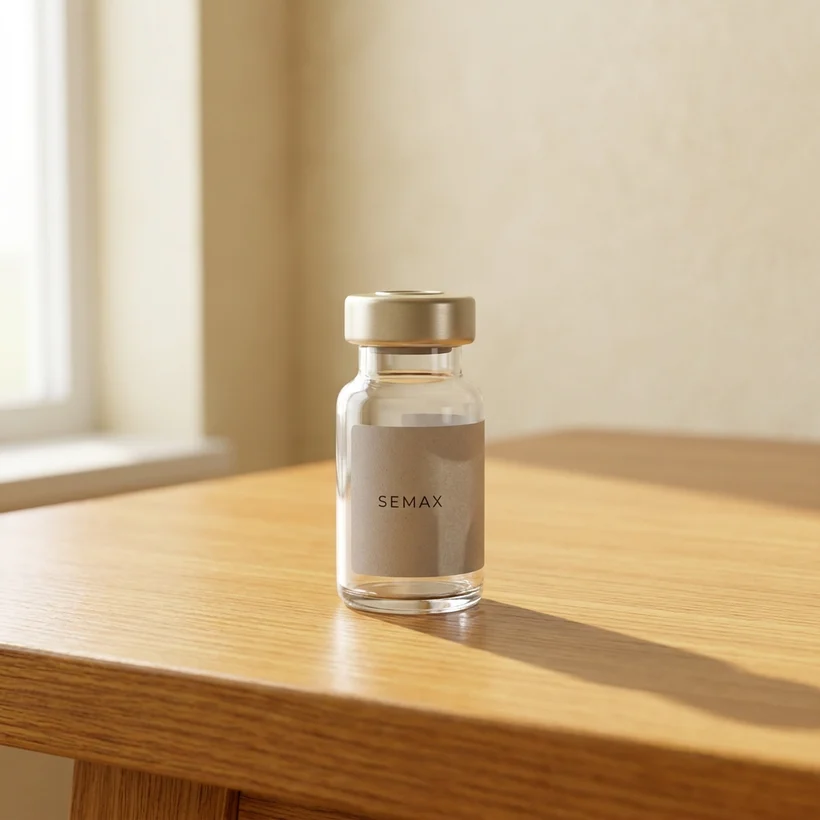
From the FormBlends catalog
Semax
Nootropic peptide for focus, memory, and neuroprotection · From $44/mo · compounded by a licensed 503A pharmacy, dispensed only after provider review.
Learn about Semax →Nootropic users seek it primarily because of its documented BDNF-upregulating effect in animal studies and human clinical data from Russian stroke trials. The working hypothesis is that elevated BDNF supports neuroplasticity, focus, and mood. This is a plausible but not proven extrapolation to healthy adults.
Evidence Ledger: What the Science Actually Shows
| Claim | Best Evidence Type | Direction | Confidence |
|---|---|---|---|
| Semax upregulates BDNF and TrkB in rodent brain tissue | Multiple animal studies (rat, mouse) | Positive, consistent | Moderate-High |
| Semax improves outcomes in ischemic stroke (Russian clinical trials) | Small controlled human trials, methodological limitations | Positive | Moderate |
| Semax improves cognitive function in healthy adults | No human RCT; animal data and community anecdote only | Uncertain | Very Low |
| Semax modulates dopaminergic and serotonergic systems | Animal receptor binding and neurochemical studies | Positive (direction varies by region) | Moderate |
| Intranasal route achieves meaningful CNS delivery in humans | Pharmacokinetic inference; direct human CNS PK data limited | Plausible, not confirmed | Low |
| Semax is safe for long-term use in healthy adults | No systematic long-term safety data | Unknown | Very Low |
| Met residue oxidation degrades potency | General peptide chemistry; not Semax-specific published study | Directionally established | Moderate (mechanism) |
How Does Semax Work? The Mechanism with Real Numbers
Semax does not bind the melanocortin receptors with the same affinity as full-length ACTH. Its fragment structure shifts activity toward neuromodulation rather than adrenal stimulation. Key documented mechanisms:
- BDNF upregulation: Multiple rodent studies show Semax increases BDNF mRNA expression in the hippocampus and basal forebrain. Shadrina et al. (2010, published in the Journal of Molecular Neuroscience) reported significantly elevated BDNF and its receptor TrkB transcripts in rat brain after Semax administration. The magnitude varied by dose and brain region; exact fold-changes differ by study protocol.
- Dopaminergic modulation: Animal studies show Semax increases dopamine and its metabolites in the striatum and frontal cortex. This is consistent with observed activating and focus-enhancing self-reports but is not proven to translate 1:1 in humans.
- Enkephalin system: Semax has been shown in animal studies to influence enkephalin expression, which may contribute to its anxiolytic component and distinguishes it pharmacologically from pure stimulants.
- Half-life: The parent peptide is rapidly cleaved by serum enzymes; intravenous half-life is estimated in the range of minutes. The intranasal route slows absorption across the nasal mucosa and potentially allows direct olfactory nerve transport, extending effective duration. Quantified human CNS pharmacokinetic data after intranasal administration is not publicly available in Western literature.
What this mechanism does NOT prove: That BDNF elevation in rodents, achieved after systemic or direct CNS injection in research settings, translates to equivalent CNS BDNF increases in healthy humans using a commercial nasal spray. BDNF does not cross the blood-brain barrier freely; the degree to which intranasal Semax elevates CNS BDNF in humans is unmeasured.
Where to Buy Semax: Current Vendor Landscape
The r/nootropics community has discussed Semax sourcing extensively. The landscape shifted materially when science.bio closed in 2022. Current options fall into two categories: pre-made nasal spray (Russian pharmaceutical origin) and raw peptide powder for reconstitution.
| Vendor | Product Type | COA Available? | Community Reputation (r/nootropics) | Notes |
|---|---|---|---|---|
| Cosmic Nootropic | Russian pharma-grade nasal spray (0.1%) | Batch-level documentation; sourced from Russian manufacturer | Frequently recommended for pre-made spray | Importation from Russia carries customs seizure risk; pricing varies by order volume |
| Peptide Sciences | Lyophilized peptide powder | Third-party HPLC COA available | Consistently positive for purity; DIY reconstitution required | Higher quality control transparency than some US vendors |
| Pure Rawz | Nasal spray and powder | COA provided; verify lab independence | Mixed; some positive, some quality complaints over time | Pricing competitive; verify COA batch matches product |
| Science.bio | Nasal spray (historical) | Yes (when active) | Was the community gold standard; closed 2022 | No longer available; older forum price references are outdated |
| FormBlends | Compounded peptide formulations | Yes; compounded under pharmacy oversight | N/A on r/nootropics specifically | US-compounded; different regulatory pathway from research vendors |
What Most Pages Get Wrong About Buying Semax
This is the section commodity pages skip entirely.
- The science.bio nostalgia problem. A significant fraction of r/nootropics search traffic is anchored to science.bio semax spray price references. That vendor does not exist anymore. Prices and availability cited in threads from 2019-2022 are not useful for current purchasing decisions.
- Pre-made spray vs. raw powder are not equivalent products. Russian pharmaceutical Semax spray is manufactured under defined GMP conditions with a specified 0.1% concentration (1 mg/mL). Raw peptide powder from a research vendor requires accurate reconstitution, sterile bacteriostatic water, a clean technique, and proper storage. The user error rate with DIY reconstitution is non-trivial. Comparing prices without accounting for this is misleading.
- COA theater is common. Some research vendors display a COA on their website that is months or years old, batch-unspecified, or conducted by an in-house lab. A real COA names an independent third-party lab, includes a batch number, and that batch number matches your vial. Many buyers never check this. It is the single most important verification step.
- The 0.1% spray is not a universal standard. Some vendors sell higher-concentration preparations (0.5% or 1%). These are not validated pharmaceutical products; concentration claims in research-grade products depend entirely on the accuracy of the manufacturer's synthesis and the validity of their HPLC testing.
- Community anecdote is not clinical trial data. R/nootropics threads are valuable for pattern recognition about side effects and vendor quality. They are not a substitute for controlled trial data on efficacy. The two types of information answer different questions.
Why Storage Rules Exist: The Chemistry Behind the Rules of Thumb
Semax contains a methionine (Met) residue at position 1. Methionine is sulfur-containing and its thioether side chain is susceptible to oxidation. In the presence of dissolved oxygen, peroxides from water, or light-generated reactive oxygen species, Met is oxidized to methionine sulfoxide. This alters the peptide's three-dimensional conformation and can reduce or abolish receptor binding affinity.
This is why the rules exist:
- Store cold (2-8 degrees C): Lower temperature slows the oxidation reaction kinetics and reduces dissolved oxygen activity in solution. This is not a preference; it is basic Arrhenius kinetics applied to peptide stability.
- Avoid light: UV and visible light photosensitize dissolved oxygen and generate singlet oxygen and hydroxyl radicals, accelerating Met oxidation. Amber or opaque vials mitigate this.
- Avoid repeated freeze-thaw cycles: Each freeze-thaw creates mechanical stress on the peptide and, more importantly, concentrates dissolved ions and oxygen at the ice crystal boundary during freezing, creating local high-oxidation environments. Aliquoting before freezing prevents this.
- Use within 28-30 days of reconstitution: This is a conservative industry standard for peptide solutions in bacteriostatic water. It is not a Semax-specific RCT finding; it is general pharmaceutical peptide guidance. The actual degradation rate for a specific reconstituted Semax vial depends on storage conditions, pH, and initial purity.
Practical implication: Degraded Semax solution does not necessarily look different. A product that has been improperly stored may have significantly reduced potency with no visual indicator. This is a reason to buy from vendors with clear manufacturing dates and to discard solution older than one month even if it appears clear.
Honest Head-to-Head: Semax vs. Alternatives
| Compound | Mechanism | Best Human Evidence | Where Semax Wins | Where Semax Loses |
|---|---|---|---|---|
| Semax | BDNF upregulation, dopamine/serotonin modulation, ACTH fragment activity | Small Russian trials in stroke; no healthy-adult RCT | BDNF pathway specificity; neuroprotective data in disease state | Evidence quality; no Western regulatory approval; sourcing complexity |
| Selank | Enkephalin modulation, anxiolytic GABA-adjacent effects | Small Russian clinical trials; similar evidence gap | May be better for anxiety-predominant users; calmer profile | Less BDNF data; also unregulated in the West |
| Modafinil | Dopamine reuptake inhibition (primary), orexin modulation | Multiple human RCTs for wakefulness, some cognitive domains | Robust RCT evidence base; FDA-approved for narcolepsy; predictable effect | Scheduled substance (Schedule IV US); does not clearly upregulate BDNF |
| Racetams (piracetam, aniracetam) | AMPA receptor modulation, membrane fluidity effects | Some positive trials in cognitive impairment; mixed in healthy adults | Longer safety record; widely studied | Effect size modest; BDNF pathway not primary mechanism |
| Prescription stimulants (amphetamine salts) | Catecholamine release and reuptake inhibition | Strong RCT evidence for ADHD; moderate for healthy adults | Strong, reproducible effect in most users | Schedule II; dependence potential; cardiovascular risks; suppresses BDNF acutely via some mechanisms |
Honest verdict: Semax loses on evidence quantity and regulatory standing compared to every approved compound in this list. It wins on a specific mechanistic hypothesis (BDNF upregulation combined with mild dopaminergic activation) that is not replicated by the approved options. Whether that mechanistic advantage translates to real-world superiority in healthy adults is unproven.
COA and Label Literacy: How to Verify What You Are Getting
This is the most actionable section for buyers. A research-grade Semax product requires you to verify the following:
- HPLC purity: above 98%. HPLC (high-performance liquid chromatography) separates peptide from impurities by retention time. A purity below 95% is a red flag. Above 99% is ideal. The COA should show the chromatogram or at minimum the purity percentage with the lab name.
- Mass spectrometry (MS) confirmation. MS confirms the molecular weight of the compound. The Semax sequence (Met-Glu-His-Phe-Pro-Gly-Pro) has a calculated molecular weight of approximately 887.0 Da for the free acid form. If the MS shows a different mass, the product is not Semax or contains a substituted analogue.
- Endotoxin testing (LAL assay). Endotoxins (lipopolysaccharides from gram-negative bacterial contamination during synthesis) cause fever, inflammation, and systemic reactions even in small amounts. Any peptide intended for nasal or injectable use should have LAL testing. Many research vendors skip this. Its absence is a meaningful safety gap.
- Heavy metals panel. Synthesis reagents and solvents can leave residual metal contamination. This is a secondary concern but relevant for products from manufacturers with less stringent quality control.
- Batch number matching. The batch number on the COA must match the batch number on your vial. A COA with no batch number, or a vial with no batch number, cannot be verified. This is the most common form of COA theater.
- Third-party lab independence. The lab performing the analysis should not be owned or operated by the vendor. Look for recognizable independent testing laboratories. Vendor-run in-house testing has obvious conflict-of-interest limitations.
Dosing Table: Clinical Protocols vs. Community Practice
| Context | Dose Range | Frequency | Duration | Evidence Source |
|---|---|---|---|---|
| Russian clinical (stroke/TIA) | 600-3000 mcg/day | 2x daily intranasal | 10-14 day courses | Russian clinical trial protocols |
| r/nootropics community (cognitive enhancement) | 200-600 mcg/day | Once or twice daily | Variable; cycles of days to weeks | Community self-report; no RCT basis |
| First-time use (recommended start) | 200-300 mcg/day | Morning only | 3-5 days, assess tolerance | Community consensus; no clinical basis |
Important caveat: These numbers describe what has been used, not what has been validated as safe or effective for healthy adults. The clinical dose range was established in patients with cerebrovascular disease, not healthy individuals seeking cognitive enhancement. Extrapolation carries unknown risk.
Reconstitution math (for raw powder): If you have 10 mg of Semax powder and dissolve it in 10 mL of bacteriostatic water, you have a 1 mg/mL (1000 mcg/mL) solution. A standard nasal spray pump delivers approximately 0.1 mL per actuation, delivering approximately 100 mcg per spray. Verify your pump's delivered volume with the manufacturer spec before assuming any dose.
Side Effects and Safety: What Is Known vs. Speculated
Known from clinical literature (Russian trials and pharmacovigilance):
- Nasal mucosal irritation with intranasal use; generally mild and transient.
- Irritability, anxiety, and sleep disruption reported; attributed to dopaminergic activation.
- No serious adverse events documented in short-term clinical use at therapeutic doses in the published Russian literature, though this literature has methodological limitations.
Community-reported (r/nootropics threads, not clinical data):
- Anxiety amplification, particularly in users with baseline anxiety; consistent with BDNF and dopamine upregulation.
- Post-cycle low mood or anhedonia reported by a minority of users; mechanism unclear, possibly rebound from elevated BDNF/dopamine state.
- Afternoon dosing associated with sleep disruption; morning dosing generally better tolerated.
What is genuinely unknown: There is no systematic long-term safety data for Semax use in healthy adults. The neuroprotective properties documented in disease states do not guarantee absence of risk in healthy brain tissue with repeated use. BDNF is not unambiguously beneficial in all contexts; elevated BDNF has been associated with anxiety and pain sensitization in some research contexts.
FAQ
Where can I buy Semax nasal spray in the US?
Semax is not FDA-approved and is sold in the US only as a research compound. Vendors like Cosmic Nootropic, Pure Rawz, and Peptide Sciences carry it. Always request a third-party certificate of analysis (COA) before purchasing. FormBlends does not endorse any specific vendor.
What does r/nootropics say about Semax vendors?
The r/nootropics community frequently cites Cosmic Nootropic (which sources Russian pharmaceutical grade Semax) as the most commonly recommended vendor for pre-made nasal spray. Peptide powder vendors are discussed for reconstituted DIY spray. Community opinion is not a substitute for COA verification.
What is the typical Semax nasal spray price?
Russian-manufactured pharmaceutical Semax nasal spray (0.1%, 3 mL vials) typically costs $25-$60 per vial from US research vendors. Bulk raw peptide powder is cheaper per milligram but requires reconstitution, sterile equipment, and bacteriostatic water.
Is Semax legal to buy in the United States?
Semax occupies a legal gray area in the US. It is not scheduled under the Controlled Substances Act, not FDA-approved, and not approved for human use. It is sold as a research compound. Importation of foreign pharmaceuticals carries risk of seizure by US Customs.
What is Semax and what is it supposed to do?
Semax is a synthetic heptapeptide analogue of ACTH(4-10) developed in Russia. It upregulates BDNF and its receptor TrkB, and modulates dopaminergic and serotonergic transmission. Russian clinical data supports use in ischemic stroke recovery; cognitive enhancement in healthy adults has very low-quality evidence.
What is the typical Semax dose for nasal spray?
Russian clinical protocols use 600-3000 mcg per day intranasally, divided across two nostrils, for 10-14 day courses. Community self-experimenters often start at 200-600 mcg/day. There is no established optimal dose for healthy adult cognitive enhancement.
How should Semax nasal spray be stored?
Reconstituted or opened Semax solution should be refrigerated at 2-8 degrees Celsius and used within 28-30 days. Freeze-dried powder can be stored frozen for longer periods. Repeated freeze-thaw cycles degrade the peptide. Exposure to light accelerates oxidation of the Met residue.
What does a Semax COA need to show?
A credible COA should show HPLC purity above 98%, mass spectrometry confirmation of the correct molecular weight (approximately 887.0 Da for free acid form), endotoxin testing (LAL assay), and absence of heavy metals. The COA should name the third-party lab and include a batch number matching your product.
Does Semax actually work for cognitive enhancement?
Evidence for cognitive enhancement in healthy adults is very low quality, based primarily on animal studies and small Russian trials with methodological limitations. BDNF upregulation in rats is well-documented. Human RCT data for cognitive enhancement in healthy individuals does not currently exist.
How does Semax compare to other nootropic peptides like Selank?
Semax is more activating and associated with BDNF upregulation; Selank is more anxiolytic and associated with enkephalin modulation. They are sometimes stacked. Neither has human RCT data for healthy adult cognitive enhancement. Selank may be better tolerated by anxious users.
What are the known side effects of Semax?
Reported side effects from community data include irritability, anxiety, insomnia, and nasal irritation. Russian clinical literature notes these are generally mild and reversible. High BDNF states are theoretically associated with anxiety in susceptible individuals. No systematic safety data exists for long-term healthy adult use.
What was the science.bio Semax situation?
Science.bio was a well-regarded US research compound vendor that stopped operations in 2022. Their Semax spray was frequently cited on r/nootropics as a reliable source. They no longer sell Semax. References to science.bio Semax spray price in older forum posts reflect a now-unavailable product.
Sources
- Shadrina MI, Dolotov OV, Grivennikov IA, et al. "Neuroprotective and neurorestorative effects of Semax peptide treatment." Journal of Molecular Neuroscience, 2010. (BDNF/TrkB upregulation in rat brain tissue after Semax administration.)
- Manchenko DM, Glazova NY, Levitskaya NG, et al. "Semax, an analogue of ACTH(4-7), regulates expression of genes related to the dopaminergic system in rats." Bulletin of Experimental Biology and Medicine, 2012.
- Grivennikov IA. "Stem cells and nootropic peptides: new approaches to the treatment of brain diseases." Russian Academy of Sciences, Institute of Molecular Genetics. (Background on Semax development and mechanism.)
- Dolotov OV, Karpenko EA, Inozemtseva LS, et al. "Semax, an analogue of ACTH(4-10) with cognitive effects, regulates BDNF and trkB expression in the rat hippocampus." Brain Research, 2006.
- Agapova TY, Agniullin YV, Silachev DN, et al. Pharmacological properties of Semax as reviewed in Pharmaceutical Chemistry Journal (Russia), multiple issues 2000-2015. (General pharmacology and Russian clinical experience summary.)
- US Food and Drug Administration. "FDA Drug Importation Policy." FDA.gov. (Legal framework for importation of unapproved foreign drugs.)
- USP General Chapter on Peptide Stability. United States Pharmacopeia. (General guidelines on peptide storage, oxidation, and reconstitution.)
- World Anti-Doping Agency. "2024 Prohibited List." WADA-ama.org. (Peptide hormones and related substances classification; Semax regulatory status in sport context.)
- Ashmarin IP, Nezavibathko VN, Levitskaya NG, et al. "A synthetic analogue of ACTH 4-10 with high activity - Semax." Russian Journal of Bioorganic Chemistry, 1995. (Original characterization of Semax sequence and activity.)
Footer Disclaimers
Related peptide guides
Ready when you are
Semax
Nootropic peptide for focus, memory, and neuroprotection · From $44/mo · compounded by a licensed 503A pharmacy, dispensed only after provider review.
Learn about Semax →