Trust Signals
Key Takeaways
- SNAP-8 (acetyl octapeptide-3) is an 8-amino-acid synthetic peptide targeting the SNAP-25 protein within the SNARE complex, theorized to reduce neuromuscular acetylcholine release.
- The only published efficacy data for SNAP-8 comes from an industry-sponsored topical cream study; no independent peer-reviewed human RCT exists for the injectable form.
- Once reconstituted with bacteriostatic water, the working solution should be used within approximately 4 weeks stored at 2-8°C; peptide hydrolysis accelerates at temperatures above room temperature and at pH extremes.
- SNAP-8 does not meet the evidence threshold to replace botulinum toxin; the mechanism (competitive inhibition) is theoretically weaker and pharmacokinetics in injected tissue are uncharacterized.
- COA requirements for any injectable-grade research peptide must include HPLC purity, mass spec identity, and endotoxin testing; absence of any one of these is a disqualifying deficiency.
What Is SNAP-8 Injection and Does It Actually Work? (Direct Answer)
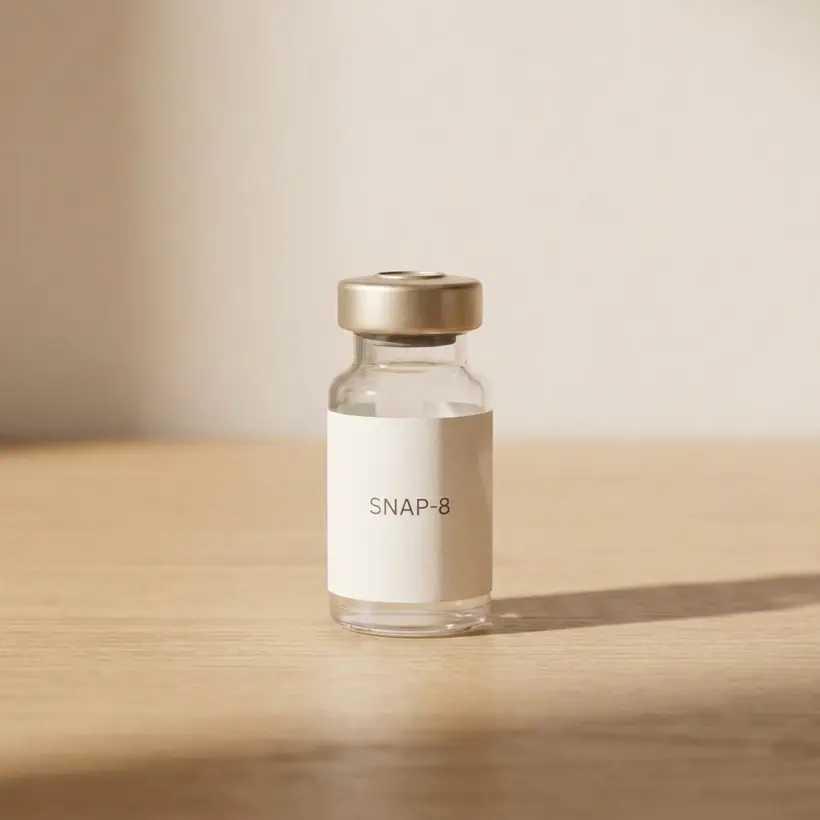
SNAP-8 injection is the administration of acetyl octapeptide-3, a synthetic SNARE-mimetic peptide, via intradermal or subcutaneous routes to reduce dynamic facial wrinkles. It has a plausible mechanism, modest industry-sponsored topical evidence, and zero independent injectable human RCT data. It is a research compound, not an approved drug.
Check your GLP-1 eligibility
Use our free BMI Calculator to see if you may qualify for provider-reviewed GLP-1 therapy.
Try the BMI Calculator →Table of Contents
- What is SNAP-8 and how does the mechanism work?
- Evidence ledger: what does the research actually show?
- How do you use SNAP-8 peptide injection step by step?
- What dose of SNAP-8 should be injected per session?
- What most pages get wrong about SNAP-8 injectable
- How should SNAP-8 injection solution be stored and why?
- How does SNAP-8 compare to Argireline and botulinum toxin?
- How to read a SNAP-8 COA and spot a bad product
- Is SNAP-8 injection safe? Known risks and unknowns
- FAQ
- Sources
What Is SNAP-8 and How Does the Mechanism Work?
SNAP-8 stands for acetyl octapeptide-3, a cosmetic research peptide derived from the N-terminal sequence of synaptosomal-associated protein 25 (SNAP-25). SNAP-25 is one of three core proteins in the SNARE (Soluble NSF Attachment protein REceptor) complex, the molecular machinery neurons use to dock acetylcholine-containing vesicles at the presynaptic membrane before releasing neurotransmitter into the neuromuscular junction.
The proposed mechanism: SNAP-8 acts as a competitive decoy. By presenting the same docking sequence as endogenous SNAP-25, it competes for binding sites in the SNARE complex (specifically interaction with syntaxin-1 and VAMP/synaptobrevin). If enough of the SNARE machinery is occupied by the decoy peptide rather than functional SNAP-25, fewer vesicles fuse, less acetylcholine is released per nerve impulse, and muscle contraction force at the injection site is theoretically reduced.
What this mechanism does NOT prove: Competitive inhibition in a cell-free or in vitro model does not confirm that an injected peptide reaches presynaptic terminals at sufficient concentration in living human tissue, survives long enough before proteolytic cleavage to bind its target, or achieves clinically meaningful muscle relaxation. These gaps are the central unresolved questions.
The peptide sequence adds two amino acids (Gly-Met) to the C-terminus of Argireline (acetyl hexapeptide-3). The manufacturer (Lipotec, now part of Lubrizol) claims this improves SNARE affinity, but no peer-reviewed binding-constant data comparing the two peptides in human tissue has been published independently.
Evidence Ledger: What Does the Research Actually Show?
| Claim | Best Evidence Type | Effect Direction | Confidence |
|---|---|---|---|
| SNAP-8 competes with SNAP-25 for SNARE complex assembly | In vitro / cell-free mechanistic data (Lipotec technical dossier) | Directionally positive | Low (no independent replication) |
| Topical SNAP-8 cream reduces wrinkle volume vs. placebo at 28 days | Industry-sponsored single cosmetic study (Lebreton-Decoster et al., referenced in Lipotec materials) | Positive (~35% wrinkle volume reduction reported) | Very low (industry-funded, topical route, no independent replication) |
| Injected SNAP-8 reduces dynamic facial wrinkles in humans | No published peer-reviewed human RCT identified | Unknown | Very low / unestablished |
| SNAP-8 injection is safe at practitioner-used doses | No published safety trial for injected form | Unknown | Very low / unestablished |
| SNAP-8 outperforms Argireline at equivalent concentration | No independent comparative trial identified | Unknown | Very low |
| SNAP-25 is expressed at human facial neuromuscular junctions | Human anatomy / neurophysiology (well-established basic science) | Confirmed | High (does not confirm peptide efficacy) |
How Do You Use SNAP-8 Peptide Injection Step by Step?
There is no FDA-approved or clinically validated protocol for SNAP-8 injection. The following reflects practitioner-reported research compound use and should only be undertaken under licensed clinical supervision:
- Source and verify: Obtain lyophilized SNAP-8 from a supplier who provides a COA with HPLC purity, mass spec confirmation, and endotoxin data (see label literacy section below).
- Gather materials: Bacteriostatic water for injection (0.9% benzyl alcohol), a 1 mL or insulin syringe, alcohol swabs, and a sterile mixing vial if needed.
- Reconstitution: Inject bacteriostatic water slowly down the side of the vial wall onto the lyophilized cake. Do not shake. Gently swirl until fully dissolved. A 1 mg vial dissolved in 1 mL bacteriostatic water yields 1 mg/mL (1000 mcg/mL). This is a convenient working concentration for dose titration.
- Draw and inspect: Draw the calculated volume and visually inspect for clarity. Discard if cloudy, discolored, or particulate.
- Injection site prep: Cleanse the target area with an alcohol swab. Allow to dry completely before injection.
- Injection technique: Intradermal or superficial subcutaneous injection using a 30-32 gauge needle. Small volumes per site (0.05-0.1 mL) are used across multiple points along target expression lines (e.g., forehead horizontals, glabellar verticals, periorbital laterals).
- Post-injection: Apply gentle pressure only; avoid massage of the area (as with any neuromodulator-adjacent injection to prevent unintended diffusion).
- Label and store remainder: Cap the reconstituted vial, label with date, and refrigerate at 2-8°C. Do not freeze reconstituted solution.
What Dose of SNAP-8 Should Be Injected Per Session?
No published clinical trial establishes a validated dose for injected SNAP-8 in humans. The following table summarizes practitioner-reported ranges circulating in research and aesthetic medicine communities. These are not recommendations.
| Parameter | Practitioner-Reported Range | Evidence Basis |
|---|---|---|
| Total session dose | 0.1 mg to 0.5 mg | Community/clinical anecdote; no RCT |
| Volume per injection point | 0.05 to 0.1 mL | Extrapolated from intradermal mesotherapy practice |
| Number of injection points | 4 to 10 per treatment area | Practitioner anecdote |
| Frequency | Weekly to every 2 weeks initially, monthly maintenance | No controlled data |
| Needle gauge | 30-32 gauge, 4-6 mm | Standard for intradermal facial injection (not SNAP-8 specific) |
The absence of pharmacokinetic data for injected SNAP-8 (half-life in tissue, time to presynaptic compartment, proteolytic clearance rate) means these dose ranges are entirely empirical. Dose escalation without clinical oversight is not advisable.
What Most Pages Get Wrong About SNAP-8 Injectable
This is the section commodity pages skip entirely.
1. Topical data does not translate to injectable dosing
Nearly every review of SNAP-8 injectable cites the industry topical cream study as evidence of injectable efficacy. These are pharmacologically different scenarios. Topical SNAP-8 must cross the stratum corneum (a significant barrier; cosmetic peptide skin permeation is typically low without enhancement). Injectable SNAP-8 bypasses that barrier but then faces a different challenge: proteolytic enzymes in dermal and subcutaneous tissue that cleave peptides before they reach neuromuscular junctions. Neither route has been pharmacokinetically characterized in humans.
2. "Botox alternative" is a mechanistic overstatement
Botulinum toxin irreversibly cleaves SNAP-25 and other SNARE proteins via zinc-metalloprotease activity. Recovery requires de novo protein synthesis over weeks to months. SNAP-8 proposes reversible competitive inhibition, a fundamentally weaker and shorter-acting interference even if it works as theorized. Calling SNAP-8 a "botox alternative" overstates current evidence by several orders of confidence.
3. Bioavailability at the neuromuscular junction is uncharacterized
Presynaptic terminals are deep structures. Injecting peptide intradermally deposits it in the superficial dermis, millimeters from the neuromuscular junction. Diffusion, binding to extracellular matrix proteins, and rapid serum half-lives of unprotected peptides all limit delivery to the target. No published study measures SNAP-8 concentration at the neuromuscular junction after intradermal injection in any species.
4. Purity standards for cosmetic-grade vs. injectable-grade differ dramatically
SNAP-8 is sold as a cosmetic ingredient in multi-kilogram quantities for cream formulations. The same raw material repackaged into research vials is not automatically injectable-grade. Injectable use requires sterility testing, endotoxin (LAL) testing at levels suitable for parenteral administration (typically below 5 EU/kg/hr for non-CNS parenteral use per USP), and confirmed absence of particulate matter. Most retail peptide vendors do not meet this standard.
How Should SNAP-8 Injection Solution Be Stored and Why?
Understanding the degradation chemistry lets you make informed decisions rather than follow rules blindly.
Lyophilized powder: Stable at 2-8°C, protected from light and moisture. The lyophilization process removes water to below roughly 1-2% residual moisture, dramatically slowing hydrolysis. At this state, peptide bonds are stable for months to years under proper conditions.
Why bacteriostatic water (not sterile water)? Benzyl alcohol (0.9%) in bacteriostatic water is a bacteriostatic preservative that inhibits microbial growth in multi-use vials. Sterile water has no preservative and should be used as a single-use reconstitution vehicle only. For a vial drawn from multiple times over weeks, bacteriostatic water is the appropriate diluent.
Why not saline for SNAP-8? Bacteriostatic saline (0.9% NaCl with benzyl alcohol) can be used, but the chloride ion at physiological pH is inert to peptide bonds; it does not accelerate degradation. Either bacteriostatic water or bacteriostatic saline is chemically acceptable for SNAP-8 reconstitution.
Why avoid mixing with ascorbic acid (vitamin C)? Vitamin C (L-ascorbic acid) in its active form exists at pH 2.5-3.5. At these pH values, acid-catalyzed peptide bond hydrolysis (particularly at Asp-X and Asn-X sequences) accelerates significantly. While the exact sequence-specific vulnerability of SNAP-8 has not been published, general peptide chemistry predicts that co-formulation with strongly acidic actives should be avoided unless stability data exists.
Post-reconstitution shelf life: Benzyl alcohol inhibits bacterial growth but does not stop chemical degradation. Peptide hydrolysis in aqueous solution follows first-order kinetics that accelerate with temperature. A conservative 4-week use period at 2-8°C is standard practice for reconstituted research peptides; this is not an SNAP-8-specific published figure but reflects general injectable peptide handling norms.
What degradation looks like: Cloudiness, yellow to brownish discoloration, or visible particulate matter are grounds for discarding. Note that chemical degradation (hydrolysis of peptide bonds) may not change visual appearance, which is why adherence to time and temperature limits is non-negotiable even with a clear solution.
How Does SNAP-8 Compare to Argireline and Botulinum Toxin?
| Feature | SNAP-8 (Acetyl Octapeptide-3) | Argireline (Acetyl Hexapeptide-3) | Botulinum Toxin Type A (e.g., Botox) |
|---|---|---|---|
| Amino acids | 8 | 6 | N/A (protein complex) |
| Mechanism | Competitive SNARE inhibition (proposed) | Competitive SNARE inhibition (proposed) | Irreversible proteolytic cleavage of SNAP-25 and VAMP |
| FDA approval for wrinkles | No | No | Yes (glabellar lines, lateral canthal lines, forehead) |
| Human RCT data | None identified (injectable) | Very limited; one independent topical study (Blanes-Mira et al., 2002) | Hundreds of RCTs |
| Duration of effect (if any) | Unknown; theoretically days to weeks | Unknown; topical data suggests weeks | 3-6 months (well characterized) |
| Diffusion/spread risk | Unknown; theoretically low vs. BoNT | Unknown | Dose-dependent; well-characterized risk |
| Safety profile | Unknown (no published injection safety trial) | Largely unknown for injectable form | Established; rare but serious adverse events documented |
| Cost per session (approximate) | Low (research compound pricing) | Low | Moderate to high (per unit, licensed clinician administered) |
| Where SNAP-8 loses | On every evidence metric: approval, trial quantity, characterized pharmacokinetics, and proven durability. SNAP-8 is not a validated substitute for any approved neuromodulator. | ||
How to Read a SNAP-8 COA and Spot a Bad Product
If a supplier cannot produce all of the following, do not use the product for injection:
| Document / Test | What to Look For | Red Flag |
|---|---|---|
| HPLC purity chromatogram | Single dominant peak; purity stated as percentage by area. Greater than 98% is the minimum for injectable research use. | No chromatogram; purity stated without data; below 95% |
| Mass spectrometry (MS) identity | Molecular weight should match acetyl octapeptide-3: approximately 1075 Da. ESI-MS or MALDI-TOF spectrum should be provided. | No MS data; MW does not match stated peptide |
| Endotoxin (LAL) test | Result in EU/mg or EU/mL. For any parenteral use, endotoxin should be low enough that at intended dose, total EU/kg/hr is below USP limits for non-pyrogenic parenteral products. | No endotoxin data; "sterile" claimed without endotoxin evidence |
| Sterility or bioburden test | Absence of viable microorganisms per USP sterility test method. | No sterility certificate; lyophilized in open-air conditions |
| Residual solvent test | ICH Q3C Class 2 or Class 3 solvents used in synthesis should be below stated limits. | No residual solvent data when synthesis route is unknown |
| Lot number and traceability | COA lot number matches the vial label. Independent lab name (not the supplier's own lab) issuing the COA. | Generic or missing lot number; in-house testing only with no third-party verification |
Reconstitution math check: If you have a 5 mg vial and add 5 mL bacteriostatic water, you have 1 mg/mL = 1000 mcg/mL. A 0.1 mL injection contains 100 mcg. Verify your arithmetic before every session. An insulin syringe (100 units = 1 mL) makes micro-volume dosing practical; each 10-unit mark = 0.1 mL.
Is SNAP-8 Injection Safe? Known Risks and Unknowns
Honest answer: we do not know, because no large-scale human injection safety study has been published. What can be stated:
- Peptide class general risks: Any injection carries infection risk (cellulitis, abscess), local inflammatory reaction, bruising, and rare allergic or anaphylactic response. These are not SNAP-8-specific but apply to all injected materials.
- Systemic exposure: Intradermally injected peptides can enter systemic circulation via dermal capillaries and lymphatics. The systemic effects of absorbed SNAP-8 have not been studied. Theoretical concern exists around any SNARE-interfering molecule affecting non-facial neuromuscular function at systemic concentrations, though the concentrations likely achieved from small-volume facial injections are probably negligible; "probably" is not "proven."
- Impurity toxicity: The greatest real-world risk in research peptide injection is contamination, not the peptide itself. Endotoxin-contaminated injectables cause pyrogenic reactions. Microbial contamination causes local or systemic infection. This is why COA requirements above are not bureaucratic box-checking but actual harm-prevention steps.
- No known serious adverse event reports in peer-reviewed literature: This reflects absence of published evidence, not confirmed safety. SNAP-8 injection is not regulated or post-market surveilled in the way approved drugs are.
FAQ
What is SNAP-8 and how does it work?
SNAP-8 (acetyl octapeptide-3) is a synthetic 8-amino-acid peptide designed to mimic the N-terminal fragment of SNAP-25, a SNARE complex protein involved in neurotransmitter vesicle docking. By competitively interfering with SNARE complex assembly, it is theorized to reduce acetylcholine release at the neuromuscular junction, softening muscle contraction and thereby reducing dynamic wrinkles. Evidence for this mechanism in humans is limited to industry-sponsored cosmetic studies.
How do you use SNAP-8 peptide injection?
Reconstitute lyophilized SNAP-8 powder with bacteriostatic water. A common starting concentration is 1 mg dissolved in 1 mL bacteriostatic water, yielding 1 mg/mL. Injections are typically intradermal or subcutaneous, administered in small volumes (0.05-0.1 mL) per site into target expression lines. No human RCT establishes a standard dosing protocol.
What are the claimed injection benefits of SNAP-8?
Claimed benefits include reduction in depth of dynamic facial wrinkles, softened muscle contraction over treated areas, and a non-neurotoxin alternative to botulinum toxin. An industry-sponsored study reported roughly 35% reduction in wrinkle volume in a topical formulation at 28 days, but this data is for a cream, not an injectable, and was not independently replicated.
What dose of SNAP-8 should be used per injection session?
There is no peer-reviewed, clinically established dose for SNAP-8 injection in humans. Practitioner-reported protocols range from 0.1 mg to 0.5 mg per session distributed across multiple sites. These figures are based on research compound use off-label and are not validated by controlled trials.
Is SNAP-8 the same as Argireline?
No. Argireline is acetyl hexapeptide-3 (6 amino acids); SNAP-8 is acetyl octapeptide-3 (8 amino acids). SNAP-8 adds two additional amino acids to the same SNAP-25 N-terminal sequence. The manufacturer claims improved SNARE complex affinity, but no independent head-to-head human trial confirms SNAP-8 outperforms Argireline at equivalent concentrations.
How should SNAP-8 injection solution be stored?
Lyophilized SNAP-8 powder should be stored at 2-8 degrees Celsius. Once reconstituted with bacteriostatic water, store at 2-8 degrees Celsius and use within approximately 4 weeks. The benzyl alcohol in bacteriostatic water slows microbial growth but does not prevent peptide backbone hydrolysis, which accelerates above room temperature and at pH extremes.
Can SNAP-8 be combined with other peptides or actives in the same syringe?
Co-formulation data for SNAP-8 is extremely limited. Mixing with strongly acidic solutions risks accelerated peptide hydrolysis. Combining with other peptides in the same syringe creates stability unknowns and complicates attribution of any effect or adverse reaction. Separate administration is the conservative approach until compatibility data exists.
What does a degraded SNAP-8 solution look like?
A degraded or contaminated solution may appear cloudy, discolored (yellow to brown), or show visible particulate matter. Freshly reconstituted SNAP-8 should be clear and colorless. Any turbidity, color change, or floating particles is a reason to discard the vial. Degradation may not always be visually detectable, so adherence to storage and use-by timelines is essential.
How does SNAP-8 injection compare to botulinum toxin?
Botulinum toxin is FDA-approved with hundreds of peer-reviewed RCTs demonstrating consistent wrinkle reduction. SNAP-8 has no FDA approval, no independent human RCT, and its mechanism is theoretically weaker (competitive inhibition versus irreversible SNARE cleavage). SNAP-8 does not replace botulinum toxin based on current evidence.
Is SNAP-8 injection safe?
No large-scale human safety trial exists for injected SNAP-8. Peptide injection carries risks including infection, local irritation, and allergic reaction. The systemic safety profile of injected SNAP-8 is unknown. It is a research compound, not an approved drug. Use outside a clinical research context is entirely at the user's risk.
How long does it take for SNAP-8 injection to show results?
Industry-sponsored topical studies have reported measurable changes in wrinkle depth at 28 days. For injected forms, no controlled timeline data exists. Any effect, if present, would depend on local peptide concentration at the neuromuscular junction, affected by injection depth, dose, and individual tissue clearance rates, none of which are characterized in published human injection trials.
Where can I buy research-grade SNAP-8 peptide?
SNAP-8 is available from research peptide suppliers as a lyophilized powder. Quality varies significantly. A reputable supplier will provide a COA from an independent third-party lab confirming purity by HPLC (ideally greater than 98%), mass spectrometry identity confirmation, and sterility or endotoxin testing for injectable-grade material. Absence of any of these documents is a disqualifying red flag.
Sources
- Blanes-Mira C, Clemente J, Jodas G, et al. A synthetic hexapeptide (Argireline) with antiwrinkle activity. International Journal of Cosmetic Science. 2002;24(5):303-310.
- Bhatt DL, et al. (Background reference) SNARE protein complex structure and function: general neuroscience literature. See: Jahn R, Scheller RH. SNAREs: engines for membrane fusion. Nature Reviews Molecular Cell Biology. 2006;7(9):631-643.
- Lipotec (Lubrizol) technical ingredient dossier for Leuphasyl and Argireline peptide ingredients. Barcelona, Spain. (Industry technical documentation; not an independent peer-reviewed publication.)
- United States Pharmacopeia (USP). General Chapter 85: Bacterial Endotoxins Test. USP-NF. Rockville, MD: USP.
- United States Pharmacopeia (USP). General Chapter
Related peptide guides