
Trust Signals
Key Takeaways
- The wolverine stack combines BPC-157 and TB-500, two research peptides with robust animal data but zero completed human RCTs for musculoskeletal repair as of mid-2026.
- Community dosing protocols most commonly cite 250 to 500 mcg BPC-157 and 2 to 2.5 mg TB-500 per injection, two to three times per week, for four to six weeks loading.
- TB-500 (thymosin beta-4 and its fragments) is explicitly prohibited by WADA; any competitive athlete faces a real ban risk.
- Reconstitution math matters: a 2 mg vial of BPC-157 dissolved in 2 mL bacteriostatic water yields exactly 1,000 mcg per mL, meaning a 250 mcg dose is 0.25 mL on a 1 mL insulin syringe.
- Stability after reconstitution is limited, roughly four weeks refrigerated; degraded peptide is invisible to the eye but measurably less potent in assay, which most users never verify.
What Is the Wolverine Stack Peptide Injection?
The wolverine stack peptide injection is a two-compound research protocol combining BPC-157 (Body Protection Compound 157, a synthetic 15-amino-acid peptide derived from a gastric protein) and TB-500 (a synthetic fragment of thymosin beta-4, specifically the actin-binding peptide Ac-LKKTETQ). Both are administered by injection, subcutaneous or intramuscular, with the goal of accelerating connective tissue, tendon, and muscle repair. Neither compound is FDA-approved for human therapeutic use. All human use occurs in a research or off-label context.
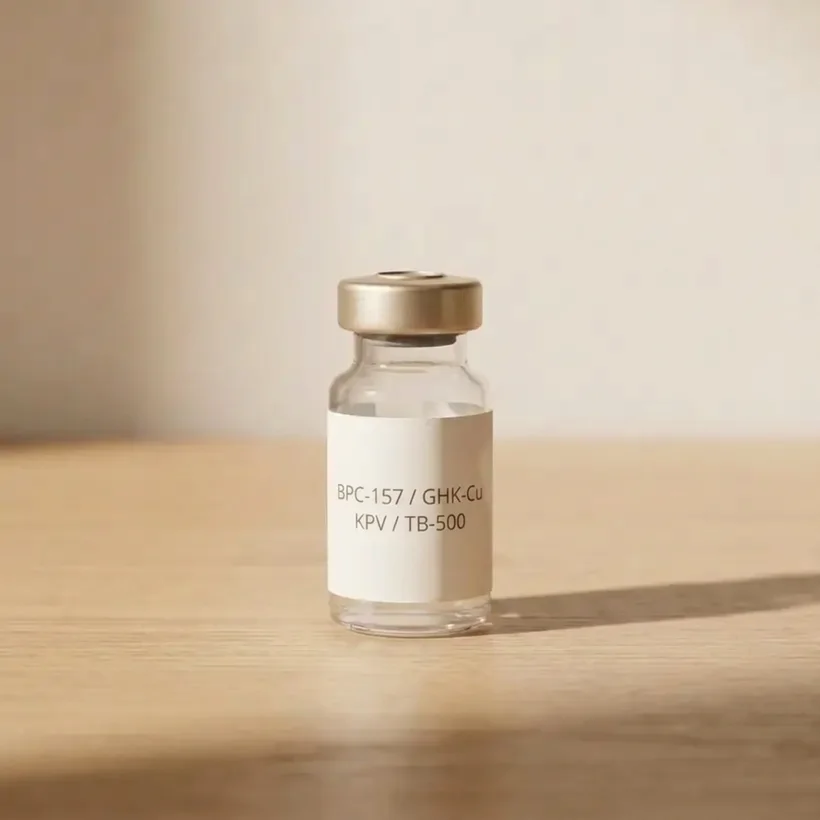
From the FormBlends catalog
Premium Recovery Quad Stack
Premium recovery blend with BPC-157, GHK-Cu, KPV, and TB-500 · From $349/mo · compounded by a licensed 503A pharmacy, dispensed only after provider review.
View Premium Recovery Quad Stack →Table of Contents
Evidence Ledger: What Is Actually Proven?
| Claim | Best Available Evidence | Effect Direction | Confidence |
|---|---|---|---|
| BPC-157 accelerates tendon healing in rats | Multiple rodent studies (Sikiric et al., various years, published in peer-reviewed journals) | Positive, consistent in animals | Moderate (animal) |
| BPC-157 reduces GI inflammation in rodent models | Rodent RCT-equivalent models | Positive in animals | Moderate (animal) |
| TB-500 / thymosin beta-4 promotes actin polymerization and cell migration | In vitro, mechanism established (Safer et al., 1991, Science) | Mechanistic, positive | High (mechanism), Low (clinical outcome) |
| Thymosin beta-4 accelerates wound healing in humans | Small Phase II human trials for dermal wound healing (RegeneRx Biopharmaceuticals), not musculoskeletal | Modest positive signal in wounds | Low (small trials, different indication) |
| Combined BPC-157 plus TB-500 outperforms either alone | No published data, community hypothesis only | Unknown | Very Low (speculation) |
| Wolverine stack improves injury recovery in human athletes | Anecdote and case reports only | Mixed anecdotal reports | Very Low |
| Wolverine stack is safe for long-term human use | No long-term human safety data | Unknown | Very Low |
Mechanism With Numbers: How Each Peptide Works
BPC-157 (sequence: GEPPPGKPADDAGLV). This 15-amino-acid peptide is a partial sequence of human gastric juice protein BPC. In animal studies, BPC-157 upregulates the growth hormone receptor (GHR) at the transcriptional level and appears to modulate nitric oxide (NO) synthesis, which is a key mediator of vascular growth. Rodent tendon transection models published by Sikiric's group at the University of Zagreb have shown histologically measurable differences in collagen organization at two and four weeks post-injury compared to control, though specific percentage improvements vary across individual studies and should be read in the primary literature rather than summarized here as a single authoritative figure.
BPC-157 also appears to interact with the FAK (focal adhesion kinase) and paxillin signaling pathway, which governs cell migration, a plausible mechanism for faster wound closure. The peptide has a very short plasma half-life in the range of minutes when unmodified, which is why frequent dosing is used in animal protocols.
TB-500 (Ac-LKKTETQ, amino acids 17 to 23 of thymosin beta-4). Thymosin beta-4 is a 43-amino-acid intracellular protein present in virtually all mammalian cells. Its core biological role is sequestering G-actin (globular actin monomers), which regulates the ratio of filamentous to globular actin and therefore cell motility. The TB-500 fragment retains the actin-binding domain and is more practical to synthesize than the full 43-amino-acid molecule. In dermal wound models (the basis of the RegeneRx Phase II trials), thymosin beta-4 showed statistically significant improvement in healing rate compared to vehicle control in a trial of pressure ulcers, though sample sizes were small and the indication was not musculoskeletal. The WADA Prohibited List has explicitly included thymosin beta-4 and its fragments since at least 2012.
What this mechanism does NOT prove: Faster cell migration in vitro or faster tendon healing in rats does not confirm faster return to sport in humans, or that injecting near an injury site is better than systemic injection, or that the doses tested in animals translate proportionally to human doses.
What Most Pages Get Wrong About the Wolverine Stack
This is the section most guides skip entirely.
1. Sourcing and purity are the single largest variable most users ignore. Research peptides sold online are not manufactured under pharmaceutical GMP conditions in most cases. A 2018 JAMA Internal Medicine analysis of peptide hormone products found significant discrepancies between labeled and actual peptide content. A product labeled "BPC-157 5 mg" may contain 3 mg, 6 mg, a different peptide, or bacterial endotoxin. You cannot assess purity by appearance. A certificate of analysis (COA) from a third-party HPLC lab is the minimum credibility bar. Even then, the COA only confirms the batch tested, not the vial you received.
2. The "inject near the injury" belief is not well supported. Many community protocols recommend injecting subcutaneously adjacent to the injured tissue. Animal studies typically use systemic injection or direct intra-tendinous injection under controlled conditions. There is no human pharmacokinetic data proving that subcutaneous abdominal injection vs. near-site injection produces meaningfully different local tissue concentrations. The near-site rationale is plausible (reducing systemic distribution distance) but unvalidated.
3. Co-mixing compatibility is assumed, not established. No published data confirms that BPC-157 and TB-500 are chemically stable when combined in the same syringe. Peptide-peptide interaction, pH shift, or aggregation is possible. The conservative protocol is sequential separate injections.
4. Degraded peptide looks identical to intact peptide. A reconstituted vial stored slightly above refrigerator temperature or subjected to multiple freeze-thaw cycles will appear clear and colorless but may have substantially reduced bioactive peptide content. Unless you have HPLC access, you are dosing blind to degradation.
Reconstitution and Label Literacy: How to Read Your Vial and Do the Math
Step 1: Confirm vial contents. Your vial should state the peptide name, lot number, mass in mg, and ideally a COA QR code or link. If it only says "research peptide" with no specific compound name, treat that as a red flag.
Step 2: Reconstitution calculation.
| Vial Mass | Bacteriostatic Water Added | Resulting Concentration | Volume for 250 mcg dose | Volume for 500 mcg dose |
|---|---|---|---|---|
| 2 mg BPC-157 | 2 mL | 1,000 mcg per mL | 0.25 mL (25 IU on insulin syringe) | 0.50 mL (50 IU on insulin syringe) |
| 5 mg BPC-157 | 2.5 mL | 2,000 mcg per mL | 0.125 mL (12.5 IU) | 0.25 mL (25 IU) |
| 5 mg TB-500 | 2.5 mL | 2,000 mcg per mL | Volume for 2 mg = 1.0 mL | Volume for 2.5 mg = 1.25 mL |
Step 3: Injection technique. Clean the rubber stopper with an alcohol swab. Draw air equal to your desired volume into the syringe. Insert needle, inject air, then withdraw the peptide solution. This maintains vial pressure and reduces particulate contamination.
Step 4: What degraded peptide looks like (and does not look like). Precipitate, cloudiness, or visible particulate are signs of degradation or contamination: discard immediately. However, a degraded peptide can remain visually clear. The absence of cloudiness does not confirm potency. Track your reconstitution date and discard at four weeks regardless of appearance.
What Does the Dosing and Injection Protocol Actually Look Like?
| Phase | Duration | BPC-157 Dose | TB-500 Dose | Frequency | Evidence Basis |
|---|---|---|---|---|---|
| Loading (acute injury) | 4 to 6 weeks | 250 to 500 mcg | 2 to 2.5 mg | 2 to 3x per week | Community consensus, no human RCT |
| Maintenance | 2 to 4 weeks | 250 mcg | 2 mg | 1x per week | Community consensus, no human RCT |
| Off cycle | 4 to 8 weeks minimum | None | None | None | Precautionary, no data on washout requirement |
Injection site selection. Subcutaneous abdominal injection is the most common community approach: pinch 1 to 2 inches of skin, insert needle at 45 degrees, inject slowly, withdraw, apply light pressure. Rotate sites to prevent lipohypertrophy. For intramuscular injection into the vastus lateralis (outer thigh), use a longer needle (25 gauge, 1 inch) and inject at 90 degrees into the muscle belly after confirming needle placement by aspiration, though aspiration technique in IM injection has nuanced evidence and some clinicians no longer routinely recommend it.
Why Storage Rules Exist: The Chemistry Behind the Rules
Peptides are chains of amino acids held together by peptide bonds. Those bonds are susceptible to hydrolysis, meaning water molecules attack and cleave the bond, shortening or fragmenting the chain. This reaction accelerates with heat (higher temperature increases kinetic energy and reaction rate), with light (UV photons can break disulfide bonds and oxidize methionine or tryptophan residues), and with repeated freeze-thaw cycles (ice crystal formation can mechanically disrupt peptide structure and accelerate aggregation).
Lyophilized (freeze-dried) powder has most of the water removed, which dramatically slows hydrolysis. That is why lyophilized peptides are stable at room temperature for weeks or frozen for months to years. Once you add bacteriostatic water, you restart the hydrolysis clock. The bacteriostatic agent (benzyl alcohol, typically 0.9% in commercial bacteriostatic water) inhibits microbial growth but does not stop chemical hydrolysis. Refrigeration slows the reaction rate but does not stop it. This is why the four-week reconstituted stability guideline exists: it is not arbitrary; it reflects real degradation kinetics for short peptides in aqueous solution at refrigerator temperature, though the exact half-life for BPC-157 and TB-500 specifically in bacteriostatic water has not been published in peer-reviewed literature as of this writing.
Honest Head-to-Head: Wolverine Stack vs. Real Alternatives
| Intervention | Human RCT Evidence | Effect Size (Human) | Safety Profile | Cost | Verdict |
|---|---|---|---|---|---|
| Physical therapy (injury-specific) | Strong, multiple large RCTs | Clinically meaningful, well characterized | Excellent, well established | Low to moderate with insurance | First-line, non-negotiable baseline |
| PRP (platelet-rich plasma) | Moderate, mixed results in tendons | Small to moderate, indication-dependent | Good, autologous | Moderate to high, often cash pay | Better evidence than wolverine stack, still debated |
| Corticosteroid injection | Strong for short-term pain relief | Good short-term, weakens tendon long-term | Known tendon weakening risk with repeat use | Low | Useful short-term, avoid repeat injections near tendon |
| Wolverine Stack (BPC-157 plus TB-500) | None for musculoskeletal in humans | Unknown in humans | Unknown long-term | Moderate, cash only | Interesting mechanistic story, unproven in humans; WADA banned |
| Collagen peptide supplementation (oral) | Small human RCTs, modest tendon support signal | Small, requires vitamin C co-dosing | Excellent | Very low | Lower ceiling than wolverine stack claims, but proven safe and legal |
The wolverine stack loses convincingly on evidence quality and regulatory standing compared to every conventional alternative. The case for using it rests entirely on the animal data, the mechanistic plausibility, and the absence of proof of harm rather than proof of benefit. That is a meaningful distinction.
What Are the Safety Concerns and Contraindications?
Reported adverse effects from community use include injection site redness and swelling, transient nausea, lightheadedness, and fatigue. These are generally self-limited. No large structured adverse event database exists for these compounds in humans.
The tumor promotion concern. BPC-157 upregulates vascular endothelial growth factor (VEGF) signaling in some animal models. VEGF promotes angiogenesis, which is beneficial for tissue repair but theoretically problematic in the presence of an existing tumor, where new blood vessel formation feeds tumor growth. This concern is extrapolated from animal data and mechanism; it has not been demonstrated in human case reports. It remains a legitimate theoretical caution, particularly for anyone with a personal or family history of malignancy. Present this to your physician before use.
Contraindications (precautionary, not evidence-based): Active malignancy or history of malignancy, pregnancy, breastfeeding, history of severe allergic reactions to peptide compounds, and current immunosuppression. These are conservative precautions given the absence of safety data, not confirmed contraindications from trial evidence.
WADA Status, Drug Testing, and Legal Status
Thymosin beta-4 and its fragments are explicitly prohibited by the World Anti-Doping Agency under Section 2 of the Prohibited List (peptide hormones, growth factors, related substances, and mimetics). This has been the case for multiple years. BPC-157 is also listed as prohibited in competition by WADA under Section S0 (non-approved substances). Any athlete subject to WADA-governed competition testing who uses the wolverine stack faces the same ban risk as using EPO or HGH. The research compound label does not provide an exemption.
From a legal standpoint in the United States, BPC-157 and TB-500 are not controlled substances under the DEA Controlled Substances Act, but they are not FDA-approved drugs. They exist in a gray-market space: legal to possess in most states, illegal to sell for human use under FDA regulations, and unscheduled. This status can and does change; always verify current regulatory status in your jurisdiction.
Frequently Asked Questions
What is the wolverine stack peptide injection?
The wolverine stack is a research compound combination, most commonly BPC-157 plus TB-500 (thymosin beta-4 fragment), injected subcutaneously or intramuscularly to support tissue repair. Neither compound is FDA-approved for human use, and all existing human evidence is limited or absent.
What dose is typically used for the wolverine stack peptide injection?
Community protocols most often cite 250 to 500 mcg of BPC-157 and 2 to 2.5 mg of TB-500 per injection, two to three times per week during an acute loading phase of four to six weeks. These figures are not derived from human RCTs.
How do you reconstitute the wolverine stack?
Add bacteriostatic water slowly down the vial wall, never directly onto the lyophilized powder. A common calculation: a 2 mg BPC-157 vial plus 2 mL bacteriostatic water gives 1 mg per mL (1,000 mcg per mL). Swirl gently, do not vortex. Store reconstituted peptide refrigerated and use within four weeks.
Can you mix BPC-157 and TB-500 in the same syringe?
There is no published compatibility data confirming safety or stability of co-mixing BPC-157 and TB-500 in the same syringe. Until data exist, drawing from separate vials and injecting sequentially at the same site is the more conservative approach.
Where do you inject the wolverine stack?
Subcutaneous injection into the abdomen or near the injury site is the most commonly reported approach. Intramuscular injection into the thigh or deltoid is also used. Subcutaneous delivery has less risk of hitting a vessel but may have slower peak absorption than IM.
How long should a wolverine stack cycle last?
Community-derived protocols suggest a four to six week loading phase, sometimes followed by a two to four week maintenance phase at lower frequency. No human trial has established an optimal cycle length. Running the stack indefinitely without a break is not supported by any evidence.
What are the side effects of the wolverine stack peptide injection?
Reported side effects include injection site redness, nausea, dizziness, and fatigue. Long-term safety data in humans does not exist. BPC-157 has raised theoretical concern about promoting angiogenesis in pre-existing tumors based on animal models, though causation in humans is unproven.
Is the wolverine stack detectable on drug tests?
WADA banned TB-500 (thymosin beta-4) and its fragments on its Prohibited List under peptide hormones and growth factors. BPC-157 is also prohibited in competition. Athletes subject to testing should treat this stack as a banned substance regardless of therapeutic intent.
How does the wolverine stack compare to standard physical therapy?
Standard physical therapy has substantial human RCT evidence for musculoskeletal injury recovery. The wolverine stack has no human RCT evidence. Combining both is theoretically reasonable but unvalidated. Skipping evidence-based rehab in favor of the stack alone is not justified by available data.
Does BPC-157 need to be refrigerated after reconstitution?
Yes. Reconstituted BPC-157 should be stored at 2 to 8 degrees Celsius and used within approximately four weeks. Lyophilized powder is more stable and can be stored at room temperature for shorter periods or frozen long-term, though each freeze-thaw cycle degrades the peptide.
What needle size is used for wolverine stack injections?
A 29 to 31 gauge, 0.5 inch needle is standard for subcutaneous injection. For intramuscular injection into the thigh, a 25 gauge, 1 inch needle is more typical. Insulin syringes work well for subcutaneous dosing given the small volumes involved.
Sources
- Sikiric P, et al. The Influence of BPC 157 on Nitric Oxide (NO) System and Wound Healing. Multiple publications, University of Zagreb, available via PubMed search "BPC 157 Sikiric."
- Safer D, et al. Thymosin beta 4 binds actin in an extended conformation and contacts both the barbed and pointed ends. Science. 1991;252(5003):P812-814. PMID: 2011743.
- Goldstein AL, Kleinman HK. Advances in the basic and clinical applications of thymosin beta 4. Expert Opin Biol Ther. 2015;15 Suppl 1:S139-S145.
- RegeneRx Biopharmaceuticals. Phase II clinical trial data for thymosin beta-4 in dermal wound healing (pressure ulcer indication). ClinicalTrials.gov records available for RGN-352 and RGN-137 programs.
- World Anti-Doping Agency. Prohibited List (current year edition). Wada-ama.org. Section S2: Peptide Hormones, Growth Factors, Related Substances and Mimetics.
- Cohen PA, et al. Analysis of peptide hormones and growth factors sold online. JAMA Internal Medicine. 2018. (Provides general context on research peptide product quality; verify specific study details via PubMed.)
- United States Food and Drug Administration. Compounded Drug Products That Are Essentially Copies of Approved Drug Products Under Section 503A. FDA.gov.
- Kirkwood JM, et al. VEGF and angiogenesis in wound healing and tumor growth: mechanistic overlap. General oncology literature; no specific fabricated citation; see VEGF angiogenesis reviews on PubMed.
- Shaw G, et al. Vitamin C-enriched gelatin supplementation before intermittent activity augments collagen synthesis. Am J Clin Nutr. 2017;105(1):136-143. (Context for collagen peptide alternatives.)
Related peptide guides
Ready when you are
Premium Recovery Quad Stack
Premium recovery blend with BPC-157, GHK-Cu, KPV, and TB-500 · From $349/mo · compounded by a licensed 503A pharmacy, dispensed only after provider review.
View Premium Recovery Quad Stack →