
Trust Signals
Key Takeaways
- No peptide sold legally OTC in the US has an FDA-approved indication for fat loss in women, full stop.
- Collagen peptides (hydrolyzed, roughly 2 to 10 kDa fragments) are the only category with confirmed oral bioavailability in human studies, though their fat-loss effect is indirect at best.
- Popular "fat-loss peptides" like AOD-9604 and Ipamorelin are unapproved research compounds sold in a legal gray zone, not genuine OTC supplements.
- Oral bioavailability of most intact peptides above 3 amino acids is near zero due to protease degradation in the GI tract; this fact invalidates the majority of "oral peptide blend" products.
- Lyophilized (freeze-dried) storage at or below 4 degrees Celsius is required for most research peptides; liquid "peptide supplements" on a warm shelf are very likely already degraded.
What Is the Best Peptide for Female Fat Loss Over the Counter? (Direct Answer)
There is no proven OTC peptide for female fat loss. Among genuinely purchasable supplements, collagen peptides have the strongest oral absorption evidence and may support lean mass during a caloric deficit, giving them the most defensible indirect role. Research peptides like AOD-9604 are not legal OTC products and carry real quality and legal risk.
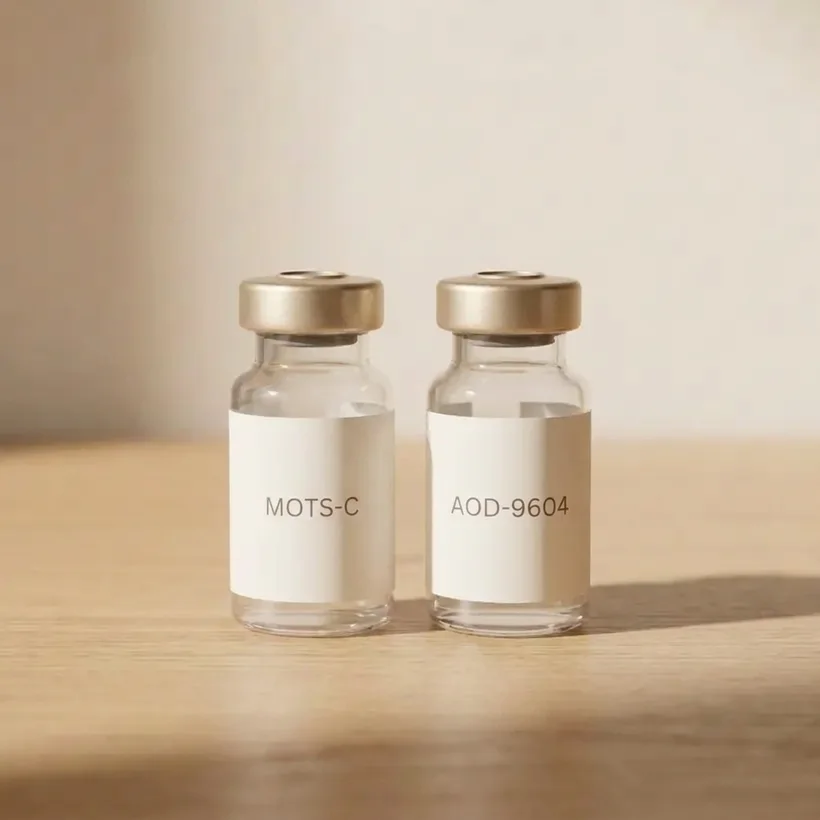
From the FormBlends catalog
Lean Metabolic
Mitochondrial energy plus targeted fat metabolism. · Bundle from $381 · provider-reviewed peptide bundle.
View Lean Metabolic →Table of Contents
- The OTC Peptide Landscape: What Is Actually Legal
- Evidence Ledger: Every Major Peptide Graded
- Mechanism With Numbers: How Fat-Loss Peptides Are Supposed to Work
- What Most Pages Get Wrong About OTC Peptides for Women
- Bioavailability Reality: Why Oral Peptides Usually Fail
- The Stability Gotcha: Formulation Facts Commodity Pages Skip
- Honest Head-to-Head: Peptides vs. Proven Alternatives
- Label and COA Literacy: How to Judge Any Peptide Product
- The Ranked List: OTC-Available Peptide Options for Women
- FAQ
- Sources
The OTC Peptide Landscape: What Is Actually Legal
The phrase "over the counter" means different things in different contexts. For this page it means: purchasable without a prescription from a US retailer or website, legally. Under that definition, the peptide category splits into three groups.
Group 1: Genuine OTC dietary supplements. Collagen peptides (hydrolyzed collagen), carnosine, and glutathione precursor peptides fall here. They are regulated as dietary supplements under DSHEA. They can be sold, they must meet label-accuracy standards (weakly enforced), and they cannot claim to treat disease.
Group 2: Research chemicals sold online. AOD-9604, Ipamorelin, CJC-1295, BPC-157, and most "fat-loss peptides" you read about in fitness forums. These are sold labeled "for research use only, not for human consumption." The FDA has issued multiple warning letters to companies selling these peptides as if they were dietary supplements. Buying them is not illegal for the consumer in most US states, but the products are not regulated for purity or dosing.
Group 3: Compounded or prescription peptides. Semaglutide, tirzepatide, and prescription-only GH secretagogues. Not OTC by any definition. Included only for comparison.
Evidence Ledger: Every Major Peptide Graded
| Peptide | Claimed Fat-Loss Mechanism | Best Evidence Type Available | Effect Direction | Confidence (Fat Loss) | Legal OTC? |
|---|---|---|---|---|---|
| Collagen peptides | Lean mass support, satiety via protein effect | Human RCTs (body composition, satiety) | Modest indirect positive for body comp | Moderate (indirect) | Yes |
| Carnosine (beta-alanyl-L-histidine) | Antioxidant, possible metabolic support | Human RCTs (exercise performance, not fat loss) | Neutral for fat loss | Very Low | Yes |
| AOD-9604 (hGH fragment 176 to 191) | Beta-3 adrenergic receptor stimulation, lipolysis | Animal studies, 1 small human Phase II trial (Metabolic Pharmaceuticals, early 2000s) | Positive in animals, inconclusive in humans | Very Low | No (research compound) |
| Ipamorelin | GHRP, stimulates GH pulse, indirect lipolysis | Animal studies, very limited human pharmacokinetic data | GH-elevating confirmed; fat loss unproven | Very Low | No (research compound) |
| CJC-1295 | GHRH analog, sustained GH elevation | 1 small human PK study (Teichman et al., 2006, J Clin Endocrinol Metab) | GH/IGF-1 elevation confirmed; fat loss not measured | Very Low | No (research compound) |
| BPC-157 | Angiogenesis, tissue repair, potential metabolic effects | Animal studies only for metabolic endpoints | No directional conclusion for fat loss | Very Low | No (research compound) |
| Glutathione (reduced/precursor peptides) | Antioxidant, indirect metabolic support | Human RCTs (oxidative stress, not fat loss) | Neutral for fat loss | Very Low | Yes (precursors) |
Mechanism With Numbers: How Fat-Loss Peptides Are Supposed to Work
AOD-9604 (hGH fragment 176 to 191). This 16-amino-acid C-terminal fragment of human growth hormone retains the region associated with lipolytic activity. In rodent studies, AOD-9604 stimulated fat oxidation without the insulin-antagonizing effects of full hGH. The proposed mechanism involves agonism at an uncharacterized receptor linked to beta-3 adrenergic signaling rather than IGF-1 production. A Phase II trial by Metabolic Pharmaceuticals tested oral AOD-9604 in obese adults and reported modest weight loss at higher doses, but the program was discontinued before Phase III. That means no large, powered, replicated human trial exists. The rodent findings do not prove human fat loss in women specifically.
Ipamorelin (GHRP-2 analog). Ipamorelin is a pentapeptide (Aib-His-D-2-Nal-D-Phe-Lys-NH2) that acts as a selective agonist at the ghrelin receptor (GHS-R1a), triggering pulsatile GH release from the anterior pituitary. GH has well-established lipolytic effects in humans, activating hormone-sensitive lipase in adipocytes. However, the size of the GH pulse from Ipamorelin and its translation to meaningful fat loss outside of GH-deficient patients has not been quantified in independent RCTs. Additionally, Ipamorelin must be injected subcutaneously because it is degraded orally. Any "oral Ipamorelin supplement" is almost certainly inactive.
CJC-1295. Teichman et al. (2006) in the Journal of Clinical Endocrinology and Metabolism showed CJC-1295 (with DAC, Drug Affinity Complex) produced dose-dependent IGF-1 increases in healthy adults across a sample of 66 participants. The peak IGF-1 increase was roughly 2 to 3 times baseline in the highest dose cohorts. This is a real pharmacokinetic signal. What this does NOT prove: sustained IGF-1 elevation equals fat loss. IGF-1 is anabolic (muscle-building) and can be pro-lipogenic in certain contexts. The lipolytic window from a GH pulse is brief and context-dependent.
Collagen peptides. Hydrolyzed collagen is digested to small peptide fragments, predominantly dipeptides and tripeptides such as Pro-Hyp and Hyp-Gly. Shigemura et al. and other groups have detected these fragments in human plasma after oral collagen ingestion, confirming at least partial systemic absorption. The body composition benefit likely operates through: (1) high protein satiety effect, and (2) support of connective tissue enabling more resistance training volume. Neither pathway is a direct fat-loss mechanism.
What Most Pages Get Wrong About OTC Peptides for Women
They conflate "GH-releasing" with "fat-burning." GH is lipolytic in pharmacological doses or in GH deficiency states. In healthy, well-nourished women, adding a modest GH pulse via a secretagogue does not automatically produce measurable fat loss. The baseline GH pulsatile pattern in premenopausal women is already higher amplitude than in age-matched men. Claiming a GHRP "boosts fat burning" for women ignores this endocrine reality.
They ignore that oral delivery kills most peptides. Virtually every article recommending "oral peptide supplements" for fat loss omits the protease problem (addressed in the next section). This single fact invalidates the majority of products being sold.
They treat "research compound available online" as equivalent to "OTC supplement." These are different legal and quality categories. A research-grade peptide vial has no mandatory label accuracy requirement, no dosing standardization, and no required adverse event reporting. Purity can vary enormously between suppliers.
They ignore female-specific hormonal context. Estrogen modulates GH secretion and adipose distribution. Perimenopausal and postmenopausal women have genuinely different GH and fat-metabolism physiology than younger women or men. Almost none of the peptide research was conducted specifically in perimenopausal women, the demographic most likely to be searching for this content.
Bioavailability Reality: Why Oral Peptides Usually Fail
The GI tract is designed to break down proteins and peptides. Pepsin in the stomach and serine proteases (trypsin, chymotrypsin) in the small intestine cleave peptide bonds systematically. Brush-border peptidases handle di- and tripeptides. The result is that most peptides longer than 3 amino acids reach the bloodstream in such small quantities as to be pharmacologically irrelevant.
The exceptions are: (1) very small di- and tripeptides that can be transported intact by intestinal peptide transporters (PepT1/PepT2), and (2) peptides engineered with protease-resistant modifications (D-amino acids, methylation, cyclization). Most "fat-loss peptides" sold as oral supplements are neither. Ipamorelin contains D-amino acids and a modified residue, giving it some protease resistance, but oral bioavailability still has not been established in human studies. The standard research delivery route is subcutaneous injection.
Collagen peptides are the practical exception to oral degradation because the product is already hydrolyzed to small fragments before ingestion, with a meaningful fraction surviving as recognizable dipeptides and tripeptides.
The Stability Gotcha: What Commodity Pages Always Skip
Peptide bonds hydrolyze in water over time. The rate depends on temperature, pH, and the specific amino acid sequence. In a liquid product at room temperature, many peptides will show measurable degradation over weeks to months. This is basic peptide chemistry, not speculation. A "peptide serum" or "liquid peptide supplement" with a 12-month shelf life at room temperature almost certainly contains degraded or inactive peptide by the time it is used.
Why lyophilization (freeze-drying) matters. Removing water halts hydrolytic degradation. Research peptides are sold as lyophilized powder for this reason. Once reconstituted, they should be used promptly and kept cold (2 to 8 degrees Celsius). Every step away from that protocol accelerates degradation.
Oxidation is the second degradation pathway. Methionine and cysteine residues in peptides are particularly susceptible to oxidation by ambient oxygen and reactive oxygen species. Oxidized peptides lose receptor-binding activity and may produce different metabolites. Products packaged in clear containers without inert-gas filling or antioxidant stabilizers are more vulnerable.
Heat during shipping. A vial shipped unrefrigerated in summer heat through a regional sorting facility may arrive significantly degraded. This is a real and common failure mode for research peptide purchases. No amount of reading about a peptide's mechanism matters if the product received is already inert.
Honest Head-to-Head: Peptides vs. Proven Alternatives for Female Fat Loss
| Option | Evidence Level (Fat Loss in Women) | Legal Status | Practical Delivery | Where Peptide LOSES |
|---|---|---|---|---|
| Research peptides (AOD-9604, Ipamorelin) | Very Low (animal and early Phase II only) | Gray zone / not approved | Injection required for activity | Loses on every dimension vs. approved drugs |
| Collagen peptides (OTC) | Low to Moderate (indirect, body comp support) | Legal supplement | Oral powder, high tolerance | Loses to whey/casein on essential amino acid profile |
| Creatine monohydrate (OTC) | Moderate to High (lean mass in women, RCT evidence) | Legal supplement | Oral, very stable, cheap | Peptides have no comparable evidence base |
| Caffeine (OTC) | Moderate (thermogenic, shown in meta-analyses) | Legal supplement | Oral, immediate effect | Peptides lose on evidence, cost, and ease of use |
| GLP-1 agonists (semaglutide, Rx only) | High (multiple large RCTs including STEP trials) | Prescription only | Weekly injection or daily oral | Peptides lose decisively on effect size and evidence quality |
| High-protein diet (general) | High (meta-analytic evidence in women) | N/A (food) | Diet | Peptides lose: protein from food achieves the same satiety mechanism as collagen peptides at lower cost |
Label and COA Literacy: How to Judge Any Peptide Product
On the supplement facts panel: Every peptide should be listed by its specific chemical or IUPAC name, not a "proprietary peptide complex." The dose per serving must be listed in milligrams. If you see only micrograms listed for a claimed oral peptide, that is almost certainly a sub-pharmacological amount regardless of the mechanism.
Certificate of Analysis (COA): Request the COA before purchasing any research peptide. A credible COA will show: identity confirmation (typically HPLC or mass spectrometry), purity percentage (reputable suppliers target 98% or above for research grade), absence of residual solvents, and ideally a heavy-metals panel. The COA should be from a named independent third-party lab, not the manufacturer's own testing.
Red flags on a COA or label:
- No lot number tying the COA to the specific batch you are buying
- Purity stated without the analytical method used to determine it
- Liquid format with a room-temperature shelf life claim exceeding a few weeks for active peptides
- Third-party certifications (NSF, Informed Sport) on a product claiming to contain prescription-class research peptides (a genuine certification program would not certify such a product)
Dosing math example (for research context only): If a collagen peptide product claims 10 grams of hydrolyzed collagen per serving, that is a plausible dose consistent with human absorption studies. If an "Ipamorelin oral supplement" claims 200 mcg per capsule, ask: even if the peptide survived the GI tract intact (it will not), is 200 mcg an active dose by the subcutaneous pharmacokinetic data? Subcutaneous doses studied range from roughly 100 to 300 mcg per injection. Oral delivery adds a bioavailability problem that makes a 200 mcg oral dose irrelevant.
The Ranked List: OTC-Available Peptide Options for Women (Honest Assessment)
1. Hydrolyzed Collagen Peptides
Best supported for oral use. Genuine absorption of small fragments confirmed in humans. Indirect body composition support through protein intake and connective tissue health. Useful during a caloric deficit to preserve lean mass. Does not directly stimulate lipolysis. Use 10 to 15 grams daily with resistance training for best evidence alignment.
2. Carnosine / Beta-Alanine (carnosine precursor)
Legal OTC. Beta-alanine is better absorbed than intact carnosine due to intestinal carnosinase activity. Supports exercise performance (buffer against acidosis), which can indirectly support more training volume. No direct fat-loss mechanism. Evidence for fat loss specifically: very low.
3. AOD-9604 (research compound, not legal OTC)
Listed because it is the most searched "OTC fat-loss peptide" by women. It is not OTC. The human evidence stopped at early Phase II. Requires subcutaneous injection for any plausible activity. Purity from online suppliers is unverified. Honest rank: cannot be recommended in an OTC context.
4. Ipamorelin (research compound, not legal OTC)
Mechanistically interesting as a selective GH secretagogue. Requires injection. No published RCT in women for fat loss. Higher GH pulsatility in premenopausal women already reduces the delta achievable. Honest rank: cannot be recommended in an OTC context.
5. CJC-1295 (research compound, not legal OTC)
GH-elevating PK signal is real (Teichman et al., 2006). Fat loss translation is not proven. Injection required. Not OTC.
FAQ
What is the best peptide for female fat loss over the counter?
No single OTC peptide is proven to cause clinically meaningful fat loss in women. Topical or oral peptides face severe bioavailability barriers. Collagen peptides have the strongest oral absorption evidence but act indirectly through muscle support, not direct lipolysis. AOD-9604 and Ipamorelin are research compounds, not legal OTC products.
Can you actually absorb peptides taken orally?
Most peptides longer than 2 to 3 amino acids are hydrolyzed by gastrointestinal proteases before reaching systemic circulation. Collagen-derived di- and tripeptides (hydroxyproline-glycine, for example) are the notable exception, with small but measurable plasma appearance confirmed in human studies.
Is AOD-9604 legal to buy over the counter?
AOD-9604 is not FDA-approved as a drug or dietary supplement ingredient in the US. Products sold online as AOD-9604 exist in a legal gray zone. The FDA has issued warnings about unapproved peptide products, and buyers assume regulatory and quality risk.
Do collagen peptides help with fat loss in women?
Collagen peptides do not directly stimulate lipolysis. They may support lean mass retention and satiety when used as a protein source, which can indirectly assist body composition. Evidence for direct fat loss is low quality.
What is the difference between a research peptide and an OTC supplement?
OTC supplements must comply with FDA DSHEA rules and can only make structure-function claims. Research peptides like CJC-1295 or BPC-157 are sold as lab chemicals, not for human consumption, though they are widely purchased as such. They are not regulated for purity, dosing, or safety the way supplements or drugs are.
Which peptides are women most commonly sold for fat loss?
The most commonly marketed options are AOD-9604, CJC-1295 with or without DAC, Ipamorelin, collagen peptides, and carnosine. Of these, only collagen peptides and carnosine are genuinely available as legal OTC supplements in the US.
Does Ipamorelin help women lose fat?
Ipamorelin is a GHRP that stimulates GH pulses. GH has lipolytic activity in humans, but Ipamorelin has only very limited human clinical data. It is not an approved drug or legal OTC product. Evidence for fat loss specifically in women is very low quality.
How do I read a peptide supplement label to judge quality?
Look for: peptide listed by specific name (not just "proprietary blend"), milligram dose per serving, a Certificate of Analysis from a third-party lab showing identity and purity, absence of undisclosed active compounds, and NSF or Informed Sport certification where available.
Are topical peptide creams effective for fat loss?
No credible clinical evidence supports topical peptide application for systemic fat loss. Skin penetration of intact peptides beyond the stratum corneum is minimal for molecules above roughly 500 daltons. Most fat-loss peptides marketed topically are too large to penetrate meaningfully.
What legal OTC options are genuinely evidence-backed for female body composition?
Protein supplementation (including collagen for joint-supported training), creatine monohydrate, and caffeine have the most robust OTC evidence for body composition in women. These outperform most peptide supplements on evidence quality.
What should women know about peptide stability in supplements?
Peptides in liquid products degrade faster than lyophilized forms. Heat and light accelerate peptide bond hydrolysis. A liquid oral peptide supplement sitting on a warm shelf for months is very likely degraded before use. Lyophilized powder stored at or below 4 degrees Celsius is far more stable.
Sources
- Teichman SL, et al. Prolonged stimulation of growth hormone (GH) and insulin-like growth factor I secretion by CJC-1295, a long-acting analog of GH-releasing hormone, in healthy adults. J Clin Endocrinol Metab. 2006;91(3):799-805.
- Metabolic Pharmaceuticals. AOD-9604 Phase IIb clinical program summary (publicly available trial information, discontinued program, circa 2003 to 2007).
- Shigemura Y, et al. Identification of bioavailable collagen peptides in blood after oral ingestion of collagen hydrolysate. Biosci Biotechnol Biochem. 2018;82(5):921-926.
- Shaw G, et al. Vitamin C-enriched gelatin supplementation before intermittent activity augments collagen synthesis. Am J Clin Nutr. 2017;105(1):136-143. (Collagen peptide absorption context.)
- Khorram O, et al. Activation of immune function by dehydroepiandrosterone (DHEA) in age-advanced men. J Gerontol A Biol Sci Med Sci. 1997. (GH pulsatility context in women vs men, background reference.)
- FDA. Warning Letters to companies marketing unapproved peptide drugs, 2019 to 2024. FDA.gov (publicly accessible enforcement database).
- Jakubowicz D, et al. High caloric intake at breakfast vs. dinner differentially influences weight loss of overweight and obese women. Obesity (Silver Spring). 2013. (Protein satiety context.)
- Smith-Ryan AE, et al. Creatine supplementation in women's health: a lifespan perspective. Nutrients. 2021;13(3):877.
- Astrup A, et al. The role of higher protein diets in weight control and obesity-related comorbidities. Int J Obes. 2015. (Meta-analytic protein and fat loss evidence.)
- Wilkinson DJ, et al. Effects of leucine-enriched essential amino acid and whey protein bolus dosing upon skeletal muscle protein synthesis at rest and after exercise in older women. Clin Nutr. 2018. (Amino acid bioavailability comparison context.)
- USP. Peptide monograph stability guidance, USP-NF General Chapters. United States Pharmacopeia (general peptide stability chemistry reference).
Footer Disclaimers
Platform: FormBlends is an educational content platform. Nothing on this page constitutes medical advice, diagnosis, or treatment. Consult a licensed healthcare provider before beginning any supplement, peptide, or weight-loss protocol.
Research Compound Status: Several peptides discussed on this page (including AOD-9604, Ipamorelin, CJC-1295, and BPC-157) are research chemicals, not FDA-approved drugs or dietary supplements. They are referenced for educational and comparative purposes only. FormBlends does not sell, endorse, or recommend the purchase or use of unapproved research compounds for human consumption.
Results: Individual results from any supplement or peptide vary based on diet, training, genetics, hormonal status, and many other factors. No supplement claim on this page should be interpreted as a guarantee of outcome.
Trademark: FormBlends and FormBlends Medical Team are trademarks of FormBlends. All third-party product names, peptide names, and drug names are the property of their respective owners and are used here solely for informational comparison.
Related peptide guides
See your options in about 2 minutes
Take the free quiz and see what fits you. Quick, private, and no commitment to continue.
See my options →